Wisconsin's Underground Railroad
Wisconsin's Underground Railroad
2/20/2026 | 29m 46sVideo has Closed Captions
Explore the abolitionist movement and what still remains of Wisconsin’s Underground Railroad.
In the wake of the Fugitive Slave Act of 1850, freedom seekers began fleeing North, following Wisconsin’s lakes and rivers through the state into Canada to safety. Join Milwaukee PBS as we explore National Historic Landmarks, hear accounts of what empowered those who fled to escape and uncover what still remains of Wisconsin’s role in The Underground Railroad.
Problems playing video? | Closed Captioning Feedback
Problems playing video? | Closed Captioning Feedback
Wisconsin's Underground Railroad is a local public television program presented by MILWAUKEE PBS
Wisconsin's Underground Railroad
Wisconsin's Underground Railroad
2/20/2026 | 29m 46sVideo has Closed Captions
In the wake of the Fugitive Slave Act of 1850, freedom seekers began fleeing North, following Wisconsin’s lakes and rivers through the state into Canada to safety. Join Milwaukee PBS as we explore National Historic Landmarks, hear accounts of what empowered those who fled to escape and uncover what still remains of Wisconsin’s role in The Underground Railroad.
Problems playing video? | Closed Captioning Feedback
How to Watch Wisconsin's Underground Railroad
Wisconsin's Underground Railroad is available to stream on pbs.org and the free PBS App, available on iPhone, Apple TV, Android TV, Android smartphones, Amazon Fire TV, Amazon Fire Tablet, Roku, Samsung Smart TV, and Vizio.
Providing Support for PBS.org
Learn Moreabout PBS online sponsorship(tense intriguing music) - [Rob] Slavery was incredibly harsh.
The rise of cotton, and the cotton gin especially, made slavery incredibly profitable.
- [Stephen] With the Fugitive Slave Act of 1850, that changed the entire dynamic of the debate over slavery, because it would allow for enforcement by US Marshals.
[Clayborn] If a runaway made their way to any state, or any location, that any citizen had the right to reclaim that person or call the authorities to make sure that that person's returned.
- After the Fugitive Slave Act, the worst parts of humanity show up, and people are running around the country as bounty hunters.
No Black American was safe.
This is something that is a really ugly part of our history.
This was scary stuff that prevented people from seeing Black Americans as humans.
- You had a number of immigrants in Wisconsin who had come here from other places.
Now they could see the runaway slave arrested for having done no wrong except to seek freedom, the same thing they had done by crossing the Atlantic Ocean.
In the wake of the Fugitive Slave Act, a great movement opposed to slavery existed now, because now they could see it.
- [Rob] And so people in Wisconsin stand up, fight back, and actually rebel.
- Other states snuck and did it, but they kept quiet about it.
Wisconsin does it, but Wisconsin makes it a national story.
- [Darren] Back in the back corner is where they found the hat, an old Bible.
- Slaves come here because we're close to Canada, and we have the waterway.
Lake Michigan allows us to get there.
- [Keighton] And this is a very emotional space for a lot of people.
You're literally walking in the footsteps of history.
- [Rob] The Underground Railroad, it's really informal network made up of conductors, safe houses, and passengers.
It's led by both Black Americans and white Americans.
This is really an underground resistance that's inspiring Black Americans to run away.
[Kimberly] My story, our story, is the American story.
(soft dramatic music) (footsteps rustling) (birds chirping) (soft music) - Wisconsin, or more specifically, Milwaukee, come alive in the 1830s.
It becomes a state in 1848, but it's beginning to organize its statehood in 1846.
When it's offered a proposal to become a state in 1846, included in that proposal, said that African American men should, indeed, have the right to vote.
It was denied in the 1848 vote.
The state became a state in 1848 with African Americans not having the right to vote.
That's a big issue in this state, because they saw voting as citizenship and equality.
- Slavery had been, believe it or not, a local matter, in many people's minds.
The fact that slavery existed in Mississippi was not on the minds of a lot of Wisconsin farmers, because they didn't live in Mississippi, but more importantly, they had no chance in their life of ever actually seeing Mississippi.
That was the way they thought about southern slavery, until the Fugitive Slave Act galvanized public opinion.
In 1850, the President of the United States was Millard Fillmore.
Fillmore understood that something had to be done to keep slavery from ever reaching the west coast.
- [Clayborn] The south is expanding to the west, creating plantations.
They're seeing the Mexican war, seeing the Louisiana territory, feeling that they can expand their property, their boundaries.
- And so by 1850, America is at odds as what was once supposed to be free states, it comes into sort of controversy.
- Now the south understood, if this stops slavery, their slavery could wither and die, but if slavery goes all the way to the west coast, it's gonna be a hell of a thing to try to get rid of it.
So they fought that, and in return, Fillmore offered kind of a compromise.
He said, "All right.
California could be admitted to the Union immediately as a free state, and we'll abolish the slave trade in Washington, DC.
But, as far as slavery goes in the rest of the country, we will enact a Fugitive Slave Act."
Southerners have been complaining for years that the slaves that have made their way north, to northern cities and towns, were not brought back.
The Fugitive Slave Act empowered the US Marshals, who were federal officials, that you've gotta go in there, and you've gotta arrest these runaway slaves.
And the federal law says, "That slave is still a slave, and a slave as much in the north as he was in the south."
But Wisconsin had a heritage of freedom going all the way back to the creation of the Northwest Territory, and that was the outrage.
You had a number of immigrants in Wisconsin who had come here from other places.
You had the Germans, you had the Irish.
Here they were, on free Wisconsin soil, and in desecration of that free Wisconsin soil, free men, according to our state, were being put into chains and taken south to continue a servitude that they had rather justly and cleverly escaped from.
And so this mobilized them.
- There's a big effort on the part of Europeans to step up.
And Wisconsin gets excited about the fact that it's my right to help these people, it's about principle for them.
It's about the idea that they had a right to help.
They didn't necessarily believe that they wanted African Americans to stay and live among them, but they did want to help them make their way to Canada.
(birds chirping) There are two major routes that brought enslaves people from the south.
One was in the central part of the state up through Beloit, to Burlington, to Waukesha.
Then along the lake area, there would be Kenosha, there would be Racine.
And they're the ones that actually navigated the rescue route for people to go around Michigan to Canada.
- The most important story I think connected to the Underground Railroad is Caroline Quarlls, who leaves St.
Louis in 1843.
(soft music) - This land was part of the 40 acre farm of Deacon Samuel Brown, who gave Caroline safe harbor.
So to be able to welcome Kimberly Simmons, her great-great-great-granddaughter, is wonderful, but to also bring the community in to say, "Let's celebrate courage and freedom and the Underground Railroad together."
Please welcome Kimberly Simmons from Detroit, Michigan.
(all applauding) - Today, we celebrate my great-great-great-grandmother.
Her name was Caroline Quarlls.
And she was here.
She was here.
[Kimberly] She was born enslaved in St.
Louis, Missouri, as the property of her grandfather, a white male in 1826.
She was an octoroon, so she was an eighth black.
She was blue-eyed, fair skin, high cheekbones.
But she kept hearing these tales of freedom, because the family she was born into was Revolutionary War.
So in 1843, 4th of July comes.
This Revolutionary War family is celebrating freedom, and left her home to wash the pants.
Before they left, she asked a question.
"You know, I've got a friend that's sick, and can I, while the family's gone, I'll go down and visit my friend?"
And she went down and told her friend she was leaving.
"I'm outta here."
(soft tense music) (footsteps rustling) So she walked to the ferry dock, and literally bought a ticket.
And she just kinda melded into what was going on in the ferry boat that would take her to Galena, that's further down the river.
It's there that she got off and bought a ticket to the stagecoach, to the furthest place that she could figure out that she thought she'd be safe, and it ended up being Milwaukee.
When she arrived a couple weeks later, she had a $600 tag on her head.
(tense music) (footsteps rustling) And in about a month's time, here comes all the folks looking for her.
(pounding on door) (people shouting) (dogs barking) The city of Milwaukee gathered themselves together and said, "She is not going back."
So when they started knocking door to door, asking people questions, and everybody's going, "Uh-huh.
Don't know.
I don't know what you're talking about."
Asahel Finch was a well-known attorney around town.
Asahel Finch was an Abolitionist.
Mr.
Finch sent someone to go find her and bring her back to him, and then he hid her.
In plain sight, as they would say.
As the story goes, in a sugar barrel, with a lid on it, in the middle of July.
And she was hidden there, because at the end of the night, Mr.
Finch had a plan, to take her, and get her somewhere safer, which is what he did.
Put her on a horseback, and took her to Samuel Brown.
She was hidden overnight by Deacon Brown, 'til it got daylight, and he decided, "Well, she obviously can't stay here."
So he put her on horseback, out to the outskirts.
Waukesha, the surrounding areas of Burlington, and they were trying to decide, well, what do we do?
So after deciding that the man who was gonna do it was Lyman Goodnow, they entrusted her to him.
And off they rode.
They went around south of Chicago, through Indiana, and then into Detroit.
Crossed the river to Windsor.
And as it turns out, she had finally made it home.
(birds chirping) - [Rob] Caroline Quarlls actually writes back to the Abolitionist that helps free her.
- [Caroline] April 27th, 1880.
Dearest friend, pen and ink can hardly express my joy when I heard from you, I was here for nearly three years before I was married, just as soon as the postmaster read the name to me, I am living and have worked very hard, my heart was filled with joy and gladness, I did marry a man on Colonel Prince's farm.
I have six children.
The youngest is 16.
I have never forgotten you, nor your kindness.
- To go through all that, hiding in the stagecoach, through Wisconsin and Illinois, to me, that shows the incredible bravery of people who were trying to get free.
- The Underground Railroad movement, that's the point where the civil rights "movement" started was then, because people came together to make it happen for other people.
Personal freedom, economic freedom.
Human rights were born out of the Underground Railroad movement.
(soft tense music) (footsteps rustling) - We are the Milton House Museum.
Originally, we were built in 1844 by Joseph Goodrich, who founds the town of Milton.
They figure there were about 24 stagecoaches coming, like, everyday.
So this place was just, there are constantly people moving.
- Mr.
Goodrich is from the Upper New York area.
He is an Abolitionist.
He brings a large number of people down with him.
His motivation for coming is as a religious person.
- Joseph was a Seventh Day Baptist.
At that time, in their religion, you could not be a member of their faith if you did not actively try to stop slavery.
This was almost like a Seventh Day Baptist colony.
Most of them were out east, and they start moving here, and they establish it.
The church is like the first thing that they establish in town.
Majority of people who are coming here are Seventh Day Baptist.
- Incredibly religious and pious people are joining the Abolition cause.
You can imagine if you're hiding a Black American in your closet, or underneath the floorboard, how important serving God is to you.
- [Keighton] Joseph Goodrich also founds a college, which eventually was known as Milton College, and that actually ran in town until 1982.
He was using that college to help share his Abolitionist beliefs.
He was bringing speakers like Sojourner Truth to come and talk about the evils of slavery.
- Joseph Goodrich, you only see his name as the owner of the Milton House, but in truth, he is supported by his congregation, or his members, who supports him, and helps him with the Underground Railroad activities.
Sometimes in the back of the stagecoach are compartments where people hide out at, and people are given food, and clothing.
They make a decision to build a tunnel, and they dig a hole from one building to the next building.
And that tunnel is under the building, and the basement, and it goes from Milton House to a log cabin.
So if the sheriffs come, they would go downstairs and get it, but they wouldn't catch them, because they would have made their way through the tunnel and to the next building and gone out the building to safety.
- The Milton House was a station on the Underground Railroad due to Andrew Pratt.
He's our only freedom seeker that we know by name.
We assume more came, but we can't prove it.
We have kind of the first mention of him in the Goodrich papers.
It talks about him coming here in 1861, that they used the Underground passage, and then the interesting thing about Andrew is he didn't move on.
He stayed in Milton for about four or five years, became a member of the community.
He kinda builds a little bit of a life for himself, and then he moves onto Minnesota, and he built an even better life for himself out of his own courage and abilities.
(soft music) - [Clayborn] From the Milton House, they make their way, they go to the river, and they will follow the river north, and that river, the Fox River, would take them right to Waukesha, and Waukesha, you walk on the river, and you would see to the east, you would see steeples or churches.
And that would be the place in which people would actually find a hideout and a location for the Underground Railroad.
- Waukesha was a hotbed of Abolitionism.
Waukesha was actually referred to on one occasion as a godforsaken fly-infested Abolitionist sinkhole.
There's a religious overtone to almost all of this, and those who were active in religion often put their religion into politics.
They developed this reputation as being, not just ambivalent, but angry over slavery.
- They organize, they come up with volunteers.
They find locations, they feed and clothe.
They do all these things to make sure that runaways make their way to Canada.
- The Waukesha Freeman newspaper had been founded in 1859 to fight slavery.
It was an anti-slavery newspaper.
Abolition was in the forefront of its mind as an editorial body.
For some time, the masthead of the Freeman said "Founded in 1859 to fight slavery."
They've maintained themselves as sort of an open forum for ideas, and they are still in that tradition.
(gulls calling) - We're seeing there were Abolitionists there.
There were people there who had sympathy, and they wanted to make it possible for people to make their way to Canada.
And they were sympathetic in the Racine area.
(soft music) [Darren] We are in the sanctuary of First Presbyterian Church of Racine.
This sanctuary was completed in 1852.
Gone through a few changes over the years, but pretty much the way it was back then.
This church, because it was located in this city, was associated with the Underground Railroad.
[David] We have the original church records.
You have a listing of all the members starting in 1839.
Sylvester E. Peck.
He died January 3rd, 1893.
Shortly before he died, he wrote a memoir to the session of the church.
He says, "But such teaching found few followers, and the fugitive slave who reached us via the Underground Railroad as generally safe."
(soft music) [Darren] The first minister in this church in 1839, Cyrus Nichols, came up from an Abolitionist background, and came and spoke strongly in that way.
- When the church was formed, there was different documents that were part of what we would call a Milwaukee Presbytery, and they had resolutions which abolished slavery, and at least seven members of this church signed that document, which was sent to Congress, and what I've done is prepare a booklet on each of the seven known Abolitionists.
William Waterman.
Excerpt from the Fugitive Slave Law and its Victims.
"Booth, editor of the Milwaukee Free Democrat, Charles Clement of the Racine Advocate, H.W.
Waterman, and George Wright were arrested for aiding and abetting the rescue of Joshua Glover."
(soft music) (crickets chirping) - [Clayborn] Glover is in Racine.
He's hiding out.
He worked there for two years.
Nobody paid any attention to them.
When he was turned in, his owner came to get him.
(people shouting) He is taken to jail in Milwaukee.
- Sherman Booth is a white guy who's very radical.
He's a writer, he's a newspaper person.
And so when he hears of Joshua Glover being captured, he puts the word out, and puts out the bat signal.
(horse whinnying) - [Clayborn] And Sherman Booth, he gets on his horse, much like Paul Revere, and would recruit people to come.
So that they come, they come in large numbers to actually break Glover out of jail, and to take him to someplace for refuge.
Wooden beams knocked the door down, and they actually take him out of jail, and they take him to Deacon Brown's farm.
(dogs barking) - All right, where can we take this guy?
Well, they weren't sure they could take him anywhere in Milwaukee.
First of all, the place was now crawling with people looking for Glover.
So the solution was to put him in a farmer's hay wagon, and take him out to Waukesha, which is exactly where they took him.
- Eventually, he's taken down to Waukesha, hid out for a minute, and then down to Burlington, Wisconsin.
And eventually, he's taken to Racine.
(gulls calling) - Racine built on this natural harbor of the connection of the Root River to Lake Michigan.
Of course, Lake Michigan connects us up to Canada, so you have a whole ton of boats coming in and out.
From there, you have a lot of businessmen creating shipping companies to ship goods that were grown in western Racine, largely wheat, some lumber, out through Racine's harbor, to markets all over the Great Lakes.
And if you are a prominent enough businessman, like A.P.
Dutton was, you have your own warehouse, and you know which captains of those ships that you can trust.
So A.P.
Dutton was known to have hidden Joshua Glover in his warehouse, until he could be put on a boat and taken north to Canada, where he lived the rest of his life as a free man.
And we believed that that is potentially how even more people managed to get through the Underground Railroad out of Racine.
(waves crashing) - [Clayborn] So as a result of that, there is years of court decisions on who should be punished, and why they should be punished.
And Sherman Booth is punished.
It's national news.
Both of them have violated this federal law, and they did it out loud.
- Joshua Glover becomes sort of a standard bearer of what Abolitionists are willing to do.
After the Joshua Glover case, the Wisconsin Supreme Court steps up and sorta says that the Fugitive Slave Act of 1850 is invalid, and Sherman Booth was actually persecuted.
In 1859, there's a case called Ableman Versus Booth, where the Supreme Court chastised him, basically punishes him, for helping.
And there's this attempt in Wisconsin to sort of set a new standard that slavery is not accepted in the north, and while other states are sort of hedging, and going back with the federal government, Wisconsin steps up.
(soft tense music) (footsteps rustle) (soft dramatic music) - Some people, I think they were just young kids in the church, were going down underneath the church back into some of the passageways that are just in between the foundations of the church, and found artifacts.
Okay, so we are in the basement of the bottom section of the church.
You can see kind of the foundation walls.
Back in the back corner is where they found an old Bible.
- Found little scripture catechism books.
They're like little prayer books that go back to the 1850s that were found in that space.
They're consistent that there was people underground.
- And then in the space back over that way is where they found a hat and a little shoe.
So the presumption or the idea is that this is where people might have hidden underneath the church for some temporary time, waiting most likely to be taken to A.P.
Dutton's shipyard to find passage on the mercantile section of the Underground Railroad up to Canada.
One of the things that I always think about when I'm upstairs preaching comes to my mind, what it must have been like to have people underneath you, you know?
Waiting to be liberated.
It's overwhelming for a lot of people, just that idea of people waiting, waiting for freedom under here.
Because of the nature of those artifacts, that started people questioning how the church might have been connected with the Underground Railroad.
And then when you add that with documents from people who were alive at the time, piecing all of those pieces together, it just seems likely that that was the case.
A lot of people were not claiming their role at the time, because it was illegal.
- So the question is how do we know the First Presbyterian Church of Racine actually did hide any fugitive slaves?
We don't know for sure.
They didn't sign a guestbook.
We don't have any records of signatures or names of people that passed through.
Research regarding the church's anti-slavery actions were reviewed by the National Park Service, and they evaluated this site as making a significant contribution to the understanding of the Underground Railroad in American history, and meets the requirements for inclusion in the National Underground Railroad Network to Freedom.
(crowd clapping) - For me, it was always about making sure that Racine County knows its history.
We're here today to culminate three decades of work on the Underground Railroad here in Racine County.
Dr.
Dyer was one of the staunch Abolitionists, and his office literally was here where he would actually work on the Abolitionist movement.
(people applauding) - There are 27 markers total.
These are real public reminders of what was the history of this country, because Racine County played such a pivotal role in the fight for freedom.
Dr.
Martin Luther King Jr.
reminded us, "We are not makers of history, we are made by history."
Today, may this history make us better, better neighbors, better leaders, better stewards of justice.
("Amazing Grace") - I think it's important for us to see how far society has come from 1850.
To me, this is a story of improvement and actually getting things right.
And I think that's the power of not only the Constitution, but of Americans to try to be better than their parents and ancestors.
- We had a whole civil war for us to have rights, and the whole question about equal rights is always before us, and a challenge.
- I think that the lesson to take away from all this is that the legacy of Wisconsin was one of freedom, liberty, and being on the right side of history.
- Do not allow, do not allow, someone, someone, to change your story.
And your story, our story, is the American story.
("Amazing Grace" continues)
Wisconsin's Underground Railroad Trailer
Video has Closed Captions
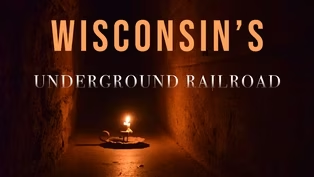
Explore the abolitionist movement and what still remains of Wisconsin’s Underground Railroad. (2m 22s)
Providing Support for PBS.org
Learn Moreabout PBS online sponsorship














Support for PBS provided by:
Wisconsin's Underground Railroad is a local public television program presented by MILWAUKEE PBS