One-on-One
Wittig; DiNapoli Gibbons; Phanord; Sadik
Season 2021 Episode 2376 | 28m 1sVideo has Closed Captions
James Wittig; Lucia DiNapoli Gibbons; Estherlene Phanord; Wunmi Sadik
James Wittig talks about the increased use of telemedicine and the future of healthcare; Lucia DiNapoli Gibbons shares how the banking industry has changed throughout the pandemic; Estherlene Phanord discusses the racial disparities in maternal & infant mortality rates for women of color; Wunmi Sadik shares the importance of environmental chemistry during a pandemic.
Problems playing video? | Closed Captioning Feedback
Problems playing video? | Closed Captioning Feedback
One-on-One is a local public television program presented by NJ PBS
One-on-One
Wittig; DiNapoli Gibbons; Phanord; Sadik
Season 2021 Episode 2376 | 28m 1sVideo has Closed Captions
James Wittig talks about the increased use of telemedicine and the future of healthcare; Lucia DiNapoli Gibbons shares how the banking industry has changed throughout the pandemic; Estherlene Phanord discusses the racial disparities in maternal & infant mortality rates for women of color; Wunmi Sadik shares the importance of environmental chemistry during a pandemic.
Problems playing video? | Closed Captioning Feedback
How to Watch One-on-One
One-on-One is available to stream on pbs.org and the free PBS App, available on iPhone, Apple TV, Android TV, Android smartphones, Amazon Fire TV, Amazon Fire Tablet, Roku, Samsung Smart TV, and Vizio.
Providing Support for PBS.org
Learn Moreabout PBS online sponsorship- [Narrator] Funding for this edition of One-On-One with Steve Adubato has been provided by Horizon Blue Cross Blue Shield of New Jersey.
PSE&G, committed to providing safe, reliable energy now and in the future.
MD Advantage Insurance Company.
ADP, always designing for people.
The Healthcare Foundation of New Jersey.
The North Ward Center.
Johnson & Johnson.
NJ Best, New Jersey's 529 college savings plan.
And by The Adler Aphasia Center, enriching the lives of people with aphasia, their families, and communities.
Promotional support provided by CIANJ, and Commerce Magazine.
And by NJ on Air.
- This is One-On-One.
- I'm an equal American just like you are.
- The jobs of tomorrow are not the jobs of yesterday.
- Look at this.
You get this?
- Life without dance is boring.
- I don't care how good you are or how good you think you are, there is always something to learn.
- Do you enjoy talking politics?
- No.
- People call me 'cause they feel nobody's paying attention.
- Our culture, I don't think has ever been tested in the way it's being tested right now.
- That's a good question, high five.
(upbeat music) - Hi, I'm Steve Adubato.
Thank you so much for joining us.
We are honored to be joined by Dr. James Wittig, who is in fact Medical Director of Orthopedic Surgery, Orthopedic Oncology, and Sarcoma Surgery at Atlantic Health System.
Good to see you, Doctor.
- Good to see you, Steve, how are you?
- I'm doing all right.
Put this in perspective.
Orthopedic oncology is.
- Orthopedic oncology is a surgical specialty in orthopedics, where we specialize in removing sarcomas of bone and sarcomas of soft tissues, and limb-sparing surgery for those types of tumors, so basically, cancerous tumors that develop from the muscles and bones, where you remove the cancer and save the limb instead of performing an amputation.
- So let's talk about, I mean, virtually everything in medicine, healthcare, as it relates to COVID.
We're taping in, on the late end of October 2020, and it'll be seen after.
So, lumps, bumps, right?
I've had these lipomas.
I had a, dozens of them taken out, another one over here.
I'm like, every time I get one, I freak out, right?
In the age of COVID, whether it's me or anyone else, should we be getting every lump, bump, whatever, checked out, A?
B, is it safe?
- So Steve, let me answer the second question first.
It's totally safe.
You know, when you come into the hospital, and you see me or you're going into other doctors' offices, everybody is taking appropriate precautions with proper mask wearing, face shield wearing, social distancing.
When you're not in the office, we're practicing social distancing with the rest of our staff, and wearing masks, et cetera.
Thorough hand cleansing between patients, so we're getting tested on a daily basis, having our temperatures taken.
So it's very safe to come into the office.
The, yes, you should take all your healthcare problems very seriously right now, particularly lumps and bumps.
I'm seeing a lotta patients who sort of failed to go to the doctor because of their pain or because of a lump that they felt and dismissed it as maybe a muscle pull or tear.
- Or a lipoma.
- And it delayed this between March and, let's say, July, and now I'm seeing it, and it's a very big tumor, or the bone has been destroyed, and it's a lot bigger operation and a lot more serious situation at this point.
- Don't put it off.
- So you wanna be expeditious about getting it taken care of.
- So don't put it off, right Doctor?
- No, do not put it off.
- Don't self-diagnose.
Don't go on the internet and try to figure out (laughs).
By the way, all the things that I do, (laughs) that's why I'm raising this.
- No, sure, sure.
The tendency is to dismiss it and be in denial, and say, "Oh, you know, it's just a lipoma.
It'll be okay."
But the, in all honesty, you really can't tell that something's a lipoma for 100% certainty unless you get a MRI of it.
- Yeah, and by the way a lipoma is- - We remove it and biopsy it.
- Yeah, and just so people know why I'm obsessing over this, they're fatty deposits.
My late dad gave it to me as a gift based on genetics.
I just wanna share that.
Telemedicine.
Someone says, "Okay, I got this bump.
I got this.
Doctor, can you look at it?"
Where does it work well, Doctor, and where do you need a face-to-face physical examination?
In person.
- So, I think telemedicine has been great, especially with COVID.
Prior to COVID, I had been wanting to expand our telemedicine capabilities with orthopedic oncology, because it really expands the access of patients to the doctor.
Think about, you know, a little 80-year-old woman who perhaps has to travel an hour-and-a-half to see me and get a lump examined.
Well, she could go locally, get a MRI done, send the MRI out to me, I can check it out, and I can take a look at her on the video camera, and we can discuss.
"Do I need to do a biopsy?
Do you need to come in, and we just remove it in the operating room?"
So there's a lot of planning and surveillance and sorta screening that we can do via telemedicine.
- Do you see it being, again, it's being used more than ever during COVID.
Do you see it even as we make progress around COVID, that telemedicine, telehealth, will be an even bigger part of the healthcare landscape?
- I think it really should.
I mean, I think it would be a mistake to now go backwards after this, after we've learned so much and learned how helpful telemedicine can be, during this process.
For us to go back to all the very stringent rules and regulations and, being unable to bill an insurance company for it, et cetera, I think that patients really need to have this access.
And it really, I think it improves their care, and enables them to see specialists that maybe perhaps they weren't even aware of that they could see.
- I wanna disclose that Atlantic Health System, one of the many healthcare systems that are underwriters of the work that we do.
Last question before I let you go.
(inhales) How optimistic are you around the fight against COVID, A, and B, the future of the healthcare industry?
- So I think, you know, I think we're gonna make it through COVID.
You know, we're making a lot of progress with various vaccines and other treatments, to minimize the effects of COVID on patients, and patients are, we know a lot more now than we did, and patients are being successfully treated and managed, so I think we're gonna see a lot less deaths from it, and a lotta patients managed much better.
The future of healthcare, I guess that remains to be seen with the new election coming up and a lot of other changes.
So I have a positive outlook.
No matter what, I think we have the best medical system in the world, and I think that we have a tremendous healthcare team and healthcare workers that are really dedicated to taking care of patients, as we saw with COVID.
- Well said, and by the way, we're taping on the 22nd of October.
It'll be seen after that, so we'll see what happens politically and its impact.
Doctor, thank you so much for joining us.
We appreciate it.
- Thanks, Steve.
- I'm Steve Adubato.
We'll be right back.
- [Narrator] To watch more One on One with Steve Adubato find us online and follow us on Social media.
- We're now joined by one of my favorite bankers, favorite people Lucia DiNapoli Gibbons, is the Metro New York/New Jersey Division Executive of Commercial Banking at Wells Fargo.
Good to see my friend.
- Good to see you too, Steve.
The highlight of my day.
- It has been way too long.
But let's do this.
You're functioning, you're working you're getting things done.
But my question is this, you and I have talked about leadership for a couple decades.
How challenging is it leading in the banking world these days?
- We could change that question to how challenging is it to lead in this COVID environment?
You know, Steve, look, I've read all your books and I've followed all your advice over the years.
And you know, it's about staying connected to people, right?
And doing it in different ways.
One of the benefits I had was for the last six years I was running a business up and down the East.
And certainly I was traveling to see people, but more often than not, I was doing meetings via, some type of technology and via the phone.
So I'm very, very comfortable with it.
So it's about making connections with people.
More often than not allowing some space for them to talk about, how they're feeling and how everything that's happening is impacting them.
You know, me, I love leadership.
So it's been great to exercise those skills to help people during this time.
- But you also love connecting with people and that's a big part of who you are and your success.
So I'm also curious about this, dramatically since say let's say Friday, March 13th, 2020.
How has the banking industry changed?
- It's interesting.
So first I would say, we were making major investments in technology platforms and people pre-COVID.
All of that is accelerated dramatically, because consumers and businesses have really adopted all of those new tools out of necessity.
So those investments are accelerating.
So I'd say banks are becoming more like technology companies than anything else.
The other interesting thing Steve- - Sure go ahead.
- Is that despite, low to no interest rate environment, banks are awash in deposits right now because the savings rate for both consumers and businesses is up.
People are stowing away the rainy day fund, right.
Which is a really, really good thing.
And then lastly, I would say now more than ever our customers and prospects need us, they need our insight, our advice, our credit, tools and technology to help them get through this pandemic and hopefully to a much brighter future.
- You know, let's do this.
First of all, I want to say that Wells Fargo, one of the significant supporters of what we do and have been supporting public broadcasting for a long time.
But part of that and the cumulative community goes to this Open for Business fund.
What is the Open for Business fund and why should the average person care about it, Lucia?
- I'm so excited that our company has done this.
So the Open for Business fund was created with the $400 million in fees collected through making PPP loans, right?
Which are helping businesses get through this pandemic.
And right here in New Jersey, we have funded, I'm gonna look down just for a second.
It's the Greater Newark Enterprise Corporation for 250,000, and the Union County Economic Development Corporation for 500,000.
We're supporting nonprofits that are supporting minority owned businesses.
So I'm excited that we've done that.
- Why?
- It matters.
Listen, in order for our business to thrive, businesses and people have to thrive, and you know this Steve.
Small businesses have been so hard hit by what's happened during the course of the past year.
We have to do everything we can to make sure that businesses survive and get through and that people survive and get through.
Otherwise what good is our business?
We're only as good as the communities that we serve.
- Along those lines it's so interesting Lucia, we've talked to many business leaders, small business, big business, medium sized business, talk about their struggles, challenges.
Philosophical but relevant question.
How much do you believe the government is responsible for helping... You talked about what your bank is doing, other banks doing important things as well.
Do you believe the government, has an important role to help business during these very tough times?
- I absolutely believe.
I believe everyone has a role.
Certainly government has a role.
The Paycheck Protection Program- - That's right.
- Was good for small business.
And we played a huge role in that.
There are companies though that are not going to survive, right?
Infection rates are spiking again, and consumers and businesses need another injection of funds, some of them to help survive what's happening.
So it would be great to see the government come together and decide on a second stimulus program.
I will tell you that from an economic perspective the forecast that we're making, don't assume that because it's so uncertain at this point.
- Lucia, do not assume that, you do not assume that.
- Don't assume, we do not assume that.
It's too uncertain at this point.
It's too uncertain at this point.
- So you know, 30 seconds left, you used the word uncertainty.
What is the impact of the tremendous amount of uncertainty in having to make the business decisions that you and your colleagues have to make every day?
- So I would say, let me, I'm gonna turn that around and say that businesses really stood in place for a while given the great uncertainty.
We have more certainty now, Steve, we're closer to a vaccine and therapeutics that we've ever been.
And we are seeing certain customers that are doing well take advantage of opportunities by making acquisitions, buying real estate.
Doing those kinds of things if they have wherewithal to do it because people are starting to see the light at the end of the tunnel.
But again, there's the have nots that are not in that place, and they are ensuring that they have liquidity, and working with us to ensure that liquidity, so that they can get through the other side.
- Well said, by the way, I remind folks as we talk to Lucia was taken on the 17th of November, it will be seeing the rest of this year into 2021.
So the vaccine, right.
That is safe, that is accessible and people get it.
Hey, Lucia, it's great seeing you.
Next time, we'll see each other in person in a studio, God willing and we'll talk that way, thank you, Lucia.
- I look forward to it Steve, thank you so much.
- You got it, we're right back right after this.
- [Narrator] To watch more One on One with Steve Adubato find us online and follow us on Social media.
- We're now joined by Estherlene Phanord, who is a health educator for Trusted Links.
They are connected to the Partnership for Maternal and Child Health of Northern New Jersey.
Estherlene, so good to have you with us.
- Thank you for having me.
It's a pleasure.
- Describe Trusted Links.
- So Trusted Links, what we are is we are a peer-to-peer education model where we train Black women, specifically, in New Jersey.
We train about reproductive health.
We train them about a healthier birth outcome.
We teach them about nutrition, to just different things about pregnancy, in order to empower women, specifically Black women.
- So we've talked about racial inequity, social determinants of health, social impact, et cetera, et cetera, when it comes to healthcare.
Women of color are impacted disproportionately in a negative way by the healthcare system.
- Definitely.
Yes, we would agree with that.
- And how does it play out in reality, in terms of childbirth, in terms of reproductive health education, talk about it.
- So some of the things that I teach at Trusted Links is we understand there is a great disparity, so when we look at childcare or when we look at Black women and Black childbirth, we see that, you know, Black infants, they have a 3.5 times more likely to die than white infants and we see that Black mothers have 3.8 times more likely to die than white mothers.
And the way that it plays out is we understand that there is the stress of racism that can impact the way that a mother has childbirth.
We understand there is implicit bias, oftentimes, and that's why we at the Partnership, we really try our best to implement professional education (indistinct) programs that can not only tackle this idea or this reality of the disparity, but trying to find a resolution and a solution for it.
- You know, it's funny, I'm going to ask our team to put up the "Confronting Racism" graphic, because some folks might say, "Oh, well, Steve Adubato's doing something on healthcare.
He's doing something about women of color and maternal and maternal health and its disproportionate impact on women of color."
But this is confronting racism, is it not?
- So the way we try to look at it is we understand there is a stress that racism can play when it comes to Black mothers giving childbirth or the impact that it has on a woman's experience on her child delivery, on everything.
We do understand there is an impact and there is implicit bias behind it.
- And you came to us through the folks at the Horizon Foundation.
Does most of your dollars as a not-for-profit, do they come from foundations and corporations?
- So most of our dollars, I'm not quite sure where they come from because my expertise is Trusted Link.
However, they do come from people or different organizations that I believe that are committed to a cause.
And we don't only work with, you know, Black families or, you know, Black mothers, but we do service and we do give our attention and resources to all women, families, mothers, children.
- Devil's advocate, someone says, "You know, pretty much folks have to take care of themselves."
There's some folks who watching right now who say, "Listen, I happen to be white.
I happen to be middle-class or upper-middle-class, whatever, but it's challenging for me, too."
Give us one concrete example, if you could, Estherlene, as to why it's specifically and concretely more challenging and difficult for a woman of color when it comes to reproductive health education and frankly, childbirth.
- So, as some of us may know, that Black women or Black people in general, sometimes we are more high-risk to other things such as preeclampsia, which can lead to mortality.
We are more likely to get, more likely to have premature babies, we are more likely to have diabetes, and all these other health factors.
And not only that, I also also teach in a Trusted Links program that sometimes it isn't just due to the fact that, you know, our economic status or socioeconomics or environment, sometimes it is a big umbrella of things which we consider the social determinants.
- Could be geography, could be your zip code, could be the inability to get the appropriate transportation.
It could be what health organizations, hospitals, or whatever are in your neighborhood, and a whole range of other things, right?
- Yeah, so it can be an umbrella of things, different social determinants that can impact it, but we do see that oftentimes, you know, the stress of racism, as we can see now, or we do see the implicit bias that we are trying to tackle and trying to work with hospitals and administration about that it also plays an impact (indistinct).
- And you're making a difference every day.
Estherlene, I want to thank you and your colleagues for the work that you're doing.
I know you're going to keep doing it and continue to shed a light and share this story and make sure public policymakers understand how important this is, not just for women of color, but for all of us, because we are all in this together.
I cut you off.
Final words, go ahead.
- I was going to say that, thank you so much for having me.
You know, this conversation is a conversation I am so happy that we are in the current state now, that it's a more prevalent conversation.
You know, since 1992, we've been doing this work and trying to figure out how we can make the quality of care for women, for children, for pregnant moms and new moms, different, so thank you for shedding the light on this conversation.
And hopefully this conversation can extend farther out and we can really make a difference.
- Well, that is why we're here.
Estherlene, thank you so much and we wish you all the best.
- Thank you.
Have a great day.
- You too.
I'm Steve Adubato, we'll be right back.
- [Narrator] To watch more One on One with Steve Adubato find us online and follow us on Social media.
- We are now joined by Dr. Wunmi Sadik who is a distinguished professor and Chair of the Department of Chemistry and Environmental Science at NJIT.
Good to see you doctor.
- Thank you, Steve, thanks for having me.
- Our pleasure.
Doctor, in getting ready for the show the term biosensors kept coming up.
What is a biosensor, and why is it especially relevant to our lives at this moment?
- A biosensor is a small size device that would typically be used to provide information about the presence, or the level of any biological molecule.
A good example is what the diabetic patients will use on a daily basis to tell about the level of glucose in their blood.
Biosensors are especially useful in our lives at this time because we're dealing with an invisible virus that kept everybody at home.
And so biosensors are good for telling us the presence about the virus, as well as the level of the viral load in human samples.
- But doctor you also, you look at wastewater and that tells us what?
- So rather than looking at individual clinical samples like blood or nasal swab, biosensors can help us look at the community level about the presence of this virus in sewage, for example.
- Why is that relevant?
- That's relevant, because we can use these wastewater, for example, to target a particular area.
We can use that to look at the population level of this virus in a particular location.
- Dr. Sadik, were these biosensors, were they around and being used pre-COVID-19, or because I'm a student of innovation and I'm fascinated by how it comes about, many say innovation, necessity is the mother of invention.
I don't know how much of it's a cliche or how much it's true, was this around before, or did it come about because, or in part, because of COVID?
- No, biosensors have been around for over 50 years.
We've used them in many, many areas of human endeavors.
For example, you have biosensors for testing, if you have alcohol in your blood, biosensors are good for telling me the level of alcohol, some of those monitors that law enforcement agents will use, some of them are biosensors.
- So it's interesting.
This whole area of environmental chemistry, critically important for a variety of reasons.
However, what I'm curious about, and I actually spoke to the president at NJIT, Joel Bloom, Dr. Joel Bloom is one of our board of trustee members.
We've worked with NJIT on a whole range of higher ed initiatives and trying to learn what's going on in the world of research.
But what I'm curious about is this.
Environmental chemistry, does environmental chemistry become that much more important in the age of a global pandemic?
- Absolutely, because in the age of global pandemic you have needs to monitor the environment, to monitor air, to monitor water, to look at wastewater, to look at sewage and sediments.
And so environmental chemistry is always important even in this time that we're in.
- It's interesting because I know you're doing some of that work in Newark, New Jersey right now.
And we've had Mayor Ras Baraka on many times, and also check out our website, steveadubato.org, for a very in-depth comprehensive interview we did with Newark Mayor Ras Baraka, much of it was about these topics, public health in Newark.
Is it critically important, Dr. Sadik, that you share your findings from a lot of this research using biosensors with government officials, particularly public health officials, so they can then execute policy and programs?
- That's the essence of it.
When we do research in this space, we provide information for public health that would be of interest to policymaking, to protect human health, to protect the environment.
So it is critical that we are able to lay and present information in such a way that they understand what is at stake.
- And so finally, for those who, as we do this program on the 22nd of October, lot of things will happen between now and the end of the calendar year.
For those who question a lot of the science, fair to say you question the science at one's own risk or society's own risk?
- I would say so.
I think science has done a lot to protect us and will continue to protect us.
And so by knowing science, we are basically, endangering our health, I think it's important that we will listen to the scientists.
- Yes, well said.
And Dr. Wunmi Sadik, Distinguished Professor and Chair of the Department of Chemistry and Environmental Sciences at the New Jersey Institute of Technology, NJIT.
Dr. Sadik, thank you so much for joining us.
We appreciate it.
- Thank you for having me.
- You got it, I'm Steve Adubato.
Thank you so much for watching.
We'll see you next time.
- [Narrator] One-On-One with Steve Adubato has been a production of the Caucus Educational Corporation.
Funding has been provided by Horizon Blue Cross Blue Shield of New Jersey.
PSE&G.
MD Advantage Insurance Company.
ADP.
The Healthcare Foundation of New Jersey.
The North Ward Center.
Johnson & Johnson.
NJ Best.
And by The Adler Aphasia Center, Promotional support provided by CIANJ, and Commerce Magazine.
And by NJ on Air.
- Choosing a new family doctor can be confusing.
Check with your health insurer to see which physicians near you participate with your plan.
Find out which hospitals the doctor uses, and who covers when the doctor is away.
And remember to schedule an appointment with your new doctor in advance, to fill out any paperwork without the added stress of being sick.
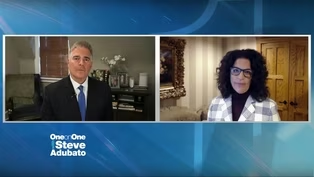
Changes in the Banking Industry During COVID
Video has Closed Captions
Clip: S2021 Ep2376 | 7m 42s | Changes in the Banking Industry During COVID (7m 42s)
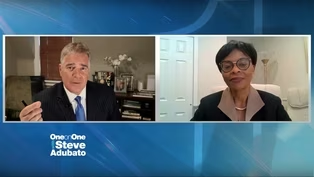
The Connection Between Environmental Chemistry and COVID
Video has Closed Captions
Clip: S2021 Ep2376 | 7m 29s | The Connection Between Environmental Chemistry and COVID (7m 29s)
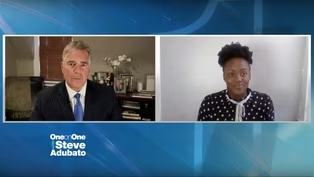
Examining the Racial Disparities in Maternal Health
Video has Closed Captions
Clip: S2021 Ep2376 | 6m 36s | Examining the Racial Disparities in Maternal Health (6m 36s)
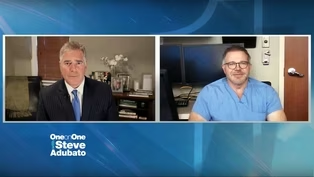
The Importance of Resuming Normal Healthcare During COVID
Video has Closed Captions
Clip: S2021 Ep2376 | 7m 44s | The Importance of Resuming Normal Healthcare During COVID (7m 44s)
Providing Support for PBS.org
Learn Moreabout PBS online sponsorship
- News and Public Affairs

Top journalists deliver compelling original analysis of the hour's headlines.

- News and Public Affairs

FRONTLINE is investigative journalism that questions, explains and changes our world.












Support for PBS provided by:
One-on-One is a local public television program presented by NJ PBS