Womontown
Womontown Screening Q&A
Clip | 25m 24sVideo has Closed Captions
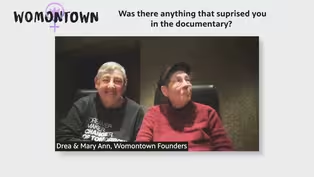
Q&A after screening with producer, Sandy Woodson, and founders Drea and Mary Ann.
Q&A after screening with producer, Sandy Woodson, and founders Drea and Mary Ann.
Problems playing video? | Closed Captioning Feedback
Problems playing video? | Closed Captioning Feedback
Womontown is a local public television program presented by Kansas City PBS
Womontown
Womontown Screening Q&A
Clip | 25m 24sVideo has Closed Captions
Q&A after screening with producer, Sandy Woodson, and founders Drea and Mary Ann.
Problems playing video? | Closed Captioning Feedback
How to Watch Womontown
Womontown is available to stream on pbs.org and the free PBS App, available on iPhone, Apple TV, Android TV, Android smartphones, Amazon Fire TV, Amazon Fire Tablet, Roku, Samsung Smart TV, and Vizio.
- Okay, so first I was thinking we would throw out a question to Mary Ann and Drea, to kind of get the questions going for the evening and then we'll go to questions from the audience.
So, you two, was there anything that you saw that you'd forgotten about or that surprised you?
- I think we got a little older.
(audience laughing) - I thought we look damn good after all these years and so Dela do you on the screen, yay.
- Yeah, it was a lot of good energy and I remember the energy but I remember it even more now seeing all the women, their words, their energy, their work, all the different scenes that we saw there, yeah.
Good memories makes me cry.
- I wanna make sure everybody can see who we have in the room here.
We practically have everybody that was in the show, almost everybody, we're missing a few people.
I don't know if anybody can even see this, oh, hang on.
It'd help if I was doing it, Ryan.
- Oh God, I'm sick.
I'm gonna make everybody sick, hello everybody.
- How did you discover this story and how far did you have to go to capture the story 30 years later?
(audience laughing) So actually what happened is I was sitting at UC Tomato, having coffee and Annie who runs the place introduced me to Karen West, who had literally just sold her house, which was the house she with Barbara Lee, 30 years later she just sold it or like 28, probably at that time.
Anyway, I had heard the word Womontown before but hadn't done any research on it but after talking to Karen, I was like, okay, I need to do this story.
So then thank God for Facebook.
I mean, I went to the GLAMA, the gay and lesbian archive, there was a folder there with some names, at least, so I knew who to start looking for because Karen kept skating away from me so I couldn't pin her down for an interview.
And so just a lot of hunting on Facebook and sending out emails and putting posts out on Facebook.
I met Fran Windler that way, who gave me some names.
And I don't wanna talk forever 'cause this isn't my show but although I guess in a way it is.
So I actually bought an old beat up camper about a year and a half ago and during COVID I traveled all around the United States and at the time I hadn't been approved to do this show I had my full time job but I thought I'm gonna go to Georgia and I'm gonna meet Mary Ann and Drea and I'm gonna talk to them and I'm gonna go down to Florida and talk to Barbara Lee and I just went and did some beginning interviews and scanned a bunch of photos, anything they'd let me scan and you can see we needed every single one of 'em for this show.
And a lot of people have asked me this why only five years for Womontown and the way that I explain this and I'm gonna have Mary Anne and Drea comment on this as well, to me it was an organized effort for five years, it never stopped.
For those five years they were doing all kinds of things, like a newsletter and going to events to promote the area and organizing weekend events, all those things that Mary Anne was listing in the show, that was a lot of work.
There was no internet, they were answering letters, they were answering phone calls, women would come into town, stay at their houses or somebody's house in Womontown and get put up for the night, giving tours throughout the city.
Mary Anne and Drea both had long lists of every house that was available, how much it was, what the jobs were like in Kansas city.
I mean, it was a lot of work.
So that part of the organized part of it, that's how I explain it went away after five years but nothing else went away and in fact, Mary Anne and Drea still had houses there until 2015.
So do you guys wanna comment on that at all?
- No, that's correct.
The organizing part is the beginning of any project but as a number of folks said, it was the energy around the people that we thought the more people that came, as some of the interviews showed, yes, somebody from California decided let's go.
Bev said, I wanna be there, I'll be welcome there.
So those were the things that we thought that momentum and that joy and that living in community, that would just be spontaneous forever.
And as we all know, once you get settled in, then women have jobs, then they have relationships, then they have other things going on in their life.
And then looking at community, we take things for granted and that might have happened some as time went by, we were glad to see each other but we were also involved in a lot of other things.
And so I think the momentum for the community just in the community building stage did win and I think that's probably true of any utopian community you'd read about that it's about momentum.
- Well, one thing I wanted to point out, I'm sorry, Drea, go ahead.
- No, I was thinking about when Martha and Sarah came in it was like, mmh, because they're like one of the first ones in there.
- And Bev and Sue too.
- That's what I was gonna say, then this house came up and a slum landlord was gonna buy it and Martha said, well, we'll all throw our pennies together and buy it but then Bev and Sue showed up and was like, oh and they bought it and we had to get these properties quick.
We stayed fully energized, especially those first five years, because once the lenders came in, once the word got out that the house was go up at value, we were gonna be out and there was such a hard push and so when we took a break, it was because it was there.
You could come into Womontown, the crime had dropped, houses had found its ballots, we were there, that's what happened.
And you're right, it never went away because we didn't sell our properties till 2015, we were still saying, you live in our building, you buy a house in this neighborhood, we forgive the lease, come on.
So all the way up until that point and we sold our building to two young lesbians that took it over from us and continued on.
- And we did, we had an apartment behind 2820 Harrison for all this time.
So we did come twice a year.
Drea has spent even longer sometime but we did come twice a year, all those years.
So the connection with the momentum and even part of the Longfellow Association, we were still tapped into and aware of and still promoting it wherever if we went to festivals we said, we'll promote the Womontown concept if nothing else.
Drea wanted me to write another book on that, how to do an urban community and I said, it'll be so much work, nobody will wanna read it.
(audience laughing) - Well and I wanted to bring up a little bit about that where I'm gonna be putting out like a three and a half minute piece, next week on the 17th on Flatland, about the rural lesbian communities.
A lot of people on this call probably already know about this but for those who don't, really kind of, from what I understand, really the main thing people were doing in the past, before this urban experience, was rural lesbian communities and those still exist now and many of them still want to be secret, don't want people to know where they're at or how to find 'em and you can find out more about that in the piece that I'm doing soon.
But I do wanna mention too, just today, somebody reached out to me on Facebook and said, she wanted to know where Womontown was 'cause she had a VA loan, she could get a VA loan and she was looking for it And I said, well, this is where it is, now the houses are a lot more expensive now than they were in the earlier times.
- When we bought our house in 2820 Harrison, in the cleanup of the yard, I'm sure we got garbage bags of at least a hundred syringe needles.
It was a rough, rough area and now you walk by our own house and it's a 300,000 dollar house now.
- So another question I got are, are there any lesbians still living in the area of Womontown?
And I know there are, because we have some of them in the room, as a matter of fact, that haven't left.
Does Womontown have a Facebook page where everyone can connect or reconnect?
There isn't anything like that right now but the Womontown women, a year ago after we shot in June, we got everybody together and did a potluck and was from that potluck and two, I wanna mention Brydie, I don't know if Bright's on this call.
Brydie O'Connor was our consulting producer and she was with us on all of the shoots.
She's a woman filmmaker.
I saw her work at the Kansas City film festival.
She grew up in Kansas city but she lives in New York now and she actually is doing some documentary work on Barbara Hammer, I think it's Barbara Hammer, who was an artist in the sixties or seventies.
I'm destroying that so I'm just gonna stop now.
- I think it's worth mentioning that a lot of energy that was there got put into the neighborhood association, which was more plural if you will but people like Bev and Sue worked really hard on zoning.
City Hall got really sick of seeing us.
We'd walk in there and they'd say, oh, it's you again?
What do you want?
But it took a lot of energy, it wasn't just the houses and the street, it was the legal community as well, the city, piece of the city, that we were part of, anyway.
- Using today's language, do you feel the original or older residents in the neighborhood see you as gentrifiers and what was the racial makeup of the rest of the neighborhood?
- It was women, older women, elder like us we are now but it was a blend of women, racially, it was mixed but economically, we were poor, frigging poor and the city had forgotten us and were willing to throw us away and that's what the fight of the city was and even the people that ran the long fill early on, they were willing to throw us away, they would sell us out in a heartbeat and they didn't want tenants and they didn't want group homes and they didn't want poor people and they didn't want uneducated people.
And I will tell you, they fought us just as hard, until we were able to get them to flip and see us, people like Bobby and Sue, people that had degrees and professional women where the voice that go forward, that's what it took.
And like what you said, you just kept going back and back and back and pretty soon you could get the streets clean, you could get street lights, you could get acknowledgement, they would come fix things.
It was just incredible what we had to fight.
- It helped and Senator Bond and then we had community cops.
They all worked together and we worked together and we get rid of that building, it got torn down.
- [Lady] Old Preston.
- And now it's a community garden, I think.
- (inaudible) Street between Campbell and Harrison, that roll of apartments that were rat-infested, roach infested and just terrible.
- Bob Long helped us with the urban planning with the city to come and help us design and pass forward the 25 year tax abatements and Mona Turner, myself, we were on that committee with Bob Long and he still works there with urban planning, was instrumental in helping us make sure that that went through.
So we had a lot of allies in City Hall also that were very.
- Well an unlikely neighborhood ally was a publishing Nazarene that really, really had our backs on cleaning that neighborhood up.
- Mark Parker and what he agreed to, he was the head of the Nazarene Publishing and what they would do is they'd buy the property around there and they would fence it up, keeping all of us homeowners kind of at bay.
Well, we used to meet with him and he said, all right, I'll take down the fencing, we'll turn it into parks, as long as you keep it cleaned up, don't drive your trucks upon the yards, he said, we'll be good neighbors and I'll tell you, they were, the Nazarene Publishers, Mark Parker and then they came in and they helped us stabilize a lot of properties around there and gave us our properties back basically by taking down the fences.
- Yeah, there was (inaudible) green space right across the street from 2820 and down our street.
It was fun place to hang out after work.
- And then you had hallmark car too, they were willing and they started feeding tenant sent to our groups because they said if you help with the housing and you show us that you really are helping bring it all up, we'll give you tenants and they did and that was good.
The Truman Hospital, they also became an ally for us, it was just great.
(audience laughing) - Everybody was going down there for the auctions, buying their discarded little Jeeps, everybody was driving those and those were so much fun.
- [Sandy] There were a lot of people that asked me about those and the way I understood it was it was part of your security efforts.
Does anybody wanna talk about that?
Like you couldn't tell if somebody was home or not, because there were so many of these Jeeps sitting around.
- It was just a cheap vehicle.
It was a good way to go down the auction and get a cheap vehicle and it always just had of course, one seat and then you can put stuff, mine was school bus yellow and it was just a good, cheap, good, sturdy vehicle.
- [Sandy] Somebody told me that they saw one in Brookside, that there was one in Brookside for years and they were wondering if it was part of your cruise.
- We has ours in the garage in the back for the longest time.
- Another question is, I always said or what I've been saying in promotions and stuff, is to me I felt like you guys were using the system to beat the system.
When it came to you getting a job at the city so that you could find out about all of these programs that could be used, when you guys went into the neighborhood association and they didn't wanna play ball so you basically took it over, because you had to 'cause they were stopping you from really getting much done.
Those are the kinds of things that I think of when I talk about that.
Is there anything else that you can think of?
- I think that we didn't take over the neighborhood association in terms of running for all the offices but I think the PR in the neighborhood, once we started writing the neighborhood newsletter, the Longfellow Dutch Hill newsletter, we just turned the focus a little into the positive.
I mean, there's neighborhood news going on all the time.
We could point out all the cleanups that we did, the things that all the women were doing to contribute to the neighborhood, as opposed to pointing out something that was always a problem and when they were writing the newsletter, it was just a negative place to live and it was our kind of little secret PR too, that we are contributing, we're doing a lot.
- I know we had to leave a lot of things out, a lot of stories out because of time in this show, are there some stories that you guys can think of that you would like to make sure people know about?
- Yeah, one of the things I would like for the people to realize is there was idleness, and snare bars and conies and it was the eldered women that lived there that helped give us our strengths.
They were there before us, hidden behind doors and in a way we brought them back out into the world but they also gave us our strength and all of them have passed away and I wish they could be here to see who we have become as elders and I hope we will mentor as strongly as they did for us when they were brave enough to walk outside their door and meet us and say, go girls and we did.
- I know the one, the other story I like to tell is and we alluded too it in the show but you were talking about the neighbors that you had in the apartment building and how they throw beer bottles over and say terrible things and pee on your dogs and what I love, the way I say it, is then you bought the house and you throw 'em all out but there was one family who lived in that house, go ahead and talk about them.
- Yeah, you knew Vernon.
- There was Vernon and his wife and they had three, - Two or three children.
- They had three children.
Now they lived next door to us for three, four years before we bought the building.
- We didn't even know they had children.
- We didn't know, they kept them hidden in the building 'cause they were so worried about the violence and when we bought the building and we put everybody out, I met them and I said, stay and they stayed and they were like a god sent because they watched the building, they watched us, we were watching each other and then the day came, they said, we're buying a house right around the corner from Bobby, right around the corner they bought a house in the neighborhood, they didn't move out, they stayed.
And what a great story that was for us because they were there for the beginning in the late seventies when I bought.
We were neighbors that did not know each other for all those years.
Didn't know their children, until we bought the building and it came out and they were nine and 10 year old children.
I actually thought what an incredible thing.
- I wanted to mention that we were activists also participating in local like marches and that and then a group of us went to the 2000 march on Washington for women and we represented Womontown with the banners and we had a wonderful time.
So we were activists too in a positive way and just I wanna make sure to remember those people that have passed, like Donna B, she lived in that area and her mother for a long time, even before and Bev and Margarita, from New York, Olga from Hawaii.
So women did come from all over the United States.
- Where was Karen from?
- [Lady 2] Sandy from Wisconsin, oh Jean Green.
- Jean Green.
- TJ.
- TJ, oh my gosh.
- And TJ's gone, she's passed away.
She called me and she was dying I think and talked to her for a while.
There're a lot people to miss.
I think we were Washington less than 24 hours.
I think you took us to get there, do the march, see everybody get out excited about everything and then fly home but it was worth it.
- So one question I have is you mentioned the criticism of the gay male community but did you feel a part of the larger gay community or did you feel like outsiders in general?
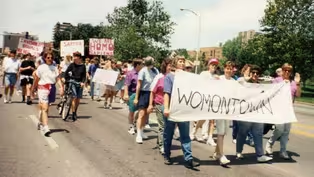
- No, we were part of the gay community and we even marched in the pride marches and stuff.
We have Womontown banner, with a lot of us standing behind it was just like representing the neighborhood in a pride march.
- Yeah and the thing about it is we weren't against gay guys at all, it was fine, it was some egonomics, that's all that was about.
Most of us were social workers, teachers, nurses, we didn't have the type of incomes lawyers and doctors and the guys had, plus we didn't have the acceptability as strong as they did, because really somebody like Byron some of them came in, Dale, others, that bought properties and did great things.
They were strong friends of ours.
We kept in contact with each other over the years and oh no, we were definitely part of their community and they were part of ours.
- Yeah and we also took part in the AIDS March, well the AIDS walk, every year we would have a Womontown group of us go down to that AIDS walk and walk and support, walk and that was early on, that was before all the antiretrovirals, there were still people who were dying from AIDS.
- Yeah, that's one of the things during that part of the show, I wanted to make sure there were lots, that people saw there were a lot of different opinions.
Yes, there may have been a couple of separatists in the group, yes, there may have been but it was such a mix of people, it wasn't just 20 people that all thought exactly the same way and did exactly the same things, it wasn't like that.
- [Lady 3] Everybody had dogs.
- [Lady 4] Some people had ferrets from what I understand.
- Ferrets harder to spread around.
- [Lady 5] Ferrets were legal back then, another underground activity we were participating in.
(audience laughing) - [Sandy] Well and I remember you guys talking about how in the security efforts, you tried to get people to walk their dogs at night or something.
Were there any other security things that you tried to do in the neighborhood that people say?
- We had those orange shirts we wore.
- And then the neighborhood association in the, I wanna say late nineties or early 2000 but a came forward that different people in the neighborhood association walked around and film illegal activities that was going on, so we could show it to the cops when they came.
'Cause we would have prostitutes living out of some of those apartments, we would have drug interactions, the buying, stuff like that going on and it was dicey, even as we were settling in and cultivating the neighborhood so to speak, there was activity, especially on the fringes of the neighborhood.
- I know that technically our time is up, is there anything anybody wants to say before I pass this back to Tyler?
- I just wanna thank you for, you and Emily, for doing this documentary because it's.
- Brought us together.
- We got flowers.
'Cause it wouldn't have happened without you too, being instrumental in this.
(audience clapping) Thank you, amazing.
 Now Playing
Video has Closed Captions
Clip | 25m 24s | Q&A after screening with producer, Sandy Woodson, and founders Drea and Mary Ann. (25m 24s)
Preview | 30s | The story of a group in the 1980s who band together to create a community by and for women. (30s)
Providing Support for PBS.org
Learn Moreabout PBS online sponsorship













Support for PBS provided by:
Womontown is a local public television program presented by Kansas City PBS