
Wood County 4-H Youth Programs
Season 27 Episode 18 | 25m 26sVideo has Closed Captions
A look at the range of 4-H activities in Ohio
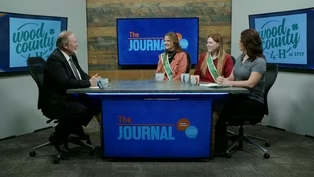
We're joined by Wood County 4-H staff and members to discuss the group's activities.
Problems playing video? | Closed Captioning Feedback
Problems playing video? | Closed Captioning Feedback
The Journal is a local public television program presented by WBGU-PBS
Wood County 4-H Youth Programs
Season 27 Episode 18 | 25m 26sVideo has Closed Captions
We're joined by Wood County 4-H staff and members to discuss the group's activities.
Problems playing video? | Closed Captioning Feedback
How to Watch The Journal
The Journal is available to stream on pbs.org and the free PBS App, available on iPhone, Apple TV, Android TV, Android smartphones, Amazon Fire TV, Amazon Fire Tablet, Roku, Samsung Smart TV, and Vizio.
Providing Support for PBS.org
Learn Moreabout PBS online sponsorship(upbeat music) (graphic pops) - Hello and welcome to The Journal.
I'm Steve Kendall.
It empowers youth with lifelong leadership skills and a lot more.
We're joined by Amy Michaels to talk about the opportunities available to those who wanna join the 4-H Youth Development Program.
Amy, thanks for being here.
- Hi, thank you.
- Kind of give us a little overview about what 4-H is.
I mean, a lot of us participated when we were younger, but probably, it's evolved over the years a little bit.
So talk a about what it is now because it falls under the umbrella of the OSU extension service, so kind of give us what it's like today to be in 4-H.
- Yeah, absolutely.
So 4-H was founded in 1902 actually in Clark County, Ohio by A.B.
Graham with a strong focus on agriculture, so for youth that maybe grew up on farms or had livestock.
And then from there it's grown into a huge organization which reaches millions of youth throughout the nation.
So 4-H is present in several countries, not just the US.
- [Steve] Oh, okay.
- It has a very strong foundation, especially in Ohio.
- Yeah, because I know everywhere you go and especially, you know, we're here in Wood County, but obviously 4-H all over the state.
And of course when you see county fairs, 4-H has a high profile at that as well.
And you talked about the fact it began as an agricultural based sort of thing, but it's expanded into a lot of other areas.
It's not just, oh, you need to live on a farm to be in 4-H.
- [Amy] Correct, that's one of my favorite parts about 4-H.
So 4-H has definitely changed its scope, especially even since I was in 4-H, so over the past 10 years.
So 4-H no longer is just for agriculture students or people living on farms.
We actually offer projects ranging and everything from sewing, cooking, STEM, arts, those were all projects that I was very interested in taking, leadership, public speaking, as well as lots of state, national, other opportunities for teenagers to become involved in 4-H.
So it's just a very overall dynamic program and it offers something for several interest areas.
- Yeah, now one of the things too, and we're gonna talk to a couple of people who are in 4-H here later on in the program, talk about the age ranges because there are different levels you can start out at and be in different parts of it.
So describe kind of how early could I start, if I have a child, how early can they start in 4-H?
- Yeah, so you can be in 4-H from ages five through 18.
Now five through eight-year-olds, they are in Clover Buds.
Clover Buds are a non-competitive program, so they focus more on learning some basic social skills, life skills.
They get to do a lot of crafts, eat a lot of snacks, play a lot of games.
Super fun.
I love the Clover Bud age kids.
They're always so enthusiastic about everything and they just want to learn.
And then after that you become a Project Age member, so from ages nine through 18.
You can compete, you can maybe show livestock at the fair, or you can also take some of those still projects like I mentioned earlier.
So you're STEM, sewing, cooking, arts, stuff like that.
- Yeah, now in Wood County, I know, and again, you referenced, like looking at the Wood County Fair, you'll see all the different names, roughly how many different 4-H clubs are there in Wood County alone?
- Yeah, so we actually have 46 clubs.
We are definitely a large program.
4-H is present in all 88 counties, and Wood County does have one of the larger programs.
We reach over a thousand youth each year.
And then we also have over 200 volunteers that make the whole program possible.
- Yeah, and and so each of those organizations, and they have really, I always like to the fact, they have really unique, colorful names.
And I think that's always nice, too.
Geographically, is that how things evolve?
If I want to be in a club, say in the northwestern part of the county, do I have to go there or can I join a club somewhere else in Wood County?
- That's really interesting.
So previously, clubs were maybe focused-area based.
So if you were taking cattle to the fair, you would be in more of a cattle-focused club.
That's not so much how it works anymore.
Now you can join whatever is convenient for you and your family.
So it might be for your location, it might be the day of the week that they meet or the time that they meet.
And we still have some that are focused on, such as like horses or maybe shooting sports.
- Yeah, and you mentioned too a little bit about the fact that once you get to age eight, then you move into the next category at age nine.
So talk about the competition part of it.
Because yeah, horses, cattle, I mean all those different areas you talked about.
How does that work exactly.
So describe, so now I'm age nine, I'm moving from being a Clover Bud to this, what are my options?
What's different about that than I when I was a little younger?
- Well, the good thing about if you start in Clover Buds, you kind of get to watch older members, see what they're interested in, you know.
And then I always kind of start with, you know, asking your kids, "Well, what are you interested in?"
I would argue there's a 4-H project for almost every interest area.
And if not, it's closely connected.
So it usually starts from personal interests or maybe it's something that your family is interested in, like beekeeping or woodworking, and you kind of move on from there.
So every year they attend a judging, and from there they might qualify to go to state fair and actually compete at the state fair level.
- Ah, okay, and then probably from there, there's probably a national level beyond that.
- Yeah, absolutely.
So I would definitely say that kids find their spark in 4-H and then they move on to do all kinds of things nationally, and even internationally.
So one thing that Ohio 4-H offers is a cultural immersion trip.
And so we have youth that can go to Greece or Puerto Rico or visit other countries and learn about 4-H in their country and how things are done there.
[Steve] Wow.
- Yeah.
- Now that's something I'm sure people didn't, anybody outside the program wouldn't know about.
Now, when you talk about the different levels, do you see the fact that maybe families like a brother or a sister or a cousin or maybe your mother, father, if somebody was in 4-H, do you see a family sort of trend that develops with that?
- Yeah, absolutely.
I would say, especially in Wood County, I have noticed a very strong legacy.
So these kids' parents were in 4-H, their parents' parents, grandparents, great grandparents, and they all kind of passed down that heritage of being in 4-H.
Whether it is the 4-H club that they have all been in for, you know, a hundred years or certain projects that they take or even becoming an advisor or a camp counselor or other volunteer.
- Yeah, because at some point too, and I guess I'm thinking about this, do some of the people who are in 4-H, like the students that are in it, the kids that are in it, become take on leadership roles as well within their particular organization?
Correct?
- Yes, absolutely.
That's very common.
So obviously I created a whole career out of it.
And so we do see that, you know, people like to get back and volunteer for the organization that shaped them as youth.
- [Steve] Yeah, now to participate, is there a charge for this?
Is there a fee?
Because obviously this all costs money and nothing's free in this world, obviously.
So what sort of, are we talking, if I want to enroll my 5-year-old in a Clover Bud, what's the cost?
- 4-H can be very low cost.
It can be about as expensive as families choose to make it, depending on the projects that you take.
So obviously if you are taking horses to the fair, you have the cost of boarding the horses, feeding the horses, care of the horses.
But we do have very affordable projects.
The cost to take a project is very low.
You might have some club dues, which are very affordable, but there are projects like knots, bicycling, very, very low cost projects that are affordable for families and whatever they're interested in.
- Yeah, because, and again, going back to, you know, you hear the old guy tell a story, but I mean when I was in 4-H and we're talking before the turn of the 21st century, you know, the focus areas were very agricultural.
So if it wasn't actually taking a livestock to the fair, it was something related to farm equipment or something like that.
But obviously now the range is so wide.
As you mentioned earlier, there's a project for anybody who wants to be a member.
Yeah.
- Absolutely.
Everything from polar science, lakes, or natural resources, like I mentioned, beekeeping, there is definitely something for every child, whatever their interest area is.
And if there isn't, it's very easy to connect it to something they're interested in.
- [Steve] Okay, great.
- Yeah.
- When we come back we can talk more about that and we'll bring a couple of the current 4-H members on with us as well as we get through the next couple of segments here on The Journal.
Back in just a moment with Amy Michaels, Wood County 4-H, here on The Journal.
Thank you for staying with us here on The Journal.
We're joined by some guests from the Wood County 4-H program, Amy Michaels, of course, the Director.
And we're joined in this segment by a couple of the participants, Sara and Grace, who are in the program.
Amy, talk a little about the two folks we're about to talk about and kind of who they are.
We're gonna talk to them a little more in depth, but kinda give us a little overview first of who they are.
Because they're wearing banners among other things, so talk a little about that for us.
- [Amy] Yeah, absolutely.
So Sara and Grace here are two of our more involved older youth that have kind of grown up through the 4-H program.
Even though I've only known them for a short time, it's amazing to see how 4-H has definitely shaped who they are.
They're both very active in a wide range of activities through 4-H.
So they are serving on the 4-H honor court right now, which is a large privilege.
They're also both camp counselors, they are leadership board members, and they are very involved taking projects, livestock, state fair participants, just overall great 4-H'ers.
- [Steve] Yeah, okay, so Sara, talk a little about how you got into 4-H and some of the things you've done during it, and then tell us about what it takes to be on the Honor Court a little bit too.
So kind of take us through your life as a 4-H member.
- [Sara] Yeah, so 4-H has been a big part of my life.
I had older siblings that are running it and it's always been a big part of my family.
So I've been at it since I was a Clover Bud.
And then once I was old enough to start taking projects, I started taking livestock right away, especially pigs and cattle.
And I still take them.
I show cattle quite a bit outside of the fair as well.
And then I've also taken many different miscellaneous projects as I've gotten older.
So I've taken a scrapbooking, sewing, baking, all that fun stuff.
So all kinds of different projects.
- Yeah, now do you do, I mean obviously when you've got livestock, that's a year long sort of thing.
So you've got that going on and then you're doing other projects at the same time.
- [Sara] Yeah.
- So in a typical year, how many projects would you have done besides your livestock?
- [Sara] So I usually take a couple, like probably three or four different miscellaneous projects on the side.
So those are a lot of fun.
Like, those are all different ones.
I like taking those.
- Yeah, and Grace, talk about your evolution through the program.
- [Grace] So I have been involved in 4-H for as long as I can remember.
I live on my family's farm.
We have been there for six generations.
And we are a cattle, beef-producing farm.
And I kind of got into that and I was more focused on livestock my first couple years of 4-H.
But as I progressed about three years ago, I got more involved in the leadership aspect of things and kind of sought after all these opportunities that I could do, found out a little bit more about miscellaneous projects, and you know, how to become a camp counselor, midnight madness camp counselor, all these things that kind of helped me grow in my leadership skills.
And I have to thank my friends at the extension office for that.
And that's kind of where I'm at as far as my 4-H journey goes.
- Yeah, now Sara, when you talk about doing the projects, obviously those are pretty focused and that sort of thing.
What are some of the other things that you learned along the way?
Like while doing the projects, working with other people, that kind of thing, because that's all a part of this too is learning how to socialize and work with other people and learn new skills.
- [Sara] Yeah, so you learn a lot of different skills, especially the livestock, like I've learned time management, how to be organized there.
There's a lot of work and definitely being, like I said, organized, and you have to be able to do it like every day.
So you're not, especially about livestock is, especially with the cattle for me, is also I raise cattle, so I do it, it's all day every day kind of.
So just to be able to like, you have to kinda have the consistency to get up every day and feed and then work the animals and all that.
So that's definitely probably taught me one of my biggest skills that I'll be able to take throughout my life.
- Yeah, to be able to say, yeah, to basically look at a project and say, "Here's where I need to be.
Here's how I need to accomplish this."
- [Sara] Yeah, and to grow with the project.
- And learn those skills of like, yes, I do need to get up every day and go to do this and do this and do this and keep it all focused with that end goal then of having, you know, the livestock, in this case, something you can show at the fair and then beyond that as well.
- [Sara] Yeah.
- [Steve] Yeah, yeah.
And typically too, now, when you take something to the fair or a competition, usually does someone end up buying that particular animal at the end or not?
Or how does that work?
- [Sara] Yeah, so it's so different for each one.
So if you're taking like a beef feeder, then yeah, there's like a sale at the fair, so someone could buy the animal.
If you're taking a market animal, so like a fat steer, then he'll go straight to market usually.
Either you can go on the truck at the fair or you can take them home and then take them to market.
Or I kind of specialize in breeding animals.
So I have a lot of heifers, so I'll take them home and then we'll end up breeding them and then they'll have babies and we'll kind of take that animal.
- So yeah, there's several different routes you can go with a particular animal depending on what your goal is.
And Grace talk about, so in your case too, obviously you said you grew up on a farm, your cattle and beef, what's that kind of like for you?
What kind of skills, now, obviously had family members who were sort of showing you a path, but what did you learn on your own as you went through that process?
- [Grace] So not only have I learned to just show the animal and all about that, but I've also learned a lot about how the meat industry works and in general, because my grandparents run their own beef business and they sell locally, and I've just kind of learned a little bit about that.
Learned how the process works and how to properly take care of your animals, manage them, organization, and just that it is a time commitment and you can't just choose when you want to do it.
It takes a lot of time and effort and energy.
- Yeah, now Sara too, were there things that you learned that you didn't know you were gonna learn when you started?
I mean there were things like, "Oh, I didn't know I learned this," or this is something I didn't expect to find out about or not.
- [Sara] Yeah, and like Grace said, like I've learned so much more about cattle industry and just going to different shows and just asking different people things like how the cattle work and how to show them and how to present them the best.
And you've definitely learned a lot more about the animals and the livestock than you ever thought you would.
And how to get them ready properly and all the work it takes to get them to look and act how you want them to at a fair.
- Yeah, and probably too, Grace, you see the way other people are doing what they're doing, you learn, you pick up ideas and things like that from them as well, right?
So it's again, watching being in a competition or just being involved in the group, each of you probably share ideas and that sort of thing.
- [Grace] Yes.
- Yeah.
Now in your case, Grace, was there something that you didn't expect to find out when you became a 4-H member or something like, "Oh, I didn't know this was gonna be part of it."
Anything like that or not?
- [Grace] So I didn't really know much of anything as far as the leadership opportunities go until, like I said, about three years ago.
I never really delved into that.
I'd look at the people around me and I'd be like, "Man, like it looks so cool to be a camp counselor."
I just, I don't know how to do it.
And I ended up reaching out to, you know, some of the people at the extension office, like my extension office, Jenny Morlock.
And she kind of led me through the steps that it took to get into like apply for certain things and what the steps took to grow in your leadership skill that you could go on to become like a camp counselor because you know, you have to go through an interview process and they look for specific things.
And she kind of led me through all the steps that it took to grow in my skills and get to where I am.
- Yeah, well, we come back, we can talk more about that because obviously you can take these skills that you've learned being in 4-H and then basically project those on to anything else you wanna do the rest of your life.
So we can talk about it too.
And we'll talk about, yeah, you just touched on what it's like to be a camp counselor, how to get to that point.
We'll delve into that a little bit as well.
Back in just a moment with some members of the Wood County 4-H Clubs and Amy Michaels, Director of the youth development office here in Wood County.
Back in just a moment on The Journal.
You're with us on The Journal, our guests are from the Wood County 4-H organization, Amy Michaels, Director of the youth development program.
There's several things that we are gonna talk about here.
One of which is the fact that besides the local organizations, and both the folks, Sarah and Grace, both have participated at a level beyond that, but beyond the county level, there are opportunities to then participate at the state level in other leadership roles and that kind of thing.
So briefly talk about that a little bit.
- [Amy] Yeah, absolutely.
So every year we send out a teen opportunities packet to our older youth and there are all kinds of opportunities.
You can go to Washington, DC, they have a new program, Ignite, which Sarah is actually going to be attending that.
That is a kind of STEM-focused leadership experience for older youth.
You can also attend statewide trainings.
So one that I actually attended when I was a teenager was making extreme counselors.
I think I might have been in the pilot of that program, but that is a statewide camp counselor training, which is very cool because the camp counselors get to meet camp counselors from across Ohio.
And so even though the counties might be close together, everybody camps very differently and even in different locations.
So it's a really cool networking opportunity.
We also have the Team Leadership Council, which is a statewide program and they will do different leadership activities throughout Ohio.
And I think Grace would be able to talk a lot about that.
- [Steve] Yeah, so tell us a little about that Grace, because you're a member of that, so talk about that, the Team Leadership Council, - [Grace] So the Ohio 4-H Team Leadership Council is essentially where 4-H members from across Ohio, whatever county, can come together once to twice every month.
And we just discuss ways to improve 4-H and grow it within different areas that may not have it as much.
And that comes both with the urbanization in Columbus, like how we can reach out to those who may not live on a farm and can do livestock but they can do miscellaneous projects instead or learn more about STEM and be involved in that.
- Yeah, and one of the things too, I know, Sarah, we were talking a little bit between the segments here, you show livestock but you also do more than that.
So talk about the other thing you do with livestock because you've evolved into now being a judge.
- [Sara] Yeah, so I do participate in livestock judging.
So I'm on the Wood County 4-H Livestock Judging team.
So you can go to many different competitions throughout the year, throughout the state.
And our big ones kind of state fair, so we participate there.
And then this year actually, I was on, Wood County had two teams that placed in the top five and we were able to go on to two different national contests too.
- [Steve] Wow.
- [Sara] So I was able to be a part of that, so yeah.
- Yeah, now the other thing too is we talk about the fact too that Camp Palmer is a big part of 4-H in the area and we're celebrating anniversary.
Talk a little bit about that because you guys both are counselors there, I understand.
So tell us a little bit about Camp Palmer and then you guys can talk about being counselors.
- [Amy] Yeah, absolutely.
So Wood County originally camped at Kelly's Island.
So over on the island, which is Erie County's 4-H camp.
And then in 1975, Wood County actually outgrew that camp.
So we were able to switch and join with 4-H Camp Palmer.
So this past year, we celebrated 50 years and we had a very large celebration at camp for 50 years of camping at 4-H Camp Palmer and 4-H Camp Palmer was actually named after our state 4-H leader at the time of its founding, which was in 1946.
- Wow, so you guys are both counselors.
So Sara, talk about that.
Did you go to Camp Palmer before you became a counselor?
- [Sara] Yeah, I've been to camp a couple different times as a camper.
And so yeah, I always had a great time as a camper and I knew I wanted to come back as a counselor to be able to help the kids have as wonderful as experiences as I did.
- [Steve] Oh, yeah.
And Grace, what about you?
- [Grace] I did not attend camp when I was younger, but I did end up becoming a counselor and I just like to tell people that may not have attended camp that, you know, there is still an opportunity for you to join and make a lasting impact on those who are attending camp.
- Yeah, now when you go to that, Sara, how long is the participation?
How many days are you there?
Or is it go through the summer or?
- [Sara] Yes, you're there for about five days in June.
- [Steve] In June, okay.
- [Sara] Yeah, it's a fun time.
It's all kinds of different camp activities.
- Yeah, and you're seeing people from all over the area basically there as well.
Now, do people come from outside of Wood County to go there or not?
Or is it basically Wood County?
- [Sara] No, it's just Wood County.
- [Steve] It's Wood County's camp.
Okay, alright.
Yeah.
Yeah.
When you first got there, was that the first time you'd gone away to a camp like that or anything or not?
- [Sara] Yeah, my first year I went when I was nine, and yeah, that was my first time kind of being away from home for that long and stuff, and being kinda out in the middle of nowhere in a camp and stuff.
But it was a great experience.
- [Steve] Along with a bunch of other people who were in the same situation.
Hey, what are we all doing here?
And what was your experience, Grace, first time you went?
- [Grace] So I have been to camps previously.
I actually attended 4-H Camp Ohio a year previously as a camper.
And I think that, you know, going to Camp Palmer, it was a new experience.
Being a counselor was something that, you know, I kind of always dreamt of.
It was very fun.
I got to meet new people throughout my county, including the campers that I may not have known previously.
And we just all kind of bonded and did activities together and kind of all grew.
- So Sara, what's your role as a counselor?
What are you responsible for?
Are you assigned like a group of other campers and things?
- [Sara] So you have your cabin and there's about 15, 20 different kids.
So like I had like girls and then there's two or three different co-counselors you have in your cabin.
So you're in charge of them at night.
And then you have a different day group, so that's girls and boys.
Then there's about four counselors total in that.
So that's like leading them through the different group activities and stuff.
So whether it's canoeing, crafting, swimming, all the different things.
And then we kinda get together, like sometimes you can break off and like the different groups do different things and the whole camp will come together for different activities as well.
- But lots of responsibility obviously.
Lots of organizational keeping.
- [Sara] Yeah, you're responsible.
We plan like all year, we'll start playing in February so we plan all the different activities and skits and all like outfits and all the different things.
- [Steve] Oh wow.
Yeah.
- [Amy] So all of our camp counselors actually have to have 24 hours of training to be a camp counselor.
So it's kind of a time commitment but it's really important that way they know how to handle a lot of situations that can come up at camp.
Obviously kids are, you know, unpredictable.
So we try to prepare the best we can.
But yeah, it's crazy.
We are already starting planning for camp in 2026 and we have camp counselor training, which we'll be starting in February already.
- [Steve] And Grace, when you decided to become a counselor, what's the process for that?
because obviously they don't just say, "Oh, you're now anointed as a counselor."
What are some of the things you had to do to demonstrate you're gonna be capable of doing it?
- [Grace] So there is an application process that you have to go through.
And from there they have a big interview process where you meet with like five different panels.
And you have to, you know, they put you through scenarios and see how you'll answer them.
And then I know my personal favorite was you had to act out a skit with a group of people with props in front of three judges, and it is a blast and it, you know, not only shows you, like it gives you an idea of like what your interview processes may be like in the future.
And that kind of not only can help you when, you know, maybe applying for a job in the future or something like that, but just in general kind of gets you that experience and you know, maybe even if you don't become a counselor, you know, you know what to come back and expect.
- Yeah.
Cool.
That's really amazing though when you describe that's a process.
Amy, if somebody wants to get involved now in 4-H, either they have children or whatever, what's the best way for them to do that?
- [Amy] Yeah, so reach out to our office.
Our website is wood.osu.edu and any of us would be more than happy to help a family find a good club or a good program that's a good fit for them, yeah.
- [Steve] And there's no time like you have to, is there a deadline or not?
- [Amy] So enrollment for the year ends on March 15th.
So we already have some enrollment trickling in, yep.
- [Steve] Okay, so there's still time to do it.
- [Amy] Yep, absolutely.
- [Steve] There's still plenty of time.
Don't wait until the last day to do it.
So great.
Well, thank you so much Sara, Grace, Amy.
Thank you for coming on top of this.
We all learned a lot and it sounds like a great program.
You guys have obviously learned a lot too and things you can apply as you, you know, move outside the 4-H area and that kind of thing.
So thank you so much for being on.
- [Amy] Thanks for having us.
- [Steve] I appreciate it.
- Yeah, thank you.
You can check us out at wbgu.org.
You can watch us every Thursday night at eight o'clock on WBGU-PBS.
We'll see you again next time.
Goodnight and good luck.
(upbeat music)
Wood County 4-H Youth Programs- Preview
Preview: S27 Ep18 | 30s | A look at the range of 4-H activities in Ohio (30s)
Providing Support for PBS.org
Learn Moreabout PBS online sponsorship
- News and Public Affairs

Top journalists deliver compelling original analysis of the hour's headlines.

- News and Public Affairs

FRONTLINE is investigative journalism that questions, explains and changes our world.












Support for PBS provided by:
The Journal is a local public television program presented by WBGU-PBS