
Work
Season 2 Episode 5 | 23m 46sVideo has Closed Captions
See the work behind the art.
See the work behind the art. Metal artist Joshua Prince takes us through his knife making process. Come shopping, and tasting, with cookbook author and the host of Maria's Portuguese Table. See how Abilities Dance Boston is making dance and performing arts accessible to everyone.
Problems playing video? | Closed Captioning Feedback
Problems playing video? | Closed Captioning Feedback
Art Inc. is a local public television program presented by Ocean State Media
Work
Season 2 Episode 5 | 23m 46sVideo has Closed Captions
See the work behind the art. Metal artist Joshua Prince takes us through his knife making process. Come shopping, and tasting, with cookbook author and the host of Maria's Portuguese Table. See how Abilities Dance Boston is making dance and performing arts accessible to everyone.
Problems playing video? | Closed Captioning Feedback
How to Watch Art Inc.
Art Inc. is available to stream on pbs.org and the free PBS App, available on iPhone, Apple TV, Android TV, Android smartphones, Amazon Fire TV, Amazon Fire Tablet, Roku, Samsung Smart TV, and Vizio.
Providing Support for PBS.org
Learn Moreabout PBS online sponsorship(radio static) - Art is everywhere.
It might be a dance with your favorite partner, or the dance of a butterfly's wings.
It might be a delicate fragrance, or a delicate orb made of glass.
It might be something you've never even imagined because art is incorporated into almost everything.
And we're excited to share that everything with you.
Welcome to "ART inc." - [Broadcaster] If you want to know what's going on... (mellow music) (machine buzzing) (water splashing) (bird chirping) (audience applauding) (static hissing) (suspenseful music) - [Tracy] How I make a knife.
(forge roaring) - For me, creativity is just trying.
(hammer ringing) Everyone's capable of creating beauty.
(forge roaring) My name is Joshua Prince.
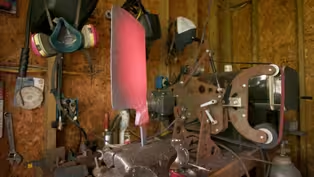
I'm a metal artist, and I'm gonna show you how I make a knife.
One of the main reasons I do this, has to do with the process that I enjoy so much, and not so much the results.
The physical experience of the heat, the fire, the failure.
(metal cracks) Oh!
Every project, at its best, will start with a concept for me.
I have like this idea, I want to do a a winged dragon, and it got me thinking about a dragon devouring the sun.
And I'll begin to sketch.
I'll just sketch something that's impossible, and then I'll try to develop the actual technique to get to what I'm trying to do.
Then I'll go out to my shop and I'll light the forge.
(forge roaring) (funky music) So inside the forge, the temperatures go up to 2,300, 2,400 degrees.
I'm looking at the material as it heats up more as a visual cue to me as to when the material is ready to begin to be worked.
Once the steel is at the desired temperature, I'll take it out and I'll begin to manipulate it under the various tools that I have in the shop.
(machine whining) (machine pounding) (hammer ringing) Once I begin working the steel, the temperature goes out of it, and the risk of destroying the material increases as you work it down to lower temperatures.
But it can always be just put back in the forge, brought back up to the appropriate temperature, and worked again.
During the time of forging, I'll move between machines as appropriate.
You can get a lot done in a very short amount of time.
(machine pounding) Forging is the most romantic visual part of the knife-making process.
There's these beautiful moments of material, and sparks, and fire.
(grinder whining) The glow of the material, very kind of enchanting.
The way I know I'm done forging is usually exhaustion.
(hammer ringing) I don't have an idea about it's gotta be exactly right.
I just have an idea that I'm pursuing and when I feel like I've gotten really close to that idea I just consider it done and I move on to something else.
I think it's good.
The final quenching, or hardening of the steel, is what gives the steel its properties.
Usually we're looking for hardness, toughness, possibly flexibility.
That's the wonder of steel is you can sort of impart those qualities into the steel based on your temperatures.
(mellow music) After a series of hardening and heat treatment steps on the steel, I have to take it to grind.
(grinder whining) It's important because that's where you have go from something very crude to something very refined.
Then I come back inside and I choose the handle material.
(blocks clattering) That's sort of a slow process.
Sometimes it takes me weeks to make a decision.
For this knife, this is the material that I chose.
And this is a piece of curly maple, tiger maple.
It's basically just got sort of like these undulations in them and this just fit really well with the pattern that's in the steel.
For the next step, we're gonna go outside.
All right, so we're gonna demonstrate the etching process on a couple of samples that I have prepared here.
We're using a chemical called ferric chloride.
And I'm just gonna put some in the jar here.
And this reaction happens, usually it happens almost instantaneously.
Might overflow this a little bit.
So it acts on one steel and not the other.
So you get basically two tones, silver and black, and darker color.
So I'm gonna show you a finished knife.
(dinging) So what I like about this knife is it has a whole reggae band on one side, and a whole funk band on the other side.
Yeah, this one's pretty awesome.
And so this is called Soulsonic Force after one of the original funkadelic bands from my childhood.
In order to make this a cutting tool, a useful tool, it has to be sharpened.
And this one has been sharpened by just bringing the knife up a few degrees creating that zero cutting edge.
I would kind of sum up my process as catch and release.
I catch the idea, I go through the process to create it, and then I release it.
My name is Joshua Prince and that's how I make a knife.
(suspenseful music) - [Tracy] Shopping the market: Portugal.
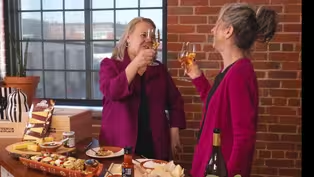
(bright music) Maria Lawton is a cookbook author and host of the series "Maria's Portuguese Table" on PBS.
She's passionate about sharing her Portuguese heritage, especially Portuguese culture and culinary traditions.
Today we're joining her at Portugalia Market to shop for and taste some of her favorite ingredients.
- Welcome, Tracy, to Portugalia.
- Thank you, Maria.
Super excited.
- Yeah.
- To be here.
- So today I wanna show you all the ingredients that I use in my recipes and where I source them.
- Fantastic.
- Let's go see the first place.
Let's go.
Follow me.
Now we're gonna go into the cod room.
Wow.
- It's, it's incredible.
- The whole room.
- The whole room.
- Hi, Frank.
- [Frank] Hey, Maria.
- When you think of Portugal, cod is the national dish, but cod is not fished in Portuguese waters.
- Right, that was my question.
- Our fishermen would go to Norway, go up to Canada, and fish in those waters.
They would bring it back and it was called Our Faithful Friend, because you could always depend on having cod.
Look at this, look how beautiful this is.
- And huge.
- And huge.
- [Tracy] So nice and plump.
- [Maria] Nice and plump.
This is gonna give you a lot more cod when you rehydrate it, when you desalt it.
- And how do you say it, for those who don't know?
(Maria speaking foreign language) (Tracy speaking foreign language) - Yes!
- Yow, yow!
- Yow, yow!
All right, we've got more places to go.
We've got more things to see.
- Right.
- [Both] Cheese.
- Oh my goodness.
- My favorite.
- It's my favorite thing.
We have fresh cheese here, which is a staple, I think, in every Portuguese breakfast.
- Delicious.
- And then we have the cured cheeses, and the creamier, the younger it is.
It gets sharper as it gets older.
- Right.
- So the next thing I wanna show you is the red-hot chopped peppers.
- Fermented.
- It's fermented.
And my dad would make this, and you could hear the popping going on.
- [Tracy] Popping?
- Yes, 'cause it's fermenting, it's making all those wonderful noises.
The more you see seeds in it- - [Tracy] The hotter.
- [Maria] Oh, the hotter it is.
- [Tracy] Always, right.
- [Maria] Yeah, the hotter it is.
- Perfect.
- That gives you so much flavor when you're cooking your meats, and your chicken, or any of that.
(bright music) (customers chattering) - Olive oil.
- Here comes the olive oil.
Ta da!
Olives have been grown in in Portugal for centuries.
And we produce the most wonderful olive oil.
It needs to be in a dark bottle.
- Right.
- It's something where, like wine, you need to taste test all of these things.
- Delicious.
- Yes.
- [Tracy] Olive oil.
- And now ta-da, the tinned fish.
I grew up having tinned fish, right?
- [Tracy] So what kind of fish?
- We would do tuna, sardines- - [Tracy] Sardines.
- Squid, tuna pate.
Tracy, you know what goes really great with tinned fish?
- What?
- Wine.
- Perfect.
- Let's go for some wine.
- Love wine.
- Let's do that.
Wine, wine, lots of wine.
So you have Douro region, you have Alentejo, you even have Lisbon.
I still feel that Portuguese wines are undervalued.
- Mm.
- So I think people need to find out about Portuguese wines.
And the best way to do it is when you have wine tastings.
So I highly recommend coming for wine tastings.
I'm so happy that I've been showing you all my favorite things, and how I procure all the stuff when I'm making my dishes.
- [Tracy] Thank you so much.
- Oh, yeah.
Now the question I have for you is, would you like to taste some of the things that I've pointed out today?
- I would definitely like to taste.
- Oh, that's awesome.
I think we need to try this one.
And that is the (speaking foreign language).
So let's take this.
Let's take some of the stuff that we picked out and let's try it.
- Let's do it.
- Let's go, Tracy.
- Yum.
Thank you, Maria.
- [Maria] Thank you.
(cork popping) - I'm just gonna do a little pour.
Ching-ching.
(glasses clinking) (happy music) Ooh, that's good.
That's real good.
Oh my goodness.
The cod is here.
- Wow.
- Thank you, Colleen.
- You're welcome.
- Thank you so much, honey.
And this is the codfish (speaking foreign language).
But before we try that, I want us to try some of the cheese.
This is now four months, okay?
- Beautiful.
Buttery.
- Buttery, and then comes the woohoo.
Nice little kick.
Then we're gonna go to the seven-month.
And then we have fig, the fig jam that's gonna go with it.
Okay, so let's try that.
- [Tracy] Okay.
- That just opens up your palate.
It is salty, it is sweet.
- Oh, that's delicious.
- It is just, it's divine.
- Mm.
- Isn't it?
Mm, mm, mm, mm.
I mean, cha-ching again.
- Mm hm, yum.
- And then- - [Tracy] This wine is really good- - [Maria] With that- - With the cheese.
It's perfect.
- So now when we were downstairs, I also showed you the fresh cheese.
This is a whole milk cow cheese with rennet.
If you were to go into any Portuguese home, whether it's breakfast, or they'll serve it to you as an appetizer.
- Mmm, that's delicious.
(Maria laughing) Oh my gosh, everything's- (happy music) - And then the piece de resistance, right here, right now is the codfish (speaking foreign language).
- How is this prepared in terms of hydration, rehydrating?
- Take out the excess salt.
I put it, I layer it in a bowl, put fresh water in it, I put the bowl in the fridge, that's in the morning with fresh water, and you would change that water two, three times a day.
I do it for two days.
- Labor of love.
- Labor of love.
The way you cook it for like something like this is you're gonna be boiling it in water.
So you need to take off all the bones, you need to take out the skin, you need to shred all the pieces of cod.
And then you would saute that cod, that shredded cod, with onions.
And that's one step.
And then what you do is literally layers of cod and onion, olive oil, potatoes, olive oil, cod and and onions, little olive oil, potatoes, little olive oil.
- Nice.
- And then you're just making that layer of all of that.
And this is- - [Tracy] The flavors, just layers.
- [Maria] Yes, yes, yes, yes.
(both speaking foreign language) (speaking foreign language) is wow, yeah.
That's so good.
- [Tracy] So thinking about all of this rich history.
- [Maria] Yes.
- How does it feel to be part of the preservation and sharing of all of this?
- I feel really grateful to be able to do that because it needs to be preserved.
When you grow up in this nationality, you know, you don't think twice.
You don't think twice about the food.
I mean, but no matter what, and I don't care, even with any nationality, you need to preserve your food, your culture, your art, your music, your all of the above.
- Agreed.
- [Maria] There's a lot of food history in our plate right here, right now.
- [Tracy] Hmm.
- And you're tasting the same dishes that have been eaten centuries.
You know, this has been- - What a beautiful history.
- Isn't it?
It really is.
- And it's all art.
It's all art.
- And it's all art.
- The cooking, the presentation- - Oh, absolutely.
- The ingredients.
- Absolutely.
- Maria- - Yes, hon?
- Thank you so much for sharing your history and traditions with me.
Thank you so much for this whole day.
- Thank you for doing this.
I really appreciate it.
- Of course, my pleasure.
- And I- - Cheers to you.
- Oh my goodness.
We have to put our plate down and we have to cheer this.
We have to cheers this.
- Ching-ching.
- Ching-ching.
Cheers, sweetheart.
- Thank you.
(suspenseful music) (static hissing) - [Tracy] Abilities Dance.
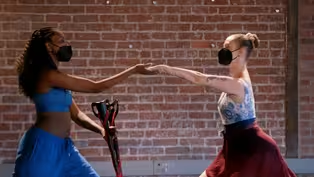
- My name is Ellice Patterson, and I'm the founder and executive artistic director of Abilities Dance.
(suspenseful music) I was coming into a place where I wanted to be able to dance professionally, but other folks weren't working in spaces that were accessible, or just not willing to adapt or conform their classes or choreography.
And so with different attempts at trying to fit into these spaces and not being successful, realized that I would have to create my own space.
And so Abilities Dance founded from there.
Today, Abilities Dance has two different programs consisting of adult artists with and without disabilities and contribute not just dancing and choreography, but music, and composing, and access measures.
All right, so let's dive in, shall we?
So we have our story, "The Banned Ballet."
Leslie enters, a librarian who is sad and disappointed about the recent book bans.
Majority of our rehearsals, like 95% of them, are online.
We're gonna start here.
Rehearsing in person is not the most successful.
It's definitely not the most accessible for me, in addition to others.
And I'm gonna take myself off, and we're just gonna practice that.
I think it's important to allow accommodations for folks to be able to really show up in their best selves.
And we're just going to step, step, step, and rotate.
We have been working to create a story that follows Librarian Leslie.
- I will show you also, I brought one of Ashley's dolls.
Ashley put her in my bag.
- Aww, precious!
Leslie Taub is the lead of this ballet.
(flowing music) Leslie is based in New York.
She's coming here to be able to have in-person rehearsals.
I come around to here, we embrace for a moment.
Lovely.
The arm comes up, we rotate around to here.
Lovely.
- I began dancing as a kid, actually.
I started dancing instead of physical therapy.
I took dance class, and in fact, my mom actually used to drive me almost two hours to ballet.
- I'm gonna be, can we reach in?
- [Leslie] And then we had a performance.
- Here, sliding out.
- [Leslie] I was allowed to dance like in the background in the chorus, but I wasn't allowed to dance a meaningful role.
- Lovely.
- And at that point, my teacher told me that I could not be on a stage.
That that was not, because I of how I look.
And so I didn't dance again until I was 40.
- From here, bringing both hands together like a book.
- [Leslie] I'm excited to be the lead.
(Ellice imitating scooting steps) - [Ellice] Lovely.
- [Leslie] I'm interested to see Ellice as my fairy bookmother.
I think what will probably really be the star of "The Banned Ballet" is not so much going to be- - Here.
- [Leslie] This character of the librarian, or the character of the fairy bookmother, - Roll.
- [Leslie] But the interplay and the dynamic between characters.
- Let's practice that again.
- Okay.
(traffic whooshing) - [Stage Manager] This is your five-minute call musicians and dancers; five minutes.
(door thudding) - Hello!
Yay, we are here.
We made it.
- [All] Whoo!
- Excited to bring the story to life and I know so many others are, too.
Getting a lot of folks coming in about just the excitement of these stories being told.
We are the creators and defenders of our own stories.
(dancers responding) (flute playing single, high note) Librarian Leslie is reaching towards something more than her current reality.
Our ballet is as accessible as possible.
She turns to face left as if holding a diverse book that has vanished due to these sweeping book bans that have hit her community.
We have a captioner to be able to caption the audio descriptions in person and virtually, as well as having an ASL interpreter for our deaf and hard-of-hearing audiences.
- She daintily weaves through all the school committees, library boards, and other spaces that have made these regulations possible.
We are, first and foremost, creating work for our community.
When there is so much content that is not accessible, we try our best to be as accessible as possible.
She comes to Leslie's side in a comforting embrace.
I think that most people don't realize accessibility is achievable.
A lot of it is just a mindset shift.
But it's not bad at all.
It illuminates how their actions have affected others on a personal and societal level.
Making the work more inclusive means you're bringing more people in, and we wanna be brought into so many different spaces.
(audience and dancers cheering and applauding) It's possible, you just have to make it work.
- [Tracy] Thanks for watching, and we'll see you next time on ART inc. (TV static hissing) (suspenseful music) Watch More ART Inc., a Rhode Island PBS original series now streaming at ripbs.org/artinc.
Video has Closed Captions
Clip: S2 Ep5 | 7m 2s | Abilities Dance Boston makes dance and performing arts accessible to everyone. (7m 2s)
Video has Closed Captions
Clip: S2 Ep5 | 5m 51s | Metal Artist Joshua Prince takes us through his knife-making process. (5m 51s)
Video has Closed Captions
Clip: S2 Ep5 | 9m 22s | Come shopping, and tasting, with cookbook author and host of Maria’s Portuguese Table. (9m 22s)
Providing Support for PBS.org
Learn Moreabout PBS online sponsorship

- Arts and Music
The Best of the Joy of Painting with Bob Ross
A pop icon, Bob Ross offers soothing words of wisdom as he paints captivating landscapes.













Support for PBS provided by:
Art Inc. is a local public television program presented by Ocean State Media