Utah Insight
Wounds of War: Veterans and Mental Health
Season 2 Episode 5 | 27m 8sVideo has Closed Captions
Each day, nearly 20 veterans die by suicide. We explore the resources available to help.
Research shows up to half of Afghanistan and Iraq war veterans may have some kind of mental health disorder. And here in Utah, veterans are more likely to die by suicide than the general population. Mental health experts discuss the challenges in getting help where it’s needed, what can lead to positive outcomes, and the national strategy to keep these heroes safe.
Problems playing video? | Closed Captioning Feedback
Problems playing video? | Closed Captioning Feedback
Utah Insight is a local public television program presented by PBS Utah
Utah Insight
Wounds of War: Veterans and Mental Health
Season 2 Episode 5 | 27m 8sVideo has Closed Captions
Research shows up to half of Afghanistan and Iraq war veterans may have some kind of mental health disorder. And here in Utah, veterans are more likely to die by suicide than the general population. Mental health experts discuss the challenges in getting help where it’s needed, what can lead to positive outcomes, and the national strategy to keep these heroes safe.
Problems playing video? | Closed Captioning Feedback
How to Watch Utah Insight
Utah Insight is available to stream on pbs.org and the free PBS App, available on iPhone, Apple TV, Android TV, Android smartphones, Amazon Fire TV, Amazon Fire Tablet, Roku, Samsung Smart TV, and Vizio.
All Episodes Now Streaming
Hosted by Jason Perry, each week’s guests feature Utah’s top journalists, lawmakers and policy experts.Providing Support for PBS.org
Learn Moreabout PBS online sponsorship(gentle music) - [Announcer] Funding for "Utah Insight" is made possible by viewers like you.
Thank you.
- [Announcer] Next on "Utah Insight", helping hometown heroes before it's too late.
- It's kind of hard for a lot of people to ask for help.
Veterans, especially some of the older veterans like myself, it's more of a, it's a pride issue.
We're told to be self-reliant, take care of yourself.
You can get hurt, you just shut your mouth and just keep doing your job.
- [Announcer] Learn the factors and red flags that you should know about veteran suicide.
Plus, new resources available to help those in need.
(bright music) - Welcome to "Utah Insight".
I'm your host Liz Adeola.
Every week we ask you to weigh in on the topics we discuss here on the show, and while most people share their thoughts on social media, some of you also chime in via our phone line.
- [Rebecca] Hi, Liz, this is Rebecca Mabe, and my comments are for your program tonight on suicide prevention.
It was an excellent program and I thank you so much for it, but I think that there was an quite an omission.
6.5% of the civilian population here in Utah are veterans and veterans die by suicide at the rate of 20 a day.
Thank you so much for bringing to light this very important information and have a great day.
- I want to thank Rebecca for her feedback on our mental health episode Season 1.
She weighed in holding us accountable in a respectful manner.
And she also connected us with some of the experts that you're gonna hear from today as we dedicate this episode to spreading awareness about the wounds of war, veterans and mental health.
Joining us now, we have Josh Hansen who is the co-founder of Continue Mission.
He is also a two tour Iraq war veteran as well.
We have Dr. Michael Tragakis who is the suicide prevention clinical director at the VA Salt Lake City Health Care System.
And also, Michelle Wilcox who is the LGBT veteran care coordinator at the Salt Lake City Health Care System.
Welcome all, and thank you for joining us for this conversation.
Josh, I wanna start with you.
You joined the military after September 11th after the terrorist attacks in hopes of saving just one person.
And since your deployment and return home, you've saved so many more.
Can you share a bit of your story?
- Yeah, so after 9/11, I was 30 years old.
I signed up in the army, did my two tours in Iraq.
My job was a combat engineer.
My job was to go ahead of everyone, find the bombs on the roads and disarm them so we could save lives.
During my tours in Iraq, I lost six men during the war, doing battle day in and day out clearing the roads.
And I was injured in Fallujah March 15th.
I spent three months in the hospital and years recovering from my injuries.
During my recovery time, my mental health was in such a bad place that I just felt I was such a burden on everyone around me, and if I died by suicide, it would be better for everyone.
And as I was going down this dark road, one of my soldiers died by suicide, and that was a serious wake up call to me after going to his funeral and seeing how it affected the whole family and everyone around him and myself.
I thought this is not the answer.
This was my turning point to do something and I got myself healthy enough to start Continue Mission, a nonprofit organization serving veterans with mental, physical, and emotional injuries, getting them outside recreational activities and supporting one another here at home.
- What a difference it's made here in the community.
Michelle, according to the VA, more than a million veterans identify as LGBTQ or LGBTQ+ and or related identities with higher rates of anxiety, trauma, and also depression.
And there are still those who are afraid to come out and to share their identities as well.
What are some of the challenges that you've come across while trying to connect these veterans to the care that they need?
- I think some of the challenges are not feeling welcome in our hospital.
I think particularly for our transgender veterans feeling that they aren't addressed appropriately by the names that they prefer, their pronouns that they prefer.
I guess if you walked into the hospital and didn't see people on the wall that look like you that are like you, it doesn't feel like a welcoming environment.
- [Liz] What do you mean when you say on the wall?
- There are posters.
There's media everywhere.
When you look and hear about a soldier, you might typically think about a man, and I mean, the majority of the military, it is male.
But the military has a large amount of service members who are LGBTQ and transgender particularly, and so here's a minority population that doesn't feel seen in the hospital.
- Well, the Psychological Health Center of Excellence conducted a study in 2019 and found that 60 to 70% of military personnel with mental health needs do not seek treatment.
While there are many barriers to care, stigma was most frequently reported with veterans concerned about how it could impact their career, how unit leadership would view them, and just not wanting to be seen as weak.
These are all things that people are struggling with when it comes to mental health care.
Dr. Tragakis, there have been huge campaigns that tout the strength of our nation's military and the men and women who serve.
So how do you break through that programming to say it's okay to ask for help?
- Great question.
I think it's gotta start in the military and fortunately, the VA and the military have really started to shore up processes, teaching folks while they're still in the service that it's okay to seek help.
Another piece of the puzzle is, just as a society, I think it's really important for us to work on destigmatizing mental health issues across the board: depression, anxiety.
One of the big illnesses and disorders that folks in the military struggle with, as you might guess, is post-traumatic stress disorder.
And it's absolutely no fault of the veteran herself or himself.
These are things that require treatments.
These are conditions that require support.
And so one of the things we can do as a community is really shore up how we talk about mental health issues, how we talk about suicide, and that is starting in the military.
- And Josh, you've had your daughter, you've told me your daughter is serving right now in the military.
Have you noticed a difference with her in the conversations you've had about her with mental health in the military?
- I think with having me gone through war and experienced military life it's easier for me and her to communicate.
And when she's needing help, she reaches out to me and asks questions, and I'll refer her to the VA or other places to seek help if she needs to talk, definitely.
- And Michelle, what kind of programs are there?
I know you told me that a lot has happened for pride month, but what kind of programs are in the works for veterans who are LGBTQ+?
- Salt Lake particularly has a very strong LGBT program which started in 2009 before Don't Ask, Don't Tell was abolished or repealed.
And so, these are very brave veterans who came and sought services.
It started with a group and these veterans came together and talked about their fears of coming out.
So this group was the basis.
Today, we have nine groups, including yoga, queer yoga, mindfulness-based stress reduction, mindfulness stress compassion.
We do recreation as well.
We have a big summer retreat coming up where we go for four days in Park City.
We do activities like, let's say, hiking, archery, paddle boarding.
And I think it's a time for this community to just be together and not have to worry about stigma and feel safe.
- And is that something that's opened up to all LGBTQ veterans or is this something that they are welcome to go to after they deploy?
- The only requirement is to be enrolled, be enrolled in Salt Lake City, contact me and say I wanna be part of the program, and they can be parts of any of these services.
- And Dr. Tragakis, that was one of the biggest questions that I had.
What is being done before veterans are deployed to help with mental health and also to help destigmatize people going and asking for help when they have mental health issues?
- Well, again, in the military, there are a lot of new coping programs that have started while folks are in the service.
So problem solving strategies, interpersonal strategies to help with family issues, what have you.
There's a real new focus between military and VA now on the tough contributor of economics to suicide.
So in the veteran population, in particular, poverty, under employment, unemployment, these have been linked to suicide thoughts, suicide death.
And this goes for while folks are in the military as well as post, sort of when they're veteran status.
So across both of these sites, again, military and VA, we're working much harder to provide economic supports tangibly, as well as financial assistance and financial responsibility classes.
- You talked a little bit about families as well.
And we had a Facebook viewer who chimed in saying that the state needs to do more to support veterans' families and their spouses who are also dealing with veterans and mental illness as well.
Can you share a bit about what's being done and what's available for families?
- Yeah, and I'm so glad you're asking because we're at a very important time in terms of addressing veteran suicide nationwide, and thanks for the opportunity to share that, and veteran families is one big prong of that.
So VA nationwide is partnering with the Department of Defense, as well as SAMHSA, the National Mental Health Institute, to create statewide and nationwide suicide prevention programs that both have a clinical focus, sort of an individual focus, which focuses on evidence-based treatments, evidence-based psychotherapies to intervene when somebody's suicidal, evidence-based screening tools to help make sure that we're finding who is suicidal before an untoured event, as well as the big piece.
And this podcast is a great opportunity.
The other big prong now is a public health approach to suicide prevention.
So that the challenge for the VA where Michelle and I work is that two thirds of veterans who died by suicide were never connected to the VA Health Care System.
And we actually know, research shows that veterans who are connected to VAs have lower rates of suicide than those who are not connected to VAs.
So we are realizing as a VA system, we need to outreach folks.
So this is just such a wonderful opportunity as part of that.
Each state is gonna be embarking on what's called a governor's challenge.
So Utah just completed what's called a policy academy.
It's an NRA agency initiative to work with the state, community mental health and healthcare partners like IHC and University of Utah, as well as VA. And we're creating some wonderful public health projects that we're gonna be working on over the next two years.
One of those prongs is a family support prong where we're gonna be working on increasing the number of outreach events that we have for families, increasing education and supports for families, so including lethal means reduction, how to talk about safe storage of guns, how do identify folks who might be suicidal.
And we're gonna be targeting the public school system to do that.
So anyway, great question and thanks for asking.
- Amazing, thank you so much for sharing it.
Another possible solution or a solution that's helping veterans right now is making a difference one person, one dog at a time.
That's a part of the mission for Canines with a Cause, and RaeAnn Christensen explains how the program helps veterans in their journey to healing.
- [Oliver] So at 17, I joined the military.
I had to have my mom sign the paperwork.
- [RaeAnn] A combat medic in the army, Oliver, now a veteran, says he saw a lot of tragedy in his time in Iraq.
- We treated a lot of local Iraqi civilians and there was a time when we were treating a lot of children.
And I treated this one little girl, and her family was killed, like she was shot.
- [RaeAnn] Oliver was diagnosed with PTSD when he got home.
And while the memories didn't affect him immediately, the invisible wounds of war eventually caught up.
- I think it was just the innocence that I saw taken at such a young age.
When I started having babies, I was like, I can't let anything happen to them.
I was super hyper alert.
- [RaeAnn] Oliver says he knew for his family's sake he needed to get help.
- It's kind of hard for a lot of people to ask for help, but I think once you ask, it's pretty amazing to see how open and receptive people are to lending a hand or just listening to you or offering advice.
But it's that initial, like just coming out of the proverbial mental health closet and asking for help.
- [RaeAnn] Helping him on his journey of life after war.
- [Oliver] Come on.
- [RaeAnn] Tasha.
- I never understood the dynamic an animal could have with your mental health.
I just thought, I'm like, what's a pet, what is a pet going to do for you?
- [RaeAnn] Chloe Chinchilla is the lead trainer and program manager for Canines with a Cause.
- I think the most surprising thing is actually just seeing how much they can actually help and just how intelligent they are in picking up on even little changes to moods and behaviors.
(dogs barking) - [RaeAnn] The program rescues shelter dogs, giving them a second chance giving back to the people who have served our country.
- [Chloe] There are certain tasks that we train for and the tasks are just to mitigate symptoms of PTSD.
So whatever that veteran might need is what we we offer.
- [Oliver] She just comes in, hangs out, and she nuzzles me, like when I'm getting irritated.
- [RaeAnn] Oliver says he understands now how important psychiatric service dogs can be for those struggling with mental illness.
- I'll just give her, it's time to work.
Having her at my house now sleeping, when she sleeps in my room, I know she's more alert than I am, so it kind of lets me take the edge off of like, okay, I can relax and go to bed, 'cause I know she'll alert me if anything happens.
- [RaeAnn] Saving two lives at one time.
- The hardest part that I dealt with was telling everyone.
So we had my wife's family over and I'm like, hey, this is what's going on, we're probably getting a dog, I'm having these issues.
It's no longer an internalized problem.
If you open it up, you're sharing the beauty of your healing process and you're trying to let everyone else join in.
And I think that was probably the most beneficial for me was just putting it out there.
(bright music) - House and Senate Committees on Veteran Affairs are now considering three new bills.
The PAWS Act of 2021 would provide grants for programs like the one you saw right there, grants for canine therapy programs.
The Rural Veterans Mental Health Act would launch a study to see if the VA is adequately meeting the mental health needs of veterans in rural areas.
And the third proposal would launch a Buddy Check Week that would promote peer wellness checks.
And Josh, you said that peer to peer connection and also social interaction was crucial for veterans during this pandemic.
Can you talk about that?
- Definitely.
And with our organization, during that, we love getting the family members involved with the veteran because it really helps them.
And during the pandemic, our programs to get people out of isolation, get the veterans from isolate and get out together and doing activities.
And during the COVID, telling everyone to isolate was really detrimental on a lot of our mental health.
And so, we were shut down for about a month and we were seeing so many of our veterans going back into substance abuse, checking into the VA for mental health.
And we knew we needed to start our program back up and get veterans back together and outside and moving with their family members which is so important.
- Yes, it is, absolutely.
And Dr. Tragakis, we talked a little bit about some of the new initiatives that are out there, but can you also talk about the impact that the pandemic has had on veterans' mental health?
- Absolutely.
Sadly, we have seen an uptick in suicide thoughts and behaviors.
We've also seen an increase in the symptoms that folks have, mental health symptoms that they have, when they're presenting to our clinic.
We do know already, and Josh and Michelle are speaking to it as well, isolation is a big contributor that can play into suicide.
And so, as Josh was saying, COVID really played into that.
And so as we start to reemerge, looking for opportunities to connect, being on the alert for folks who might be struggling is gonna be a really important task for all of us.
- Absolutely.
And Michelle, we talked about a program that's coming up that's an opportunity for people connect.
Can you share that?
- Yes.
I think with, I'd like to add what he's saying, with COVID are, the LGBTQ population has a lot of strange family relations and so they were at increased risk through COVID.
And so, the recreation activities have probably been the primary way to connect and so that was another way to keep them safe.
All of their visits have been televisits, and so a lot of our veterans have kind of dropped off as far as care.
And to speak to peers, we don't have staff as far as the LGBT program, but we have three peers that connect with our veterans, and so that's really relevant and our peers are just amazing.
- And I bet it's made a difference during this crazy time.
- Amazing, yes.
- But there is another program that's coming up that you shared with me about pronouns and teaching people.
- Yes, and it relates to our peers.
Our peers actually created a pronoun training to address some of the concerns that come up in the hospital where they experienced the disparities and unwelcoming environment where people misused the pronouns and their names.
Unfortunately, our electronic health record does not, has not... We have a very old electronic health record in the hospital, so it can't reflect their names of choice and their pronouns.
And so when they go to check in or see a doctor, they're constantly bombarded with the name, they call it a dead name, not the name that they have chosen.
And it's very triggering and it's a very traumatic event.
And so this is a training to teach them how to approach our transgender and nonbinary veterans.
And it was developed by our LGBT veterans including videos and stories about the impact.
And it's been really impactful, it's gone through our hospital, and now it's going national, and it's available for the public.
It will be June 30th at 12 to 2 and available to the public.
- And all people have to do if they're interested is contact you, we'll have your email on the screen so they can do that.
And I'm just so grateful for you guys opening up today and sharing this very important issue and what's going on.
And before we wrap, I do wanna hear from each of you, what are your final takeaways?
What words of wisdom or even words of hope do you have for people out there that may be dealing with mental health conditions right now, starting with you, Dr. Tragakis.
- Thank you.
I'd like to share what people can do, how we can all help, because one of the keys to this podcast is that partnership is required, community building is required, making sure we stay connected.
So some of the keys that I'd invite people to take on are to get informed.
VA reached out to me.
VA provides trainings on how to become a suicide prevention gatekeeper, what to look for if somebody might be struggling, how to ask the question about suicide.
We also have trainings on how to limit lethal means, how to help veterans who are very savvy and comfortable with firearms, how to help them work on safely storing their firearms.
So we'd love to... Get trained is the bottom line.
We can provide that.
There are lots of wonderful online trainings as well.
And then the other big piece, and we're talking about it again and again, can't reinforce it enough, is let's work together to reduce the stigma with regard to mental health and suicide.
We've got to really start talking and get people into care.
Thank you.
- Thank you.
And Josh, what are your final thoughts?
- For me, I just want veterans to know to please seek professional help if you're having issues and look up organizations like ours, Continue Mission, that we get the veterans at no cost out doing all these activities with their family members and it gets that networking and connection with other veterans so they have that support system.
If you have a good support system network, then you have people to go to in a crisis.
And if we can be a link to that, it's saving lives, and it's been incredible to see the family members' and the veterans' lives change through our organization.
- [Liz] And Michelle?
- I guess my message is a little different.
I hear frequently of people who say... We heard in the lobby, "My dad was a veteran and I would love to do something about it."
Get involved, volunteer, find out more.
There are ways to support our veterans and know more and help and encourage.
Get involved in the programs like Dr. Tragakis did.
There's so much more we can do, and Salt Lake loves its veterans, that's very clear, but we have to do something.
- Absolutely, thank you all for being here and opening up and sharing today.
I know that it's helping the people that are watching right now.
And while we've covered a lot of ground, I know there's still a lot more that we can discuss on this.
And so PBS Utah is going to revisit this topic again with a town hall coming up in the next few months on mental health and wellness.
And coming up next week on "Utah Insight", the politics of redistricting lawmakers are working to redraw Utah's political boundaries, and we're asking you what should they do to make sure that Utah's votes and voices are heard.
You can chime in using the methods that you see on your screen and share your thoughts about that with us, and you just might hear your comment on the show.
- [Caller] Yes, I'm most interested in an equal or fair redistricting if Utah comes up with another district.
Thank you very much.
- And thank you for connecting with us and also for watching "Utah Insight".
Please keep the comments coming and we'll see you again next week.
(bright music)
Video has Closed Captions
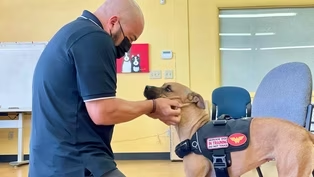
Clip: S2 Ep5 | 3m 15s | See how a group is connecting veterans with shelter dogs to improve both their lives. (3m 15s)
Wounds of War: Veterans and Mental Health - Preview
Preview: S2 Ep5 | 29s | We examine resources for returning heroes on the next Utah Insight. (29s)
Providing Support for PBS.org
Learn Moreabout PBS online sponsorship
- News and Public Affairs

Top journalists deliver compelling original analysis of the hour's headlines.

- News and Public Affairs

FRONTLINE is investigative journalism that questions, explains and changes our world.











Support for PBS provided by:
Utah Insight is a local public television program presented by PBS Utah