
Wright-Arbubakrr; Vilceus-Talty, Haines; Eagles
9/14/2024 | 27m 34sVideo has Closed Captions
Wright-Arbubakrr; Vilceus-Talty, Haines; Eagles
Nadine Wright-Arbubakrr, Founder of Nassan’s Place, examines the needs of autistic children. Mariekarl Vilceus-Talty, President & CEO, and CNO Emily Haines, from the Partnership for Maternal & Child Health of Northern NJ, discusses the Family Connects NJ program. Douglas Eagles, Chief Executive Officer at Boys & Girls Clubs of Monmouth County, speaks about serving marginalized communities.
Problems playing video? | Closed Captioning Feedback
Problems playing video? | Closed Captioning Feedback
Think Tank with Steve Adubato is a local public television program presented by NJ PBS
Wright-Arbubakrr; Vilceus-Talty, Haines; Eagles
9/14/2024 | 27m 34sVideo has Closed Captions
Nadine Wright-Arbubakrr, Founder of Nassan’s Place, examines the needs of autistic children. Mariekarl Vilceus-Talty, President & CEO, and CNO Emily Haines, from the Partnership for Maternal & Child Health of Northern NJ, discusses the Family Connects NJ program. Douglas Eagles, Chief Executive Officer at Boys & Girls Clubs of Monmouth County, speaks about serving marginalized communities.
Problems playing video? | Closed Captioning Feedback
How to Watch Think Tank with Steve Adubato
Think Tank with Steve Adubato is available to stream on pbs.org and the free PBS App, available on iPhone, Apple TV, Android TV, Android smartphones, Amazon Fire TV, Amazon Fire Tablet, Roku, Samsung Smart TV, and Vizio.
Providing Support for PBS.org
Learn Moreabout PBS online sponsorship- [Narrator] Funding for this edition of Think Tank with Steve Adubato has been provided by Horizon Blue Cross Blue Shield of New Jersey.
Here when you need us most.
The Russell Berrie Foundation.
Making a difference.
The Turrell Fund, a foundation serving children.
The North Ward Center.
Kean University.
Where Cougars climb higher.
PSEG Foundation.
Holy Name.
The Adler Aphasia Center.
And by The Port Authority of New York and New Jersey.
Moving the region through air, land, rail, and sea.
Promotional support provided by Insider NJ.
And by New Jersey Monthly.
The magazine of the Garden State, available at newsstands.
[MOTIVATIONAL MUSIC] - Hi everyone, Steve Adubato.
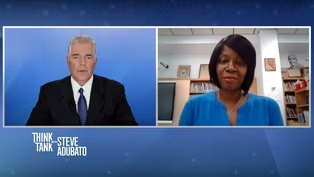
We kick off this program as part of our series, "Making a Difference," not-for-profit leaders, making a difference every day, and we have our longtime friend, Nadine Wright-Arbubarkrr, who is the president and founder of a terrific organization called Nassan's Place.
Nadine, good to see you, my friend.
- Good to see you as well.
- You got it, let me also make it clear that Nadine is a 2024 Russ Berrie, Making a Difference winner.
Nadine, tell everyone as we put up Nassan's Place, the website, tell everyone what it is and why it's so significant, and so personal for you.
- Well, Nassan's Place is out of love of a mother for her child and wanting to have resources within her own community, not only for her child, but for others.
I am the proud mother of a soon to be 20-year-old, 6'6", 320 pounds, he'll be 20 years old on July 28th, and our journey has been a long journey.
It has been good days and bad days, but Nassan's Place is inspired by my own son, Nassan, on the autism spectrum, who was diagnosed back in 2006.
When we got the diagnosis, it was life-changing, but I also went on a search to find programs and services that will help me better understand, or to help give me some types of assistance.
I am born and raised in the great city of Newark, and now currently live in the great city of East Orange.
And when I couldn't find programs and services, I kept asking, "Why aren't there no services here for children on the autism spectrum in urban inner cities?"
And the question came back, "Well, why don't you, as a mother, do something about it," in my head.
And so I set out on a journey in 2012 and started a nonprofit, called Nassan's Place that will help children and families, like my son, to be able to find access to program services.
And truth be told, I was just looking for a mental break, right?
I needed respite, I needed someone to take him for a little bit or to help me better understand what I was dealing with because it was very challenging.
But after I started doing a lot of research, I was able to find programs and services.
They just didn't exist in urban cities of Essex County.
And Nassan's Place was born, and it has definitely changed so many lives, including mine, but it also has opened up the doors to educate more families to get rid of that stigma, but more importantly, to educate our community.
- I remember the day, I was fortunate enough to be there, the day Nassan's Place opened up.
My sister Michele, the founder of the Center for Autism, and you've worked collaboratively with her, and I remember being there the day of and, Nassan was not 6'6", 320 at the time.
He was a very young man, young boy, and you left a career in banking.
20, 25 years in banking, and you said, "I'm gonna do this."
The biggest lesson you've learned in leading a not-for-profit that is so personal, and there are so many challenges leading a non-profit, not the least of which is money, biggest lesson you've learned in doing this over the past 12 years, - I learned to be more patient, to lean on my faith, because my faith has brought me through those days where I thought I could not go on, because even though I am running this organization, I live autism every single day, and just like any other parent, I go through my challenges, and one of the things that has helped me more than anything is my faith, and to believe that I can never give up.
And even when there were those days where I did want to, my faith showed me that I could not, and I know that I live in my purpose right now.
So faith is what keeps me going.
These families who are in so much of the need to have support, and I call children in underserved, inner city communities, the forgotten ones.
I don't want them to be the forgotten ones.
I want the world to know that these children can do anything any other children can do if they just got the right opportunities.
And through the support of so many amazing people, and I call them earthly angels, throughout the years, we've been able to make a difference in the lives of these children.
But the one thing that has kept me steadfast is my faith and my commitment to making sure these children, all children, get the supports and services that they need within their own communities.
- Nadine, let's press this a little further and keep putting up the website for Nassan's Place.
Some of the key services needed by family members of folks like Nassan, how old again, right now?
20?
- Nassan will be 20 on July 28th.
- Okay, we're taping it right before that.
Some of the things that are needed are?
- Well, there's a lot of things that are needed, but before I go further, I just gotta tell you, your sister is one of my sheros along this journey called autism, Michele Adubato.
She has been my inspiration because your sister opened up her heart, right?
Back then, she didn't live it every day, but she had this special heart that your parents raised this amazing human being to open.
And I appreciate her and I just wanted to note that.
But the services that are needed so desperately is programming, such as an afterschool program, such as Saturday respite, such as emergency respite.
One of the things that I'm dealing with now more than I've ever dealt with before is the need for emergency respite.
The state does do very well in providing some of these services, but when a parent is going through what I call an emotional breakdown, and I get those calls in the middle of the night or during the day, we send in staff to go in and give that parent some much needed de-stress time, and that is so important, because if that parent is not mentally able to take care of that child, then where does that leave the child?
So emergency respite is something that I've noticed that we've needed.
Not only that, I'm dealing with food insecurity.
So many of these families now don't have enough food by the end of the month to feed their children.
And some of 'em require a special diet that is a little more costly.
And not to mention homelessness.
So there's so many variants, and when I started Nassan's Place, I was just looking, actually, for some programming and respite.
I had no idea that the social service impact was so huge for the autism community in urban inner cities.
- Nadine, you're one of the winners, a select elite group of winners of the Russ Berrie Award for Making a Difference, 2024.
What did and does that mean to you?
- Wow.
To be honored by this prestigious foundation means the world to me, because I know that they take very seriously the sacrifices that so many of us that are on this non-journey path takes.
So to actually be amongst all of these amazing and distinguished honorees and all the amazing work that they do, I'm truly honored and I'm humbled, but what was so even more, I guess great for me is that when Russell Berrie created this award, he thought about the sacrifices of people like Nadine and the Nadines and the countless other people out there who are doing the work, who made sacrifices.
As you mentioned earlier, I worked in a banking career for 25 years.
That was my career.
I gave that up because I wanted to go into the nonprofit and do work within my community and I wanted to serve.
And so we all make these sacrifices, and so often we, as the individuals, don't get that recognition, and what the Russ Berrie Award did is it recognized the sacrifices and it thanked us for the sacrifices that we had done personally.
So I was truly grateful to be one of the top three, and out of 330 nominees, and I gotta tell you, I was truly, truly taken back 'cause my daughter, Naya, submitted the nomination for me.
- That's beautiful.
Listen, the series can be called "Making a Difference," and they're all different folks trying to make a difference every day in the not-for-profit community, but to see how you have grown, how the organization has grown, how Nassan has grown, it's incredibly inspiring.
And wish you and your team all the best, your son, Nassan, all the best, and you are making a difference.
Thank you, my friend.
- Thank you.
- You got it, I'm Steve Adubato.
That's a real leader.
Stay with us.
We'll be right back.
To watch more Think Tank with Steve Adubato, find us online and follow us on social media.
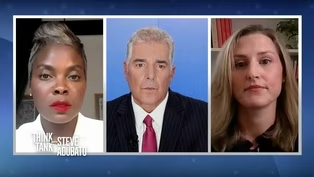
- We're now joined by two leaders with the partnership for Maternal and Child Health of Northern New Jersey, Mariekarl Vilceus-Talty and Emily Haines.
Mariekarl is the president and CEO, Emily is the Chief Nursing Officer.
Thank you both for joining us, we appreciate it.
Mariekarl, you've been with us before.
Let's talk about specifically the Family Connects NJ program.
Website is up.
What is it, who does it serve, and why is it so important?
- It is so very important.
Who does it serve, it serves every birthing woman who has delivered within the state of New Jersey and it's an evidence-based home birthing program, home visiting program with no eligibility restrictions and it is so important because we know that the two weeks after delivery, we need that support, we need that education because that is when the majority of morbidity and mortality happens.
And I'm so happy to have Emily here with us because she's leading that initiative with our other sub-grantees and community partners to make sure that we are supporting families and making sure that these issues are not happening.
- Emily, do this for us.
We've had several conversations with First Lady Tammy Murphy and others about maternal health.
Put in context the maternal health of minority women, of Black and brown mothers and why their maternal health is so much worse...
The situation so much worse than those and who happen to be white and disproportionately in suburban communities and wealthier.
- Yes, so in New Jersey, we really have a maternal mortality and morbidity crisis, especially in Black and brown mothers.
We know that regardless of their income or educational level, a Black woman with a PhD is still seven times more likely to die from childbirth related complications compared-- - One second, regardless of education, one second.
Regardless of education, regardless of income, regardless of zip code, seven times having nothing.
Okay, please pick up your point.
- So that's why a program like this is so critical because it's universal.
It does not matter what type of income you have or what your educational background is.
It is for every person who has given birth in New Jersey to receive a personalized visit from a nurse within two weeks of delivery with a nurse that's been specially trained.
So this type of program is very innovative and it is something that could address those issues that we have in New Jersey.
- Mariekarl, that's moms who happen to be African-American, Latino, Black and brown moms, Black children three times more likely to die before their first birthday.
- Absolutely, three times more likely to die.
It's really apart and this is for everyone, regardless if you are Black, white, but when we specifically talk about the African-American community, we wanna make sure that these social determinants of health, food deserts, access issues are mainly a suggestion and not a destination.
So when you have a program like this, it really does circumvent issues.
We go into the home, like Emily said, we have specialized nurses from different backgrounds to ensure that we have cultural humility.
We learn about your culture, we speak to you in the ways that you can understand and if there's a problem, the entire family is there to hear what we're talking about, to be educated and to know when to call the doctor and when to call 911, when to get more information.
That's why it is really such a great program that will make a difference.
- The website continues to be up.
Let me ask you this, Emily, some of the goals of the program, 14%... Well, I don't wanna get these statistics wrong and the goals wrong.
What are the most meaningful, impactful goals of the Family Connects NJ program please?
- So our goals are really to reach most of the birthing population in New Jersey with a free nurse home visit within two weeks after birth.
- Those two weeks are critical because?
- That is when a lot can happen.
So a mom is typically discharged around three to five days after delivery and is sometimes seeing their OB-GYN provider for a postpartum check around three to six weeks.
And so that two week period is really critical to not only identify issues where the baby may be having some issues with infant feeding or infant weight gain, but also to check on mom to catch elevated blood pressures, to catch infections from their C-section incisions.
These are the types of issues that the nurses find at that two week point on the home visit that are able to be elevated to their OB-GYN or to the emergency department and really save lives.
- And Steve--I’m sorry.
- Sure, please.
- Not at all, go ahead.
- I was gonna say, if I may add, when you are home and you've had a baby, or this can even be your second or third baby, you start thinking that things are normal.
You have a headache, oh, I'm a little tired.
This is something that happens.
Meanwhile, specifically in the African-American community, you may have high blood pressure 'cause we know that even though the numbers have changed from 47th to 25th, we are still suffering from cardiovascular-- - I'm sorry.
- No, we were 47th in the nation in terms of morbidity and mortality for maternal health and throughout working with Nurture New Jersey and this administration, we have now was up to 25th.
But when you look at the African-American community, those numbers have not changed.
And when you look at the morbidity and mortality and the diagnoses, cardiac issues, cardiovascular issues are number one.
So if you have family connects, these specialized nurses that come in two weeks later within that 14 day period and you tell them, you know what?
I've had a headache, I already saw my doctor, but I have a headache and my grandmother, my aunt, my sister told me it's okay, I'm just a little tired.
You start educating, you take a blood pressure and your blood pressure is elevated over your normal.
This is time for you to go to your physician.
And it's not only the significant other that hears that, sister hears that, grandma hears that, family member, neighbor, and then they start educating the community.
So it's really not only the foundation of education, but the scaffolding that we give to the generation that is really important, going into the home and meeting people where they're at.
- Do we know, Emily, where New Jersey is?
Again, Mariekarl gave the statistics in terms of where we rank, but is there something about New Jersey that causes us to have such a serious problem as it relates to maternal health?
Something about our culture, our politics, our policy, something?
- I think Mariekarl probably is better to answer that one.
- Is this a national issue that-- - It's a national issue, it depends where you are.
If you're in Louisiana, you're 12 times more likely.
If you're in New York, you're nine times more likely.
The numbers are... We have to get a whole of the redundancies that are being built within the system and we have to look at upstream issues.
What are the issues?
Is it having a provider that looks like you?
Is it access, is it transportation?
Is it food deserts?
There are so many issues we're focusing right now on being in the home, catching people within those two weeks.
But we also have to look at the upstream issues.
So when they talk about social determinants of health and when they talk about your genetics, that again, it is not a destination, but simply a suggestion that we can work on to mitigate these factors.
- Mariekarl and Emily, important conversation, important work being done every day.
Thank you so much, we appreciate it.
- Thank you, we appreciate you.
- You got it, I'm Steve Adubato.
Stay will us, we'll be right back.
To watch more Think Tank with Steve Adubato, find us online and follow us on social media.
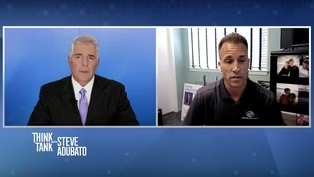
- We're now joined by Douglas Eagles, who's Chief Executive Officer of the Boys and Girls Clubs of Monmouth County.
Douglas, good to see you.
- Good to see you too, Steve.
- Doug, we're gonna put up the website.
This is part of our ongoing conversation about youth mental health, related issues as well.
Describe the Boys and Girls Clubs of Monmouth County, please.
- Yeah, of course.
So, you know, the Boys and Girls Clubs in Monmouth County is focused on providing a safe place for our members.
But beyond providing just a safe place, we really are about equipping them to succeed and thrive in life through a host of different programs and services that we provide.
- Talk about the programming.
Let me try this before I even get into programming.
The perception on the part of some is, well, Monmouth County, it's a very wealthy county, but then again, you also have communities like Asbury Park, Neptune, Long Branch, Red Bank, some communities that are not as wealthy or sections of those communities not as wealthy as some folks think, correct?
- Yeah, that is correct.
- Talk about more specifically, the initiatives at the Boys and Girls Clubs around youth mental health, please.
- Yeah, of course.
So, for several years now, have been focused on what we call trauma-informed care.
I think for us here at the club, we recognize early on in the work that we do that a lot of the kids that we serve come from parts of the community where they're exposed to different levels of trauma, whether that's abuse, drug abuse, alcohol abuse, violent crime, and these things have long-term mental health impacts on our young people, if left unaddressed.
So, knowing that as an organization, we decided that we were in a unique position really to be able to meet these kids where they're at.
And so, we went through a pretty significant paradigm shift in terms of the work that we do and how we do it to ensure that we could be there for them as they understand the trauma in their own lives and help navigate them through that trauma to a successful and thriving outcome.
- You talk about a mental health journey, if you will, trauma-informed practices.
Connect this for us.
Poverty in and of itself, trauma?
- Well, the original study around adverse childhood experiences didn't include poverty per se, but numerous studies since then have included looking at poverty and in seeing the ways in which poverty.
- Adverse childhood experiences, otherwise known as ACEs, please.
- Correct, yes.
Numerous studies since then though have grounded various levels of trauma being rooted in socioeconomic disparities.
- And describe what the young men and young women at the Boys and Girls Clubs are facing.
Be more specific about this trauma.
What are they facing, violence?
- Yeah.
Well, I think the best way to explain that would be to share a story with you.
- Please.
- One of our staff members who grew up as a club kid here in Asbury Park several years ago, he was shot standing on his front porch and he showed up at the club to come to work the next day with a bullet literally, lodged in his arm.
And I was talking to this young man I could not believe he showed up to work and I was trying to understand what happened to him and he said, "Mr. Doug, relax."
He said, "This is something that the common experience where I grew up.
Hearing gunshot is like hearing the birds chirp."
And that really blew me away, because what that spoke to me was that the kids growing up in this community feel like that violence is the background noise of their life.
And we wanted to do something to change that and to create a space where they could come and feel safe away from that.
- Wow.
How's that young man doing right now?
- He is doing fine.
He is an employee at the club and, you know, giving back in key and strategic ways from lessons that he learned growing up in the community.
- You're a not-for-profit leader, we're a not-for-profit, and every time we have a not-for-profit leader, it's important that we ask about the money part of it, the fundraising part of it.
Your resources, your support comes from where?
- So, from a really diversified stream of funding, from government grants to family foundations and individual donors and special events.
We're also school-aged childcare centers.
So, we get some subsidies from the state to provide afterschool care for kids who are eligible.
- And also there's a mutual funder in the Horizon Foundation to be clear- - Yes.
- for you folks and for us.
Go back to the government funding piece.
Support from Washington, you've argued that our national leaders, you told our producers, our national leaders have to have a more visceral understanding of how the budgetary items and the budget issues that they address impact local communities like yours.
Describe that, what do you mean by that?
- Well, I think, you know, oftentimes when decisions are being made in Washington DC there can oftentimes be either a real disconnect or a perceived disconnect between the reality on the ground in the local communities and what's happening in Washington.
I think we've been lucky enough in our district with Congressman Palone to have a really strong relationship with him.
- Congressman Frank Palone.
- Yes.
And he's seen and recognized the impact that trauma has in our communities and through congressionally-directed spending has supported our trauma-informed initiative with a $500,000 grant that's been paid out over a three-year period.
- That's federal money?
- Yes.
- What is Project LEAD, L-E-A-D?
- So, that's of our Youth Workforce Development Program.
It's an acronym for Learning Earning and Advancing Dreams.
You know, you talked a little bit earlier in the segment here about poverty, and one of the things that we recognized was that we had a unique opportunity to build and equip our young people with the skills that they need to actually thrive in what is arguably a growing economy here on the Jersey Shore.
A lot of our kids just haven't been positioned well to take advantage of those opportunities and our project LEAD does that.
Positions them to take advantage of different job opportunities here on the Jersey Shore.
- Before I let you go, Doug.
How did you find your way to this work?
- Well, I've been doing youth development work for about 20 years, but I think from a very young age, I've had a lot of opportunities that my parents gave me and I think growing up I realized that I wanted to go into communities where those opportunities weren't as prevalent and do my best to make sure that those kids would have access to the same opportunities that I had growing up.
- Important work being done by the Boys and Girls Clubs of Monmouth County.
We've had a whole range of interviews with other leaders in the Boys and Girls Clubs across the state and also national leaders as well.
Doug Eagles is the Chief Executive Officer at the Boys and Girls Club in Monmouth County.
Doug, thanks so much.
Keep up the important work you and your colleagues do every day, thanks.
- Great, thanks, Steve.
- I'm Steve Adubato.
Thank you so much for watching.
See you next time.
- [Narrator] Think Tank with Steve Adubato is a production of the Caucus Educational Corporation.
Celebrating 30 years in public broadcasting.
Funding has been provided by Horizon Blue Cross Blue Shield of New Jersey.
The Russell Berrie Foundation.
The Turrell Fund, a foundation serving children.
The North Ward Center.
Kean University.
PSEG Foundation.
Holy Name.
The Adler Aphasia Center.
And by The Port Authority of New York and New Jersey.
Promotional support provided by Insider NJ.
And by New Jersey Monthly.
- (Narration) Healing is never just about medicine and technology.
It has to go further than that.
It has to combine science with humanity.
It has to be our best medicine, combined with large doses of empathy, kindness, dignity and respect.
It has to be delivered by people who love what they do and who they do it for.
Holy Name.
Great medicine, soul purpose.
Challenges facing marginalized people in Monmouth County
Video has Closed Captions
Clip: 9/14/2024 | 8m 31s | Challenges facing marginalized people in Monmouth County (8m 31s)
Examining the needs of children & families with autism
Video has Closed Captions
Clip: 9/14/2024 | 10m 11s | Examining the needs of children & families with autism (10m 11s)
How the "Family Connects NJ" program is supporting mothers
Video has Closed Captions
Clip: 9/14/2024 | 9m 50s | How the "Family Connects NJ" program is supporting mothers (9m 50s)
Providing Support for PBS.org
Learn Moreabout PBS online sponsorship
- News and Public Affairs

Top journalists deliver compelling original analysis of the hour's headlines.

- News and Public Affairs

FRONTLINE is investigative journalism that questions, explains and changes our world.












Support for PBS provided by:
Think Tank with Steve Adubato is a local public television program presented by NJ PBS