Write Around the Corner
Write Around the Corner: Alix Harrow
Season 8 Episode 4 | 27m 41sVideo has Closed Captions
Alix Harrow talks about her novels that are a blend of fantasy and fairy tale with a twist of magic.
Alix Harrow, award winning author of The Ten Thousand Doors of January and Starling House, talks about her novels that are a blend of fantasy and fairy tale with a twist of magic.
Problems playing video? | Closed Captioning Feedback
Problems playing video? | Closed Captioning Feedback
Write Around the Corner is a local public television program presented by Blue Ridge/Appalachia VA
Write Around the Corner
Write Around the Corner: Alix Harrow
Season 8 Episode 4 | 27m 41sVideo has Closed Captions
Alix Harrow, award winning author of The Ten Thousand Doors of January and Starling House, talks about her novels that are a blend of fantasy and fairy tale with a twist of magic.
Problems playing video? | Closed Captioning Feedback
How to Watch Write Around the Corner
Write Around the Corner is available to stream on pbs.org and the free PBS App, available on iPhone, Apple TV, Android TV, Android smartphones, Amazon Fire TV, Amazon Fire Tablet, Roku, Samsung Smart TV, and Vizio.
Providing Support for PBS.org
Learn Moreabout PBS online sponsorship-[Woman VO] This program is brought to you by the generous support of the Secular Society.
Advancing the interests of women in the arts in Virginia and beyond.
♪ ♪ ♪ ♪ Every day (every day), every Day (every day), every day ♪ ♪ Every day I write the book ♪ ♪ ♪ ♪ -Welcome.
I'm Rose Martin and we are Write Around the Corner at Daedalus Used Bookshop in Charlottesville, Virginia, with New York Times best-selling author Alix Harrow.
You'll love her blend of fantasy fairy tales with a twist of magic and characters who are finding a place to call home.
-Hi, Alix.
-Hi.
Thank you so much -for having me.
-[Rose] Well, and thank you for this--having picking this beautiful shop.
-I know.
It's one of my favorite places in Charlottesville.
-[Rose] And why is it a favorite?
-Because just scale.
Like it's got three floors and you can just wind around in a circle forever.
-It's wonderful.
-Yeah, as we were looking around where we were going to shoot, we noticed all the little nooks and crannies and little rooms -just full of amazing books.
-Absolutely lose your children -in the store.
-[Rose] Yeah.
-Well, and I--he was telling me over 100,000 books -Yeah.
-that are located in here.
So it's a real treasure trove.
So I can see why you chose it.
But a bookstore wasn't something you visited a lot as a child or even a library, right, where you grew up in rural Kentucky?
-I'm from Alveton, Kentucky, which you've not heard of.
-No one has.
-I haven't.
I agree.
-[indistinct] go by county, so I'm from Allen County, Kentucky, outside of Bowling Green.
I vaguely remember the public library as just being like a one room, cigarette smoke filled area that was not welcoming to children.
My school library was a very conservative and restrictive space, you know.
So like, books were constantly being pulled off the shelves because they had witchcraft or magic or something.
But luckily, I had my mom's library because I am a second generation nerd, so she had all of the paperbacks from the '70s up through the '90s for sci-fi and fantasy, and that's what I was raised on.
-Well, and your mom is quite a woman to begin with, so I've read, as you described her, and some of her background that just lends itself to growing up in an adventurous childhood.
-Yeah, adventurous and just like a really useful resource if you want to become a fantasy author.
Like I don't-- I never want to brag too much, because I feel like it's like a cheat code to be but she's an English instructor and a fantasy reader and a falconer, a licensed falconer in Kentucky, and an archer and a horse trainer.
And so she sort of has the skill set that you would need to like research Lord of the Rings , and it's very, very helpful to me.
-Right.
You could write books just on her life and you've got all the content you need.
-The last book I wrote, I sent it to her, and was just like, "Send me everything I got wrong about horses," and I got six pages back.
-Well, that could be very helpful, though.
-Yeah.
-So, and your mom is also one of your readers down the way, yeah.
So your jobs growing up, so you were a history professor, but yet, there were lots of other things that you had -a chance to dabble in.
-That's the most prestigious sounding job that I had.
-Okay, we'll just leave it there then.
But, you know, we all have history.
-[laughs] Yeah.
I graduated from a small liberal arts college, Berea College in Kentucky, with a history major in 2009, so the recession had just hit and everybody was just like, "There's no jobs."
-And you're like, "Yes, I just graduated."
-Excellent, perfect timing.
And so I kind of lived, you know, at and below the poverty line for a number of years.
I lived in my van for a while.
I did migrant farm work.
I harvested blueberries.
I was a cashier.
I had retail jobs, anything that I could have for like three weeks and then quit and then go goof off in the van some more.
-For real.
-So it was just -a little pocket money.
-Yeah, exactly.
I didn't have any real expenses.
I'd just keep me and a dog alive -and I was fine.
-And you lived in your van.
-Yes, exactly.
Exactly.
-What else did you need?
But you met your husband picking blueberries.
-I did.
-Right.
And so that's-- -Your husband's name is Nick?
-Yes.
-And so I guess I also know that your dad did something really, really special for you with twisted, tangled grapevines?
-Yeah.
See, this is wild.
No one does this much research for an interview.
I imagine I'm explaining myself for the first time.
But you know everything about my life.
Yeah, I was on and off again home-schooled in very rural Kentucky.
And so my family is very, very tight, my two little brothers, my mom and dad and I, and they're all variously eccentric.
And my dad is sort of a carpenter, handyman, artist.
And so my husband and I got married on my grandma's land in Kentucky, and he planted and built this amazing grapevine arch with flowers, and my grandma planted a bunch of wildflowers for it.
It was wonderful.
-Oh, it sounds magical, like some of the places you create in your books, right?
That you could go into this very, very special world.
Well, you know, I was reading that you used to kind of be a snob when it came to some kind of genres, you didn't really think that they were something you really wanted to read, but you kind of branched off and gave them a second chance.
-Yeah, I would say-- so I started out, obviously, sci-fi and fantasy, reading all that stuff, and then I tried to write my first book when--in middle school, right?
And then it takes a really long time to be as brave as you were when you were a 13-year-old girl.
So after that, I was like, "No, actually, I'm very serious.
I don't read and write fantasy."
I would have died if somebody found out that I wrote a fantasy novel when I was 13.
-Or romance.
-Yeah, no, I didn't read any romance, none of that stuff.
I was very serious.
I majored in history.
I read serious books, and it wasn't until I went to grad school-- because I'd gotten one history degree, so I thought, why not another one, that'll employ me, that'll do it.
And I was in grad school in winter in Vermont, so it was like very depressing.
And I checked Wizard of Earthsea out of the library and read it for the first time since I was a kid.
And it was like, I don't know why, it was so embarrassing to me that I thought that I had to choose between fantasy and serious intellectual arguments about the world, because obviously, you know, Ursula Le Guin exists, Octavia Butler exists.
They've been doing this work for generations, and I was like, "Of course, I get to have my cake and eat it too."
-[Rose] But you also have a particular love of Spider-Man.
-I do.
Well, all right, when you have two kids... -[Rose] Okay, let's be clear.
-and Spider-Verse comes out, it's very formative to your life.
Yeah, my kids love Spider-Man.
I love Spider-Man.
And I've always loved superheroes.
My mom read superhero comics.
So I was, like, raised in like a video game, comic book nerd, kind of a household, and I love that a lot of those stories are getting more complicated and interesting and reflective than they used to be too.
-Well, and the fact that you have such a diverse background, but I didn't hear when you were mentioning your jobs, except for cashier, and we know it was at Tractor Supply, but where did the carpentry skills come from that you and your husband bought this amazing, big old house and decided, "You know what, we're going to renovate."
-I know.
Just a bunch of great financial choices.
Right?
Like history degree, and then we bought an abandoned house in the middle of the recession.
I think it cost 42,000 dollars, so it was all our savings and then a little loan to buy this house that had been sitting empty for five years.
And it was like no single system worked.
We closed on it, we walked in and it was raining, and there was water pouring down all the way down to the first floor.
So we did electric, plumbing, HVAC, new roof, drywall, refinished the floors; every single part of that house we did, and we had no money.
So we did it just on my limited skills that I got growing up with my dad and working with him and scrounged supplies.
-Yeah, and you had mentioned the Habitat ReStore.
You were like, "Yes, let's see -what they have new this week."
-Yeah.
Oh, our countertops, they had a bunch of, like, old wood flooring, and that became our countertops, so.
-So you were inventive and creative.
It had to be kind of hard when you moved to Virginia, though, and left the place that you guys poured so much -of your beginning into.
-Yes.
It was very hard to leave Kentucky.
I think that is where a lot of the emotions of my third book, Starling House , came out of was just leaving that home that we had literally built together.
-Well, and when we think about stories, I know that you also have an affinity for maps, and that maps tell stories and can take you into different worlds.
Were you someone as a child that liked to read maps or find new places?
-I just feel everyone loves maps.
-Am I wrong?
I feel like-- -Yeah, and we do.
That's right.
My husband thinks he should have been a cartographer.
-Yeah, exactly.
-Really.
Right?
-I just think they have an inherent excitement to them, and fantasy has this wonderful tradition of opening the cover, and they have this wonderful map of like a place that doesn't exist.
I'm sure that's Tolkien's fault, and I loved looking at those as a kid, and then when I was in grad school for history, I was studying empire, and I came to see maps as a more complicated cultural document than just this pure wonder and escapism, because they're part of the project of empire, right?
They're about making a space legible.
It's about the ambition of control in a lot of ways, is what a map is.
And so I found them even more interesting in some ways than I had before, because they're not only expressions of whimsy, but they're expressions of dangerous and violent ambitions sometimes.
-And you know, you're right, because you open up the front of that book and you're like, "Oh, where am I going to go in this story?"
-"What am I going to see?"
-Yeah, "What am I going to see?"
Or "I'm going to come back to that and look at it throughout the book to see where I am."
But there's also something I read that you had said, "Writing a book is like designing -a roller coaster."
-[laughs] -I stole that from someone.
-[Rose] Oh, did you?
Okay.
Well, you know, I'm gonna attribute it to you right now, so that's good.
-Yeah, that's from George Saunders, who's just one of the best writers about writing in the world.
And he was--it was an interview of his where he said he thought the job of a writer was indistinguishable from that of some man who designs roller coasters, which is all you're trying to do is inspire a single moment of wonder.
And I think that's incredible.
-And that's what writing is all about, right?
That's what you want when anyone gets a book.
-And it's so--I love it so much because it's not like highbrow or artsy or elevated sense of what writing is.
It's work, it's labor that you're doing, to create a very specific emotion.
And I feel like that's right.
-Well, and, you know, the fact that you kind of started in short stories thinking it was going to be a place to jump off, and then, if I'm right, tell me if this is true, that you were pitching a short story and someone really liked it and asked if you had a novel, and you were like, yeah.
-Yeah.
And to be clear again, like, this is not a map for like, success, because, like, everyone will tell you, like, short stories don't make money, they don't sell and they don't really do anything for a career, unless you're, you know, there's like 1 percent of people that make a career in short fiction.
But I didn't know how to write.
I did not have an English degree.
I had never had a workshop or anything.
So I was doing short stories as practice to teach myself just the craft of it and to get more comfortable while I was working on my first book.
And one of those stories got published in a small sci-fi fantasy magazine, and it kind of went around the internet, and then an agent and an editor DMed me on Twitter-- you remember Twitter-- to be like, "Hey, do you have a novel?"
And I was like, "Yes, here it is."
So I didn't have to query and do kind of a more traditional publishing process.
-Something I think that I found interesting about you is that no matter that you're a planner and a great outliner, you also like the story to kind of determine where it needs to go.
-Yeah.
Well, that's part of the outlining process.
Like I really-- when I say outline, I don't want you to imagine, like the classic beat sheet, or like, save the cat, or whatever they call it, where it's, you know, there's a three act structure, and you need to plan in exactly when, you know, this happens and this happens.
It's more like... this particular story has to adhere to its own structure that internally makes sense for it and contributes in some way to the argument that the story is making, right?
So, if it's a story about stories, then it gets to have a book within a book.
You know.
If it's a story about history, then it gets to have interwoven historical narratives.
Like, I want everything to kind of match up.
-Right.
And I heard, I read something that you said, you know, having that perspective of having a story within a story, or a world within a world, if you don't do that, it's like stealing a fancy car, right?
Stealing a fancy car and having nowhere to go or knowing what to do with it.
-Yeah.
I mean, you do have to-- if you're gonna do something that is gonna get you slammed on Goodreads, [laughter] like, you know, writing in a weird perspective, or having interwoven stories, or a strange tense choice or something like that, you have to have a really good reason.
You have to at least be able to argue for its existence.
-Yeah, and you-- so you love fairy tales.
-Yeah.
-You've loved fairy tales since you were a little girl, and a way to write a fairy tale, but kind of take out the cruelty and give them a little bit of magic.
-Um-hmm.
I mean, I don't necessarily-- I don't know if I want to say that, like take out the cruelty, because I think in some ways, one of the reasons things like fairy tales and mythologies are sort of enduringly popular, especially with children, is that they're narratives that are allowed to go very hard.
-They can get very dark -Mm-hm.
and they can get very intense and strange and inexplicable in ways that a lot of more contemporary narratives-- narratives tend to be safer.
And so I really like that sense of sort of familiar danger that is built into fairy tales.
-But in the current context... -Yeah.
-so it's like, you'll take this Victorian era children's book, or you'll take another story that you know, and you'll want to try to make it contemporary in a way that's putting in this world, but yet letting someone's imagination fly.
-Yeah.
And a lot, it's true that as much as I love and sort of admire a lot of these old narratives, they're also often contributing to cultural structures that are deeply violent and awful, right?
So like my first book was a portal fantasy.
I studied portal fantasies in grad school.
I wrote my thesis on them, and particularly the portal fantasy as a part of the imperial project as a imagining a fictional space that could be explored and conquered.
But I still love them, right?
Like I grew up reading all the Victorian portals.
You know, like your Alice in Wonderland, Peter Pan, Narnia, all those things, and so I wanted a way to invert a narrative that I love that kept the sense of escapism and wonder, but undermined the imperial project.
-Well, and something else you do that I love is your use of footnotes and bibliography.
So I'm not sure--I mean, you're very clever in that-- so I think you want people, you're leaving these little nuggets, and you want people to read them and then to question themselves, right?
-Um-hmm.
A little bit.
And that's just because every draft I write starts out with footnotes.
Because I think I, again, I didn't have, like, a formal creative writing training, but I did have history writing training.
So I learned Chicago style, and I, you know, learned to write constantly referencing and sort of almost with a parenthetical sense as you write.
And I like that, and I feel like, it's where your little asides go.
And I think I've gotten away with it twice now in novels where I got to keep my footnotes.
-Oh, really, so like husband to mom to editor.
-I mean, where do they-- -The editors.
You can't be doing footnotes.
-But they are clever, and I found myself reading them and being, "Oh, I wonder what she snuck in here that is or maybe is or isn't true."
Something else I love that you said, "Storytelling.
I love the way bossy Southern ladies "with painted nails and smoker voices tell stories and write."
-Yeah.
I think I was talking at that point about sort of tone and oral storytelling traditions, and I feel like there's a real emphasis in contemporary writing practice, basically the show don't tell advice, that does not align at all with my experiences of being told stories as a kid, because they have, like the Southern oral tradition has like this very strong narrator.
They're not showing you the story.
They're telling it to you from a very particular perspective, with asides, with jokes, with, you know, "What had happened was..." and like it leads into this whole thing.
And so I feel like I like to have elements, in every book I've written so far, there's at least some sections that are not written as if there is a camera there and you're just seeing the action.
They're written as if someone is telling you what happened with their own biases packed in.
Because that's what I think, I feel like that's the stories I grew up with.
-Well, in almost every story we hear, especially the oral traditions-- it comes with that inherent bias, and however they've been passed down along the way.
So it's just kind of in-- we expect it.
-I know, and I think it has such-- they're so structurally interesting.
Because whenever someone, not even just in an oral tradition sense, but just in a like person to person sense, if you're telling someone a story about something that happened to you last week, you're constantly slipping -through different tenses.
-[Rose] Yeah.
-Like even the "What had happened was," or then, "And then she says to me."
You know?
And I just think it's-- it makes it very immediate, and it's very communicative in a way that is not-- doesn't necessarily adhere to the traditional novel format.
-Well, and so let's talk about your debut, right?
The Ten Thousand Doors of January .
So I mean, it's like a leather-bound book within a book and a world within a world, and doors that hold promise and it's like for a debut, jump-off book, you really went in depth.
What was that process like, and how did you live through the-- -Yeah.
I didn't know... when it's your first novel, you don't really know what a big swing you're taking.
You're like, "That would be neat.
I could do that."
Because you don't have the fear built in, you haven't seen yourself fail enough times to be like, "Wow, that did-- I did not pull that off."
So I did it without knowing how hard it would be.
And also did it without, like, a significant amount of knowledge of industry trends.
You know, I didn't know what agents were buying.
I didn't know that a book within a book with footnotes is probably a harder sell in the fantasy genre, and I think that was critical to not know that.
I'm really grateful I didn't know that because it helped me to kind of find my voice and my feet and what is compelling to me about writing, is this playing with structure and stuff.
And I think it's given me enough elbow room in the genre to keep doing a new thing in a way that is really exciting.
-So in the book, we've got January and Samuel, which I don't know, Samuel kind of based on your husband, right?
And you shared DNA with January.
Oh, okay.
We'll be quiet about that part.
So let's think about sharing with everyone who may not have read or experienced Ten Thousand Doors of January in just a short little overview of where she goes, what she does, -the importance of fathers -Oh, gosh.
-and daughters.
-It's been long time -since I've talked about this.
-[Rose] Okay.
I'm going to work you right through it.
-No.
It's structured like a traditional, late Victorian portal fantasy, which is essentially, orphan child goes on an adventure and finds portals to other worlds.
But I've built in a book within a book that is sort of a faux academic narrative, and instead of the overarching story being one of, if you think about like Narnia, going conquering and returning to a status quo, I wanted it to be more circular and about sort of finding a home where you didn't expect it.
-Oh, that--yeah, that's great.
And I love the fact that you never know where she's going to go next.
-Yeah.
-And then there's, you know, written in there is the complex relationship between father and daughter and where she goes and other people.
And, you know, you beautifully brought us into those worlds that we were feeling it because of your mastery of sentences and how you put the things together.
-So that was wonderful.
-Well, that's funny as I-- originally wrote-- started writing that before I had children, and then I had my first child in the-- I think, around the middle of the first draft, and suddenly a character that I had casually envisioned as an orphan or with absent parents, I was like, "Oh no, her parents are very important.
What have they been doing?"
And it became the relationship between the parent figures and the daughter became, like, much more important to me.
-Well, and so let's move to Starling House .
-Yeah.
-So it's kind of like your letter to Kentucky after you left.
And so, you know, I'm really curious about the house and the characters -[Alix] Yeah.
-[Rose] and how it resonated -[Rose] and grew.
-[Alix] Well, I had written a couple of books, a couple of novellas, a bunch of short stories by the time I did Starling House , and none of them, I realized, were set in Kentucky, where I grew up, where I was from, where I was living while I was writing.
They were all about escape or fantasy or something like that.
And it was really only as we decided that we needed to leave Kentucky, and we moved to Charlottesville three and a half years ago I think now, that I was like, "Oh, I know how I would write my Kentucky book.
It has to be about a fantasy of if I could stay."
And so Starling House kind of came out of that emotion of, like you said, a sort of a love letter to Kentucky, but also a breakup text, because I was leaving and we felt like we couldn't stay anymore.
And so it became, I think, at times, an uneasy combination of everything I truly miss about my home and everything that is the reason I left, all in one.
-And so for viewers, it's a Southern gothic kind of like Beauty and the Beast.
-Yeah.
-So we have the story of Opal and her brother, who's living in poverty.
So she wants to try to make some extra money.
And there's a mysterious house and-- -Well, it's a gothic.
There's gotta be -a mysterious house.
-[Rose] That's right.
-What are we doing?
-[Rose] Right.
-[Rose] And there's also a book -Yes.
-that's so-- let's give everyone a tease.
-I described my next book to my husband, -[Rose] Yeah.
-and he was like, "So it's the basic Alix Harrow book.
There's this girl who finds this book."
[laughter] -Good idea.
-Oh, no.
I was like, -"That's it."
-[Rose] Yeah.
-Yeah, it's-- I had a lot of fun playing with not just the Southern gothic, but kind of pulp gothic traditions, you know.
-And what's the difference?
-I mean, is there a difference?
This is a good argument.
And I don't think the lines between genres are very strong.
But I love the gothic in particular, because it can go very, very highbrow, you know, and be very considered very literary, and it can be a '70s mass market paperback with a woman in a white gown fleeing from a manor, a haunted manor.
And I love both of those things.
I think they're all fantastic.
And what I think it's great is they actually are using very similar tools.
There's slight tonal differences that make the differences between those.
And what I wanted to do was kind of play with all of those things, to get to have actual conversations about, sort of the like sins of the past in Kentucky and the sins of the present, but also to have some of the juicy fun of a haunted house narrative.
-Right.
The house is actually, you know, the house is actually a character in and of itself, I think.
There's a, you know, the house has a current resident, it's haunted, Opal comes in, and then there's Arthur and her brother, Jasper, along with so many things that happen within that house.
-Yeah.
-What do you want people to know about Starling House ?
-Oh, I don't know about the house itself, except that it is the result of what happens when you love haunted house narratives, but you also love fairy tales.
And sentient houses and fairy tales are often like benign, think of Beauty and the Beast castle, right?
-Like or Baba Yaga's hut -Yeah.
-or some kind of enchanted house that is actually a caretaker figure rather than a terrifying thing.
And I'm again straddling the line of both.
I'm having my cake and eating it too here.
-Well, and both of them are page turners.
Would you be willing to read something for us?
-Oh, sure.
I want to read from the very beginning of my first novel, Ten Thousand Doors, because it is the only part of the book that I think I never rewrote.
I just wrote it this way, and that's how it stayed.
-[Rose] Great.
-[Alix chuckles] -Chapter One.
The Blue Door.
"When I was seven, I found a door.
"I suspect I should capitalize that word so you understand "I'm not talking about your garden "or common variety door "that leads reliably to a white tiled kitchen "or a bedroom closet.
"When I was seven, I found a Door.
"There, look how tall and proud "the word stands on the page now.
"The belly of that D like a black archway "leading into white nothing.
"When you see that word, "I imagine a little prickle of familiarity "makes the hairs on the back of your neck stand up.
"You don't know a thing about me.
"You can't see me sitting at this desk, "the salt sweet breeze rifling these pages like a reader, "looking for her bookmark.
"You can't see the scars "that twist a knot across my skin.
"You don't even know my name.
"It's January Scaller, "so now I suppose you do know a little something about me, "and I've proved my point.
"But you know what it means when you see the word door.
"Maybe you've even seen one yourself standing half ajar "and rotted in an old church, "or oiled and shining in a brick wall.
"Maybe, if you're one of those fanciful persons "who find their feet running toward unexpected places, "you've even walked through one and found yourself "in a very unexpected place indeed.
"Or maybe you've never so much as glimpsed a door in your life.
"There aren't as many of them as there used to be.
"But you still know about doors, don't you?
"Because there are 10,000 stories about 10,000 doors, "and we know them as well as we know our names.
"They lead to ferry, to Valhalla, "Atlantis and Lemuria, Heaven and Hell, "to all the directions a compass "could never take you to elsewhere.
"My father, who was a true scholar, "and not just a young lady with an ink pen "and a series of things she has to say, "puts it much better.
"If we address stories as archeological sites "and dust through their layers with meticulous care, "we find at some level, there is always a doorway, "a dividing point between here and there, "us and them, mundane and magical.
"It is at the moments when the doors open "when things flow between the worlds that stories happen."
-Oh, that's magical.
-Alix, thank you so much.
-Thank you.
-It's been a pleasure.
-My special thanks to Alix Harrow and her friends here at Daedalus Books for inviting us for the show.
Her books are full of so much fantasy, gothic mystery, and they're fantastic.
I can't wait to see what she comes up with next.
Please join us online for an extended conversation and tell your friends about us.
Until next time, I'm Rose Martin, and I'll see you Write Around the Corner .
♪ Every day (every day), every Day (every day), every day ♪ ♪ Every day I write the book ♪ ♪ ♪ ♪ ♪ Every day, every day, Every day I write the book ♪ ♪ Every day, every day, Every day I write the book ♪ -[Narrator] This program is brought to you by the generous support of The Secular Society.
Advancing the interests of women in the arts in Virginia and beyond.
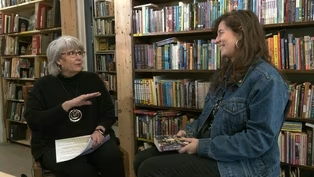
A Continued Conversation with Alix Harrow
Clip: S8 Ep4 | 12m 38s | Best-selling author, Alix Harrow, shares why she writes fantasy fiction. (12m 38s)
Providing Support for PBS.org
Learn Moreabout PBS online sponsorship













Support for PBS provided by:
Write Around the Corner is a local public television program presented by Blue Ridge/Appalachia VA