Write Around the Corner
Write Around the Corner - Audrey Ingram
Season 7 Episode 12 | 26m 16sVideo has Closed Captions
Debut novelist, Audrey Ingram, talks about The River Runs South.
Debut novelist, Audrey Ingram, talks about The River Runs South which is a page turning story of love, loss and starting over.
Problems playing video? | Closed Captioning Feedback
Problems playing video? | Closed Captioning Feedback
Write Around the Corner is a local public television program presented by Blue Ridge/Appalachia VA
Write Around the Corner
Write Around the Corner - Audrey Ingram
Season 7 Episode 12 | 26m 16sVideo has Closed Captions
Debut novelist, Audrey Ingram, talks about The River Runs South which is a page turning story of love, loss and starting over.
Problems playing video? | Closed Captioning Feedback
How to Watch Write Around the Corner
Write Around the Corner is available to stream on pbs.org and the free PBS App, available on iPhone, Apple TV, Android TV, Android smartphones, Amazon Fire TV, Amazon Fire Tablet, Roku, Samsung Smart TV, and Vizio.
Providing Support for PBS.org
Learn Moreabout PBS online sponsorship[Announcer] This program is brought to you by the generous support of The Secular Society, advancing the interests of women and the arts in Virginia and beyond.
[♪♪♪♪♪] -♪ Every day every day Every day ♪ ♪ Every day I write the book ♪ [♪♪♪♪♪] -Welcome, I'm Rose Martin, and we are Write Around The Corner in Loudoun County with debut novelist Audrey Ingram.
Her book, The River Runs South , takes us on a journey of love, loss, forgiveness, starting over, family, blurred lines of right and wrong.
There's a little bit of everything in this book, and you are absolutely going to love it.
Hi, Audrey.
-Hi, Rose.
Thank you so much for coming.
-Well, we sure appreciate you, and this is such a beautiful place.
And thank you for inviting us to your home.
-Thank you.
I'm just so grateful you're here.
-Well, I want everyone to get to know you a little bit.
So, in your former life, before writing this amazing book, you had a career as an attorney, right?
-I did, yes.
I practiced law for 15 years almost, in Washington, DC.
-And so, now we're out in the country.
And I understand you love gardening, hiking, and beautiful old houses.
-I do.
We live in a very old home.
It was built in the 1900s.
And I've fallen in love with the area.
It's a rural area, but we still have the benefit of being, you know, only an hour-ish outside of Washington, DC, so there's a lot to do.
We can go on hikes, we can garden, we can, you know, visit all the wonderful wineries in this area.
It's just... it's such a special place to live.
-And when you talk about "we," it's your husband, Jeff, and three children.
-Yes, my husband Jeff, we've been married for almost 15 years, and I have three kids.
Isabel is 12, Henry is ten, and my youngest, Leo, is six.
-Well, and I understand you have some really fun adventures with them.
And that's a word that's a trigger word for you, right?
Let's go on an adventure.
That means something like, okay, this family is out and about.
-Yes.
I really love exploring everything Virginia has to offer.
There's some amazing hikes, and my kids are always up for an adventure.
And I think it kind of helps sell it to them a little bit, like, we're gonna have an adventure day.
I think anything can be an adventure, right, if you're a kid and you're enthusiastic about it.
So we do, we explore a lot.
We spend a lot of time outside.
I think that, you know, really what's driven home for us during the pandemic was enjoying the outdoors, enjoying this beautiful area.
And so, I do.
Summers are wonderful.
We are outside a lot.
-And I read that's your favorite time of year is summertime.
-I am.
I am a summer girl through and through.
I love the warm weather.
I love a good summer beach read.
That is kind of my ideal space.
-Well, and from being in Alabama, you're used to that summer weather.
And I read somewhere like the start of summer or summertime for you is all about cherries, cherry picking, cherry pie, cherry slushies, cherries.
-So that's the kick-off for summer for us.
We have a great farm that's nearby, and my kids and I will, you know, put on our boots and we'll go out to go cherry picking.
And then, we come home and we just make everything cherry-related we can think of.
And it really does signify the start of the summer.
-Mm-mm.
That's fun.
And you also love to make homemade cheese pretzels?
-I like to make a lot of things, and my kids are always very enthusiastic taste testers, but now that they're a little bit older, helpers in the kitchen, so we do, we cook a lot as a family.
-Well, and I noticed in your book, like, we were going to the back to look for recipes to say, oh, what is this Blueberry Cobbler?
What is this Shrimp Boil?
I think you've got some interesting ways that you can even add to the readers to say, she's talking about this recipe, and my mouth is watering right now.
-I think great bonus content, right.
-Absolutely.
-That I can bring out at some point.
-Yeah.
-Yeah.
But it's interesting because we, as a family, we love to cook and eat, but for me, I think food is so transportive.
And so, when I was thinking about writing this book with the setting of Alabama, I wanted to describe the area, but I also wanted the reader to feel like they were there as well.
And I think food is a great way to achieve that.
-Well, and I agree with you because I learned a lot about Alabama, but I also learned a lot about, you know, wherever we live, we have those favorite stops.
You know, we might stop at certain places for certain foods, and they're part of what we need to do when we go home.
-Right.
-And so, that's part of something.
I think another thing I thought was really sweet of how you and your husband, when you got that first draft finished, you popped a cork and put a date on it, and it's kind of become a little tradition, huh?
-It has.
He's really wonderful about reminding me to celebrate every moment along the journey because, you know, as an adult making a huge career change, it's hard to remember that it's a long process and you need to start celebrating every little bit.
So, the first draft, I finished, we popped a bottle of champagne, and he wrote the name on it, or the date on it, I'm sorry.
And then, there have been really fun things otherwise, big and small.
The next book deal, we did it again.
But then, the first time I got a paycheck as an author, we celebrated that.
So, it has been really fun to celebrate all the moments of the writing journey.
-And I think that's important to celebrate the little moments.
And what a great model for your kids, too, to celebrate those little milestones... -Yeah.
-...that mean so much.
And you look back on them and say, oh, I remember.
-Exactly.
-I remember when we did that.
That was really fun.
Okay, so you also, because you're an adventure gal, I read that you always keep a change of clothes in the car, because, as in the book, it's like, only go onto your knees.
Oh, well, you fell down all the way.
-Yeah.
That is born of necessity, because I like going on adventures with my kids, and I think they fully embrace that spirit.
And so, we have spent many a days riding home for an hour in the car in soaking wet clothes.
-Yeah.
-So now, we've got a change of clothes for everyone, me included, just for the spur of the moments when we want to just, you know, really get a little messy and wet and swim and enjoy the beautiful area.
-So, about age eight, you started going to Fairhope.
-I did.
-And it... so you weren't raised in Fairhope?
-No, I was raised in Birmingham, Alabama, which is in the northern part.
But when I was eight, my parents were fortunate enough to get a little condo by the bay.
And so, it's about a four-hour drive, and that's where we would go almost every weekend, and certainly for most of the summer.
And so, I just have the best childhood memories of growing up in Fairhope and experiencing this, like, very cute, quaint coastal town.
-So was reading or writing something you were doing as a child?
And were your parents writers?
-My parents were not writers.
I was always a very voracious reader.
I still, to this day, just love the experience of escaping into a book.
And I always wanted to write, but I didn't know if it was something that I could do or should do.
And so, I was an English major in college, but I, you know, thought a safer, more practical path was to go to law school and then to become an attorney.
And that's what I did until, you know, the pandemic hit.
-Well, and I love the statement that you said, "We were forced to slow down in ways that we may not have done otherwise.
It gave us time to think, if we had to redesign our lives, what would we do?"
-Yeah.
And I think as terrible as the pandemic was, it really forced me to look at my life in a way I would not have otherwise.
I know I would have stayed on the same path.
I had, you know, a very fulfilling legal career.
And it didn't seem like, when you're married with three children, a smart move to completely change your career.
But, I think we were juggling childcare like a lot of families were when we were all staying at home.
And I was very fortunate that my law firm let me take a leave of absence.
And it was during that leave of absence that I really decided I want to be a writer.
I want to do this, and I want to see if I can.
And so, I took that time to see if I could, and it really has worked out, you know, better than I ever could have dreamed.
-Well, and I love the fact that you were like, had three little people, right?
-[Audrey] Right.
-And then, like, finding one-hour increments to say, I can make this work.
I know I can do this in one-hour increments between naps.
But that had to be really hard, in a way, to put the story down and figure, where was I?
That was before diaper changes, and before whatever I was doing.
How did you keep it all together?
-I think I have a couple of tricks.
Music has always been something that I've enjoyed, and has been a really integral part of my writing process.
And... -Kacey Musgraves.
-Yeah, yeah, oh yeah.
So, for every book, one of the first things I do is I make a soundtrack.
And then, I kind of listen to those songs again and again when I'm writing, and it almost becomes this, like, Pavlovian experience.
So I turn that music on, and I know I'm right back in the story, and that's when I'm writing.
-Ohh!
-And that allowed me to be able to steal these moments of brief amounts of time but jump right back in the story.
And even today, I find it so useful, because I have my debut novel, but I'm also working on other projects now.
And so, by having different soundtracks for each book, it puts me right back in the headspace that I need to be in for that book.
And it's been just a really useful tool.
-That's really clever, because I was thinking when I was reading that, how on earth does she transition back from, like, Mommy, dinner?
Okay, back, who was it?
What was the character?
Where was the setting?
Where was I?
And I understand you have three favorite parts of The River Runs South .
There are three things that you picked.
Do you remember what you said they were?
[Audrey] I think first I said it was a love story, which I really enjoy.
There is a romance, obviously, but it's also about other forms of love.
So it's the love between a parent and child, and in particular, that very tricky love story between a mother and a daughter that can have a beautiful experience and also have a lot of tension to it.
And it was something I wanted to explore.
So I wanted it to be a romance, but also to really look into other forms of love.
-And there's also the love of ecology and the fragile landscape.
So, you really feel that in the story that you love this place.
-Yeah.
The love of your home.
[Rose] Yeah.
And there were two other things.
Do you remember what they were?
-I think the other one was the setting.
[Rose] Yup.
-I really fell in love with Fairhope.
It's a place that's very special to me, and I think Alabama is a place that has people come in with a lot of preconceived notions about what it was and, you know, what it can be.
And I wanted to write a book that showed a different side of Alabama, the side of Alabama that I know.
And that was really important to me.
And so, it is a love story to Fairhope, in some respects.
-And I loved learning about Alabama in all of that.
And I guess the third thing was starting over, and I found that interesting.
But then, hearing your story about how you started over, and it's a message to everyone that says, hey, you can start over.
-Yeah.
I think what I set out to do in this book is write a story that I really wanted and needed to read at that time.
I was someone who had been working as an attorney for 15 years, and I was thinking about completely starting over my professional life and becoming a writer.
And, as an adult, that can be incredibly scary.
-Yeah.
-And so, similarly, the character in this book is having to start over in a significant way in her life.
And I wanted, at the end of the day, for it to be a really hopeful, heartwarming story of going through something terrible and scary in your life and figuring out a new path forward.
So that was an incredibly important message for me to tell myself and also put in the story.
-And the message came through loud and clear.
-Well, thank you.
-So, the title, I had to look into a little bit.
I'm like, The River Runs South .
Okay, get from DC to Alabama.
And then I read about the solace that you get when things get a little crazy, and you go to the river in order to find that peace and to resettle.
-Yeah, it's really a calming...
Being outside is a really calming place for me.
And so, as the main character in the book is returning home, she's going down south and really finding her new start.
And in that process, the rivers are also... unfolds in the story, bringing problems south.
And then, sometimes those follow you and you have to confront them.
So I thought there was a nice dual meaning in the title.
-There is.
It's beautiful.
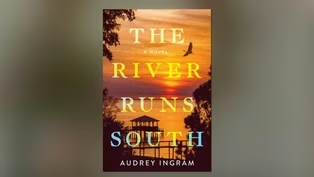
And the cover is absolutely beautiful .
I could see sitting outside there.
So, share with everyone a short little premise before we get into the characters and more the meat of the story.
[Audrey] Okay, so the novel The River Runs South is about Camille Taylor, who suffers a tremendous loss in her life.
Her husband dies unexpectedly.
-And we're not giving anything away because that happens in the beginning of the story.
-It happens very early in the story.
Yes.
And she really has to decide how she is going to move forward, especially with her young daughter.
Her daughter is six years old, so she very reluctantly returns back home and finds herself drawn back into her hometown, finding a new hope, new love, new start.
-Well, and I love the tension of what she has to go through when she's trying to maintain being a lawyer and going to practice, and thinking she's going through the motions until she realizes maybe what I'm going through is not really what it should be, right.
So when she picks up her daughter to go home, then it's not all easy.
I mean, there's tension because, you know, her daughter's a vivacious girl who she's increased... You know, she said, "I want you to be independent.
We want you to think."
And yet, Mom is a southern lady, right?
So, that was great.
So introduce us to Mom.
-Yeah.
So there are three generations.
So the main character, Camille, is a mother in her 40s, or in her 30s, and her own mother, Marion, is a very traditional kind of Junior League Southern woman to her core.
And then, Camille's daughter, Willa, is a six-year-old who's very precocious, and has grown up in Washington, DC, and has been surrounded by adults, and has thoughts and opinions that don't necessarily align with the way some women view that little Southern girls should act.
So there is this tension when Camille is bringing her daughter home, how her own mother, Marion, is going to be viewing her parenting decisions, her life decisions, and then, you know, the love between all three of them.
-And I love that because there's two mother-daughter relationships, right?
It's Camille and her mother, Marion, and their history, along with then Camille and Willa, and how their history has evolved and loss, and starting over.
-Right.
-And there's lighthearted moments, too.
So I don't want people to think it's all, you know, oh, it's all starting over and tension and grief, because there's funny moments where Marion has certain expectations of, you know, taking her to the tea party and to the garden club and to things.
And yet, you know, she wants nothing more than a great adventure.
-Right.
-So she stepped away from law, and she's down there to try to think about what her life's gonna be like.
-Right.
-And she's having adventures with her daughter, trying to navigate this new relationship with her mom.
And what happens?
-Well, she meets someone.
She meets someone that really, for the first time, makes her... and it's been close to a year since her husband has passed away, that, for the first time, makes her think, you know, gosh, could I love again?
But that meeting is not without complications, because this is a person who is not liked by the rest of her family.
In fact, it is kind of the enemy of her parents, and she doesn't know why.
She doesn't know what has happened because she hasn't been home.
-Yeah.
So we see that tension and that story unfolding, which is wonderful, because then you try to navigate what's happening, how to balance family, how to balance grief, with still grieving, how to balance this little daughter who is like, wow, wide open.
This is a whole new world.
Let's go again, right?
Let's go have an adventure.
And so, she finds herself having to step in for her family, and then she finds herself thinking, like you said, about, you know, making decisions, and what's right and what's wrong and where do things happen that are kind of blurry.
-Right.
-So I'm gonna be real careful not to give anything away to any of the readers, but I think it's important that they understand all of the complexities of the story, not only the beautiful ecological landscape of Alabama, but the personal struggles that maybe Camille deals with in finding her way.
-Yeah, because she really has, her parents have been her support through this very difficult time in her life.
And you think about the loyalty you have to your family, and then there are situations where you have to also make decisions about what you would do in those situations, what you view as right or wrong.
And she's really having to navigate those very adult-like problems that all of us confront at some time in our life.
-Well, and I think it's great that you take us into Alabama and, like, standing on the edge in boots with the buckets, catching salmon, picking blueberries, having those experiences, going for seafood, making a Shrimp Boil.
That is a very special recipe, I guess.
And that in a way, Camille kind of finds her own way back.
-Yeah.
-Yeah.
Her own way back to center, maybe, or how would you put it?
-Yeah, well, I think it's interesting because she's experiencing all of these adventures with her daughter, and so she's getting to see, relive things almost for a second time, and see them through a child's eyes, and the wonder and amazement of it all.
And I think sometimes we're quick to dismiss our home as, you know, something in our past, that we're going to move forward to bigger and better things.
But I think Camille is really, reflects on it as she's experiencing it with her daughter, and she's falling back in love with the place where she grew up.
-And a place that she thought she would never go back to again.
-Right.
Never go back.
-And reluctantly went back this time.
-Right.
-Right?
Because her parents are trying to help her by being there for her at a real time of need.
And then, Camille finds out, you know, this could be a two-way street.
Maybe I can be there for them, too.
And I think that's a really great part of the story that you watch unfold.
-Yeah, I think it's an interesting part of grief because for so long, you're inside your own emotions and your own head.
And I think when Camille really starts healing is when she finds this purpose beyond her grieving experience, where it really helps get her out of bed every day, do something every day.
It gives her a purpose to her days, and that's when you really start seeing her heal more.
-And she kind of goes back to a career choice that she did for a while, but it's in a whole new setting, right.
And there's new people involved and, you know, there's a tree house, and there's other, you know, people and players in all of this that she might think one thing is happening when the reality is, maybe there's some other things.
But she's smart and she's curious and those same characteristics that her mother has, that she has and her daughter has.
So, what do you think is a takeaway from the story that you'd like everyone to know, about where it kind of evolves?
We told them that, you know, there's grief that happens, and she moves back home to Alabama, and loves the landscape and the ecology of it.
-Well, I think, you know, one theme that was really important to me and that I learned in my life, especially through writing this book, was the importance of slowing down and really appreciating the people and places that matter the most to you.
And I think one lesson Camille really took away from her husband dying unexpectedly was that time is very precious.
And, a lot of times, we're going through the motions of, you know, doing the next thing, taking our kids to the next activity, getting to the next vacation.
But it really forces Camille to say, you know, I need to decide what kind of life I want, and who is important to me, and what I'm going to do to fight for those things.
And I think I also just want people to know that it's a really hopeful, heartwarming story.
-Well, and I love the fact that there's tough choices.
There's tough choices you have to make, and there's ways to say, is this the truth or is this blurry?
And there is all, you know, there's a law case and a lawsuit, and there's love and there's reconciliation, and there's so much, it's so well written.
You did such a fantastic job on the book.
Would you be willing to read a section for us?
-Yes.
Oh, gosh, I would love to.
-Okay, what do you, what'd you pick?
-Okay, so I'm going to read the... so the beginning of the story, Camille is in Washington, DC, and she experiences the loss of her husband.
This is towards the very beginning.
It's, you know, page 41, so we're still towards the beginning of the story, but this is when she has first returned home.
She's made the decision to return home.
"In the small bay town of Fairhope, Alabama, "the air was different, calmer, saltier, thicker.
"Camille took several deep breaths, "inhaling the briny medicine of familiarity.
"She sat in a rocking chair "as the soundtrack of early evening played, "seagulls fighting over dinner, "fishermen packing up for the day, "early evening joggers slapping the pavement.
"It calmed her momentarily.
"Coming home tangled Camille's emotions.
"There were a million reasons she had left Alabama, "and those reminders always made it hard to relax "in the place she had abandoned.
"She was 35 now, a single parent, "back in her parents' house.
"She knew there were circumstances "outside her control that had brought her back, "but at the same time, she couldn't help but feel "a pang of failure.
"She thought she was better than her home, "and returning humbled her.
"Lying in the hospital bed, "it had seemed like a reasonable decision.
"Spend a couple of weeks in Alabama "while she figured out a plan.
"But sitting on her parents' porch "back in the place she had left behind "felt like a mistake.
"Camille had never fit in Alabama.
"The South was full of boxes, antique silver boxes "passed down from generation to generation, "simple wooden boxes that served a purpose "but never tried to do anything more.
"These boxes seemed determined at birth, "and it was hard to stay in the South if the box didn't fit.
"Camille hadn't quite been able to make herself "into the daughter her mother wanted, "the daughter Marion still tried to make her into.
"She'd quit trying and left, a brazen 18-year-old "asserting that she would never live in this place again "because the best way to beat rejection was to claim supremacy."
-Wonderful.
Such a beautiful job!
And, you know, I'm thinking about when you read that section about the boxes, what it must have been like for you when that first box arrived, and you saw the cover of this the first time.
-I mean, that was such an exciting moment.
I think, you know, publishing is a very long journey.
It takes a long time and a lot of work to make a book that you can finally hold in your hands.
And so, when you open the box and you see all of that work in a physical way, and you can hold it and see your name, it's just a surreal moment, and one I will certainly never forget.
-So did you have a cork for that moment, too?
-Absolutely.
-A cork in the bowl.
-Yes.
Yes.
Another cork in the bowl for sure.
-So, what's next?
-So my second novel is coming out August 6 of 2024 this summer, and it's called The Group Trip .
This is a book about six friends from college who are inseparable over the next ten years of their lives until there is a falling out.
And they have to decide, is there a path forward for their friendship?
Can they grow up without growing apart?
So they take one last group trip together to the beaches of seaside Florida, to see what their future holds.
-So, it's again a summer read.
It's going to be in the nice warm weather.
But you ventured us a little further south from Alabama.
-Yeah, yeah, about two hours down the road.
But it is another really quaint, cute coastal town along the beaches of 30A.
It's a beautiful setting, and it's a book that's told one week in the present, and then ten years in the past.
So you learn about the history of their friendship.
So there are lots of other little places they go on their group trips.
It's a lot of fun.
-Congratulations to you, Audrey.
You are definitely on your way.
-Thank you so much.
-My special thanks to Audrey Ingram for inviting us here to Loudoun County and her beautiful home to share The River Runs South , this book about a love of her life in Fairhope, Alabama, and for sharing about her new work coming up.
Please join us for our extended conversation online, and tell your friends about us.
I'm Rose Martin, and I will see you next time Write Around The Corner .
[♪♪♪♪♪] -♪ Every day every day Every day ♪ ♪ Every day I write the book ♪ [♪♪♪♪♪] -♪ Every day every day Every day ♪ ♪ Every day I write the book ♪ -♪ Every day every day Every day ♪ ♪ Every day I write the book ♪ [Announcer] This program is brought to you by the generous support of The Secular Society, advancing the interests of women and the arts in Virginia and beyond.
A Continued Conversation with Audrey Ingram
Clip: S7 Ep12 | 9m 51s | Get a sneak peek into Audrey's upcoming books and more! (9m 51s)
Providing Support for PBS.org
Learn Moreabout PBS online sponsorship













Support for PBS provided by:
Write Around the Corner is a local public television program presented by Blue Ridge/Appalachia VA