Write Around the Corner
Write Around the Corner - Bradley Harper
Season 6 Episode 9 | 27m 55sVideo has Closed Captions
The game is afoot as we talk with award winning mystery author, Bradley Harper.
The game is afoot as we go to Toano, Virginia, to talk with award winning mystery author, Bradley Harper. He’s a retired US Army Pathologist who has traveled the world and at age 63 took up the pen. In his debut novel, A Knife in the Fog, Jack the Ripper meets Sherlock Holmes’ creator, Arthur Conan Doyle.
Problems playing video? | Closed Captioning Feedback
Problems playing video? | Closed Captioning Feedback
Write Around the Corner is a local public television program presented by Blue Ridge/Appalachia VA
Write Around the Corner
Write Around the Corner - Bradley Harper
Season 6 Episode 9 | 27m 55sVideo has Closed Captions
The game is afoot as we go to Toano, Virginia, to talk with award winning mystery author, Bradley Harper. He’s a retired US Army Pathologist who has traveled the world and at age 63 took up the pen. In his debut novel, A Knife in the Fog, Jack the Ripper meets Sherlock Holmes’ creator, Arthur Conan Doyle.
Problems playing video? | Closed Captioning Feedback
How to Watch Write Around the Corner
Write Around the Corner is available to stream on pbs.org and the free PBS App, available on iPhone, Apple TV, Android TV, Android smartphones, Amazon Fire TV, Amazon Fire Tablet, Roku, Samsung Smart TV, and Vizio.
Providing Support for PBS.org
Learn Moreabout PBS online sponsorship[♪♪♪♪♪] -♪ Every day every day Every day ♪ ♪ Every day I write the book ♪ [♪♪♪♪♪] -Welcome, I'm Rose Martin, and we are Write Around The Corner in Toano, Virginia with Bradley Harper.
He's a US Army pathologist turned award-winning author.
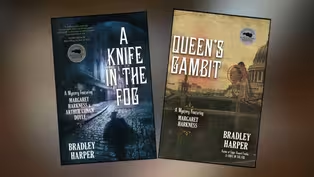
His book, A Knife in the Fog features Dr. Doyle, Professor Bell, who was the inspiration for Sherlock Holmes, and female author and suffragette Margaret Harkness.
They're on the trail of Jack the Ripper.
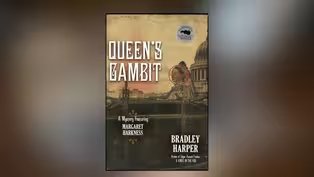
And his second book, which we're also gonna talk about today, is the Queen's Gambit.
It reunites the threesome to protect Queen Victoria from an assassin on her Jubilee.
So, what do you think?
Do they succeed or fail?
Welcome to Write Around The Corner .
-Well, Rose, thank you very much.
I'm really kind of blown away for this opportunity, and thank you.
-Well, we're so excited to be here, and thank you for inviting us here to your home.
When I was reading about your background, I thought, okay, so he's retired US military, 37 years Colonel, he's a forensic pathologist turned award-winning writer, who also plays Santa.
So, I'm looking at this thinking, wow, what an illustrious career, and what stories he must have to share with all of us.
So, you picked up the pen at 63 after a wonderful career.
Share with us a little bit about what that life was like when you were traveling the world and commanding people all over the world.
-I came in the Army, 1973, right out of college, not due to any choice of mine.
My drafting was '84.
So, I took an RTC scholarship for my last two years.
I figured, if they're gonna take me anyway, they might as well help underwrite my education.
So, I was in the infantry for a brief while.
I set a brief and undistinguished career in the infantry.
I went to Jump School and when I graduated from Jump School, my father, who had been an artilleryman in the National Guard, said, son, only two things falls outta the sky.
Bird poop and fools.
-Mm.
-So, he wasn't too impressed.
But my father-in-law, who jumped into Normandy as part of the D-Day invasion, was much more impressed.
And so, I made some major brownie points with him, anyway.
Anyway, after that, I, my basic branch was transportation.
I was in Turkey for a year and a half.
I ran a motor pool over there for the NATO Headquarters.
And one day, I went in sick hall and the doctor who saw me was such an unpleasant individual.
I went home, told my wife, Chere, I says, you know, if that guy can make it through medical school, I think I can.
So-- -So, that's true.
I read that about you.
-Oh, yeah.
Oh, yeah.
-That's how you ended up in medical school.
-It is, it is.
-So, then how did forensic pathology come about?
And over 200 autopsies?
-Yes.
-[Rose] During your career?
-Well, after I graduated medical school, I did a medicine internship.
I didn't want to be an internist, but I felt like it's sort of like, if you will, an internist or like an infantry guy except the medical aspect, 'cause you have to know of quite a bit about different aspects of the human body.
And so, I felt like that's gonna gimme a good grounding in whatever else I want to do.
But I chose pathology because one day I was thinking about, okay, you know, what do I wanna do, I wanna be, when I grow up.
And I thought about it and says, well, the fun part for me of medicine was making the diagnosis.
And once you make the diagnosis, then you're just adjusting medication, up of this, less of that, you know, whatever, and says, well, as a pathologist, I get to have all the fun.
And then I'll tell the clinician, well, they have this or that disease.
Good luck with that, and I'll go on to the next case.
And so, to me, I got paid to play.
-So, then you're being paid to play, and you're thinking, I don't know, maybe I need to write crime mystery novels now.
How on earth did you make that transition?
-Well, you know, as you mentioned, I had four careers, four commands as well.
And I spent two time, two years in the Pentagon working for the US Army Surgeon General.
And when I got out, I really just wanted to take a break for a while.
But after about a year, I said, you know, this is a lot of... traveling around is a lot of fun, but I don't wanna spend the rest of my life on a buffet line on a cruise ship, although it might look like I do.
And I got a book from my younger daughter from the author, Mary Roach.
Mary Roach does non-fiction.
And the book I got was Packing for Mars .
It's about the challenges of getting astronauts to Mars and back.
And I read the book, it was very well done, very well researched.
And I wrote her a fan letter, which I'd never done before in my life.
To my surprise, she wrote me back and said, oh, thank you for your comment.
You know, I mentioned I was a retired pathologist.
She said, I'm looking for an idea for my next book.
Do you have any ideas?
So, I said, well, you know, we do a lot of human research in the Department of Defense.
So, long story short, I hooked her up with some people, and she did some research, and the book was called Grunt .
And in the afterword, there's a long, like seven lines in the book, the first, how I helped her make the book happen.
And so, I saw she took the information and made it into a book.
I said, well, you know, I could do that, but I didn't want to do non-fiction.
And I had this idea, for a couple of years actually, about putting Arthur Conan Doyle on the hunt for Jack the Ripper.
And so, I said, well, I said, the worst thing that can happen is my grammar will get better.
And it did.
So, yeah, my mother was an English teacher at one point, in fact, and she edited one of my first manuscripts.
And she gave it back to me about two weeks later, all marked up in red.
And she looked at me, she said, son, didn't I teach you anything?
-[Rose chuckles] -Thanks, Mommy.
I said, you taught me to love the written word.
-Yep.
And she so did.
And I know, I'm hearing a pattern here.
Someone comes to you with an idea, or you see a model and you're like, I think I can do that.
And then the same thing with Margaret.
You see that in the books and you're like, you know what, I think I can do that.
I think I can write that.
And that was the beginning of a wonderful career taking off.
But there's also another piece, and it's the Santa Claus piece.
So, what is it like playing Santa?
-It's wonderful.
It's a lot of responsibility.
You know, some men can grow a beard in six weeks.
I'm not that lucky.
It's quite a bit trimmed right now 'cause the season's over.
But as I get closer to the season, it's more and more full.
And the thing that I'm aware of is when I'm out in public, I've had small children run up to me and hug me, and call me Santa.
So, I always have to be very careful when I'm in public.
-Sure.
-What I say, how I act.
I never want to give a child a, you know, to disillusion them if you can with that character.
And it kind of happened by happenstance.
In the military as a commander for the Christmas parties, they always want the commanding officer to be, to play Santa Claus.
And so, I did.
And my wife Chere, she noticed that I really enjoyed doing it.
So, after I retired, she kind of egged me on, you should try this.
So, I auditioned to Busch Gardens and they, to my terror, they hired me.
And so, the first season, third day on the job, I said, you know, this is pretty easy.
You know, the kids come up, I ask 'em what they want, they tell me.
I say I'll look into it, I never promise anything.
We do the picture, they leave, and the next family comes in.
So, one of my elves comes up to me, she says, Santa, you're about to see three children, a girl and her two younger brothers.
And they were orphaned about a year ago.
And the foster parents who've been keeping them have just been approved to adopt all three of them together.
-Oh.
-So, they can grow up together.
-Mm.
-They want you to tell them.
-[gasps] Oh!
-So, you know, and poof, there they are.
So, I had no time to really think about what to do.
So, to gimme time to think, I said, well, what would you like for Christmas?
And they start telling me, and I'm nodding, I don't hear a word these children are saying.
-Right.
-'Cause I'm saying, you know, what am I gonna do?
-Mm.
-So, they finally ran out of breath.
And so, I said, you know, good ideas.
I'll look into it.
And then I knew exactly what to say.
I said, but I have something for you today.
And the oldest girl, the girl said, what's that, Santa?
I said, a family.
-Mm-hmm.
Oh, that's amazing.
Talk about a Christmas.
-I'm saying, that's the moment I became Santa Claus.
-Yes, you did.
And not only for you, but for everybody else.
That's the moment.
Oh, I love that story.
And I bet there's so many others that you've touched along the way that you don't even know about.
But what a moment to treasure for that family and for you.
Thank you for sharing that story.
That means a lot.
-I'm a very lucky man.
-Yeah.
And you have two daughters and some grandchildren?
-I do.
I do.
-Are any of them writers, did that carry through the genes?
-Not yet.
Of course, my grandsons are five and one, so a little early for that yet.
But my other two girls, no.
One's, my younger daughter, she took after me.
She's a cytotechnologist.
She interprets Pap smears.
When I, we were stationed in Heidelberg, her school was close to the hospital there.
So, after school, she'd come to my office, I would pay her 25 cents an hour to file slides.
So, she's been pushing glass for quite a long while.
-So, there's, that might be a career thing for her too, unless she's like you and sees something else and says, hey, I think I can do that.
-Yeah.
-And your beautiful wife, Chere, is also Mrs. Claus with you sometimes, right?
-That is, that is true.
-And she's been your lifelong partner, what, 49 years?
-Forty-nine years.
-Yeah.
I thought I read that.
So, congratulations to both of you.
-Thank you very much.
-That's wonderful.
And I'm so curious as to what keeps, you know, the vigor alive for having so many career opportunities and so many things that then you said, you know what?
I think I wanna write, and there's nothing stopping you.
There's not, you had mentioned earlier, you're in your early 70s, and you thought, why would I stop now?
Why should I just sit back and relax and then, you know, just take every day as it comes?
But you're constantly, you're constantly, interested in so many things the world has to offer.
What advice would you give to people who are wanting to get a new career or wanting to try something new, no matter what their age is, or where they are in life?
-Well, I say, you know, you can never tell how far a ship will go until you raise its anchor.
We're... our biggest obstacles to overcome is our own fear and self-doubt.
So, I say I'm 71 years old, I don't have time to be timid, but then, I never did.
-[Rose] Yeah.
-I'm not the brightest guy in the world, but I'm very curious.
I enjoy talking to people.
I like seeing how they view the world so I can try to understand the world from their perspective.
That makes me...
I may not agree with them, but it helps me to understand them and their world a little bit better.
And so, it's just stay curious and-- don't be afraid to fail.
When I was taking ski lessons, my instructor told me, if you're not falling down, you're not learning.
-Well, and as a matter of fact, you just recently came back from Scotland.
-I did.
-And what was that experience like, for your writing career?
'Cause you were learning more about your craft.
-I was, I was.
I had one year of GI Bill left, and by golly, I'm too Scots to leave that money on the table, Lassie.
So, I took a master's program in creative writing at Napier University in Edinburgh, and lived there for eight months.
The last trimester was online, so I went ahead and came back to the States, but lived in Edinburgh for eight months and had a wonderful time.
The thing that I really picked up there was the importance of theme, and how to build theme into the story throughout and use that as a guiding principle.
That was very good.
And of course, just rubbing elbows with... we had students from around the world in the program.
And again, talking to them, seeing how they viewed the craft.
And my mentor, David Bishop, was just really, really good.
He's got, he's written screenplays.
He's got a, he writes historical fiction as well.
He does radio plays, and is really quite a master of the craft and was a great mentor to me.
Being one of the older professors there, we didn't have the, you know, couple of the professors you can easily imagine were less than half my age.
-[Rose] Mm-hmm.
-So, having an older gentleman working with me was, it was good for me.
-And nice colleague, a nice collegial relationship.
-[Bradley] Oh yes.
-And I'm sure a friend, lifelong friends, 'cause you've made friends all over the world, throughout your travels.
Did it change your process at all?
Because I read that you are between a, you know, an outliner, a poser, and a pantser.
So, where do you kind of fit in your process?
Do you outline first?
Did this change your process when you had that experience?
-I am a bit more organized now as a consequence of what I learned over there.
One thing that I learned that was very good was to do an outline of every chapter.
Just, you know, two or three sentences, what happens in each chapter, so that I can stand back and look at the overall arc of the plot and make sure that the right thing happens at the right time.
And so, that was very... a very useful technique that was very easy, easy to do.
And I wouldn't necessarily write the synopsis before I wrote the chapter, but after I did, I would write a little synopsis of what happened.
So, as I'm going along, I can refer back to make sure that I'm maintaining-- continuity.
-So, now being more focused on theme and doing this for plotting, do you find that theme might emerge more than characters first?
Or do you look at character development and fit them into the plot and the theme?
-Well, you know, I think if you go theme first, then you're, you're not really telling a story.
You're preaching.
If you don't do anything else as a writer, you have to create characters that the reader cares about.
And so, I think, you know, the plot's important.
I write crime, so you have to have a plot that's believable, sustainable, you know, when it comes to a logical conclusion.
But it has to involve people that are real to you in that fictional world, and that you care what happens to 'em.
-So, when you're writing, I read you are-- something about the halo effect.
That you, you know, you like to infuse the halo effect in your writing, and you're kind of like bringing the reader right along with that.
What's the halo effect?
-Well, the halo effect in historical fiction, I think it's very important.
I may tell you five things on a page, four of which are absolutely true.
And the fifth thing may not be entirely accurate.
I may have altered it somewhat, but the other four things being absolutely true gives the fictional part of my historical fiction more believability, more-- credibility.
So, the halo effect of the true things I tell you and teach you in the course of the story lend credibility to the fiction.
-And, you know, I thought about myself after I read that.
I'm like, okay, if someone tells me something and this is true, and then the next thing they tell me is true, and the next thing they tell me is true, I'm much more apt to believe the next thing they tell me.
It's just part of human nature, and you've built up that trust.
-Right.
[Rose] So that I didn't even question it.
And in your form of writing, it turns out to be great because I'm believing something that later on may turn out to be something totally different because of twists and turns.
-Right.
-So, that was, that was, I really, really enjoyed it.
So, okay.
How on earth did you get to think about working with Sherlock Holmes?
Being a pathologist, having a career in the military, now thinking about writing?
How did that transition come to focus on the whole idea of, you know, Sherlock Holmes and the mystery writing?
And then we'll get into the part with Jack the Ripper.
-Okay.
Well, Sherlock Holmes was easy.
When I was growing up in Oklahoma, in Tulsa, I lived on the edge of town.
So, in the summertime, I would get on my little bicycle with a big wire basket, and once a week, the bookmobile would come to the parking lot in the grocery store.
Safeway, I'd go peddling, you know, four or five miles.
Gets longer every time I actually tell that story.
-[laughs] -Anyway, so I pedaled up in my big wire basket bicycle, and I could only check out four books a week.
I'd read a book a day for four days, and then I'd have three days going crazy until the bookmobile came back.
So, one time I went, and there was a big thick book.
It was the entire canon of Sherlock Holmes.
Every single Sherlock Holmes story was in this one big book.
I said, well, that should take me more than a couple of days.
Well, it took me two weeks.
But the age of 13, I pretty much mainlined, or I guess you'd now say binge-watched the entire Sherlock Holmes Canon over two weeks.
-Wow.
-And I cried when I finished the last story because there were no more.
So, I was a Sherlock Holmes fan from the age of 13.
And I still think that The Hound of the Baskerville is probably still one of my favorite stories, the way it was told.
Just absolutely a beautiful story.
Then Nicholas Meyer wrote The Seven-Per-Cent Solution , 1973.
I said, oh wow.
Other people could write Sherlock Holmes stories too.
I said, and that was just, it's just an amazing book.
I got to meet Mr. Meyers and I told him how much I admired him.
I had a cold, so we stood about five feet apart, but I said, you, you're a God.
And he acknowledged my admiration, and we moved on.
-So, now A Knife in the Fog is born.
-Yes.
[Rose] And you're thinking about A Knife in the Fog.
So, for our viewers and everyone, go ahead and set it up for us.
Who are the main characters, and what's the premise of the story?
[Bradley] After I retired, I was, who knows why?
I was going through Wikipedia, and I read a mini biography of Conan Doyle.
And I saw that the very first Sherlock Holmes story, A Study in Scarlet , was written in 1886.
Well, Doyle couldn't find anybody to take it to till finally this one editor, to placate his wife, offered Doyle 25 pounds, which was an insult 'cause Doyle wrote short stories for boy's magazines, and he would get 25 pounds for a short story.
A Study in Scarlet is a novella, so it's considerably longer, but he said 25 pounds, but I want full copyright.
So, Doyle was, at this point, was sick of, over six months he'd been rejected so many places.
Okay, fine.
He took the 25 pounds, let him have the story.
And said, I'll never write another crime story in my life, a complete waste of time.
Okay, fast forward to 1890.
Doyle goes-- is taken to dinner in London.
An American news magazine publisher offers him and Oscar Wilde a commission to write something for them.
So, Doyle returns to writing Sherlock Holmes and Oscar Wilde, by the way, wrote The Picture of Dorian Gray .
That was a very successful dinner.
Anyway, Jack the Ripper does his thing in the late summer, early fall of 1888, only over 13 weeks, kills five people and then mysteriously quits as soon as he stops.
So, I just came up with the idea, how about I involve Conan Doyle somehow in the hunt for Jack the Ripper to explain why The Ripper was never knowingly caught, but stopped killing people.
And why Doyle eventually returned to writing Sherlock Holmes.
-And it was very, very clever.
And the character of Margaret, oh, I loved her.
And the fact that these were based on real people of the time.
Did Margaret actually have lupus in real life, like she suffered from in the book?
-I do know that she had some ailment that required her, at one point to, she lived in the south of France for a while, lived in Italy, and also lived in Australia and India.
-[Rose] Right.
-So, I do know that she had some chronic condition, and since it was ill-defined and autoimmune diseases, even now, are difficult to, to sort out, I just gave her a lupus like condition to fill in what her real-life biography mirrored.
-One of the things that really struck me and struck Carol, she's our co-producer, was the fact of the density of the people.
I couldn't imagine that there were 800, you know, people in such a small space, and that again, they slept standing up.
-Yeah.
-So, when they needed to have a night...
So, that was true?
-That was true.
If you were a poor person, extremely poor-- a bed and a rooming house for the night was four pence.
If you couldn't afford that, for two pence, you could stand up against the wall, the staff would run a rope across you, and you slept more or less standing up.
-Wow.
Well, you know, all three of the characters have such distinct personalities.
I love when they're getting the letters, you know, and whether or not the letters were true or false.
-Right.
-Or they were actually believed if they were really from, you know, Jack the Ripper.
There's been a lot of Jack the Ripper stories, and a lot of people have come up with a way to find out, you know, who he is or what he did.
I love the fact that you took us on a journey to discover it, and found a solution for Jack that I hadn't really heard about before.
So, it was really, really interesting.
And then, you put the same three characters together in Queen's Gambit.
Why don't you briefly tell me the premise of the Queen's Gambit.
So, we've got Queen Victoria, it's gonna be her Jubilee, and these three are reunited to stop an assassin.
[Bradley] Yeah.
That one was interesting.
The way that book happened was a publisher wanted A Knife in the Fog .
They wanted to make it a two-book deal.
And so, my agent quickly emailed me, and he said, this editor's going... in two hours, he's leaving for a two-week vacation.
Can you get me something back, like now?
And so, I had sort of been playing around with this other idea.
I'm a huge fan of a thriller written by Frederick Forsyth, came in '73 called The Day of the Jackal.
And that's about a political assassination attempt on Charles de Gaulle.
And so, I thought that there was something I could do with that.
And so, what I did is-- I have... the anarchists are trying to jumpstart World War I to get rid of the ruling aristocracy.
And since Queen Victoria was either-- was the mother or grandmother to half the aristocracy of Europe, they thought if they could have her assassinated and look at, look like it was an act of the German government, it could start a world war.
And so, the anarchists take this one man, and he's basically a decent human being, but they're manipulating him and trying to force him to do this.
He's a sympathetic character.
You don't want him to succeed, but you understand his motivations and why he does what he does.
And so, I have Margaret, is trying to get the money to move to Australia for her health, and she does a mission with Bell for the German government.
And during the course of that, she crosses paths with the man who ultimately becomes the assassin.
And he blames Margaret for something bad that happens to him, and tries to take her out as well as the Queen.
-Well, and it's amazing.
The characters are well developed, your background in pathology, Margaret dressing like a man and doing all kinds of great stuff.
I can't wait for the viewers to pick up your books and read them.
Would you be willing to read a section for us?
-I certainly would.
Just so you know, there is a-- I'll be, next month, I'll be pitching to a television producer for a possible adaptation of A Knife in the Fog .
-[Rose] Great.
-And wish me luck on that.
Okay.
As we've already alluded, Margaret Harkness is a woman who frequently dresses as a man for her own safety.
She's right at this point in time, she was living in fact, in true fact, she was living in Whitechapel because she wrote about the working poor of London.
So, she wanted to live like her characters to accurately portray their lives.
And she initially is hired as a guide to Doyle and Bell to help them to navigate their way around in this society.
So, in this episode here, Doyle is with Margaret.
Bill hasn't arrived on the scene yet, and he's asked her to take him to the scene of one of the, where one of The Ripper's victims was found.
So, it's late at night, and here we go.
"So, we're about to go to the second spot "when our evening took an unexpected turn, "and I saw another side of my well-educated "and published companion.
"A large man suddenly appeared outta the shadows "I had found self-threatening just moments before.
"I smelled him at the same instant, "reeking of gin and of body "and clothes that had not seen hot water "for at least a fortnight.
"He held a straight razor "in his right, slightly shaking hand, "his intent obvious even before he spoke.
"His pale face was distorted by a leer "made even more disturbing "by his gray complexion in the darkness.
"'Good evening, gents.
"Here to smell little blood and get some shivers, are we?
"How about you both hand me yer wallets, "and you'll be havin' a grand story "to tell your mates when you get home.
"If not, things may go ill for you, "and you'll be tellin' no tales at all!'
I started," and this is-- told as a first-person from Conan Doyle.
"So, I started to step forward to place myself "between the scoundrel and Miss Harkness, "when she moved past me in a blur.
"She pressed a small handgun up against his neck so quickly "that to him, it must have appeared by magic.
"'Allow me to introduce you, sir, "to my good American friend, Mr. Derringer.
"He only knows two words, but at this distance, "one should prove enough.
"I suggest you leave now before he speaks his mind.
"Oh, and you can drop that razor, "which you apparently rarely use, "as a token of your goodwill.'
"Our erstwhile companion, assailant dropped his blade "to the pavement with a stricken look on his face, "mumbling some vague apology.
"Miss Harkness stepped back and watched him "until he disappeared once more into the shadows.
"After he was gone, she bent over to retrieve his weapon, "folded it with care, and placed it in her pocket before turning to me."
And as I mentioned before, she's dressed as a man in this episode.
"'Well, Dr. Doyle,' she said, 'You have had now had "a proper East End welcome.
"I suggest we adjourn for the evening, as I believe you've had a full day."
And then they go on.
And I'll just read the last paragraph in this particular chapter.
"Our traditional roles of man as protector "and woman as protected were reversed "the remainder of the evening "(though thinking back, they had been all along), "as Miss Harkness led me to the nearest place "a cab was available.
"Perhaps I should have been ashamed at being rescued "by a woman, but at that moment, my only emotion was gratitude.
"I comforted myself with one thought "as we made our way back to Whitechapel Road: "Miss Harkness was definitely not boring.
"Once I was safely aboard, she bowed slightly, "maintaining her masculine façade, "and slipped back into the dark noisome warren of the East End as though she had never been."
-Thank you so much.
You know, I've thoroughly enjoyed spending time here with you to learn about A Knife in the Fog and the Queen's Gambit and taking us on a journey through not only Jack the Ripper and through your twist on Jack the Ripper, and what we're gonna learn from that.
But your background in pathology and everything you're doing is really, really evident in both of these books.
Thank you so much for inviting us.
-Well said.
-[Rose] I appreciate it.
-It was a pleasure.
Thank you.
-My special thanks to Bradley Harper for inviting us here to his home in Toano, Virginia, and for sharing A Knife in the Fog and Queens' Gambit with us.
You're gonna wanna pick up both of these books.
And while you're at it, check out our extended conversation online, and tell your friends about us.
I'm Rose Martin, and I'll see you next time Write Around The Corner .
-♪ Every day every day Every day every day every day ♪ ♪ Every day I write the book ♪ ♪ Every day every day Every day ♪ ♪ Every day I write the book ♪ ♪ Every day every day Every day ♪ ♪ Every day I write the book ♪
A Continued Conversation with Bradley Harper
Clip: S6 Ep9 | 20m 12s | Learn about the inspiration and research behind Bradley's books to "boldy go". (20m 12s)
Write Around the Corner - Bradley Harper reading
Clip: S6 Ep9 | 3m 49s | Harper reads a passage from his second novel, Queen's Gambit. (3m 49s)
Providing Support for PBS.org
Learn Moreabout PBS online sponsorship













Support for PBS provided by:
Write Around the Corner is a local public television program presented by Blue Ridge/Appalachia VA