Write Around the Corner
Write Around the Corner - Brendan Slocumb
Season 7 Episode 8 | 27m 43sVideo has Closed Captions
Classical musician & author Brendan Slocumb talks about his novel, Symphony of Secrets.
Classical musician and author Brendan Slocumb is our guest to talk about his page turner, Symphony of Secrets. Once you read this book, you'll never look at music the same.
Problems playing video? | Closed Captioning Feedback
Problems playing video? | Closed Captioning Feedback
Write Around the Corner is a local public television program presented by Blue Ridge/Appalachia VA
Write Around the Corner
Write Around the Corner - Brendan Slocumb
Season 7 Episode 8 | 27m 43sVideo has Closed Captions
Classical musician and author Brendan Slocumb is our guest to talk about his page turner, Symphony of Secrets. Once you read this book, you'll never look at music the same.
Problems playing video? | Closed Captioning Feedback
How to Watch Write Around the Corner
Write Around the Corner is available to stream on pbs.org and the free PBS App, available on iPhone, Apple TV, Android TV, Android smartphones, Amazon Fire TV, Amazon Fire Tablet, Roku, Samsung Smart TV, and Vizio.
Providing Support for PBS.org
Learn Moreabout PBS online sponsorship[Announcer] This program is brought to you by the generous support of The Secular Society, advancing the interests of women and the arts in Virginia and beyond.
[♪♪♪♪♪] -♪ Every day every day Every day ♪ ♪ Every day I write the book ♪ [♪♪♪♪♪] -Welcome, I'm Rose Martin, and we are Write Around The Corner in Washington, in DC, with Brendan Slocumb.
His book Symphony of Secrets takes us into the world of a famous composer during the jazz age, and a black jazz prodigy who may have had all of the music stolen.
So, who is the real genius in this story?
Hi, Brendan.
Thank you so much for inviting us here to chat with you about Symphony of Secrets.
-Thank you so much.
It is a pleasure to have you here, Rose.
-Well, one of the things we loved about the book was the fact that it was not only a book about music, but it's got twists and turns all the way through it.
As a young boy, I understand you started playing the violin at nine.
-Yes, age nine.
I started in a public-school music program, and it was life changing.
-I've heard you say the violin literally saved my life.
-Yes, 100 percent.
Had I not had the music program, had I not had the violin, I probably would still be out running the streets, doing bad things, breaking into people's houses, vandalism.
That's all there was to do, until the violin came into my life, and it totally saved me, turned me around completely.
-Do you remember the first time you saw it, or the first time you heard any kind of music come from it?
-Like it was yesterday.
-[Rose] Really?
-The first time I saw my first violin, it was in the trunk of my dad's car, and it was in October, so it was cold.
I know now that you should never keep a violin in the trunk of a car in October.
That's one of the worst things you can do.
But I didn't know then, you know, as a beginner.
-Sure.
-And just seeing it, I, you know, had no idea that it would take me to where I currently am.
No clue.
But I see it like it was yesterday.
-Did you take to it right away?
Was practice laborious?
Or were you thinking, I don't know if I really want to do this, or did music just grab your heart?
-It was like every day was Christmas when I first picked up the violin.
My very first lesson in school, in fifth grade, I learned a song the very first time I had the violin.
I was so proud.
And I played it all the time.
All the time, all the time.
I wouldn't do my homework because I was playing my violin.
-Now, did your family, were they a family of musicians actually playing music?
Or was there just music emanating from your household as you're growing up?
-Music, yes, absolutely.
We listened to, my siblings and I, all the time, every type of music you can imagine, with the exception of classical music.
We would listen to Kansas and Boston and ABBA and Marvin Gaye and The Temptations, and just everything.
But classical music was never a thing until I heard my first symphony.
I heard Mozart for the first time, and it just opened up a whole new world.
-And your favorite right now, who's your favorite?
-Ooh, that's a tough one.
Okay, this guy right behind you, Antonin Dvoák, is one of my absolute favorite composers.
It's a close between he and Vivaldi, Antonio Vivaldi, one of my absolute favorites as well.
-Well, and you talk about music changing your life.
I read that one of your most precious experiences that you felt really fulfilled was as a kindergarten teacher.
-[chuckles] Yes, 100 percent.
First, kindergartners are just adorable.
They're so innocent and so sweet and just adorable.
And I was so proud to be able to say that these kids will be teaching their kids this song that I am teaching to them.
And one of my absolute favorite songs, which consequently became one of their favorite songs, is "I've Been Working on the Railroad."
And we would sing it every day and have a little choreography that went along with it.
And, you know, it's a precious, precious, precious thing to be able to do, to show those kids the joy of music and have them living it.
-And when you see that on their faces, I mean, how many of us, we all know the song.
-Yeah, yeah.
-[Rose] Right?
And to be able to share that with them, and see the first time maybe music touched one of their lives in a way that it was life changing, like for you.
-Just knowing I had a little something to do with that, it just, it makes me smile.
And little known fact, I don't know if anybody knew.
"I've Been Working on the Railroad," it's actually a classical piece of music.
It is the cello solo from the "Poet and Peasant Overture" by Rossini.
-That's amazing.
-Yeah.
-That really is amazing when you think about it, and how many of us know it.
And it's so familiar, too, but didn't know that it had that link to classical music.
-Every day.
Yeah.
-But along the way, it wasn't always easy for you.
-No.
-As a young Black man playing violin, and I understand there was someone at one time in your life who told you your hands were too big.
-Yes, unfortunately.
-[Rose] And you're not going to make it.
-Oh, yeah.
He told me that I should quit because he can't teach me because my hands are far too large to ever play violin in tune.
That was my very first private teacher my freshman year in college, and, you know, he was the pro, and I'm just a freshman coming in, so he knows better.
And I wanted to quit.
I was like, "Okay, I'm done.
I take your advice.
You know better than I do."
And it was devastating, but, you know... -But then, that special teacher came into your life.
-Yes, just... And in my book, The Violin Conspiracy, the teacher, Janice Stevens, is based on my teacher, Dr. Rachel Vetter Huang, who came in and taught me every single thing that I know, not only how to play the violin, but also how to teach.
And I am forever indebted to her.
Forever.
She changed my life.
-That's nice that we have those special people... -Yeah.
-...who make a difference, and for a lifetime.
And so glad that you went back and didn't put that violin on the shelf for one person's opinion that was obviously wrong.
-Yes, yes!
-Obviously wrong.
-Obviously.
Well, thank goodness he was wrong.
-So, outside of music, I understand you love comic books and science fiction.
-I do, I do, I do.
And I'm not embarrassed to say that.
I do.
-Yeah.
Well, I think it's fantastic.
And a lot of people, you know, get literacy questions and wonder, can literacy really be comic books?
And can young people learn from and read?
Yeah, they can.
-Absolutely.
I got so much vocabulary.
I love science, and I love science fiction, and, you know, I got so much vocabulary from reading comic books.
I would go, you know, back in the days where, pre-Google, I would go and look up words in the dictionary that I would read in the comic.
Is this a real word, or is this made up?
Whoa, this is actually a term that refers to blah blah blah, you know, all the time.
And I would get a ton of new vocabulary from comics.
And, you know, the pictures are great, the artwork is phenomenal.
The stories are great.
I'm like, wow, this is good stuff.
And, you know, it takes you out of your world into a whole new one, and it's always been fun for me.
-You know what else?
I think with comic books, you can see yourself in a situation which, oftentimes, you don't see yourself.
You couldn't see other people like you who were a concert master or a conductor and playing the violin as a young man, and you're reading a comic book.
Just like any other story, we can kind of put ourselves in there.
-Yes.
-What is it about music that really, you know, is your favorite thing?
If you were to think about music in its entirety?
-The fact that it transports you to someplace different every single time.
Every piece of music that you hear can take you to a different place.
You can even hear the same piece of music several times, and you will always get something different from it.
I can hear the same recording of a Beethoven Symphony, and I will hear something different each time.
Or I will listen to ten different recordings of the same symphony, and it's like hearing it for the first time every time.
And it just transports you, and it's energizing, and it lifts the weight of the world off of your shoulders.
You know, it's relaxing, it's stressful.
It's beautiful.
It gives you an appreciation for everything.
And, you know, I listen to Beethoven, "Symphony No.
6," and it just makes me happy to be alive.
And I just, you know, how can one man have so much beauty, like, just embedded in his soul and share it with the world?
It's fascinating to me.
I love it.
-Mm.
Well, the light in your eyes and the light that you emanate when you talk about music, you just glow.
And I love the story from, you know, it is, music is a story.
And I think it's very soulful because you can place the same notes, you can look at the same score, but whoever the person is and the soul behind it, that's why you can hear it differently.
Or maybe the place we're in when we hear it, you know.
-True, very true.
It's, you know, the composer's intention, you know, his intention might be one thing, but I could get something completely different from it, you know.
And Shostakovich, his music was very, very nationalistic, you know, and he was forced to write music that the government wanted him to write.
But there are always these little hidden messages, you know, for people who wanted freedom.
And I get it, I get it.
I get where he was coming from, and the music was his way to be able to express that.
He couldn't say it, he couldn't verbalize it, but it would come through in the music.
And that is just, you know, what else does that?
What else can do that?
-So, you decided you're in music, you're teaching music, COVID hits, and you're thinking, you know, I've got a story, and I'm going to see about writing books.
-[chuckles] Yeah.
COVID was horrible for so many reasons, but it also ended up being great for me because it gave me an opportunity to have a creative outlet when my main form of creativity was just cut completely off.
You know, everything stopped during COVID.
I was actually in a wedding reception, playing, when we got the news that our next three or four weddings had been completely canceled.
And you just didn't know, the uncertainty, it was really bad.
You just didn't know when you were going to be able to do this again.
My symphony rehearsals stopped.
You know, my lessons stopped, everything stopped.
I needed a creative outlet, and, you know, I went back to writing, and it was the best thing I could have done.
-Did that encourage your passion to play again, too?
Did you lose that during COVID?
Like, why am I doing this?
Like, I'm sitting here playing for myself in the living room, and it's great, but, you know.
-Absolutely.
-You kind of feed off an audience, too.
-Yeah, you know, I had something to practice for.
Of course, I always play for myself, but, you know, when I was working towards that concert, it was great.
It was wonderful.
It gave me drive.
It gave me ambition.
Yeah, I'm going to play this passage really well, and I can't wait for people to come and hear it.
But all of that was gone, and you just did not know when it was coming back.
And like I said, the creative outlet that I needed, you know, just happened to fall into my lap with the writing.
And I'm like, "Oh, good, I can do something."
But it was definitely a need.
-The books are fantastic.
-Oh.
-But interestingly, like, you chose writing a book, not painting a picture, or, you know, doing some other kind of creative outlet.
What was it about words?
Because I've often heard that there's ties in between, you know, math and music, or the specificity of word choice and how they're going to rhythmically go together in a book.
Did you find that when you're writing?
-You know, it was more along the lines of, I actually, now I have time.
I've always wanted to write the story, The Violin Conspiracy.
I'd been saying, a friend of mine in college joked about it when the book came out.
He said, "Brendan, you always said you were going to write a story about your life, and I can't believe you actually sat down and did it."
It was the perfect opportunity.
I knew it was going to happen at some point.
Had COVID not happened, I probably would just be getting around to doing it now.
So, the timing was absolutely perfect, and it just worked out the way that it was supposed to.
-What's your process for, even for this book, for Symphony of Secrets or for The Violin Conspiracy ?
And has that process changed?
-Oh, no, not at all.
I'm one of those, hey, if it works, don't mess with it.
I'm an outliner, 100 percent outliner.
-Beginning to end?
-Beginning to end.
-Okay.
-I tried, seat of my pants, tried it one time, and it resulted in a terrible, terrible manuscript.
So, I don't do that anymore.
And I work very closely with my literary agent, and he gives me ideas on what direction to go in, and everything is outlined.
And then I follow a strict, here's part one, here's part two, here's part three, and got to make sure that the pacing is good.
I want to be entertained when I'm reading, and I want my readers to be entertained as well.
If it's not entertaining for me, how could it be entertaining for someone else?
-How long did it take you to put Symphony of Secrets or The Violin Conspiracy from your head to paper?
-Okay.
People hate me when I say this.
For Violent Conspiracy , it took two months.
-That's true?
Okay.
I read that.
I'm like, I'm going to ask him that to see if it really was only a couple of months.
-It was COVID.
There was nothing else going on.
I wrote every day.
There was nothing else to do.
And I was enjoying writing the story because I would go back and read... you know, I wrote four chapters, and I would go back and reread those four chapters and add four more.
And whenever I go back and reread, I was enjoying it.
It's like, "Wow, this is actually pretty good.
I can't believe I'm writing.
Wow, this is good."
-I wrote this.
Yeah.
-Me, I did this.
But with Symphony of Secrets , you know, I'm a little embarrassed.
It took me about four and a half months to write that book.
-You know, there are people that we meet on the show who, four and a half months, they're still outlining, right.
And people are still trying to get it together.
And I love the...
I'm so curious about everyone's process, because it's so different and individual.
-[Brendan] Yeah.
-And when you feel like you're ready to go, you know, it's very different.
So, I think a lot of our life experiences play into how we then transition or to write or when we're ready to open up the flow for what's going to happen.
-Oh, absolutely.
-So, the idea for Symphony of Secrets , where'd it come from?
-Poof.
I needed, I needed, I got a two-book deal after The Violin Conspiracy was picked up, and I needed another story.
And I'm like, well, okay.
The whole thing with being a musician, I wanted to stay in my wheelhouse, and I, you know, wanted to do something with a composer, and I, especially the aspect of having synesthesia.
One of my favorite composers, Rimsky-Korsakov, had synesthesia, and I just thought that it was interesting.
And I figured, okay, how can I develop this?
And I love New York City and just jazz.
Strictly American.
Okay, I can do an American story about an American composer in America, and, you know, let's see where it goes.
And it just kind of rolled off itself.
And it's so funny.
One of the main characters, Josephine, she was actually just an afterthought.
-Really?
So, I was curious as to whether you knew a Josephine, or you've modeled a Josephine after someone.
No?
-She, well, okay.
The concept of Josephine, I was like, okay, I'll just have, you know, just... she'll just be a secondary character.
But when I began to develop her, I talked to, well, first, as a teacher, I've taught students who live with autism.
One of my best friends, his brother lives with autism.
Friends that I used to play with in the symphony, you know, have children who live with autism.
And I did extensive research based on what I knew, and I went and sat for probably six hours with a friend of mine who showed me everything that her son, who, he's like 22 years old now, from when he was a baby, she kept everything.
And, you know, it was just fascinating to me.
I'm like, wow, this is really in depth and involved.
I had no idea that this was the extent that, you know, he goes through to communicate, and I just found it fascinating.
And I wanted to portray someone living with autism in a positive light.
-Yeah, and it's beautiful.
So, the story, we've got this composer, and he's world famous.
And give our viewers a little bit of a tease of the book, and then we'll get to talk about the characters just a little bit.
[Brendan] Well, Symphony of Secrets takes place in two different timelines.
The past, which is 1920s jazz age New York.
Frederick Delaney is an up and coming musician who meets Josephine Reed, and their relationship will have ramifications throughout history.
And in the present, Professor Bernard Hendricks is tasked with authenticating a long-lost Delaney score.
And his tech-savvy partner, Eboni Washington, they together discover that hm, maybe Delaney was not the genius that we thought he was, and the corporation that hires him will stop at nothing to keep that a secret.
-Right, so the family foundation of, you know, Frederic Delaney finds this amazing manuscript, and they really can't figure it out.
-Right.
-So, here we have the professor who is, you know, a diehard fan who knows everything possible.
-Everything.
-But then we bring in this fun character of Eboni, who is just a firecracker, smart as a whip, right, who doesn't pull any punches.
-Right.
-And then there's Josephine.
Like, there's so many fun scenes in the book of how she can write things down and interpret things.
And as a savant hearing music, I got the feeling that she needed music as an outlet for so many things in her life.
-Absolutely.
-And she found that not only to go in, but also to get it out.
-Yes.
-And it was a natural gift.
-Yes.
Because of her synesthesia and her, well, you know, back in the '20s, no one knew what autism was.
They would just say, oh, you're just crazy.
I don't think it was formally diagnosed until the 1950s.
So, for her to be able to express herself, you know, she absolutely needed that.
And when you hear, like, I'm hearing, I can hear tones right now, and not to the extent that Josephine would, but like, you know, you hear a car horn blow.
And I can tell you now, there's two different notes.
There's usually a C-sharp and an A.
Like, all right, okay.
So, I hear that all the time, but I think, I don't know that I would be able to handle if I were as talented as Josephine.
Seeing colors and hearing everything, you know, a knock on the door, that's music.
That would just be too much for me, and she somehow could handle it.
-It makes us a lot more observant.
-Oh, yeah.
-After reading this book, you know, Carol and I were talking about the fact that we're listening, you know, I want to be observant.
But there's a mystery here, and there's some things that happen that become, you know, a page turner to say, oh, my gosh, what are they going to do now?
On a side note, kind of funny.
Eboni and the Professor Bern, they always go for pizza, and so they do every kind of pizza.
Is that a-- so, you're not particularly a big pizza lover, but were you just trying to find something fun for them?
-Well, I am.
I love pizza.
[Rose] You are a big pizza lover.
Okay.
-I break my vegan diet every now and then whenever I go to New York, because there's nothing better than New York pizza.
Well, the pizza in Italy is pretty good, too, but it doesn't compare to New York pizza.
And, yeah, I figured that would be a really good way to show the bond between Eboni and Bern.
Not only were they, you know, professional colleagues, but they actually had a lot in common, and, you know, it was just a way for them to bond.
-So, this mystery, they've got to figure out this mystery.
And he's been tasked with looking at this manuscript that was found, and I'm carefully choosing my words not to give anything away, but I love the way that you brought us into their world, to where we could feel like we were investigating with them, or waiting for the door to open, or not knowing what was going to happen.
Would you be willing to read something for us?
-I would love to.
-[Rose] Okay.
What did you pick?
-I'm going to read the very first encounter between Freddy and Josephine.
Freddy's a good guy.
I like him.
"Freddy Delaney would always remember "the leaves in her hair "the night that Josephine Reed changed his life.
"Right then, Eli Evans, the upright bass player, "was all up in Freddy's face, blocking out the lights, "the club, and the handful of audience members "swirling their glasses at the far end of the room.
"'Did you even look at the charts I made for you?'
"Eli said, his tiny mustache quivering with fury, "nearly disappearing into his bottom lip.
"Freddy could smell the cigar that Eli had smoked "several hours before.
"'I told you, this would totally be a waste of time,' "Eli said to the group, and then to Freddy, "'It's time for you to go, man.
"You did your best, but you need to go.'
"Freddy couldn't believe he was hearing this.
"His bandmates, the band he had put together, "were firing him.
"How is this even possible?
"But Red Simmons was nodding, "his head bobbing on the end of his neck like a baby bird's.
"Freddy thought that at least one of the jazz combo "should stick up for him, but they stood there, "eyes blinking back at him.
"The lights in the Alibi Club beat down, "seeming to underscore the pathos of, "yet again, an almost empty house.
"Those lights were the reason that nobody had come, "Freddy was sure of it.
"How could musicians "try creating an atmosphere of mystique "in this shabby, too-bright dump?
"This flop house shouldn't be lit up "like it was Saturday afternoon.
"It should be dark, magic, and serenading moonlight, "whiskey fresh out of straw packed crates, "not watered down hooch.
"'Come on,' Freddy said to Eli.
'It was better than rehearsal.'
"The cold tendrils of failure "were sliding like sweat down his back.
"'It's time for you to go, man,' Eli repeated, "louder this time to the room at large.
"Eli was barely tall enough to play his bass without a stool, "but now his baritone voice "curled in the back corners of the club.
"Eli arranged the sets, called the rehearsals, "and corrected Freddy, only Freddy, regularly.
"Freddy wanted to believe that he wasn't a failure, "or he had just gotten unlucky to possess the wrong skin color.
"He needed them to understand "that at least his musicality was true.
"'It was better than rehearsal,' Bobby Roosevelt put in, "the drum player, heavyset in a threadbare suit coat, "had dark pock marks on his cheeks, "and a soft spot for Fred.
"'This time, he managed to get through the third change "with only six mistakes.
He's getting better.'
"'Nine,' Eli said.
"'Eleven,' Freddy thought he heard, "but who had spoken?
"An impenetrable ring of empty tabletops "lay between the audience and the band members on stage.
"Only one person was close enough to have overheard, "and she wasn't paying any attention to them.
"Head down, hands folded in her lap, "Freddy thought maybe their music had put her to sleep.
"'Fellas, take it easy,' Freddy said.
"'I just haven't found a groove yet.
"It's not all that easy to do "when Red decides in the middle of Blue Ribbon "to take it back to the edge.'
"Red Simmons, the tenor sax player, said, "'It's called timing, Freddy.'
"He leaned in close, "two of Red's lower incisors had been capped with silver.
"'You just get into the groove way too late.'
"Bobby laid his drumsticks carefully on the beat-up snare.
"The nickel rim glittered on the stage lights.
"Freddy waited for Bobby to back him up "and defend him again, "but he was sliding the sticks into the edge of the drum "as if he were barely listening.
"'The point is,' Eli went on, 'this isn't working.
"I don't know if you just don't get it "or if you just don't care.'
"'Of course I care.'
"Freddy's suspenders felt way too tight.
"His shirt constricted on his chest.
"He so desperately wanted the respect "from these three talented men.
"He was afraid that they'd see that he cared too much.
"His words sparkled like motes in the club's glow.
"Eli's mouth had dropped open only slightly.
"Then he burst into laughter, and Red and Bobby joined in.
"Freddy kept his tight smile against his lips.
"Why were these lights so bright?
"The heat was in his hair and his temples.
"Sweat slithered down his cheeks.
"How could he make his bandmates like him, "make them understand how important this was to him?
"'See, when you say stuff like that, "it's hard to take you seriously.
"The only reason the crowd looks bigger "is because they took out all the tables in the back.
"Don't you see that?'
Freddy said again.
"Somehow calling them fellas made him feel like he belonged.
"'I really think we can do it.'
"He knew he wasn't a bad musician.
"Compared to some, he was downright good.
"He played the clarinet and the piano, "and even mucked about making up his own jingles.
"Had they been positioned on stage slightly differently, "with Red on the other side and Bobby on the other side of him?
"Maybe no one would have noticed, but it was.
"Freddy saw the woman suddenly shake her head as if to say, "'No, no, you didn't play it correctly.'
"Eli laughed again.
'See?
Looky there.
"Even crazy Joe knows that you missed the change.'
"Her face tilted upward towards them.
"'Late,' she said, very clearly this time, "the word crisp and round in her mouth.
"'It was too late.'
"She was surprisingly beautiful, "with a medium brown complexion and full lips.
"Thick lashes framed wide set eyes; "her eyebrows arched up perfectly.
"But something seemed off.
"Something about the way she looked at them, "as if seeing through them or beyond them, "not quite connecting.
"'What are you talking about?'
Freddy said.
"'You were late,' she said, "voice low and even utterly confident.
"'Two bars late.
The green with the star "came in two beats after it should have.'
"The green with the star?
"'See?'
Bobby said.
"'She said it, man.
The green with the star.
"Come here, Joe.'
"'What?'
Freddy started, but Eli chimed in, "'Yeah, Joe, come up here and show him how it's done.'
"And then to Freddy, 'Even crazy Joe can play better than you.'"
-Great passage to choose because it tells us, it teases everyone about the future of what's going to come, and how talented Josephine is, and what is yet to happen in the story.
Brendan, it's been a pleasure being here and getting to know you and learning about the book.
Thank you so much.
-Pleasure has been mine.
Thank you.
I appreciate it.
-Special thanks to Brendan Slocumb for inviting us here to his home in Washington, DC and for sharing Symphony of Secrets with us.
There's so much in this story, it's a page turner.
Make sure that you get your own copy, and, you know, tell your friends about us.
And check out more of our conversation online.
We'll talk about Brendan's other books and so many more things coming up.
And of course, lots of music.
I'm Rose Martin, and I'll see you next time Write Around the Corner.
[♪♪♪♪♪] -♪ Every day every day Every day ♪ ♪ Every day I write the book ♪ [♪♪♪♪♪] -♪ Every day every day Every day ♪ ♪ Every day I write the book ♪ -♪ Every day every day Every day ♪ ♪ Every day I write the book ♪ [Announcer] This program is brought to you by the generous support of The Secular Society, advancing the interests of women and the arts in Virginia and beyond.
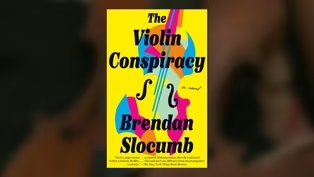
A Continued Conversation with Brendan Slocumb
Clip: S7 Ep8 | 12m 44s | Learn about Brendan's debut novel, Symphony of Secrets. (12m 44s)
Providing Support for PBS.org
Learn Moreabout PBS online sponsorship












Support for PBS provided by:
Write Around the Corner is a local public television program presented by Blue Ridge/Appalachia VA