Write Around the Corner
Write Around the Corner - Brian Castleberry
Season 6 Episode 2 | 27m 24sVideo has Closed Captions
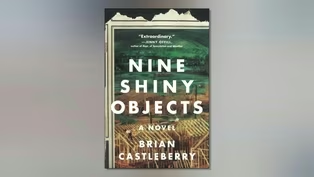
We’ll visit with Brian Castleberry and discuss his novel, Nine Shiny Objects.
On this episode we’ll visit Richmond, Virginia, and Brian Castleberry where we’ll discuss his book, Nine Shiny Objects. His novel covers a timespan from 1947-87 and follows a wide cast of characters all seeking some kind of meaning in a nation often defined by its chaos.
Problems playing video? | Closed Captioning Feedback
Problems playing video? | Closed Captioning Feedback
Write Around the Corner is a local public television program presented by Blue Ridge/Appalachia VA
Write Around the Corner
Write Around the Corner - Brian Castleberry
Season 6 Episode 2 | 27m 24sVideo has Closed Captions
On this episode we’ll visit Richmond, Virginia, and Brian Castleberry where we’ll discuss his book, Nine Shiny Objects. His novel covers a timespan from 1947-87 and follows a wide cast of characters all seeking some kind of meaning in a nation often defined by its chaos.
Problems playing video? | Closed Captioning Feedback
How to Watch Write Around the Corner
Write Around the Corner is available to stream on pbs.org and the free PBS App, available on iPhone, Apple TV, Android TV, Android smartphones, Amazon Fire TV, Amazon Fire Tablet, Roku, Samsung Smart TV, and Vizio.
Providing Support for PBS.org
Learn Moreabout PBS online sponsorship[♪♪♪♪♪] -♪ Every day every day Every day ♪ ♪ Every day I write the book ♪ [♪♪♪♪♪] -Welcome, I'm Rose Martin, and we are Write Around The Corner in Richmond, Virginia, with author Brian Castleberry.
His book, Nine Shiny Objects takes us on a 40-year adventure, 1947 to 1987.
Imagine seeing twinkling lights over the Cascades.
What are they?
A group called the Seekers is formed to try to make the world a better place.
There's so much to this story, and I can't wait for you to hear about it.
Hi, Brian.
-Hi.
-Welcome to Write Around The Corner .
-Thanks for having me.
-So in that opening, we tell people a little bit about Nine Shiny Objects .
And we'll get to that in a couple of minutes.
But you actually didn't grow up in Richmond.
You grew up somewhere in Oklahoma.
Small and rural?
-Mm-hm.
Yeah, I grew up mostly in a town called Meeker, Oklahoma.
The nearest, um, you know, town of any real size, close to it is Shawnee.
So it's kind of east of Oklahoma City.
When I moved out of Meeker, I moved first to Oklahoma City, and then started moving around the country for a while and... but Oklahoma was always my home base.
That's where most of my family still lives, so.
-Oh, that's great.
Well, I understand that you received... your aunt sent you a box of classics for young readers.
And that's what really started you on this quest of reading, and then we'll get to the writing.
-Yeah, absolutely.
My-- my Aunt Charlotte.
At the time, she was a schoolteacher in Kansas.
She ended up moving back to Oklahoma after a while.
But yeah, when I was ten years old, she sent me as a Christmas gift, a box of those, you know, "rewritten for children" versions of classics.
So it had like Sherlock Holmes and Dumas, and all, you know, all that kind of-- kind of stuff, but especially, it had Dickens.
I think it had two Dickens novels.
And that box of children's classics got me into Charles Dickens, who was really, really important to me.
But also, yeah, those books, yeah, made me fall in love with reading, fall in love with books.
I think, I don't think I would be a writer without that.
Not happening, so.
-Well, and I love the story of it coming as a present, right?
It's something that's endearing because it came from your aunt.
But your path took a little bit of an interesting turn because you were in school for a while, and then you left school for a while.
-Mm-hm.
-And then you kind of experimented doing poetry slams, and all kinds of great jobs.
Great fun jobs.
-Mm-hm.
-Share a little bit about your story with us.
-Yeah, I started college at UCO in Edmond, Oklahoma.
And I didn't make it very far at all.
At the time, I thought I wanted to be an accounting major, which I can't imagine myself doing now.
Nothing against accounting.
But I just, I can't imagine it happening.
And I didn't even finish the first semester before I just kind of drifted off and, you know, did other things, probably partied too much.
And then-- and then yeah, I just had a bunch of different jobs.
I waited tables, worked in kitchens.
I worked for my friend's independent company that made, like, spray-painted T-shirts for carnivals and fairs.
And so, we kind of went on the road with that for a little bit.
Yeah, I moved a lot of places, and pretty much just tried to survive until I finally decided to go back to school after about seven or eight years of kind of wandering around.
-Well, there was a little writing gig in there when-- ghost writer for a self-help guru.
-Oh, yeah.
Yeah, yeah.
-So that had to be interesting.
-Yeah, that was actually after I got through college and-- and got my grad degree.
I-I-I wrote, ghostwrote, three books of health advice.
I'm not especially proud of it, because a lot of that health advice wasn't necessarily scientific all the time.
But, but it was a way to survive.
Yeah, a way to stay alive and pay the bills.
-But you still found that writing, that-- that urge to write.
-Oh, yeah.
Oh, yeah.
-So then tell me about the poetry slams?
-Oh, yeah.
Yeah, that was-- that was, I guess, you know, really important as far as realizing that I could do something as a writer, that I could actually be a writer.
It's the late '90s.
You know, everybody was going to these poetry slam things at coffee shops and everything.
And there was a little place in the Paseo in Oklahoma City, a kind of artsy neighborhood, that had poetry nights.
I think it was Wednesday nights that we did those.
And at first, I just went to-- to see other people.
So I was into the, like, all the Beat Poets and people like that back then.
And at first, I just was there to listen.
And eventually, I got up and started reading things and writing poetry.
And yeah, and at some point, kind of slowly drifted over to fiction.
And now, I couldn't write a line of poetry if I had to.
-Well, I found it interesting that even though through the course of these jobs, you had a chance to meet someone pretty famous, but you didn't know who she was.
-No, yeah.
Yeah, I know the story.
I mean, yeah.
When-- when I was working with my friend Jason making the T-shirts, we were at the State Fair in Texas.
And Beyoncé Knowles came up and bought a hundred T-shirts from him.
All the designs that were up there.
There's still pictures of her wearing one with a horse on it that says "Houston Girl" on it.
But yeah, at the time, we were these punk rock kids that were just completely kind of unplugged from society.
We didn't know what was happening in pop music.
It was just kind of this, you know, glowing figure just appeared in front of us that clearly had security guards.
-And who wanted to buy T-shirts.
-Wanted to buy some T-shirts.
And then, it wasn't until the whole entourage had left that the kids still lingering around said, "That's Beyoncé..." so.
-You're like, "Wow, okay."
-Who's that?
-Yeah, right.
-And of course, now she's Beyoncé.
It's like... -Right.
-You'd have to just be living under a rock not to know.
[laughs] -ROSE: So, you know why--?
-That was 20 years ago.
Twenty-plus years ago.
-ROSE: Wow.
-Yeah.
-And she still wears the T-shirt, I bet.
I'm sure she does.
I'm sure it is one of her favorites.
I'm sure of it.
-Sure.
-So your wife is an archaeologist with Colonial Williamsburg.
-Yeah.
-Is it true that, on purpose, you were married in Vegas by an Elvis impersonator?
-Yes.
Yeah.
Yeah.
Yeah, we wanted to have the cheapest version of a wedding we could.
This is back in 2004, I guess.
2005.
I should probably know that.
-You should probably know that.
Yeah, I'm thinking you should probably know that.
-Yeah.
And we, yeah, we decided to go to Vegas and hire an Elvis impersonator.
It was a whole lot of fun, and made it a lot less stressful.
And, you know, we didn't have to bring everybody's family and a huge group of people or anything.
And so, we just ended up kind of having a great time, hanging out for about a week and wandering around.
And the Elvis impersonator we got had just had... he'd just been on some reality show where he was, he had gotten plastic surgery to try to look more like Elvis.
-ROSE: Mm.
-And he wasn't completely healed from it.
So it was actually a very strange situation.
He still looked kind of odd.
But it was still incredibly fun.
We got to ride in the pink Cadillac back to the-- you know.
-And you've got memories for a lifetime.
-BRIAN: Yeah.
-So currently, you're a professor at William & Mary.
-Mm-hm.
-All right.
So here in Richmond, you've got chickens, and you've got a cat, you've got some dogs.
-BRIAN: Mm-hm.
-And seems like you're living an amazing life as a writer.
So I'm curious, Nine Shiny Objects is based on UFOs.
Nine shiny objects in the sky.
Well, maybe they're your foes and maybe they aren't.
Do you have a personal experience out in Oklahoma in the night sky, looking up, Brian, and seeing, I don't know, something shiny?
-I definitely did spend a lot of time staring up at the night sky in rural Oklahoma.
And we actually lived right next to one of those giant radio towers that was always blinking.
So I spent a whole lot of time staring out my bedroom window.
You know, especially in junior high, just kind of bored out of my wits and watching this red light blink and blink and blink up in the sky.
But yeah, when I was younger, I-I-I went in for all that kind of stuff.
I loved stories about UFOs, you know, Bigfoot, anything that was like a secret, you know, Loch Ness monster, ghost tales, stuff like that.
I went through a long phase of really being into that stuff.
And in the book, I guess I kind of use it as a device to open up the story that's kind of more about like, you were talking about the seekers, this movement of people who, yeah, decide like, well, if, if we were to suddenly be visited by aliens or something, what would they think of us?
And, and, and they take the odd track of deciding, well, let's try to make this a better place.
And, and so, it kind of gets the whole story off the ground is that, you know, that idea of whether or not they really saw them, or what they saw was real or whatever, gets the whole kind of ball rolling.
-And it does, because then you've had an interest in kind of the fringe movements all the way through, growing up.
So having the seekers be a kind of fringe movement, that sees the world in one place and wants to-- wants to see the world in another place.
But it's really interesting, because the way you laid out this book, we've got the nine characters.
We've got five years in between them.
But yet, each of them are in their own time period that's really carefully constructed.
I got lost in each-- in the chapter for each time period, I'm like, "Oh, I know what was going on during this time.
I know what was going on during this time."
What was the research like, and why did you choose to-- to structure it that way?
-Yeah.
Yeah, I wanted to tell a story that was really, really big.
In a sense, I wanted to tell the story of that 40-year period, kind of in the post-war America all the way up into the '80s.
And, and, you know, through the Civil Rights Movement and-- and kind of track, you know, the changes that this small group, you know, got started, and the people that didn't like them and kind of fought against them.
And I wanted to tell that tale.
So I had this image in my mind of a novel that probably would have been, you know, 2,000 pages long or something.
And one of the first things that-- that clicked into place for me as I was working on it was, well, what if I kind of fragmented it and took it in pieces and told the story from kind of one angle at a time over that, the course of that time.
And then, it was, it was a pretty simple step to be like, "Wait, there's nine shiny objects in the sky, nine characters."
And then I was just, "Nah, like, I'll spread them out every five years."
And that's when as your, the first part of your question about research, like really started to kick in, because then I kind of knew the time periods I was looking at, I knew the stuff that I needed to know more about, the-- the blank spots in my own imagination or memory or knowledge.
And then I, yeah, I just started digging in and finding out, yeah, what would be that like big pop hit that maybe we've forgotten from 1967?
It's not the Dylan song, but it's the, whatever this other, you know, other thing people would be into or something?
And yeah, we, like, what did the clothes look like, and what kind of cars are people driving?
And, but I try to also kind of center each one of them around something kind of political going on in the background of America at the same time.
So that it ends up being kind of a story about like American change during that period.
Not just the kind of pop culture references, but-- but kind of like, what's, what's worrying people, what's on people's minds in each one of these.
-But all of that was a part of it.
I mean, the pop cultural influences, and where people were and what they were thinking, and what was happening, is all so beautifully integrated to where I could see kind of how the characters were evolving, and how you brought them in, again, to meet new people, because nine main characters, you know, that's a challenge in and of itself.
-Mm-hm.
-So as we're reading that, and then I could find out how, let's say someone else met Charlie down the way, and someone else could connect in another way.
So that in a way, the reader put the puzzle together, right?
-Yeah.
-Instead of me sitting back and waiting for you to reveal it to me, you kind of gave us a job... -Yeah.
-I think, as we were doing it.
-That's, I'm so glad you saw that, because that's exactly kind of the way that I, I went into it.
Probably the next thing that clicked for me, after thinking about how to get at this really big novel without, you know, keeping it around 300 pages being a normal-sized novel, was that participation of the reader.
I really felt like this could-- this book could work, you know, around those lines of like a kind of inviting the reader in to do the work with me and connect these characters, as you said, because we do circle back to almost all of them.
They come in and out of the other stories.
They're connected to the other characters.
And the-- but there are those big gaps between, and there's so much of the story that's going on kind of in the background, especially kind of the change over time of the Seekers group.
And what Tzadi Sophit, the guy that leads the Seekers, has been up to over those decades.
That's often kind of off-stage, and you hear about it kind of obliquely, and I wanted the reader to work with me to do that.
And I feel like that's part of what makes novels work anyway.
I think that's something we do.
We kind of work with the authors we're reading to, to remember, "Oh, yeah.
That's an important name from chapter one," or, you know, you know, they said that place was significant in that other-- in that other part of the story.
So I really wanted to lean on that in this book and-- and work with the reader.
-And you really did, because I found myself looking back and thinking, "Ooh, I wonder if this person is coming back again, or I wonder if they're going to change again.
I wonder if this one's gonna get their act together."
Or, you know, I understand there's one part of the book that I didn't-- I was sad about, and I know you, which you're going to know which part I'm thinking about.
But I read that your wife was also not very happy with you when she was doing a read because there's got to be tension.
I mean, there has to be ups and there has to be downs.
And, you know, as I'm reading that, I'm like, "Oh, no, there's gotta be some, there's gotta be something that's going to be a saving grace here somewhere."
-BRIAN: Mm-hm.
-And you let it play out naturally, you know.
So, is it hard to write actually, those tough scenes that, you know, have to be included?
-Oh, yeah.
Yeah, absolutely.
Because you get so invested in the characters.
At least I know I do as a-- as a writer, I mean, from my perspective.
I just, I begin feeling like these, you know, characters that I'm writing are real people that I know and having conversations with and, you know, I get really invested in where their lives are going.
And, but I can't make them perfect.
But I can't make their lives perfect, because, you know, nobody's is.
It wouldn't be natural.
So yeah, it can be, yeah, it's heartbreaking sometimes.
You-- you realize that a character's going to do something bad, or something, you know, really awful is gonna happen in their life or, you know, some dream isn't gonna work out for them or something like that.
And you just have to kind of follow your-- your gut on it and go through it.
-Yeah.
And then, yeah, follow it through to the end and actually write it and leave it in there because it... there adds that, you know, the tension, like I said in the book, and the characters and the things that happen are just naturally part of it.
You give your students, I guess, and advice to other writers to be a messy writer.
-Hm-mm.
-And being a messy writer means what?
-It means a lot of things.
I think one thing that students and-- and writers that are beginning often do, writers at every stage do this.
They-- they begin, they begin to think that they need to be perfect as they're writing a first draft of something.
As much as they've done it, as much as they tell themselves this, they forget the fact that they're going to revise and revise and revise and revise so many other times.
And so, you kind of get blocked up believing that you need to write every single sentence perfectly, or you need to write every chapter or scene that you're writing, and just kind of come out of your mind perfectly the very first time.
And so, I'm always on the side of, yeah, yeah, write messy, write a messy sentence.
Write-- write a messy chapter.
Discover the story.
I think it's a process of discovery more than it's anything.
I'm sure there are writers out there that kind of go into everything, with-- with everything pre-planned and know where their story's going, know what their characters are going to do, and know the ending ahead of time, things like that.
But I look at it as, it's a process of discovery.
And I find that, yeah, especially my students, really like thinking in that way.
They can, they can just discover their stories as they go, and then come back and clean it up.
And-- -Yeah, because a lot of times, they might not realize, you're not just writing this once and going back for a few grammar things.
-Yeah.
-I mean, it can be rewritten.
Every sentence is going to be rewritten.
You're going to rewrite this book over and over and over again.
-Mm-hm.
-And so, in the title of Nine Shiny Objects , I guess I want to make clear, it's really not a UFO book and people, aliens coming, aliens coming there to do, you know, whatever aliens do.
But you use that as almost a springboard.
And it's really clever because the Nine Shiny Objects could almost be, you know, the characters could be nine shiny objects.
Nine Shiny Objects could be the different things that happen in people's life, you know.
So I thought that was very clever of how you use that kind of as a springboard for the book without letting people think, "Oh, you're going to be reading a book about aliens."
Right?
So it was a way to hook 'em, I think, in a way.
-Yeah.
Yeah.
And it ended up allowing me to, to do a couple things that-- that interested me at least was thinking about kind of the, the buildup of paranoia in American culture over the last half-century or so.
And how, you know, UFOs are such a big part of that belief that, you know, somebody's hiding something from us.
-ROSE: Right.
-What, what, what do they mean, and what are they?
And kind of letting that play out over the time.
-ROSE: So it's like taking a look at that post-war America.
And so, for all of the characters in the post-war America, you know, seeking faith, seeking understanding.
-BRIAN: Yeah.
-Seeking community.
-Yeah.
-So the seekers... -Mm-hm.
-Right?
It could be any of us.
Or it could be all of us.
-Yeah.
-Or it could be all the people that we meet along the way who are seeking that answer or seeking that something.
-That's exactly right.
Yeah.
Each one of these characters has their own thing that they're searching for.
Even right in the middle of the book, there's a character named Skip Michaels, who is going to decide to, you know, throw his life out the window and make a big change.
And it's not necessarily a great decision on a kind of moral level.
But, but he even is, he's seeking, right.
He's trying to find like, "Where do I belong in this?
And is it too late for me?
Do I have a chance?"
And really, every one of them, whether they're-- you know, artists, homemakers, you know, from all walks of life, and they all have something that they're looking for.
And I guess I would say, too, that thinking about that idea of them being kind of shiny objects.
I tried to make each one of the chapters also center on kind of a shining moment for the character.
Like there's some kind of big event that happens... -ROSE: Mm-hm.
-...within each chapter.
That's really their event and may kind of resonate back on the overall plot of the story.
But each one of those chapters and each one of the characters gets that opportunity to have like, well, here's their kind of life-changing moment.
And the reason we zeroed in on them for this, you know, chapter, for these couple days, maybe that we see them or something, so.
-So we're right to read into the whole idea of Nine Shiny Objects , and all of us being seekers at some point in time, along with kind of the fringe movements that we find ourselves in, in America and some of the groups that, you know, emerged during this 40-year period of this journey that you take us on.
-Yeah.
Yeah, absolutely.
Yeah, I was really interested in, you know, the way that the kind of what, especially in hindsight, looks like kind of a monoculture, the late '40s and 1950s, you know, broke up in the 1960s and '70s, and went in all kinds of different fragmented directions.
And that's only continued, we've just continued to kind of split apart now, now that we're in this internet age and social media age.
They're even more kind of fringe and fragmented groups of, you know, mini societies within the society.
And I do feel like that, in a sense, become kind of a defining quality of our culture, in a sense, and, and so I wanted to, I wanted the book to kind of handle some of that and, you know, touch on some of that stuff.
-But there's also, I think, two versions of the American dream.
-Mm-hm.
-Because we see the idea of the hope, right, and the unbridled sense of what's coming and wishful thinking.
And then there's the other part of the American dream.
And there's the reality of the things that you need to deal with.
So you do a beautiful job of balancing that through the characters because there's a little bit of the characters that I think you-- I think you're asking me to see myself.
I think you're asking me to see myself in different characters, or in different situations.
Was that a conscious thing?
So you're also having us as readers not only put that puzzle together, but to kind of reflect on where we are in our own lives.
-Yeah.
-And what kinds of things are we doing or seeking?
-Yeah.
Yeah, yeah, exactly.
Yeah, I'm glad you saw it that way.
I was definitely aiming for-- for an effect kind of like that, so that we kind of sink into each one of the characters.
And then, at least for me, as a writer, I always feel like I...
I kind of embody the characters or there's a little bit of me in the characters at each stage.
But I did, yeah, I was kind of consciously thinking about, yeah, how-- how this can show a reader, as you say, kind of different sides of themselves, different stages themselves, and also reflect on yet that bigger picture of America.
And all these characters are American characters, they don't all agree with each other on pretty much anything.
But they're, yeah, they want something, they're looking for something.
And, and they have something, you know, good about them.
They have something valuable about them, wherever they're... whatever angle they're coming at, at the issue from, so.
-And I think, as people pick up this book and read it, you're going to get thrust into what was going on in the '60s... -Mm-hm.
-...'70s, being in a rock band, playing video games, the early on, and you know, editions of video games, and then also the struggles of just, you know, growing up or being in families, and things that salesmen or all of the different things of American culture that we know, and we expect, it's all in there, sprinkled with different characters that we can find something in there for all of us.
Would you be willing to read something for us?
-Yeah, absolutely.
Yeah, I thought I'd read from pretty early in the book, the character of Oliver.
His-- his chapter is called A Leap , and it's set in 1947.
And this is right after he-- he's kind of shaken up already.
Something kind of scary happens in the first few pages.
And he's-- he's-- he runs off to a café to get something to eat, runs into a used newspaper and picks up the story of the sighting of the nine shiny objects of the Cascade Mountains.
And this picks up right after that.
"He read the story at least three times.
"Then he carefully ripped it from its surrounding page.
"Back in his one-room apartment four flights up, "he stared through the open window "trying to make out the stars from all the city light, "feeling a familiar buzz, even hearing it, "behind his ears.
"Once when he was onstage at an audition for The Front Page , "this same buzzing overtook him, "and it was like the whole theater "had filled with insects "fluttering in the unnatural light.
"Words had spilled out of him then in a sort of ecstasy, "but when he turned to the wings, "another actor was wagging his head and laughing out loud.
"This time, though, Oliver didn't feel any shame, "and when he read the first lines of the news story again, "he felt the buzzing coming on "with even greater force like a drug.
"The next morning, he was out of Chicago "on the highway, thumbing his way west "with anyone who would take him.
"He started with 28 dollars to his name, "and by the time he reached Boise, Idaho, "where he was stuck for two days "before finding a ride for the final leg of the trip, "he was down to 19.
"Turns out a hitchhiker with any money at all "is expected to pick up the lunch tab.
"He'd bought food for a salesman and two truckers, "and coffee for a pair of women "who looked white as anything "but could hardly speak a word that wasn't Spanish.
"But the colored family with their trunk overpacked "with everything they owned and three kids "stuffed into the back seat "with his long legs and arms in their way "wouldn't hear of it.
"They insisted on covering his dinner "and a sandwich to pack for his next leg.
"The Stuarts.
Jim and Tandy and the kids.
"They played a game of rhyming funny words and laughing "that he never caught on to, but which warmed him inside.
"When he parted with them in Boise, yes, in Boise, "they were settling for a job, likely the only Black family "anyone in that city had ever seen.
"And without him asking, they offered to let him sleep "curled up and cramped in the back seat of their car, "outside their rental house, under a tall fir tree.
"The following day, "standing along a narrow state highway "with a clear view of rolling blue mountains on the horizon, "he was struck by the thought that one of the first things "those people in the flying saucers-- "and he never had any doubt there were people-- "would think about the human race was "what a bunch of narrow-minded cowards we were, "running off to our little corners, "pointing hateful glares at anyone who looked "or sounded or acted any different.
"They'd probably laugh.
"People from the skies.
From distant planets.
"He thought of them dressed in clothes "made of shiny tinfoil, "outfitted with transistor radios, "their lives a lackadaisical glide between stars, "full of spare time, "talking philosophy and poetry "with their feet propped up on thick down pillows.
"Yes, they'd laugh at our foolishness.
"And if they meant well-- and surely, why doubt it, "they meant well-- "they'd swing down out of the air "and settle our troubles for us, "get everything in line, "have everyone shaking hands with everyone else.
"He could see it, America in another ten years: "the whole melting pot getting along, "focused on tomorrow, a gleaming technological utopia "of television communicators and robot cafeterias "and trains zipping along at a thousand miles an hour.
"Even out here, deep in the old frontier country, "there would be magnetic rails to ride in cars "that took you around without having to steer, "and nobody with any real jobs, just living life, "anything of want a distant memory.
"Nineteen fifty-seven.
"The numbers seemed to hang out before him "in the thin mountain air.
"Yes, ten years on, in '57, all this would look different "and everything would have changed.
"Hell, ten years earlier, when he was only 20, "there was no European war and no Pearl Harbor, "and it was just the long legs of the Depression "stretching out ahead of them.
"Things could change fast.
Look at him now, even.
"A couple days before, he'd been in Sullivan's, "watching Necky collapse out of view.
"And now, here he was "in some place he'd never dreamed, "the sort of place you expect the cavalry to ride through, "a landscape made for Randolph Scott or Gary Cooper, "delivered here by a saintly colored family "who didn't ask him for a dime.
"And him a stinking pool hustler, a would-be actor.
"If he could set off like this in no time flat, "meet people like the Stuarts, "already feel like he'd walked out of an old skin, "then there's no reason to think "a whole nation couldn't make a change, "couldn't turn a corner, if the right thing was presented under that nation's collective noses."
-That's a great passage to set up what's going to be happening and what-- how the journey that you're taking us on through the rest of the 40 years.
Thank you so much.
-Thank you.
-My special thanks to Brian Castleberry for inviting us here to his home in Richmond to share his book Nine Shiny Objects with us.
It's a great book, and I think you're gonna really enjoy it.
Please join us online for our extended interview with Brian.
He's going to be sharing a little bit about his next book, and what's coming up next for him, and it sounds wonderful.
Please tell your friends about us, and I'll see you next time Write Around The Corner .
-♪ Every day every day Every day every day every day ♪ ♪ Every day I write the book ♪ ♪ Every day every day Every day ♪ ♪ Every day I write the book ♪ ♪ Every day every day Every day ♪ ♪ Every day I write the book ♪
A Continued Conversation with Brian Castleberry
Clip: S6 Ep2 | 14m 51s | We dive deeper into Nine Shine Objects and hear about Brian's next novel. (14m 51s)
Providing Support for PBS.org
Learn Moreabout PBS online sponsorship













Support for PBS provided by:
Write Around the Corner is a local public television program presented by Blue Ridge/Appalachia VA