
Write Around the Corner
Write Around the Corner-Cameron MacKenzie
Season 3 Episode 2 | 28m 11sVideo has Closed Captions
Explore a complex Pancho Villa in Cameron MacKenzie’s debut novel.
When you hear the name Pancho Villa do you think bandit, or hero, or scoundrel, or maybe, Robin Hood for the poor peasants in Mexico? Explore a complex Pancho Villa in Cameron MacKenzie’s debut novel, The Beginning of His Excellent and Eventful Career.
Problems playing video? | Closed Captioning Feedback
Problems playing video? | Closed Captioning Feedback
Write Around the Corner is a local public television program presented by Blue Ridge/Appalachia VA
Write Around the Corner
Write Around the Corner-Cameron MacKenzie
Season 3 Episode 2 | 28m 11sVideo has Closed Captions
When you hear the name Pancho Villa do you think bandit, or hero, or scoundrel, or maybe, Robin Hood for the poor peasants in Mexico? Explore a complex Pancho Villa in Cameron MacKenzie’s debut novel, The Beginning of His Excellent and Eventful Career.
Problems playing video? | Closed Captioning Feedback
Where to Watch Write Around the Corner
Write Around the Corner is available to stream on pbs.org and the PBS app.
Providing Support for PBS.org
Learn Moreabout PBS online sponsorship[♪♪♪] ♪ Everyday everyday ♪ Everyday everyday ♪ Everyday ♪ Everyday I write the book - Welcome.
I'm Rose Martin, and we are Write Around The Corner in Roanoke.
So, when I say Pancho Villa, what do you think of?
Bandit?
Hero?
Scoundrel?
Maybe a Robin Hood for the poor?
Whatever your answer, you're right.
So, we're here with Cameron MacKenzie.
His debut novel takes us into this treacherous and an interesting life of Pancho Villa.
And his debut novel, The Beginning of His Excellent & Eventful Career.
We're going to dig in.
Hi, Cameron.
CAMERON MACKENZIE: Hi.
How you doing?
- I'm doing great.
So, I've got to know, and full disclosure, I did not know a lot about Pancho Villa when I started reading your book.
How on earth did you ever decide, this is the guy that I wanna learn about and write about?
- Gosh.
At the time, I was reading some Cormac McCarthy, Blood Meridian.
I loved that book, and I was watching Deadwood at the same time.
I don't know if you're familiar with Deadwood on HBO, but I never really liked the idea of a Western before.
But as I started to get, really, both into those two texts, I started to see the possibilities of a Western.
And I was also reading at the same time, I was finishing up grad school, a lot of stuff about revolutionary actions and things.
Tahrir Square was happening.
So, I was trying to figure out how we could blend all of these things that I was interested in.
And really, I was just wandering through the Temple Library, which is where I was at, Temple in Philly.
And it sort of jumped off the shelf at me, the Memoirs of Pancho Villa .
- Okay, I've been to a lot of libraries-- - Yeah.
- --and I can't think of anything like jumping off the shelf at me.
I don't like that.
So, okay.
[laughs] - Yeah.
I took it off the shelf, and I opened it, and I looked at it, and after about the first paragraph, I said, "I don't know who this person is, but I love him already."
Just the voice.
It's so interesting, but mysterious at the same time, but then trying not to be mysterious.
And I said, if I could capture this somehow, if I could somehow project this, I need to figure out who this person is.
- Okay.
So, let's wind back, and let's figure out who Cameron MacKenzie is.
- Okay.
- So, growing up, were you always interested in libraries and Westerns or this kind of a genre?
What was it like?
- Yeah.
Gosh.
Not Westerns at all.
What was I interested in?
Ninjas.
[laughs] Transformers.
G.I.
Joe.
Yeah.
I grew up in Richmond, Virginia.
I was there 'til I was about five, and my family moved to Maryland for a few years.
And then, I sort of grew up in Northern Virginia, Ashburn, Virginia.
I spent a lot of time really playing sports.
And went to JMU and played rugby there.
But at the same time, that was also balanced with, really, this love of literature that started, gosh, Hemingway and Faulkner.
Those were the two big ones and that sort of moved out into Eliot and Pound, then Wallace Stevens, and things like that.
And that sort of opened the door for me, by the time I got to college, to really explore and knock around in that as much as I could.
- Who was your influence?
Those are some pretty heavy hitters.
So, when you think about elementary school, and middle school, were your parents really lovers of literature?
Is that-- was that the inspiration?
- My mother was an English teacher.
ROSE MARTIN: Okay.
- She had been.
She-- So, she encouraged it a lot, you know.
One of the things that, when I think about this book, is that my dad is a storyteller.
And I didn't realize that really until relatively late into the book when I realized that it was on some level, my dad telling me this story.
- Hm-mm.
That's interesting.
So, what kind of stories did your dad tell you?
- [laughs] You know, he would always tell stories about his family, I think, and the people that he worked with, you know.
- Does anything ring true for you as... ring in your mind right now like, "Oh, my gosh.
One of my favorite stories that I heard from my dad."
- He told a story about a crew.
He worked in West Virginia at a power plant, and he told a story about a crew that had come from a deeper part of West Virginia that I can't remember what they were doing at the plant, but one of the guys was a champion arm wrestler.
And so, there was another guy that worked at the plant that also believed he was a champion arm wrestler, and this led to a series of battles between these two guys, and lots of bets and things like that.
And I remember my dad telling me that story, and me thinking that was cool stuff.
- So true stories, or did he make them up as if he was writing a book?
- I'd say embellished stories.
- Okay.
[laughs] Oh, I love those kinds of stories, right?
Oh, that's fun.
So, that early interest in hearing a story unfold, do you think that was a little springboard for you?
Were you a storyteller also?
- You know, I mean, he would spellbind me with these things.
I think I remember writing stories in grade school.
That was always my favorite part really of the curriculum, and I would take all this time, I would miss recess so I could finish writing this story.
Much more writing than telling for me, I think.
I enjoyed, you know, getting the words on the paper, and then, trying to move them around.
- Mm.
That's interesting.
So, do you remember one of your first stories?
- Oh, gosh.
[laughs] I remember a story about a dog that somehow made the Olympics.
I can't remember how the dog made the Olympics.
I can't remember what the dog was doing to get there.
- Well, I'm a dog lover, so I'm glad the dog was in the Olympics.
- Yeah.
- So let's fast forward.
You get through high school, you end up following in your mom's footsteps, right?
Teaching English?
- I do, yeah, yeah.
Yeah, being a teacher.
I got out of really college, and the last thing I wanted to do was teach English.
ROSE MARTIN: It wasn't?
- The last thing I wanted to do was explicate another poem, but I did want to live in another country and learn another language.
I thought that would be a really important thing to do.
I wanted to get paid while I did that.
And so, I ended up teaching English in Japan for about a year and a half.
And really, once I started teaching, I said, "Oh, I can do this.
I understand this.
I enjoy helping students.
This is great."
So, when I came back from there, I decided I would go to grad school to try to get a PhD.
- And you did.
CAMERON MACKENZIE: I did, yeah.
- And you did.
Congratulations.
- Thank you so much.
ROSE MARTIN: And so, from teaching English, you kind of still had this yearn to get these words down on paper.
You got Pancho Villa jumping off the shelf.
CAMERON MACKENZIE: Right.
- And you're thinking, it's time to write a novel because you've done essays, you've done-- CAMERON MACKENZIE: Sure.
- --contributory works for magazines and other things, but then, we've got this baby of a novel that just needed to come together.
How long did it take?
- From the time I started writing to the time it was accepted for publication, because I was writing and rewriting, constantly, probably something like five or six years.
- Have you played with it a lot during that time period?
- Oh, gosh.
- Editing, and--?
- Yeah.
I wrote it in third person.
I wrote it in first person.
I created characters to tell the story.
I got rid of those characters.
I didn't know what I was doing at all.
I just sort of kept spinning out scenes.
The narrative voice was all over the place.
You know, when you're writing a novel, and you haven't written a novel before, it's like you're sort of inventing it, you know.
And no one can really tell you how to do it unless they themselves have done it, and half the time, they don't know how they did it.
You know, so, you just have to sort of teach yourself, and there's a lot of, you know, blind alleyways, a lot of dead-ends.
And at the end, I looked at the stack of papers that I had.
So, what can I do with these?
And I remember writing out, this was right when I thought I was done with the book, I'm like, "I'm not going to have a novel.
It's going to stay in my drawer for the rest of my life.
This is going--" But I took out little note cards, and I went through all the scenes that I had, and I wrote the scenes on the note cards.
And I sat down on my floor, and I laid them out in a way that, "Okay.
This would work.
Now move this over here."
And then, once I did that, and it took an afternoon, once I did that, I said, "I think I actually have a book with what I have."
- That's exciting.
That's like that moment of, "Wow".
This research has come together.
All the binders of everything that you had, and character development, you can put those aside and now focus on getting-- - Exactly!
ROSE MARTIN: --the core out-- - Now I have the thing.
- Yeah.
I've got a book.
I've got a book.
Well, I read somewhere that you had said that you had the realization that you were discovering your own severe limitations as a writer.
- That's true.
- What did you mean by that?
- Oh, gosh.
When I would look at what the scene demanded, and what the story demanded, and I would ask myself if I was capable of delivering on that and, you know, profound doubts that I couldn't, and, you know, sometimes knowledge that I'd never written anything like that.
I didn't have the ability to do that, that sort of thing.
So, I sort of wade into it, you know.
But really, to look down the barrel with that and say, "I can't do that."
That's bad on one level 'cause it's disappointing.
But it also clarifies what it is you can do, you know.
And it really tells you who you are as a writer, what you're capable of, what you're not capable of.
- So, who are you?
- [laughs] For this book, you know, it's funny, as an academic, I was certainly trained to speak in, you know, universalities, right?
Like, this is how things are.
And when, you know, at the end of this, I realized that's not true at all.
It's, you know, it's really just this one thing.
You know, it's like, what did I do.
And, you know, as far as this book, trying to write it, trying to put together all the things that I had read to come up with a voice, you know, that felt natural, and that felt real, and felt true, I would probably say it's a distillation of all these other things that I've read and all the things that I've wanted to do, you know, at some point during the book, and I always ask myself, "Who am I writing the book for?"
And I finally just wrote down the names of about three or four authors that I really admired.
And I said, I'm going to write the book for them.
- And who are those people?
- Oh, gosh.
Alain Badiou, who is a philosopher.
Cormac McCarthy, who I read and loved.
Edward P. Jones, another writer whom I love, and Ron Hanson.
- Not your mom, as an English teacher?
Not your maman.
Not your family.
- Not my mom.
- But how were they as critics reading your work?
I mean, it makes you a little vulnerable and raw-- - Oh, gosh.
- --to put your whole life, and like you just said, you were looking at your own limitations and then you were bringing parts of yourself into this book.
And you're pouring you into here and there's a little bit of hesitation, I would think, when you pass it off to someone and you're like, "All right.
Let me... Give me your thoughts.
What are you thinking?"
- Yeah.
What did my mom say?
She said it's a man's book.
[laughs] And my dad wanted to talk about particular scenes.
ROSE MARTIN: Oh, okay.
- My mom is certainly more of the reader of the two.
My dad will read, you know, history, things like that.
He didn't really read a whole lot of fiction.
He was more interested really, I think, in how it came together.
- Well, and that process is fascinating.
And I also read somewhere that you said, you know, covering Pancho Villa was a little intimidating just because his persona was so much larger than life, but yet, it was so multidimensional.
And you bring through that multidimensional part of him in here.
How did you reconcile those things?
- You know, when I started with Pancho Villa, I really just had a voice, and it was a voice that I found out, later on, wasn't even his voice.
Something that I thought was the memoirs of Pancho Villa was actually a novelization by a Mexican writer, Martín Luis Guzmán, of interviews that he had found with Pancho Villa.
He had met Pancho Villa.
He said Pancho Villa doesn't talk like the books say.
Pancho Villa talked like this, so he wrote this out.
And that was sort of the spark of it, but then trying to dig into the historical character of Pancho Villa.
And the deeper I got, the more I realized how big he was, how intelligent he was, how charismatic he was.
And that was another challenge, is that I realized that I couldn't write all of Pancho Villa, and yet I had to write some of Pancho Villa.
So, I had to sort of distill what I understood to prevent-- to present a character that matched up with... with something that would fit the story and something that was internally consistent all the way through.
- And that's where the title comes from because you decided to start at the beginning-- - Right.
- --of his excellent, what is it... his eventful career.
- Excellent and eventful career.
- And you know, he is a little-- he's intimidating.
He's a little psychopath.
I would, you know-- - Yes!
- You know, and on the other hand, he's talking about, you know, wanting to not have people drinking because they're not gonna be of their right mind and then he's also, on the other hand, wanting to give money to the poor.
And then, he'll just shoot you in the head if there's something, you know, that's not right.
So, what a complex, complex guy.
- Yeah.
- So, let's talk about the book.
You open it up with him as a young boy, and you decided, "Let's start here."
Why?
- So, the thing that the story-- one of the things about Pancho Villa is, it's so many stories.
He's still such a contested figure, politically, historically, even the major biographers struggle to settle on a set series of events.
And, you know, people were telling different versions of the events as Villa was alive and he was altering them, telling them different ways, certain times, but I loved the story that really kicks him off into being a bandit which is his decision to shoot his family's landowner after he had-- And it's unclear what he did to Villa's sister.
Did he sexually assault her?
Did he make a pass at her?
Did he say something to Villa's mother?
It's not clear.
Again, it's total different ways every time.
But, I loved the absence of a concrete meaning, of a concrete reason.
There's sort of a hole in the middle of Villa, certainly a mystery in the middle of Villa that Villa himself doesn't really understand, but that nevertheless powers him.
And so, you know, from that moment, we could see him make the decision that he wasn't going to really put up with the way that things had been in his life up to that point even though he's, gosh, what is he, maybe 16, something like that.
And that he's going to go in a completely different direction, but one that to him feels natural and correct.
- Well, that charismatic part of his personality, that if he decided, "This is the road I'm going to go, and this is what I think is right," there weren't too many shades of gray in what I read here, right?
He surrounded himself with some pretty interesting characters who were afraid of him, but yet, respected him at the same time.
And then, the other thing that surprised me was the-- there was a scene in here with his mom when he goes home and he's giving her money back, and you see her just kind of sit down and be like, "Who have you become?
What are you doing?"
And there was just a glimmer, it was brief, don't get me wrong, it was brief, [laughs], but you had it in here.
There was a glimmer of someone who maybe did have a conscience and who thought, "What kind of a road have I gone down?
And what am I doing?"
So, did you find that complexity in him as you were developing him and learning more about him that you felt, "I have to bring in part of that all the way through."
So, he's just not this horrible murdering bandit that one scene after another is just violent and gruesome.
- Yeah.
You know, one of the things about a revolution, especially like the Mexican Revolution which is different than say, the American Revolution.
The Mexican Revolution, it really is a grassroots movement from the peasants up, and Villa, being one of those peasants, is really a unique sort of figure in the 20th century in that he was able to lead certainly Northern Mexico in this direction.
But, I wanted to try to figure out what sort of personality succeeds in this chaos, and, you know, as I was going through the book, I realized what I was trying to say is that at some points, the world demands a certain kind of figure.
And it's not necessarily a good figure, but it's what necessary for the next thing to happen.
And I think what I was trying to say in the book is what Mexico demanded at that moment was this sort of figure.
If Villa had been born in another place, in another time, who knows what would've happened.
But because he was born in Northern Mexico at this time, he becomes the leader of an incredibly violent revolution.
But again, within that violence is a, I think in Villa's mind, and in the minds of a lot of characters in the book, a sort of necessary and restorative violence.
And the book, to me, really became an exploration of that violence because it's obviously terrible.
I wanted to look at it from as many angles as I could because of course, the world is a violent place, we see that, you know, gosh, on the news every single day.
And why does that happen?
Why does it continue to happen?
And how does it get excused?
Right?
The cloak of the revolution, the cloak of the people, for the good of this and for the good of that, oftentimes is really just an excuse for violence.
But then, you know, what is the spark of that inherent violence?
And, you know, for Villa, that spark is there.
Now the question that I had, and I struggled with throughout is, is Villa a psychotic or not?
I was really interested in the personality of psychotics.
I do a lot of reading in that.
Is he a sociopath?
Sociopaths apparently don't exist anymore.
The DSM-5 eliminates us from that, so... But again, it's this incredibly charismatic person.
I think a psychopath, really a psychotic, pretends like he understands people.
And that's different from Villa and different from the Villa of the historical record that I could find at all.
Villa really did understand people.
He was very empathic, but he was also committed to his own really success.
And anything that was going to get in the way of that got in the way of something much bigger for Villa than just himself.
And that's why I think he aligned himself so closely with the revolution, you know, for the good of the people.
That sort of thing.
That begins to excuse really his overarching narcissism.
- Right.
Because I was going to bring up the narcissism because, throughout the book, he's his own number one hero.
Right?
He's his own number one promoter and continued to do that, and perpetuate that... that almost myth of Villa you know, throughout Mexico.
But then there's this patriotism love that, you know, he really, at least I was convinced it's in your book, he really did love his country.
And he really did want to protect the people who he felt were wronged in a way, even though the way he went about it, people would question, right?
So, did you find that to be absolutely true that he really was, at the heart of this, trying to elevate the peasants, elevate the poor, and get rid of corruption, but he was doing it his own way?
- Hmm.
Only to a degree that in elevating the peasants, he elevated himself.
Again, I think before he becomes a revolutionary leader, he's searching for a meaning to his own life.
He believes his life to be grand or capable of grandness, but he doesn't know what the expression of that's gonna be until he's presented with this opportunity to, of the revolution, to commit himself to something bigger than himself, and that feels true to him.
But in the course of that, he's like, "Yes.
It's bigger than me, but I'm pretty big."
- Yeah, right.
And I got that.
[Cameron laughs] - He's like, "Yeah.
It's big, but I'm pretty big too."
CAMERON: Exactly.
- So, the other cast of characters who surround him in the book, how many are absolutely historically real and accurate, and how many did you kind of build in there in order to build a cadre of people to enhance the story?
- In the beginning, the first couple chapters, you know, I found people that he had met and people that he talked about, and I built them up into much stronger characters.
I think his cousin, Refugio, especially.
He mentions, you know, he met him, he didn't like him, and then, you know, he dies.
- And I don't like it, yeah.
You have a few of those in there that I'm like, "Ooh.
You are coming back."
- Yeah.
But, I sort of began to understand Refugio as this could be a foil to Villa because one of the problems when you're writing something like this, about a character like this who-- how wide, really, is his range of understanding emotion, things like this.
We need more notes in there.
I'm like, well, who's going to provide the notes if it's from a first-person perspective, right?
This is all through his-- so I had to come up with these other characters that were going to play off him, and they had to be incredibly strong characters, but they also had to be able to bring out parts of Villa's personality that he wasn't willing to bring out on his own.
Right?
And so, in the beginning, it was like that.
I think probably the one character that I really spun was Señora González who converts Villa to the revolution.
In fact, it was her husband, Abraham González, who converts Villa.
- I did love seeing a strong female character in here, I've got to tell you.
As I'm reading through, and I'm thinking, they've got to be a couple of really strong women.
So, I was glad to see that.
- Got to be, because women for Villa, he understands men, and he understands himself to be above all men.
But there's something beyond men for Villa, and that's women.
And so, women are completely outside of his control.
And that, you know, is exciting to him, but also terrifying to him.
- What would you want people, your readers, and our viewers, to know about him?
- About Villa?
- Mm-hmm.
- Oh, gosh.
The historical figure, or the character?
- It may be a combination of both, right?
- Yeah.
Villa, he's a man who believes that he should be powerful, and he's willing to do absolutely anything necessary to grab ahold of that power, and to hold that power.
And he's also very charismatic.
He's able to bend anyone to whatever appeal he wants to bring forward.
I think we can see that certainly in him, but constantly in these sorts of revolutionary movies throughout the 20th century.
And even today, we're talking about fascism, we're talking about strongman dictators, you know.
A lot of these people, I think, share similar characteristics, similar personalities.
- And, you know, he looks-- he lived his life always looking over his shoulder, and ends up being assassinated anyway.
So, well, that had to be horrific.
Would you be willing to read for us?
- Yeah.
Sure.
Absolutely.
- What did you choose?
- So, this is a scene... Villa's really young.
He has shot his landowner and escaped to the mountains.
And then with the winter, he has to come down out of the mountains.
He doesn't have any clothes or anything like that.
And he walks into a town and he's identified as soon as he walks in.
So, they put him in jai and they're going to shoot him, and this is where I'm going to start.
"In the morning before shooting me, "they took me ou to grind a barrel of nixtamal.
"The guard stood by as I sat in the dirt of the yard "in clothes the cleanest I had worn in a year.
"These were the garments given to prisoners "who were all subsequently shot.
"And looking at my legs as they stretched before me "on the dirt of the yard, "I studied the faded and innumerable streaks "at the last life's blood of the executed "as they intertwined in myriad shades.
"'My friend,' I said to the guard, "a fat, lazy man with long mustaches.
"'How many innocent men have you seen "wear these pants into that yard?'
"'None,' the guard spat.
"His hands moved about his rifle without purpose.
"'How many,' I continued.
"do you suppose deserve to be shot like a dog "for the righteous killing of an evil man?
"'I make no judgments of those already judged,' he said.
"The guard was silent for a time and then turned suddenly.
"'Get back to grinding!'
he shouted.
"'And wipe that stupid grin off your face.
"'What is there to laugh about "when you'll be dead inside the hour?'
"I gripped the stone pestle in my hands and I said, "'I go to meet the savior with a pure and open heart "because my actions have been justified.'
"I bent once more to the work "and ground through the grain with purpose.
"My guard appeared to calm himself, "and his rising color told me "that he had become ashamed of his outburst, "that he believed himself to be a man of principle.
"Yet, I suspected by his shame "that it was principle adopted from principled men, "and not otherwise earned.
"'I wonder,' I said to the work under my hands, "'if you feel so justified, my friend.
"You, whose purpose is to shepherd men "into the arms of death "so sanctioned by the dons of the state.'
"This had the desired effect, "and my guard sputtered and gripped his rifle again.
"'You,' I continued, 'who would not judge, "and yet are as much a peasant as myself "and are so ready to betray your own people "simply because a judge with beautiful horses and land "commands you to do so.
"A judge who no doubt secured such things "through the blood of your own family.'
"The guard bent down quickly, "so close that his mustaches brushed against my cheek.
"His breath smelled of rancid liquor, "and he said, 'It is better to kill vermin like you "than to allow you to breed.'
"And at this, I brained him with the pestle "until I felled him like an ox.
"Indeed, I continued to beat him there "after he had ceased to move or to make a sound.
"When at length I raised my head, "I heard not even the birds around me.
"I ran to the low wall, and climbed it, "and headed for the nearby river.
"Out past the few ramshackle houses of stone, "and through a low stand of trees, "I moved, and my thoughts likewise moved beneath me, "buoyant and clear.
"I found a suitable pace and sustained it, moving eastward.
"And as I did so, the day slowed, "much as water around objects which are hard and undeniable.
"And I knew that I had slipped a hand of fate.
"I knew as well as I felt my heart move within me "of its own accord that a rhythm older than the god "who would make mere echoes of this "had risen free of explanation to the face of things.
"At length, I came to a river, and there, "standing as though placed by a hand "was a wild colt watering in the shallows.
"I mounted him, and I rode upstream.
"After a few leagues, the horse tired and I let it go, "and I walked north toward Rio Grande.
"In time, I arrived at the house of a distant cousin, "and he took me in without question.
"He and his young wife made a place for me at their table "and she fed me tortillas and eggs.
"I ate from their plates like the starving boy I was "until at length, my cousin's toddler "began to pull at my pant leg.
"The little boy's face was serious, "round and soft as a doll's.
"I pulled him onto my knee and there we spoke about "ponies, and dogs, and the moon in the daytime sky.
"He told me it was his birthday.
His eyes were as bright as riverstones."
- And even within that passage, you can see the things we've talked about, right?
He can be tender, and yet, he can beat up that guy and kill him, and just leave him on the-- you know, - Without any sort of remorse.
- Without any sort-- yeah.
No remorse whatsoever, just because it was justified to him.
Right?
So, I have to tell you, thank you for teaching me so much about Pancho Villa.
I did not know all about it.
It was great having you on the show, and I really appreciate the work that you did, and best of luck on this debut novel.
- Thank you so much for having me.
I appreciate it.
ROSE MARTIN: You're welcome.
Special thanks to Cameron MacKenzie for inviting us here to Roanoke for sharing his interest and his research and all about Pancho Villa.
If you'd like to know more about Cameron, the research that went in behind the book, and some of the specifics, we're going to get into more of those details in our conversation online.
So, make sure to check it out.
I'm Rose Martin.
Please tell your friends about us, and I'll see you next time Write Around the Corner.
[♪♪♪] ♪ Everyday everyday ♪ Everyday everyday ♪ Everyday ♪ Everyday I write the book [♪♪♪] ♪ Everyday everyday ♪ Everyday ♪ Everyday I write the book ♪ Everyday everyday ♪ Everyday ♪ Everyday I write the book
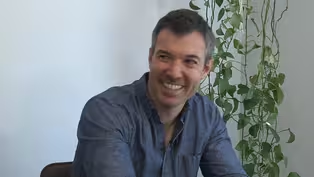
A continued conversation with Cameron MacKenzie
Clip: S3 Ep2 | 15m 22s | Learn more of the story behind Cameron's book featuring Pancho Villa. (15m 22s)
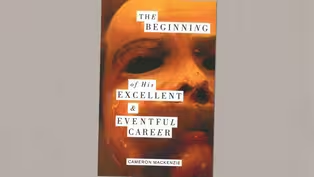
Clip: S3 Ep2 | 3m 54s | Find out the story behind the cover and title of Cameron's book. (3m 54s)
Providing Support for PBS.org
Learn Moreabout PBS online sponsorship










Support for PBS provided by:
Write Around the Corner is a local public television program presented by Blue Ridge/Appalachia VA