Write Around the Corner
Write Around the Corner - Constance Sayers
Season 6 Episode 7 | 27m 51sVideo has Closed Captions
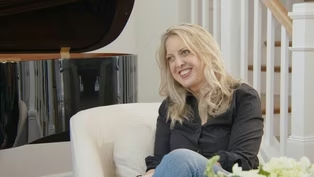
We talk with Constance Sayers about her latest book, Ladies of the Secret Circus.
We’re Write Around the Corner in Alexandria, Virginia, to talk with Constance Sayers about her latest book, Ladies of the Secret Circus. The novel is a suspenseful story that has readers time traveling between present day Virginia and 1920s Paris. It’s full of magic, suspense, and lots of secrets!
Problems playing video? | Closed Captioning Feedback
Problems playing video? | Closed Captioning Feedback
Write Around the Corner is a local public television program presented by Blue Ridge/Appalachia VA
Write Around the Corner
Write Around the Corner - Constance Sayers
Season 6 Episode 7 | 27m 51sVideo has Closed Captions
We’re Write Around the Corner in Alexandria, Virginia, to talk with Constance Sayers about her latest book, Ladies of the Secret Circus. The novel is a suspenseful story that has readers time traveling between present day Virginia and 1920s Paris. It’s full of magic, suspense, and lots of secrets!
Problems playing video? | Closed Captioning Feedback
How to Watch Write Around the Corner
Write Around the Corner is available to stream on pbs.org and the free PBS App, available on iPhone, Apple TV, Android TV, Android smartphones, Amazon Fire TV, Amazon Fire Tablet, Roku, Samsung Smart TV, and Vizio.
Providing Support for PBS.org
Learn Moreabout PBS online sponsorship[♪♪♪] -♪ Every day every day Every day ♪ ♪ Every day I write the book ♪ [♪♪♪] -Welcome, I'm Rose Martin, and we are Write Around The Corner in Alexandria, Virginia with Constance Sayers.
Her book, Ladies of the Secret Circus is going to take us on a magical journey from present day to the Jazz Age of 1920s Paris.
It's magical suspense, a lot of secrets, a family curse, a missed wedding, and a mysterious circus.
Oh, and if you're wondering, the only way to get a ticket to Le Cirque Secret is to wish for it.
Hi, Constance.
Welcome to Write Around the Corner .
-Thank you, Rose, for having me.
I'm thrilled.
-Well, we're so excited to be here.
And these books were really, really fun to read.
But before I get to the books, I want to talk about the very first experience when you were thinking, I don't know, am I a playwright?
Do I want to think about what I want to write?
And actually, you were doing a storyline for soap operas?
-Oh, yes.
Well, yeah.
Well, I can't say that I actually had lofty ambitions when I was in college.
I really wanted-- I had grown up, you know, with General Hospital , Santa Barbara , and I thought that that was, I mean, really what I wanted to do.
I loved the idea that every day you went like by habit to, you know, find out what was happening with these people's lives.
And so, I thought, well, that's what I want to do.
And so, I, you know, took playwriting and screenwriting classes, because playwriting is actually a very, very good training ground for that.
And about the time, though, that I was getting interested in that, they were all canceling all of them.
So, by the time I, you know, left college, there was really nothing that, you know, the soap opera industry was kind of gone.
So, I would have probably gone to New York and done that.
I did, when I was 12 years old, though, write my own soap opera.
And so, it was, you know, I think it was probably 200 to 300 pages of treatment that I would just go and sit down and write every night.
And that's really, I think, where I kind of got the idea that I could have a, you know, basically the kind of continuity and that long relationship with characters.
And I think that's always something that has certainly interested me more than-- I don't think I would have been a great just, you know, screenwriter for one film.
I love the idea of a long series or things like that.
I'm drawn more to that.
-Well, and it was fun to read how you pulled out your sister's typewriter, and you're trying to figure that out and writing the whole thing at 12.
You've got a beautiful home, and thank you so much for inviting us.
-Thank you, yes.
-And this beautiful piano is a part of your life also, so a trained musician and opera singer, and amazing.
And so, the life as a musician, you went to college, and you changed your major and didn't tell your parents?
-I did not.
That's correct.
So, my father was a Methodist minister, and always wanted to be a musician.
And candidly, he probably wasn't very good.
So, he wasn't, you know, but that was always his dream.
So, when I was growing up, you know, music was a big thing.
So, my parents, you know, I've studied opera with a woman from the Chicago Opera for about five or six years when I was very young, and took piano lessons for 14-15 years.
And that was really, I think, more their dream than my dream.
And so, when I went to college, it was, you know, I just always kind of came to the piano and I was like, urgh, I'm not very good at this.
It's not, you know, it was a chore.
And so, when I went to college, I took a writing class and just really kind of rediscovered what I had had as a 12-year-old child, the wonder of the typewriter, and found that, you know, that's - I changed my major, took a little while to tell them because I felt bad.
Like, they'd spent a lot of money that they didn't have, to, you know, for lessons and things like that.
But I think they were happy I had any type of creative pursuit.
That was always what was very much of interest to my parents, both of them.
-Well, and I think it's wonderful they-- not only did they help with that creative pursuit, but that's carried on through all of your books also.
-It has.
-So, that's kind of a soft spot that'll be a little nudge to them to say, hey, thanks about that.
-Yeah.
-But writing is not your full-time job.
Your day job as a media executive has got to keep you so busy.
-I am.
It is.
And I think with the first two books, it was-- you know, you always have all the time in the world to write your first book.
You know, I spent years perfecting that, I got an agent, you know, got it, you know, got it published.
And so, the second book then is a quick turnaround.
You're like, whoa, I need to, and then the third book has also been a tough turnaround just because we were acquired, we were part of the Atlantic.
We were acquired by a private equity firm.
My company is a company called Government Executive, and it's a media and information company, and we were acquired in March of 2020.
And so, in the middle of the pandemic, we, you know, acquired another 13 companies and so, I've been integrating most of them.
So, I do have a full-time job.
I write part-time.
So, there might be things that people don't, you know, necessarily know, but that's... -And I'm thinking, for writing, it's discipline, but yet it's a joy too, because it's not like you... and well, now you have deadlines.
But with that first book, you got to tinker with it, and you got to play with it, and you could take however long you wanted to finesse the sentences.
-Right.
And that book, A Witch in Time , we'll talk about in a little bit, the bonus interview.
But I also was reading that you are very disciplined as far as your writing schedule, a thousand words a day, even if you're sitting there thinking, I don't know how this first draft, which is the toughest for you, happened to come to fruition, right?
-Yes.
And I think again, you know, you just draw on where you can.
You know, so I definitely learned that, you know, that I could write and work.
But then I also, I didn't know how to write a novel, which is a diff-- you know, in graduate school, you learn short stories, that's the discipline that they teach you.
So, I didn't really kind of get the long form, you know, and I would do what everyone does.
I would start 50 pages and I'd stop, start 50 pages and stop, redo the 50.
I was obsessed as everyone is over the first 50 pages.
And rarely do you kind of get into that like mushy middle, which is really where a lot of the book happens.
And so, it took me probably five years to get to understand how to write a book.
And so, as you were saying, like, you know, you do take that first time with your first book.
I think what I was doing with my first book though, was finding my voice.
And I didn't really have that.
So, I was writing rural noir, which was very much that kind of, you know, you've got Ron Rash, Bonnie Jo Campbell, people like that that are writing, and they're very claustrophobic books by nature.
And I do think that, for me, I was not having success there.
I was not - look, the work wasn't very good.
It's just my first novel, just I-- it was an exercise in just learning how to do it.
When I switched over to fantasy and I was just dabbling with it, when I switched over, it was like a light bulb that went off for me, and that was my voice.
And it took me a while.
-I love the story of your agent telling you when that first book didn't sell and you're like, well, gosh, this didn't sell.
Okay, what do I do now?
And she's like, you know what, that thing you sent me, let's get back to that.
-Yes.
Because what happens is, you know, when agents are trying to package you up to a, you know, when they're taking out your book to all of the, you know, the publishing houses, she's like, what else do you have?
So, I'm going to package up this and she's like, oh, that's very intriguing.
And she, you know, read it, and so when the first book didn't sell, and she pulled it, and she said, we're not going to go forward with it, I was devastated because, again, I had, I'd spent, you know, five, seven years, you know, getting this book, and it was not very good.
Like I looked, and in fact, I actually repurposed it for Ladies of the Secret Circus , and probably could only save about 25 pages of it.
-ROSE: Oh, really.
-Yeah.
And so... you know, I definitely was like, you know, well, here's this, I have this, I have, you know, I had a short story one time.
It looked like this, you know.
-Here's when I have everything.
-And you're bundling up everything you have, you know, and so, and gave it to her.
And she said, well, that's better anyway.
And I was like, what, you know, and she was right.
And what I found was that as I was writing that and giving it to people to read, everyone kept saying they couldn't put it down.
I assure you, no one said that about my first book.
And again, like you just have to, but that was the-- definitely A Witch in Time was about me finding my voice, and finding things that I still love to read.
I grew up reading Anne Rice.
I spent more summers going to New Orleans trying to find her house on First Street.
You know, it's a joke in my family's house about my brother having to like, you know, go along with the-- trudging along in the middle of the, you know, oppressive heat to try and find her house.
And I met her one time, and she told me she loved my name.
And, you know... -ROSE: Wonderful.
That does it.
-Yes.
But that's what I love to read.
-Yes, that does it.
So, you also bring a lot of your personal life into your books that you share, which I was very interested to read that you share with a beta group.
Like, you do a test and you're like, does this work?
-Yeah.
-Does this not work?
And what does that teach you?
And what advice would you give to other people about maybe using a beta group if they're starting out, even learning how to do a novel, if they're finding their voice like you did?
-Well, I definitely think that, I mean, that comes from doing workshops.
I always had a workshop setting, whether it was, you know, at George Mason, and then when I didn't have the master's program and wonderful writers like Susan Richards Shreve, who was my, you know, was my thesis advisor at Mason.
And when I didn't have that, then I was seeking that out.
And, you know, the Writer's Center in Bethesda is a phenomenal place, and they have, you know, courses that are virtual.
I mean, it's just a great supportive environment.
So, I always had that and really relied on that.
For example, whenever I-- originally, A Witch In Time was a deathbed confession.
And when I took that to the group, they were like, I mean, we love the lives... Like I had two in a live session.
We love that, but maybe not the deathbed confession so much, and so, you definitely look for that.
From a writer standpoint, I have, like my sister is my first reader.
She knows me well enough to know what is in my head, and she loves me enough to tell me that I didn't, I didn't execute it well.
So she'll be like-- -Sisters are wonderful, aren't they?
-And she's so good.
And she is like, I know what you're trying to do there, you didn't pull it off.
And I'm like, oh, okay, you know, and so I get that from her.
And then, you know, A. X. Ahmad, who is...
The Last Taxi Ride , he's a beautiful writer.
He is also a good friend and a good beta reader for me.
He will...
I find his insight on structure to be better than anyone.
He's an architect by training, and I think that he's just phenomenal.
And so, I get a lot from him on that structure, maybe you want to look at it this way.
And so, I'm looking for different things from everyone.
And then I have, you know, a great friend who, she just loves to read.
And she'll just be like, couldn't put it down.
I'm like, great.
That's what you want.
So, you're looking for things, I think, from each one of them.
-Well, and from that, let's move into Ladies of the Secret Circus.
-Yes.
-Because it was a great story, and I was captured, you know, the opening where I'm thinking, where is this adjustment enchantment thing kind of going, right?
-Right.
-And then, as you beautifully wove the characters and the sequencing and the times, you know, you're jumping us back and forth in time, it was amazing.
Let's give the viewers a quick overview about Ladies of the Secret Circus and what they might be able to find when they open up the pages of this book .
CONSTANCE: Absolutely.
So, the book is about a, I will say, I'll back up for a second, and I did use characters because I think I'd mentioned about the fact that I had another book that didn't sell, and I was kind of in a pinch to, you know, produce a second book.
And so, I went and found my characters from my book that didn't sell and reused them.
They were characters I knew well, I thought, okay, I can put them into any setting.
And so, I did that.
And so, what you have on that is the basis of the character, Lara Barnes, who is, she is - we meet her on her wedding day, and her groom does not show up.
And her family isn't exactly shocked by that.
Apparently, this has happened at some other point and, you know, so there is this sense of like, well, you know, there's some legacy that she finds that she's a part of that she wasn't aware of.
And so, and this legacy, of course, is attached to a secret circus that ran in the 1920s in Paris.
And so, it is her journey to find out-- the quest to find out what had happened to her, what happened to her fiancé, and how is this tied to her legacy?
And it basically is a quest that she goes to find answers to the underworld.
And that's essentially kind of an overview of the Ladies of the Secret Circus .
-And I think viewers would want to know if there's magic.
-CONSTANCE: Yes.
-There are spells, there's secrets.
-CONSTANCE: Yes.
-There's witchcraft, a little witchcraft-- -CONSTANCE: Yes.
ROSE: --and how you deal with demons and magic and weaving all of them through fantasy to where, you know, you're falling in love with Lara and you're thinking, oh, my gosh, this poor girl on her wedding day, you know.
-Right.
-But then, there's a twist with her wedding dress, right off the bat.
And then you're thinking, oh, where is this going?
-CONSTANCE: Right, right.
-You know, and how is it going to be woven in?
-Right.
Well, she definitely...
I mean, I was responding in some ways to some of the criticism that fans had had for A Witch in Time .
And many folks were, you know, were like, I loved reading A Witch in Time .
I just wish it had more magic.
And so, I was like, fair, fair point.
And so, I wanted for people who liked A Witch in Time to have a little bit more magic.
And so, I definitely, when I went through again, made sure that I, you know, kind of brightened up those spots a little bit in the book.
And so, you had her enchanting her wedding gown.
You meet her at the beginning, and you kind of know, this isn't just a normal wedding.
She's enchanting her wedding dress, she doesn't like it, and her mother is giving her grave warnings that you don't want to do this because you have to hold the spell together and someone has to hold the spell together.
If it like, unravels in the middle of the ceremony, it will be a bad thing.
And so, you realize you're not just at any old wedding.
-Right.
And you realize that this is not just an old show of Bewitched , right, either.
-Right.
-So, it goes further, and it goes deeper.
And then you take us to Paris.
-Right.
-And so, we're in 1920s Jazz, and what's going on in Paris?
-Well, you have-- So, Lara finds a, you know, she keeps getting drawn and kind of courted into the circus.
There's a circus that the, you know, the family - her family has this long, they had a long-standing circus in the town that kind of went defunct , when circuses kind of went defunct in, you know, like the 1970s, and it didn't stay.
So, they go to, you know, basically see a similar Cirque de Soleil type of performance because there's a connection between that family and her family.
And there is this kind of courting of Lara as a like, you know, there's something more to her heritage with the circus.
And so, you see her, she stops a woman from dying on the trapeze with her magic.
And then she meets, you know, she meets this kind of carnival barker, who, you know, is giving her... her fortune, reading her fortune.
And she's like, look, if anyone needs it, it's me.
And so, you definitely, I think for Lara, you identify with her as a person who has just, you know, she's confused, you know, her dreams that she had for herself did not come to play, and you're kind of willing to go with her on this journey.
So, yes, she meets, she has this great connection with her mother, but her mother isn't telling her everything.
And that's a betrayal for Lara because they're so tight.
And so, she decides, well, I'm going to go to Paris and I'm taking my honeymoon ticket, and I'm going to cash it out, and I'm going to go to Paris because there's something else that comes into play, which is that they have a painting that might actually be famous.
And so, and it's of the circus, the secret circus in the 1920s.
She also kind of starts to get these journals that take her back into, so then you kind of get, you know, transported then into the 1920s and you learn the story of the two twins.
-So, let's talk about the characters.
So, I'm thinking, she's just been broken up with, she's, you know, she's having a hard time, right.
And then she meets a mysterious guy and a woman who tells her, oh, yes, that's not the one for you anyway.
Don't worry about it, right.
-Right.
-So, then you're thinking, oh, okay, well, who is that man?
And why is he here?
And then, all of a sudden, we're finding oh, she's in a family.
And there, who are with us, we've got Esme, who are with us-- Cecile's journals.
So, introduce the viewers to the characters.
-So, in the 1920s, there is this circus that would show up, and you had to have a ticket and to get the ticket, you had to wish for it.
But there are definitely... it's not all that easy.
-And that was kind of clever, really, to think nobody could go, yes.
-You wish for it, right.
And so, there is - so, you meet this family who run the circus, and there are twin daughters, Esme and Cecile, and they're very different.
They're fraternal twins, which is why they don't look a thing alike.
And they're very different from one another.
And Esme is the star, she's the extrovert, she is, you know, she's the lion tamer, you know, she has this thing for herself.
And their father, Althacazur, runs the circus.
He is the, you know, he's the lead man for the circus.
And so, Cecile is trying to find her way; she doesn't have a thing that she does.
She's an annoyance, she's like, you know, get out of the way, you're in everyone's way.
And so-- -The little sister.
-She's the little sister.
-Although they're twins.
-They're twins, but she's definitely got the little sister role.
And so, you kind of, you go on to Cecile's journey as she becomes a trapeze star.
And, you know, no one wants, you know, no one wants to take her on because if she gets hurt, the wrath of-- there's definitely something supernatural going on.
-Because they don't want Althacazur to be mad at them for any reason whatsoever.
-Right, right.
And so, you know, and you kind of see the wrath of him and you, you know, and you do begin to realize that you are in hell.
You are - the circus resides in hell.
And so, and there are little things, there is perhaps the, you know, the identity of the circus manager is a monkey, and he very well may be a former dictator of Italy.
And, you know, there's a strange thing about-- there's a reincarnation of who these people are who are in the circus performance and why they perform.
So, there was a little bit of going on, like I went with something a little philosophical about good and evil there.
But at the heart of it, you have a story of a girl coming of age, and she falls in love with a painter, and so does her sister.
And so, then you have this rivalry between the two of them for the love of this painter, and it has catastrophic consequences.
-Right.
And the painter tries to paint both of them, and wants to paint both of them.
-Right.
Émile Giroux.
Right.
-So, then you were transporting back, and we're finding, we're back in modern day, and we're finding Lara wanting to figure out her family history and digging into this more.
So, she's reading the journals, she's going on this travel journey, and then Barrow was an uncle.
And he was really a kind of a cool character in this, I think.
-Yeah, yeah.
-You know, you kind of slid him in and slid him out, and you're thinking, who is he and what's his point, you know.
-Yes.
I mean, I definitely think, you know, while she's in Paris, she's getting sucked into the circus.
And literally, she gets a, you know, she gets a ticket.
-ROSE: Yeah.
-And she heads into the circus, and that is her - she doesn't realize it at the time, but she's headed into the underworld.
I know, and it's definitely got that, like, you know, just the hints of Dante's Inferno .
I mean, I love that kind of - my idea, and I should say this, my idea of hell is not the-- it's like Lord Byron meets, you know, Jim Morrison.
-You had glamorous demons.
-They're kind of of the Victorian age, like it's as though they have, you know, that that's kind of what they - I have that kind of romantic kind of Victorian notion of what they are, and I do think that that, I have that heavy hand on them with that.
But, you know, it's definitely a, you know, she has these wonderful people that she, you know, she goes with, you know, Gaston takes her and, you know, and she meets, you know, his college friend who helps, you know, they're trying to determine where these paintings are, and there are three of them.
And they're the ladies of the secret circus.
That's what they, the three paintings are.
And so, then there's a quest to find them.
And, you know, it's all just a ruse to get her deeper into the circus and to find her legacy.
-And what I loved were the different points in time where you brought in that little magical touch, so even if it was a trapeze artist or it was someone, you know, the other sister learning how to do, go on the trapeze, or it was how the circus just appeared because of getting the magic ticket, and then... -And it wouldn't appear if you didn't have a ticket, you didn't see it.
-ROSE: Right.
And you couldn't even go.
-Right.
-Would you be willing to read something for us?
-Yes, actually.
And it's funny I... it's so weird that that's exactly the scene I'm going to read here.
So, I will say, you know, we have these wonderful unboxing videos that you have.
And sitting on your lap is my dog and she unboxed it before I unboxed it.
So, this became the desk copy of Th e Ladies of the Secret Circus .
Absolutely.
So, I will, and funny that you said exactly what we're going to read here.
"So, it's Paris, July 3rd, 2005.
"At the foot of the Grand Palais Brongniart "at the corner of Rue Vivienne and Rue Reaumur, "Lara looked down at her watch.
"Five minutes until 11.
"The imposing building in front of her "was too large to be so quiet.
"Moonlight illuminated the fronts of the pillars.
"The waiter at the bistro across the street "was stacking chairs in an effort to close.
"During the day, this part of Paris "was buzzing with offices and businesses, "but at night, it was nearly abandoned.
"Other than the waiters and the occasional couple "on their way home, there was nothing here.
"She looked down at the ticket and confirmed the streets.
"The courtyard in front of her was empty and dark.
"She paced, her heels clicking on the cement.
"Turning, she thought she heard something behind her, footsteps.
"She kept pacing.
"If anyone was watching her, "she'd pretend like she was waiting for someone.
"She was waiting for someone.
"She regretted not telling Gaston "what she was doing tonight, "but she didn't want to worry him or Barrow.
"After the woman had chased her, "she should have been more careful, "though she'd cast a protection spell again tonight "before she left the hotel.
"She looked down at her watch again.
"Three minutes until 11.
"All she had to do was hold this woman off "for three minutes.
Althacazur would find her.
"The night air in Paris was sticky and warm, "giving little relief.
"Feeling the need to dress for the occasion, "she'd worn a black dress with strappy sandals "like she was going to a dinner or a concert.
"Slung over her arm was a denim jacket.
"And she heard it again, the clicking of heels, "a woman's heels.
"Lara spun.
"The noise was coming from the corner near Rue Vivienne "where the streetlight was out.
"She felt a chill running up her neck.
"'Come on, come on.'
"She looked around for something to change.
"Silently, she began the chant.
"Bracatus losieus tegretatto, Bracatus losieus tegretatto.
"From a distance, she heard a church bell begin to clang.
"It was 11.
"As if her vision were bending, "she saw the pillars in front of her warp.
"At first, it was small, "like a ripple when you throw a small stone in the water.
"Within seconds, the smooth waves became more pronounced, "like something was trying to tear through the scene.
"The streetlights dimmed, making a charged noise "as the scene in front of her - "the massive building with pillars - gave way.
"In its place emerged a giant round arena "with an opulent gold entrance "complete with a Devil's open mouth.
"Lara gasped.
The Devil's mouth.
"It was just as Cecile and Barrow had described.
"Looking back toward Rue Vivienne, "she thought she saw the outline of a woman "standing under the dead streetlamp, waiting.
"She stared in that direction, "letting the woman know she wasn't backing down.
"Straining her eyes in the dark, Lara couldn't make out "if this was the same woman from the Père Lachaise.
"There was a steady hum, "as if a fluorescent light had just been turned on "after a lengthy recess.
"Four sets of pillars led the way to the door, "gaslights illuminating the path.
"Like a picture coming into focus, "the circus with its matinee sign became clear.
"Lara looked down at her ticket.
"If she threw the ticket down now and ran, "would this scene disappear?
"Tempting though it was to flee, "she stared out at the figure of the woman "standing in the shadows.
"If she didn't go through the doors to Le Cirque Secret, "then she had to face whoever was out there, "knowing that it was the woman.
"No, it was safer to be inside this circus.
"Blinking, she took the scene in front of her.
"The entire circus had just materialized "in front of her eyes, "supplanting a Parisian landmark.
"Lara looked around.
"The waiter at the nearby cafe continued to stack chairs "as though the entire square had not transformed "in front of him.
"Without a ticket, perhaps it had not.
"'For goodness sake, get in or get out.'
"Lara looked around the pillars to find a clown "holding a miniature version of himself, "a ventriloquist dummy, Doro.
"From Cecile's journal, she felt like she already knew him.
"'Yes, you.'
The clowns were dressed identically "all in white, from the face paint "to the fez hat to the costume.
"Above her, a horse whinnied.
Was the statue alive as well?
"Amazed, she spun around, "not unlike Dorothy who'd just entered Oz.
"'Ms.
Barnes,' the dummy's hand pointed to the door, "'this way, s'il vous plaît.'
"As the clown walked, the dummy peered around him.
"'I am Doro, or he is,' "the little wooden hand pointed up to the clown "who held out his hand to claim her ticket.
"She was reluctant to give it up.
"'The ticket does not belong to you,' snapped the dummy.
"It was the same dread she felt "entering a fake haunted house on Halloween.
"She expected to be entertained, "yet there was a foreboding sense in the background.
"Lara nodded and handed the larger clown the ticket "and watched as it melted into his hand.
"As she stepped onto the carpet, it rolled up behind her, "giving her the sinking feeling that perhaps the ticket was one way."
-Hmm.
So, the question for everyone who's hearing you read this right now is, who was the woman?
Does she actually get to leave the circus?
And then, how does all of this come to the end?
So, I know that people are going to be wanting to absolutely find out the answers to those questions.
Connie, thank you so much for having us here-- -Oh yes, it was wonderful.
Yes.
ROSE: --to your beautiful house in front of your piano to learn all about Ladies of the Secret Circus .
-Thank you.
It was wonderful to have you.
-Thank you.
And special thanks to Connie Sayers for inviting us here to her home in Alexandria and for sharing her work, Ladies of the Secret Circus .
I know I was enthralled by the book, and I think you will be too.
Tell your friends about us, and check us out online.
And until next time, I'm Rose Martin, and I'll see you Write Around The Corner .
-♪ Every day every day Ev ery day every day every day ♪ ♪ Every day I write the book ♪ ♪ Every day every day Every day ♪ ♪ Every day I write the book ♪ ♪ Every day every day Every day ♪ ♪ Every day I write the book ♪
A Continued Conversation with Constance Sayers
Clip: S6 Ep7 | 20m 32s | Find out the story behind the stories. We also dive into her other book, A Witch in Time. (20m 32s)
Providing Support for PBS.org
Learn Moreabout PBS online sponsorship













Support for PBS provided by:
Write Around the Corner is a local public television program presented by Blue Ridge/Appalachia VA