Write Around the Corner
Write Around the Corner-David Barudin
Season 5 Episode 7 | 27m 53sVideo has Closed Captions
We discuss Alternate Routes, part travel tale & part coming of age story during the 1970s.
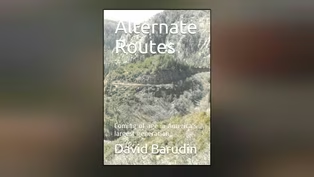
We’re in Roanoke to talk with the author of Alternate Routes. This novel is part travel tale and part coming of age story during a time of social changes in mid-1970’s. For the main characters, Walker and Kyla, it was a trip neither could have imagined when they started their journey.
Problems playing video? | Closed Captioning Feedback
Problems playing video? | Closed Captioning Feedback
Write Around the Corner is a local public television program presented by Blue Ridge/Appalachia VA
Write Around the Corner
Write Around the Corner-David Barudin
Season 5 Episode 7 | 27m 53sVideo has Closed Captions
We’re in Roanoke to talk with the author of Alternate Routes. This novel is part travel tale and part coming of age story during a time of social changes in mid-1970’s. For the main characters, Walker and Kyla, it was a trip neither could have imagined when they started their journey.
Problems playing video? | Closed Captioning Feedback
How to Watch Write Around the Corner
Write Around the Corner is available to stream on pbs.org and the free PBS App, available on iPhone, Apple TV, Android TV, Android smartphones, Amazon Fire TV, Amazon Fire Tablet, Roku, Samsung Smart TV, and Vizio.
Providing Support for PBS.org
Learn Moreabout PBS online sponsorship[♪♪♪] -♪ Every day every day Ev ery day every day every day ♪ ♪ Every day I write the book ♪ [♪♪♪] -Welcome.
I'm Rose Martin, and we are Write Around The Corner in Roanoke with author David Barudin.
So, his book, Alternate Routes, Coming of Age in America's Largest Generation, is part travel tale, but also part of growing up and the social changes that came about in the 1970s.
Walker and Kyla set out on a trip that neither one of them could have ever imagined.
It became a trip that changed them from the people that they started out being when they first took off.
Let's take a look and meet David.
Hi, David.
Welcome to Write Around The Corner .
-Thank you.
I'm so pleased that you came over.
-Well, I'm so excited about this book, and we'll get to a little bit about your journey.
But before we get to the part about you actually going on this amazing trip and talking about it here, what's your background like?
What was it like growing up?
-I'm a New Jersey kid, a Jersey boy from a small high school in Bergen County, played all sports and went to the University of Pennsylvania on a football scholarship.
And I was on "the team" for four years, and it was a formative experience competing at that level.
And afterwards, I took a job.
I graduated from the Wharton School of Finance and Commerce, and took a position in business and soon left that position.
And it was the best decision I ever made in my life to take a career break after years of growing up from being passed along, so to speak, from institution to institution, being educational institutions and schools and teams.
-Oh, I got where you're going.
-I just had to find myself at that stage in life after a year of being passed along to the ultimate institution of the "firm", and needed to see who I was and take some time out for myself.
So, I joined Volunteers in Service to America, VISTA, and I left New York City and went to Iowa, and worked for a year as a community organizer.
And, like I said, it was the best decision I ever made because it led to my marriage and an eventual career for me - one that I never considered being a day at work.
It was just enjoyable to me.
-Wouldn't that be great if it's not a day at work, right.
When, you know, I saw a picture of you and your football gear as the quarterback on your football team for a while that you played quarterback.
-A quarterback.
-Okay, a quarterback.
-I was the guy on the sidelines mostly with the ball cap, charting the plays.
-Getting ready.
-Getting ready to go in.
-As a little boy, was reading or traveling, having adventures always part of the things that you loved to do in spare time?
-Rose, I got to tell you - I grew up in the most idyllic little town of Leonia, New Jersey in Bergen County.
And we were all over that town.
Every day was an adventure, especially over summers.
Growing up in, you know, as an early Baby Boomer in the '50s and '60s.
We didn't have a lot of-- parents didn't have a lot of the worries that they have today.
So, we would go uptown, up the park, down the park, ride our bikes all over.
And those were my earliest most memorable adventures - making friends and going down into the weeds.
We had the Overpeck Park by the Hackensack River that was just miles with weeds.
-Literally grown-up weeds?
-Grown-up weeds.
And we would make forts and have our own-- make up our own adventures there.
So, growing up in town like that and having those experiences, you make up a lot of things you do.
And I think that was my earliest opportunity to exercise my imagination and made me later decide that, hey, I want to do that.
I want to be a writer and imagine things and write things.
But it took leaving the business community and a conventional lifestyle in order to do it.
And basically, that's what Alternate Routes is about - coming of age.
I do not presume to define a generation of Baby Boomers.
The book talks about two people out of that, Walker and Kyla, and their experiences in life were very different, two different worlds coming together, both as VISTA volunteers in Iowa.
And that's when life began for me, adult life, I should say.
-Yes.
Were you always the storyteller, the one in your family to make up those adventure stories and share those with even all of your friends or all of your teachers?
-I was the listener.
I enjoyed so much a large family, a blended family.
That itself is a story and one that I deal with in a collection of short stories that I'm just completing.
It was a blended family out of the tragedy of a loss of mother and loss of a father on the other side.
So, two groups of three young kids, five boys, one girl, and then a seventh child.
And everyone had a story.
And my favorite thing was sitting down at the table and listening to my father talk about his experiences in life and his naval experiences in World War II in the Pacific; and my brothers, who several were older than I was, and had had so much to share with us.
And we were a very sharing, talking, chatty family, so listening was, I think, important to me.
-Well, in a big family, you do have to take your turn, right.
You have to take your turn and listen sometimes.
-And don't be the last one to reach for that last piece of steak or the last piece of fish.
-That's right.
-On the platter.
-Because it might not be there.
How about with your own grandson now?
-Oh, thank you for asking.
He's the delight of our life.
His name is - may I say his name?
-Sure.
-Over the air.
His name is Hyatt Walters Barudin.
They live in Salem.
And he's been with us, on and off, my daughter, for much of her life after Hyatt has been as a single mom.
So, as grandparents, we've had just a blessing of considerable time with Hyatt.
And I am a storyteller to him, and there are several of those in the collection of short stories that I just completed.
He's been wonderful as far as that goes and making up things, I found a reserve of playfulness and fun with this grandson that I really didn't know raising my daughter.
This has been a different experience, and a lot of it has been storytelling and making up things.
And reading stories, it's amazing how kids' stories, the Dog Man stories and Pokemon, and all of these little stories that you read to kids are terrific stories.
And I've learned so much from how they're constructed, and the craft of how the characters interplay.
-And he's just like a sponge, I'm sure.
We walked around a little bit in your house, and I know you created an adventure zone for him even in part of your house, so that's such a special relationship, I think.
And you said it ignited something in you about being and having more energy and having that playful side.
You know, part of what you talk about in Alternate Routes is the fact that you, we all need a break, or we should all take that time to play and reinvent ourselves.
And you find that, every once in a while, that can be so beneficial for you that you want to make sure that Hyatt knows that too, like, you know, no matter what we do, it's okay to just take a break.
-Rose, you know, as an educator, especially with special education in children, that that's exactly what you do - they help you reinvent yourself.
It's like a story is, and writing itself is, so you better understand yourself.
I write, so I know myself better after I finish a writing session because to me, that's what writing is all about.
And so, as Hyatt been, it has taught me who I am and as you said, you know, reinventing myself.
We get into our ruts in life.
-We do.
-I was a media sales representative selling advertising for a large association in Washington DC.
For my working career, you know, you have to earn a - writers also have to earn a living, unless you're a real professional writer who has made it, and I'm still looking for an agent.
But I find that going to the Amazon as a Kindle e-book and a paperback that Amazon has offered me so much in terms of being just a wonderful publishing platform.
And so, writing has opened up a new world for me since my retirement a few years ago and back to writing full time and finally finishing the book.
-Well, you mentioned, you mentioned earlier that it was a kind of introspection for you to kind of get yourself, to get to know yourself a little bit more and to deal with things.
And I think that's so true when you write and have a chance to put your thoughts down on paper.
How long was the process for you to get this book to where you were getting ready to share it with the world?
-Who is it who said that writers often say they write five, seven, ten or more books before they finally write one that is published.
I've written the same book, Alternate Routes , seven, ten, any number of times before I felt I had a good one.
So, it's been the same book - rewriting, editing, revising, changing from first person to second person to third person, to changing the structure and changing how I looked on each of the characters and allowing the characters to grow.
So, in all of that process, I'd say it started when I myself was on the trip that is chronicled in the book, which was in the mid-'70s.
So, take it from there - that's how long it's been.
And I just really finished it maybe last year.
But I have to earn a living, I know, we all know.
And I put it down quite a bit and came back to it a year later and so forth.
-So, did you keep journals?
How did you remember everything over all of this time?
-I kept notebooks and that's why in the book, instead of chapters, they are notebooks - notebook one covers several different segments of the book, and goes on through notebook number nine.
And those are, it comes right out of those notebooks.
And, of course, you build the composite characters, and you change things around to make a story out of it.
But what I've found in writing that is so true is it has got to be true.
It's got to come from - a writer's best work comes from their own experience.
You can't fake it for readers.
They know if something rings true to them.
And so, I tried to stay as close to actually what happened and what came out of those notebooks, as I possibly could.
And then embellished the story and added characters and made more of a story out of it.
-Did you always know it was going to be a book when you're keeping those notebooks?
-I did the trip with my first wife whose name is close to what it is in the book.
She knew.
And she was the inspiration behind the notebooks.
And she knew I was a good writer because I had been a writer before, and I wrote magazine articles, and I wrote for Better Homes and Gardens and the Saturday Evening Post , and I was a freelancer.
And she read my nonfiction articles and my poetry and such.
And she knew I was a good writer.
And she knew this was going to happen.
And she really inspired me during these two years of our travel together in a truck and camper with two cats and a parrot.
-So, that part's all true?
-That part is taken from real life.
And that's what really the point I was making, I'd like to come back to that - that writers do their best work when they write from what they know.
There's got to be at least a kernel of truth in what you're writing about.
Readers are not gullible if it's implausible.
They're not gullible.
It's like doing comedy or telling a joke.
What makes it funny is there's truth in it and we relate to it, we identify with it.
-That's true.
-The same is in reading a story.
If we can't identify with it, if there's not a truth underlying the story that you're framing this truth, if it doesn't make me cry or laugh or feel some really heartfelt emotion, if it doesn't come from my heart, then if it doesn't work, it's not going to work for me, it's not going to work for the reader.
-That's interesting because - we'll get to the book in a second, but you mentioned what an inspiration that your first wife was.
Has she read this book?
-I hope not.
-Okay.
I was wondering if she sees herself or sees that character or even knows about it.
-And you know what, it was a mistake to write it in first person because people who are close to me see the characters as me and my first wife.
-But we will use the new characters now.
-So, it's not a memoir.
You know, it's really not meant as a memoir.
Memoir is the story of a life.
Alternate Routes is a slice of life, of a true life, picturesque tale.
The Spanish picaresque novel were two people out on adventures, usually two young boys out on an adventure, and the mischief they get in.
That's why I like to see it as a picaresque tale and the characters are all composite.
It is not me.
-Introduce us to the main characters.
-Walker, James Walker Trumbull III is an East Coast Ivy Leaguer, who takes a job after college.
And it's a very forgettable year for him.
And very unnoticed and unrecognized, he leaves that job to go out as many early Boomers did, and "find yourself" wedged between the hippies who dropped out and yuppies who came in the '80s, who copped out.
There was a small window, a more acceptable window escape, more acceptable by society and by parents at the time, called Finding Yourself.
It's a sabbatical year - you go out and you do something.
I happened to join VISTA, that was a true experience in my life.
And that's what this character does.
And that pretty much gets the ball rolling in the book.
And from there, it takes off and a lot of it is what happened, and a lot of it is my imagination and composites of events and people.
-And who's making the journey with Walker?
-Kyla is an off-the-farm girl from Utah, who couldn't leave the confines and restrictions of the "church" fast enough.
She could only do one year at a Utah college before she just had to get out completely, and a very independent, fiercely independent person who also joins VISTA.
And so, from these two opposite worlds, they meet in the middle, in Iowa, in VISTA to fight LBJ's war on poverty.
And soon after that year is up, poverty becomes a very personal thing for both of them.
-All right, because not only that, it's set in the '70s, so you tackle some, you know, changes that are happening in the '70s, not just the political changes but the absence of technology and the things that they're really going out on this adventure with not the things we're used to in this day and age, and yet, Walker and Kyla seem pretty well matched.
She's a little bit ahead of her time going into building like this camper in the auto body shop, the only woman, right, who's going to be in there.
And so, is that part of it true?
-That is true.
It was not an auto body shop, though, it was a building trades program, and she was the only woman.
And the scene that I wrote about that, about the instructor coming out for the first time to meet this class of bearded bib overalled guys, and then this beautiful, tall woman in the midst of them.
I had so much fun writing that scene, which is totally made up, but it is true.
It is hard.
It is true.
She was the only one.
And she was very successful at it.
And she pretty much, and I helped her.
And another person from the class helped her redo a ten-foot pick-up camper.
And I wrote about how it was done and published it, and published it in Better Homes and Gardens .
I was writing at that time.
And we took it on the road with two cats.
-Two cats and a parrot, okay.
So you had off on this adventure and the title, I think, the fact that you say Alternate Routes .
Your path was not clearly defined where you were going to go and what you were going to see and what you were going to discover.
-What it's about is when you gamble all the marbles and you put yourself out there where good fortune and a little luck can happen, then chances are it is going to fall in the right places for you.
There's a flow that happens to extended travel, and this was a two-year period of travel in my life, in Walker's life, as it's depicted, with a lot more happening there in story building.
But if you allow yourself to get out and experience, the flow of travel takes over the trip, and soon the whole idea of destinations becomes different.
It's different than places on a map.
Destinations are built by seemingly insignificant, inconsequential things that happen that you don't pay attention to.
And then they compound.
And the next thing you know, you're here, instead of where you were supposed to go there at the end of the day or the end of the week, you find yourself in a flow.
And keeping that flow going is one of the plots within the book.
And it often drives the two main characters apart.
So, the friction between them and a touching, romantic tale between them keep this book moving, and the colorful characters that they meet along the way.
-And some of the adventures they made along the way, I mean, from the [indistinct] to the trouble backing it up and having trouble with the actual mechanical part of the camper and so many things.
I think you take us on a journey through the alternate routes of not only the physical places you go, but I think the emotional places we go when we have a change of heart or when we're beginning to find out a little bit more about who we are and what we believe and what's important.
-Isn't that the journey of life?
-Yes, that came through in part of the journey.
So, there was a lot of introspection there too with, you know, just living the life and the journey that we're all on.
And really, the book is broken apart into these amazing sections of your journey.
Would you be willing to read a section for us?
-I'd be happy to.
Thank you for asking.
-Sure.
-I will read from the beginning.
I'm going to excerpt the part of the book that was a finalist in the Virginia Writers Club, the Virginia writing fiction contest last year.
This was a finalist.
"The rain came down harder and colder "in a precursor of the winter snowstorms "that would soon blanket Des Moines and Iowa "and the entire Midwest until the spring rains released them.
"In the streetlights, slanting stilettos of sleet "stung my face.
"My apartment was too many street corners back "to be sure how far or which way I'd come.
"Neither could I say exactly how I came to be "in my current circumstances, or where the slide began.
"Another flash of lightning "revealed the increasing intensity of the storm.
"I sloshed toward a bright patch "that shone through the sodden sky.
"I was nearly under it "before I could make out the red lit Jesus saves "in the interstices of a white neon cross.
"Its blurry glow refracted in the thousand tiny shards "of sideways sleet.
"I headed to it, splashing through the reflection "of a stained-glass window, "splattered on the saturated street "like a smashed Christmas tree.
"The worn soles of my boots "slipped on the wet buckled sidewalk.
"I stumbled up the cement steps of church.
"Underneath the overhang, I pressed an ear to the door, "it held the muffled voices of a revival hymn.
"I hesitated to go in.
"I wasn't a member, I wasn't even Christian or from Iowa.
"The 'Jesus Saves' choir started up another hymn.
"I slouched against the door.
"'You just gonna stand out here in the rain?
"Are you coming in?'
"said a figure in a hooded rain slicker, "brushing past me into the church.
"I climbed the stairs to the balcony "and found a seat at the front railing.
"The young Black preacher in a dark tailored suit "addressed the congregation in a commanding baritone voice.
"The preacher raised a hand to the balcony "and his voice rang out.
"'There are those among us here with Jesus tonight "who are down on their luck, "who are hurting in pain, who are broken.'
"Then he said, 'All who are pained, "raise your hands, raise your hands to Jesus.
"That's right, get them up.'
"Before I fully realized what I was doing, "my hand was in the air.
"The preacher cried, "'Come down here in front of the altar "and lay down your troubles.'
"I must have made a movement to stand "because several people close by "sprang to help me down the narrow stairs "and out among the half dozen downtrodden souls "who are shuffling to the altar.
"The preacher wasn't about to let me off the hook.
"Even if I wasn't Christian, "he turned his dark liquid stare back on me.
"He said, 'Son, it doesn't matter what you think "may have brought you here tonight.
"I know who brought you here.
"However heavy your load is, He will take it up.
"However burdensome He will carry it.
"Will you give it to Him?'
"He tightened his grip on my shoulders reassuringly.
"When I didn't respond right away, he added, "'Do you believe He can do that for you, Son?'
"At that point, I was ready to give anyone, anything, "credit that could even come close.
"I had quit a prosperous future career "to become a VISTA volunteer in a vague search for who I was.
"And the answer, as it turned out, "wasn't who I hoped for.
"Maybe Jesus was more than the son of a poor Jewish contractor.
"Who was I to say?
"At least I could pledge that I'd never say he wasn't.
"I must have given the preacher that impression "because he smiled and retreated to the altar in a chorus of Amen, Jesus'."
-And what an adventure you go on.
David, thank you so much for inviting us here.
I've enjoyed chatting with you.
My special thanks to David Barudin for sharing his amazing journey with us, and you've only gotten a little taste of that.
You want to make sure to check out David's book, Alternate Routes, and go on the journey that he, that Walker took with Kyla all across the United States and back.
And in his words, stepping back from an unfulfilling circumstance, be it a job or otherwise, trust you'll land safely.
Follow your heart and you'll figure it out.
Be sure to check us out online for my extended interview in our conversation with David for this book and some of the other work that he's also done.
I'd be grateful if you share the link with others.
I'll see you next time Write Around The Corner .
-♪ Every day every day Ev ery day every day every day ♪ ♪ Every day I write the book ♪ [♪♪♪] ♪ Every day every day Every day ♪ ♪ Every day I write the book ♪ ♪ Every day every day Every day ♪ ♪ Every day I write the book ♪
A Continued Conversation with David Barudin
Clip: S5 Ep7 | 13m 11s | Learn more about David's writing process and dive deeper into his book. (13m 11s)
Providing Support for PBS.org
Learn Moreabout PBS online sponsorship













Support for PBS provided by:
Write Around the Corner is a local public television program presented by Blue Ridge/Appalachia VA