Write Around the Corner
Write Around the Corner-Diane Chamberlain
Season 5 Episode 3 | 28m 2sVideo has Closed Captions
We’ll talk about a book full of history, drama and unexpected turns!
We’re in Raleigh, NC to visit with Diane Chamberlain. She is a bestselling author of over 30 novels published in more than twenty languages. We’ll talk about her book, The Last House on the Street, which is full of history and drama along with lots of unexpected twists and turns.
Problems playing video? | Closed Captioning Feedback
Problems playing video? | Closed Captioning Feedback
Write Around the Corner is a local public television program presented by Blue Ridge/Appalachia VA
Write Around the Corner
Write Around the Corner-Diane Chamberlain
Season 5 Episode 3 | 28m 2sVideo has Closed Captions
We’re in Raleigh, NC to visit with Diane Chamberlain. She is a bestselling author of over 30 novels published in more than twenty languages. We’ll talk about her book, The Last House on the Street, which is full of history and drama along with lots of unexpected twists and turns.
Problems playing video? | Closed Captioning Feedback
How to Watch Write Around the Corner
Write Around the Corner is available to stream on pbs.org and the free PBS App, available on iPhone, Apple TV, Android TV, Android smartphones, Amazon Fire TV, Amazon Fire Tablet, Roku, Samsung Smart TV, and Vizio.
Providing Support for PBS.org
Learn Moreabout PBS online sponsorship[???]
-?
Every day every day Ev ery day every day every day ?
?
Every day I write the book ?
[???]
-Welcome.
I'm Rose Martin, and we are Write Around The Corner in Raleigh, North Carolina.
That's right, with New York Times bestseller, USA Today bestseller, Sunday Times bestseller, author of over 30 published novels in over 20 languages.
Did I mention that her very first novel is a Rita Award winner?
Who am I talking about?
Our special guest today is Diane Chamberlain.
Diane's most recent book, Last House on the Street , she's going to be introducing us to two women, a generation apart, who find themselves, let's say, bound by tragedy, an unsolved decades-old mystery.
It's part suspense, it's part mystery, and it is a hundred percent drama.
Welcome, Diane, to Write Around The Corner .
-Thank you so much for having me, Rose.
This is great.
-Well, we are so excited to be here.
And thank you so much for inviting us into your gorgeous home.
-Thank you.
-You were saying before we got started, your husband, John, is a photographer, so you've got beautiful things on the walls.
-Thank you so much.
It's really fun to have that special art.
-And we noticed the little furry friend when we came in.
-Right.
I'm sorry he can't be with us, but he is so shy that - that he'd be under the table.
-And, you know, he was adorable, though, so when I know because we have - Carol and I are both pet lovers, so it's always fun.
So, in the early years, I read that you were a real avid reader.
-Uh-huh.
-Okay, any special books or any special ones that turned you into an author?
-Well, I always say, when somebody asks what's my favorite book, Charlotte's Web , because in the first grade, my teacher read us a chapter from Charlotte's Web every day.
And I sat there crying and laughing, and up until that time, every book that I had read as a children's book were so bland - The Little Red Hen , that sort of thing.
And suddenly, I was just filled with emotion, and it occurred to me that a human being did this, wrote this story that made me feel that way.
And that's when I decided that I wanted to be a writer.
So, as I got a little bit older, pre-teen, I started writing little books that.
I actually found one of them when my mother died.
I went through her stuff, and I found one wrapped in Saran wrap.
-Oh, she saved it.
-So, I still have a couple of those little books.
But when it came time to go to college, it never occurred to me that you could actually make a living as a writer, so I went into social work instead.
And then I always had an idea in the back of my mind of a book that I wanted to write.
And the way the idea came to me was, again, as a teenager, my family had a summer house and none of my friends lived around there, so I just had myself and my imagination.
And I made up a story that was my girlfriends and myself living together in this big house on the coast with Paul McCartney and Mick Jagger and James Brown.
-Nice, nice.
-And I just fed that story.
Every night, I'd go to bed, and I wouldn't go to sleep.
I would just add to my story.
It was very tame; I was only 14 or 15.
And so, I gradually changed my girlfriends and myself to real "fictional" women, and the rock stars to real fictional men, and so by the time I was in my late 20s, I still had that story going on, only of course, it was totally fiction at this point.
And one day, I was working as a hospital social worker in San Diego, and one day, I was at a doctor's office and the doctor was very late.
And I started writing down some of the scenes.
And pretty soon, I was totally hooked.
And I thought, "Well, this is my new hobby."
So, I treated it as a hobby, but then one time, I went to a night class where the professor said, "I assume you all want to be published."
And that shifted my thinking a little bit and I thought, "Well, maybe I could actually get this published."
So, it took a few years and a lot of rejections, and it became my first novel, which is called Private Relations , and which I tell people not to read.
And it came out in 1989.
And then, it's been kind of a steady road since then.
-That's a great story.
So, this one you started as a teenager, with your friends and the rock star idols, actually you were able to transform that into the first novel.
-Yes.
-You had mentioned early rejections, and I think some people are surprised to hear that successful writers often go through a period of rejection.
How do you handle that?
-Or a couple of periods of rejection.
-Yes.
Okay, true.
-Well, it was depressing, but I also just had no idea of the business and, you know.
It was before the internet, and so I didn't have friends who were going through it, I didn't, you know, I didn't know anybody who was going through it.
I didn't know exactly how the process operated.
So, the first thing, of course, was to find an agent.
And I sent samples out to 20 agents, and two of them agreed to read my entire manuscript, which was an unbelievable mess.
And one of the agents passed.
And then the other agent took it on, for which I'll always be grateful.
She made suggestions that I ignored, because this is back in the day of typewriters and carbon paper.
-Oh, sure.
-And you change one little thing, and it changes the entire manuscript.
So, I fought, you know, for every hard-earned word.
And so, she did take it out to a number of editors, publishers.
It was rejected for a year.
And then she said, "Are you ready to make some changes?"
So, they were pretty dramatic changes.
It turned the book from not a romance into a romance, which was not my goal.
But then it went on to win the best single title contemporary novel from the Romance Writers of America.
-That's the Rita Award, right?
-Right.
So, that was the beginning.
-Were your parents writers?
Did you have other people in your family?
-No.
Well, that's actually not true.
My younger brother was a mystery writer.
He still is a mystery writer, mostly short stories.
He's published about 80 of them.
But he was ahead of me even though he was younger because he knew what he wanted to do.
But they were huge readers.
My family was a bunch of readers.
My father was a school principal and so every, it seemed like every day, he would bring home a book and throw it on my bed along with a candy bar.
So, I always say we were big readers with bad teeth.
That's what we were.
So, he just fed and nurtured the love of reading.
And I think that's a big part of how it happened.
-You know, still oftentimes, I hear that too, that, you know, you have an insatiable thirst for books and love to read, and your imagination can then soar.
So, it's so important to give children the opportunity to have that book and to let their imagination tell those stories, writing them down on anything if they, you know, in any kind of notebook, just what's your story?
Tell us a story.
-Right.
-How fascinating.
Well, for - you took a little side trip into social work.
And then, how did the psychotherapy business out there come about with teenagers?
-I was a clinical social worker.
-Okay.
-So, that allows you to get your license so that you can practice psychotherapy.
So, I started out as a perinatal social worker, so in the hospital, I worked in the maternity unit, in the special care nursery.
And then when I moved to Washington, DC, I worked at Children's Hospital in adolescent medicine.
So, they're both my loves.
I just adored both of those jobs.
And then the commute from Alexandria, Virginia, to Washington, DC, was getting to me.
So, at that time, I opened my own private practice with teenagers.
-I bet that was rewarding, working with teens.
-Hugely rewarding.
-Because oftentimes, people will be like, well, the young kids and the older people, and the teens sometimes get lost.
-Yes, but they were my favorites.
-That's great.
-Absolutely my favorites.
-Were you still writing this whole time while you were in social work, and while you were in private practice?
Were you coming home and having a release of, let's get a few stories done?
-Exactly.
-Okay.
-And working with teenagers was great because I could write during the day and then go see them, you know, when they get out of school.
So, that worked out perfectly.
And I still hear from some of them, who are now 50 years old.
And it's just, you know, it's a hugely rewarding kind of work to do.
-So, then how did you make the switch from, all right, I've done this now for 20-some odd years, and I'm going to go back to this thing that's just gnawing at me about writing, writing, writing?
You know, Diane, I know you can be a novelist, again.
-Well, I knew that that was really what I wanted to be doing.
And it became - once I got, I think I was on my fourth novel, which is set in the Outer Banks, and I realized there were starting to be demands from the publisher on me for doing more than just writing, for talking to people, going out doing not quite a tour at that time, but getting really much more involved in the non-writing part of writing.
And I just realized, "I can't keep doing both of these things and be good at both of them."
So, obviously, you know the decision that I made.
-And we're so glad you made that decision.
And I'm sure that children who benefited from you at that point in time of your life feel like that was the best decision that you made.
-Oh, I don't know about that.
-You know, to offer them a rewarding career.
Yes, I think you impact people in so many different ways, right?
And even through these stories, you know, it's interesting, I was reading your process, how you might go through an extensive outline, and then it just kind of disappears.
-Throw it away.
-You do.
You actually throw it away.
So, is the outline for what purpose?
-Actually, I used to stick to my outlines much more than I do now.
And my outline - by outline, I mean, I would just start writing pages and pages of the story in the order that I thought it would go.
But as - over time, my books became much more full of surprises, and so it was very hard to capture all of that in an outline because I don't know where I'm going.
And that's what you're referring to.
It's - I always think my characters are my co-workers.
And which is really a wonderful thought because writing can be so lonely.
But when you start thinking of them that way, it's not so lonely.
So, as soon as I start writing a book, it's from the very first page, they are not doing or sounding or looking like I expected.
They're saying all kinds of other things and I have learned just to roll with it, because I figure they know something I don't know.
-That's a fascinating.
So, they come through you, then kind of evolve into their own distinct personalities, because you write in two different voices so well that - and you go back and forth.
So, do you write one whole person at a time, or go back and forth?
-Yes, I know the basic whole story.
But then I do do - if there's two characters, I do do each of their parts separately.
And the reason that I do that is I don't want to lose the chain of what's happening.
But also, and maybe more importantly, I don't want to lose their voice.
So, if you go back and forth and back and forth, the voices can get muddy.
Do you know what I mean by voice?
That they start not sounding distinctly like themselves.
So, even in the past when I've written books, I've written a book with five points of view.
I'm not doing that now.
But what I did was I did write the whole book, and then I took out all the parts of one character and all the parts of another character and just read through them and made sure that the little idiosyncrasies in their speech came out, that each person had as distinct a voice as I could give it.
-And you can tell that in reading your work.
I'm also fascinated by - now it makes a little bit more sense to me, but I was curious, like, how is she ending every single chapter with a cliffhanger?
And now I'm like, okay, so she's writing that whole thing out and you're breaking that so that, you know, we're just getting to the end of something and like, oh my gosh, the twists and turns are going to take us to the next character.
And I'm like, oh, I want to get back to this one.
No, no, I want to get back to this one.
No, I want to get back to this one.
And I'm just going to stay up and read it to finish it.
-Well, that's great.
I'm glad that you have that reaction.
And it is important to end a chapter in a way that makes the person who's reading it in bed have to turn the page and stay up a little longer.
-I'm also fascinated by your research because it seems like you are a meticulous researcher for little things that happen almost on every page.
There's some little nuance.
-Yes, thank you for realizing that.
Even if a book is not historical, there's so much to research because I like to be accurate.
So, if I'm writing a book, let's say, that took place five years ago, and there's any technology in it, I need to know what if that character is using the right cell phone or that sort of thing.
I just can't let that slide.
But in my most recent book, The Last House on the Street, there was a ton of research about civil rights in the '60s, that sort of thing, and some about architecture.
There's always something that needs to be dug into.
-Well, and with The Last House on the Street, for instance, SCOPE, like even though we think we hear a lot of civil rights movements and civil rights, what's going on, I did not know about that organization.
How did you run across that and find a way to input that in the story?
-You know, it's really interesting.
I really haven't come across anybody who was familiar with SCOPE when I talk about it.
The way I remember coming across it was when I was a young teenager, again, in my summer house, I would wake up every day to the radio and the news would be on.
And when I was about 14, the news had this story that there were three young civil rights workers in the South who were murdered, and two of them were white and one of them was Black.
And at that time, the school that I was going to was half white and half Black.
And I started listening to that story and becoming more and more aware of civil rights and the Civil Rights Movement, and relating it in my mind to what I was seeing every day at my school.
And it was my eye-opening period, you know, to how my life was different.
Of course, I didn't use the word privilege at that time, but how I could see that my life was better, partly because I was white.
And so, it just fascinated me.
And then, as I started doing research papers for my history class, here was the Civil Rights era.
I found myself in the library, constantly looking up civil rights information.
And as I did that, I came across an organization called SCOPE, which - oh, boy, now I've got to get that acronym.
-That's all right, I wrote it down - Summer Community Organization and Political Education.
-Thank you so much.
I could have gotten there but it might have taken ten more minutes.
I came across that, and what it was was bringing northern students, mostly white students, into the South to help them register Black voters, because in 1965, in the summer, President Johnson, Lyndon Baines Johnson, was going to sign the Voting Rights Act.
So, that would have made it easier for Black people in the South to finally register to vote.
Up until that time, it was very difficult for them to register for many, many reasons - literacy tests that whites didn't have to take and pass, threats to their homes, threats to losing their jobs.
It was just very difficult.
So, the Voting Rights Act was to address all those inequities.
And then the white students from the North were to help people register.
And they brought in white students for a couple of reasons.
One was because they would get more media attention.
The thinking was, and this is Martin Luther King we're talking about, his thinking was that that is why there was so much attention on those three murdered students, because two of them were white.
And so, it's for the media attention, and also because they would be trusted, looked up to more.
-And you include that in your book for Last House on the Street , because that whole scene when you are plucking one of your main character, Ellie, and she, all of a sudden, is standing up to her parents saying, "I want to join this thing called SCOPE and I want to go out there," and her family is like, "What?"
-Well, the odd thing is, and this was a little problem for me as the writer of this book, I wanted Ellie to be from North Carolina.
And SCOPE really was northern and western students.
So, I spoke to a woman who had been a SCOPE worker, Maria Guyton, and she said, "Boy, you're not going to have a southern girl who's going to be accepted by the people she's trying to help or accepted by the other students.
She needs a really good reason to want to do this."
So, that made me put my thinking cap on, and I came up with a couple of really good reasons that I won't go into.
-No, so let's talk about Last House.
Share with us Last House on the Street , the main characters.
We've got Ellie, and who else?
-We have Ellie, and we have Kayla.
And Ellie, in 1965, is 20 years old, and she's a student at the University of North Carolina.
And she learns about SCOPE, and for her own personal reasons, she wants to get involved.
-And on the other side, we have Kayla, who has just recently become widowed and building this fabulous house at the end of the street.
-Right.
And that is more in current day.
And Kayla and her husband were architects, and during - they design this house.
This is their dream home.
And during the building of the dream house, in a freak accident, the husband is killed.
And then, Kayla has to decide if she and her little girl are going to move into this beautiful house that they've created.
And the house is at, it's the last house on the street.
And it's the same street that Ellie grew up on.
-And I think the way you wound these stories together, I went back to the beginning to look - "Did I hear that name before?
What did I - I think she left a hint about something about that a little bit earlier," as I went back through the way their lives are woven together and the way you kept us hanging at the end of each chapter, and the way you gave us some twists and turns at the end that I absolutely did not see coming.
Would you be willing to read a section for us?
-Sure.
-And what are you picking?
-I am picking actually something from almost to the middle of the book.
-Okay.
-I'm reading this to illustrate something.
The students who were part of SCOPE actually lived with poor Black families.
And they were given really no special treatment.
They had to live just like the families lived.
And so, they were in the community where they were doing their work.
And the little part that I'm going to read is about Ellie, and she has moved into a house.
She's pretty new at this, and it's all a little unnerving to her.
She's moved into a house.
It's the Dawes family.
And it's way out in the country - no running water, no electricity.
And they're in an area in North Carolina, rural North Carolina, where they are very unwelcome, the SCOPE workers.
There's a huge Klan presence that was - North Carolina, at that time, had the biggest Klan presence in the country, and so, it's a very.
she's very unwelcome there in a lot of ways.
But the family has been pretty welcoming to her.
So, she is - well, you'll see.
"I was dead asleep when the shouting began.
"I sat up in the darkness, disoriented, "my brain still wired from the singing at the protest.
The little bodies around me were heavy with slumber."
She's sleeping with all the children.
"It took me a minute to realize "that someone was pounding on the bedroom door.
"Suddenly it flew open.
"'Get up, get up,' Missus Dawes shouted.
"She carried a lantern "that illuminated the fear in her dark eyes.
"'Keep the children with you.'
"'What's going on,' I asked.
But she was already gone.
"From the corner of my eye, I saw a flicker of light.
"I leaped out of the bed "and pulled aside the thin curtain "at the front window, then caught my breath - "across was a blaze in front of the house "no more than a few yards from the bedroom, "where I stood in my nightgown and bare feet.
"'Kids,' I shouted to the four of them, 'wake up.'
"I jostled them, shook them, yelled at them.
"They were like dead children, their bodies too busy, "too heavy with sleep to respond.
"I finally got the two older girls up "and grabbed the little ones in my arms "as I ran from the bedroom to the front porch.
"Outside, Mister and Missus Dawes "and the two older boys ran back and forth "from the pump to the fiery cross, "buckets of water sloshing.
"Embers flew through the air from the cross "and I was terrified one of them would land "on the roof and set the house ablaze.
"I thought I should help but Missus Dawes yelled at me, "'Just keep the children on the porch.'
"So, I stayed in the rocker - GG asleep on my lap, "Sally on the splintery porch floor sucking her thumb.
"The two older girls stood next to me, "clinging to my shoulder, my neck, "staring at the flames.
"I could see the fire and fear reflected in their eyes.
And I knew I was the person who put it there."
-And you think about the fear, right, of that time.
Diane, this - you picked a beautiful passage in order to even share with people about there's so many other things going on in this book, and so much of reality of the time in a way that helps tell the story of not only Ellie and what she went through, but then there's a lot of twists and turns to come for other pieces of things happening in the story.
Thank you so much.
-My pleasure.
-My special thanks to Diane Chamberlain for inviting us here into her home to share her latest work, The Last House on the Street .
Please go ahead and treat yourself by picking up a copy and learning something new - incredible research and incredible storyteller, and you will not be disappointed.
I'm Rose Martin.
Tell your friends about us.
And I'll see you next time Write Around The Corner .
-?
Every day every day Ev ery day every day every day ?
?
Every day I write the book ?
[???]
?
Every day every day Every day ?
?
Every day I write the book ?
?
Every day every day Every day ?
?
Every day I write the book ?
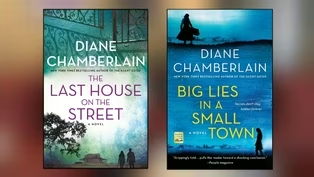
A Continued Conversation with Diane Chamberlain
Clip: S5 Ep3 | 15m 12s | Hear more about Diane's process and learn about some of her other novels. (15m 12s)
Providing Support for PBS.org
Learn Moreabout PBS online sponsorship













Support for PBS provided by:
Write Around the Corner is a local public television program presented by Blue Ridge/Appalachia VA