Write Around the Corner
Write Around the Corner - Ellen Crosby
Season 7 Episode 11 | 27m 54sVideo has Closed Captions
Ellen Crosby's past as a world traveling journalist adds depth and flavor to her books.
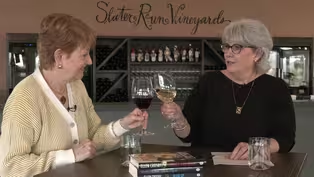
Ellen Crosby is the author of the Wine Country mysteries and the Sophie Medina mysteries. Her past as a world traveling journalist adds depth and flavor to her books. We visit with her at Slater Run Vineyards in Upperville, VA.
Problems playing video? | Closed Captioning Feedback
Problems playing video? | Closed Captioning Feedback
Write Around the Corner is a local public television program presented by Blue Ridge/Appalachia VA
Write Around the Corner
Write Around the Corner - Ellen Crosby
Season 7 Episode 11 | 27m 54sVideo has Closed Captions
Ellen Crosby is the author of the Wine Country mysteries and the Sophie Medina mysteries. Her past as a world traveling journalist adds depth and flavor to her books. We visit with her at Slater Run Vineyards in Upperville, VA.
Problems playing video? | Closed Captioning Feedback
How to Watch Write Around the Corner
Write Around the Corner is available to stream on pbs.org and the free PBS App, available on iPhone, Apple TV, Android TV, Android smartphones, Amazon Fire TV, Amazon Fire Tablet, Roku, Samsung Smart TV, and Vizio.
Providing Support for PBS.org
Learn Moreabout PBS online sponsorship[Announcer] This program is brought to you by the generous support of The Secular Society, advancing the interests of women and the arts in Virginia and beyond.
[♪♪♪♪♪] -♪ Every day every day Every day ♪ ♪ Every day I write the book ♪ [♪♪♪♪♪] -Welcome, I'm Rose Martin, and we are Write Around The Corner in Upperville, Virginia, at the beautiful Slater Run Vineyards.
Now, the guest today, Ellen Crosby, you might know her from the Wine Country Mysteries or maybe the Sophie Medina Mysteries.
Regardless, we're going to talk about them both.
So this is a really special show, and I can't wait for you to meet her.
Hi, Ellen.
Thanks for joining us.
-Thank you for having me.
It's wonderful to be here.
-And this is an amazing location.
So not only will we be talking about the Wine Country Mysteries, but we're at the Slater Run Vineyards.
And this is a special location for you.
Well, how come?
[Ellen Crosby] It's very special.
When I started writing the books, oh, like more than, almost 25 years ago, and I invented a vineyard and it was in Loudoun County, and Goose Creek ran through the middle of the vineyard, and it was on all this acreage.
And the family had a big history that went back 300 years in Virginia.
And so, Chris Patusky, he and his wife owned the vineyard.
He said to me, "Our vineyard must be the example for your book."
And I said, "No, actually, I started writing the books before you guys opened the vineyard."
So now, the vineyard is based on my books, rather than the other way around.
-Right.
And there are several, I mean, already 12 of the Wine Country Mystery books.
-There was only supposed to be one.
-Really?
-Hm-mm.
-Well, here, cheers to you.
-Thank you.
-And hopefully they run, you know... -Yes.
-Yes.
And we'll have a great time talking about that.
-Yes.
-So you've got such an amazing story from everywhere that you and your late husband Andre worked and traveled the world, and had the most amazing experiences.
-We did.
-If you don't mind, take a few minutes and give us a little bit of an insight into your background and his, which led into so many great books for you.
-Well, I think we both had wanderlust, and both of us, we met in graduate school at Johns Hopkins School of Advanced International Studies.
And he was a journalist, and I was actually working on Capitol Hill at the time.
I was an economist at the Senate.
And, shortly after we were married, he called me and he said, "I've just been asked to open the bureau for the Voice of America in Geneva, Switzerland."
And he said, "Do you want to go to Switzerland?"
And I said, "I do."
So we went to Switzerland for five years, and I learned French.
Two of our children were born there, two of our three.
And then, and it was wonderful.
I loved it.
And I started writing...
I was sort of at loose ends.
So I'd always like to write, and I thought, I'll write a novel.
You know, how hard can it be?
And it's actually very hard.
I wrote a horrible, horrible novel.
I finally shredded it in London, where it's fertilizing gardens.
But anyway, it wasn't long after we were there that it became clear that his next post was going to be Moscow.
And Voice of America is going to open a bureau in Moscow in 1989, which was in the middle of the Gorbachev era, when everything was so optimistic and anything seemed possible, it was still the Soviet Union.
So I was a little nervous about Russia.
I didn't speak Russian.
I couldn't even, I didn't read Cyrillic.
And it was kind of a scary place to go after living in, you know, Switzerland.
We lived actually over the border in France.
But we went, and it was a fascinating time to be in Russia, it really was.
And as Andre said to the kids, he said, "You know, you're living in a history book.
I mean, someday, all of this is going to be written about."
So, not long after we were there, I got asked to be the radio correspondent for ABC News, which, I mean, good jobs fell off trees in those days.
They just didn't have anybody.
And I said, "Well, I've never done radio in my life."
And they said, "Oh, that's okay.
You can learn from Andre."
And, I mean, so the next thing I know, I'm the radio correspondent for the largest radio network in the United States, in Russia.
So, and that was, that was really... -And you're pinching yourself.
How did I get here?
-I know, I know.
Those were really heady days.
And so, we were there... we were meant to be there for three years, but 18 months into our tour, Andre contracted something called Guillain-Barré syndrome, which is a form of instant paralysis.
He got that, he was Medevac'd.
He spent six months at Walter Reed Hospital.
We moved home, started our life over again, and he basically left Walter Reed in a wheelchair, and so... -And home at that time was Virginia?
-Home was sort of nowhere.
I mean, we had lived in Washington before we got married, you know, before we moved overseas.
And it was... we were kind of floating around.
I put the kids in school in Pennsylvania where my parents were living, and... so we thought, all right, we do need to find a place to live.
So we found a... we rented a house in Virginia, and so we were there for a couple of years.
And you do get... Guillain-Barré... one of the good things is you do get better.
I mean, you... it's unlike... its crueler cousins are MS and ALS, where you aren't going to get better.
But he did get better.
He regained his strength.
He learned to walk again.
He needed to use a cane.
But, a couple years into being there, and they said, "Would you like to go to London?"
And we said, "Absolutely."
So I... -Packed your bags and you're gone.
-I know.
I know.
What a great place to be for a writer.
So I took some writing courses there, and that's where I kind of upped my game.
I was still, you know, I was working as a journalist, but freelancer.
But, you know, I went back to fiction, and I took some wonderful courses in London.
And my first book, which was about our time in Moscow, based on our time in Moscow, was published in London, so.
And then we came home and sort of planted our flag back here.
Andre said, "You know, I want my kids..." Actually, what he said was, "I want my boys to know what a ground rule double is."
And we'd lived overseas for too long.
He was a real baseball fan.
So we moved home, and by then, I was... My British literary agent had heard about a trip we'd made to, on home leave, back to Virginia, where a friend took us around to the Virginia vineyards, and she thought it sounded like a great setting for a book.
And, of course, Andre is French.
We had visited all the French vineyards.
And she said, "You know, that just sounds like a wonderful setting."
And I said, "I don't really know anything about wine, about growing grapes and making wine."
And she said, "You're a journalist.
You'll figure it out."
And I said, "Yeah, but I..." -Just really nonchalantly, like, go ahead.
-Yeah.
But I said, "Well, you know, I'd like to write a book with a foreign setting."
And she said, "Ellen, you live in England.
Virginia is a foreign setting."
And I said, "Well, yeah, I guess you've got a point."
So I said, "All right, I'll write one."
So we moved home, and I live in Fairfax County, in Western Fairfax County.
And I thought, well, I've got to find a vineyard.
So I drove to the nearest vineyard I could get to from my home and be back in time for the school bus, because my kids were still little.
And it turned out to be what was Swedenborg Vineyard, which is a little further east out here on Route 50.
And the owner, Juanita Swedenborg, was an amazing person.
And she loved Murder She Wrote .
So she thought it was really cool somebody wanted to murder somebody at a vineyard.
So she brought me in and just taught me a lot until she passed away.
And then, another winemaker who had come to one of my book signings, Rick Tagg, who was the winemaker at Delafield in... sorry, Delaplane in Delaplane.
He's become my advisor for the last, I think, 17 years.
And so it's been... -What a resource.
-I know.
I know.
It was funny because Juanita was, I mean, she didn't do emails.
She didn't have an answering machine.
If I wanted to talk to her, I had to drive out to see her.
Rick would, like, text me, he'd be on like, he'd be using dangerous machinery or something.
And, you know, he did, he was as different from Juanita as it could possibly be, but he was great.
He brought me... when he first started working with me, they used to have something called the Winemaker's Roundtable, and he said, "You know, you really need to learn more about... You need to meet people.
You need to come out."
So we went out to, it was a vineyard down in Haymarket, and I can't remember the name of it.
And so, what they did is, all the winemakers in sort of Northern Virginia would bring their problem children wines to this meeting, and they would put them in a brown paper bag, and you didn't know what you were drinking.
And they had a big, long table, and they had a pen and a pencil and paper, and then they had wine glasses and water glasses and bread, and they had a dump bucket.
And so... And Rick said to me, whatever you do, spit, because they were, like, 35 bottles of wine.
So they went around, and you had to taste blind and then tell what was wrong with the wine.
And people brought the wines that they needed to be critiqued.
And so... -I've never heard of it called problem children wine... in bottles, yeah.
-So it was funny because it was... it was in the middle of Lent, and that year, Andre and I decided to quit drinking.
And so, when I got home that night, he said to me, "What'd you do today?"
And I said, "I had 64 glasses of wine."
-Oh, what a great story.
And so, then the Wine Country Mysteries were birthed, right there.
-They were.
They were.
-And 12 books in, and more coming.
-Yes.
I'm writing number 13 now.
-[Rose] That's amazing.
-It is amazing.
-Now, where did you... when along the process did you decide you needed to be a plotter?
-A plotter?
-Instead of a pantser for...?
-Oh, I've never been a pantser.
For me, you know, I sign a contract every year.
It's a business.
I'm slow.
I can't afford to get to say, my book is due in September.
I can't afford to get to June and go, oops, you know, it doesn't work.
And so, I... what I do is, I took a class in London taught by Robert McKee.
It's on, it's called STORY.
And he was a filmmaker, and so, everything in film is scenes.
And so, I write in scenes.
And so, every scene, something has to happen.
And so, I started writing out my scenes so it would give me some idea where I went.
And I would write during, I write during the day, and if at the end of the day, my book has veered off another course, I go back and fix my scene.
And so, I... -Daily, I mean, the very next day?
So... -Yeah, because, because it matters a lot when you get to, like, the editing stage... -[Rose] Sure.
-And then, you get some copy editor, and it's a year later.
you're promoting a book, you're writing another one.
This is in production, you know, and they say, like, what about this?
And if I haven't had the outline, you know, it's like, well, you know, it's still the same day, or it was raining.
It's not raining.
And so, they're looking at continuity.
And then I... and you realize, you know, hopefully with the outline, you're okay.
And the one time I didn't keep an outline, I didn't update it, we got, it was very late stages, and the copy editor called me and she said, Ellen, if you do sort of the math in this book, they're at the courthouse on Memorial Day, and the courthouse is closed, and there was no way to change it.
So finally I said, "Well, I guess they make an exception."
I mean, you know, so it's really, for me, it's really important to know where I'm at in the process of writing.
-But what happens if inspiration strikes in the middle of a scene, and you have this amazing thing that just has to be a part of it?
-I write it, and then, I go back and fix it.
-Change the outline.
-Yeah, I change the outline because it doesn't hamstring me.
It's not restrictive, it's not restricting.
And I think you should, you know, I mean, if something does happen, I think you can just go with it.
You know, I mean, it's... all of a sudden, this person isn't going to be the murderer, or all of a sudden, you know, this character is sort of taking a more prominent role.
And you don't force, you know, you don't force something into a, you know, a round peg into a square hole.
-Well, and I love the fact that with your background having touched on so many things, that in a way, you've been able to bring pieces of your life into these series or into these characters, that gives insight.
I mean, your research is amazing.
So I can't imagine the time it takes to learn all about, for instance, growing grapes, and learning about the operation of vineyards.
But then, you're also learning about what happens during murders, and talking to coroners.
-I love that.
I mean, that's part of, that's the journalist in me.
You've got to get it right.
If you don't get it right, people are going to, as they say, throw the book across the room and you lose your, you know, you lose your readers.
So it's sort of a point of pride with me that I do as much research as I do.
And you have to stop.
I mean, that's, we always have these... at the Annual Mystery Conference at Bouchercon, there's always the, you know, like, you can research and research and research, and at some point, you have to stop and start writing.
-Well, you're kind of a history buff, and there's a lot of history not only in Virginia, but the history of what you've experienced in the world.
And you have a really beautiful way of threading little nuggets of history into your books.
-Thank you for that.
What happened was, as I said, I thought I was only going to write one.
And as my publisher began asking for more, I thought, well, what am I going to write that's going to keep me interested for a year?
I always say I have really smart readers.
I'm really lucky, I have wonderful readers, wonderful fans, and they're smart.
And so, I want to write a smart book for them.
So I need to, you know, up my game, and be sure I write the best book I can write.
So, I like doing the research.
It's an opportunity to ask a lot of questions, you know, and learn something new.
And I think that's one of the things that I enjoy the most, is I'll just pick some subject that I know nothing about, like Jamestown or, I don't know, did Shakespeare write Shakespeare?
So that's a lot of, that's a lot of fun.
-Well, and it's also fun that you not only take the history but turning life into books, and then you also deal with some big, you know, big issues like climate change, or some touchy subjects in a way that you weave them either into the characters, or into the plot of the story.
And I guess I would be remiss if I didn't say there are several plots kind of going on at the same time.
-Yes.
-And that's brilliant.
I mean, you keep me going if I'm thinking about grapes one time or I'm thinking about murder one time, or I'm thinking about the characters one time.
So, that's wonderful.
-Well, I think what I've tried to do, and this is where Andre and I always used to talk, is like, I have the two plots.
There's always sort of something that's rooted in the past or some subject, and then I have the mystery and, and then I want to make it, I want to make them go together sort of organically and, you know, how am I going to do that?
So, like, the hardest one I had was the book I wrote about Jackie Kennedy.
And I was like, how am I going to weave this into, you know, wine and the mystery?
And, you know, and I usually find a way.
I mean, there's, there's, there's a book I read on creativity.
You can take, if you take two disparate subjects, you can find a way to make them relate.
And I think that's a wonderful challenge.
-And you do it beautifully.
-Thank you.
-So, Bitter Roots .
-Yes.
-It's book 12 in the Wine Country Mysteries.
And it's interesting because, you know, there's so many things going on in the book, and then you're also teaching us, like, when I heard the term "black goo" as part of vines, I'm like, I don't know what that means.
I've never heard that before.
-Right, right.
-So give a little tease without giving the story away for the overall premise of Bitter Roots .
-Well, Bitter Roots was a little bit about climate change, and actually, the first chapter of Bitter Roots is taken verbatim from a conversation I had with Rick Tagg about the fact that...
I had taken a picture of Delaplane when I was out there a couple years ago.
And it was beautiful, you know, beautiful scenery like it is here, and, you know, the countryside and farmhouses and the rolling hills and the Blue Ridge Mountains, and then the vines in the front.
And Rick said to me, "If you came out here this year, you could not take that picture."
And he said, "We lost an entire block of vines."
And he said, "I think what happened was we were sold rootstock that they couldn't guarantee was healthy," and you don't find that out for three years.
So by that time, you've bought the rootstock, you've invested all this money, you know, you've fertilized, you've done this, you haven't had a return on them, and then they die.
And then he said, "And I could kill someone."
And I thought, well, there's my book.
-Yeah.
-And so, it's about...
It's about, you know, vines that are dying and what people, you know, whether somebody knew they were dying or not, but it's also about climate change.
And I don't know if you remember the derecho of 2012 that came through Washington.
-Yeah.
-Yeah, I remember that very well.
And so, there's a derecho that takes place in this book.
And, you know, I've heard more and more from winemakers here that they're just, they're dealing with so many more issues about climate change.
I mean, there was one year, there was so much rain, nobody had any grapes the next year.
I mean, it's really, I mean, at heart, you know, people who run a vineyard, it's not the glamour job you think it is.
They're farmers, and so they're totally reliant on the weather.
And, you know, and if you get a late frost, you know, it's going to, it's going to destroy your, you know, your bud break and stuff like that.
So Bitter Roots was a lot about how someone in this trusted community, this small community, had sold rootstock that they probably knew wasn't, they couldn't guarantee that it was healthy.
And then someone's murdered.
-And that doesn't happen till late in the book, which is really interesting because a lot of times, you know, if there's going to be a murder, it happens in the beginning, and then you spend the rest of the book trying to figure out kind of what happened and how it happened.
And so, the main characters, we've got Lucie, Quinn, you know, the amazing Thelma, who's 80-plus years old.
And, you know, even, of course, there's a wedding, or if there is or isn't gonna be a wedding.
And I think the takeaway is not only is it a Wine Country Mystery, it can stand alone, apart from the other 11 books, you don't have to read them in order.
-You know, I tried to do that because the first book came out in 2005.
You know, I mean, it's too hard to find the other books.
And so, Michael Connolly once said that if you read all the Harry Bosch books, there was always a little something that he planted that was extra to reward somebody who followed him through the series.
But you really have to write a standalone, I think.
And it's, you know, so I always tell people, you can read them out of sequence.
-Yeah, you can read it.
-I mean, some people do.
Yeah.
I mean, Andre would never, I mean, if I gave him book two, he's like, where's one?
You know, I mean, he always wanted to start with the first book.
And some people are, you know, like to do that, but I'm a little promiscuous.
I'll read, you know, this, that, and the other thing, and so, I don't need to read in order.
But it was, you know, if I had known in 2005 that I would be writing another book in 2024, I think I would have said, no way, you know, that's a long time.
And so what I did, she's not that much older, actually, in all these years.
So I've had to adjust my, you know, my... everybody's past, because if I go back 20 years... -Right.
She's not just getting married.
-Yeah.
Yeah.
Yeah, I mean, they're gonna be a hundred.
I mean, and so, it's been interesting, but people have been really kind.
They sort of, they go with you where you're going.
And the other thing was, like, I know we all talked about writers as, are we gonna write about COVID, you know?
And so... -And I love the fact that you kind of left that out.
-I know.
-You know, you just left it out.
-You know, we lived it, so.
-Right.
-Yeah, I just let it go.
-Okay.
I have to pivot to the Sophie Medina, and I'll have you read at the end, and we'll see which book you pick.
-Okay.
-So the Sophie Medina Mysteries.
You're also a photographer.
-More a journalist than a photographer.
But I'm an amateur photographer, yes.
-Okay, so you like to dabble in photography.
-I do, I do.
-So she's a photographer, and she...
I love the stories, so... there's three or four of her books.
Three now and four's coming out?
-The fourth one will be out May 7.
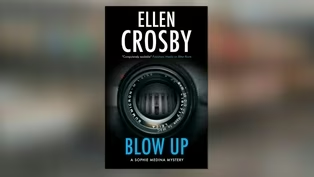
-Okay, so we're looking at Blow Up , the title of this book.
So, share with everybody the premise of this book and how it opens, without giving it away.
-Okay.
So I love my...
I wrote six Vineyard books, and I wanted to take a break because it was a very small world, and I felt I wasn't being fair with my fans.
And so, I really wanted to write this book about a photographer.
And the reason I chose a photographer rather than a journalist is that, as somebody who writes for a living, you know, you get a lot of words, especially, you know, writing for newspapers, a lot of opportunity to tell your story in many words.
But, one photograph, you know, has to do the work of all those words.
And I thought it was, you know, to be the person who's going to get that photograph that's going to say, you know, so many things.
And I worked with some wonderful photographers when I was at the Washington Post and The Journal.
And they would call me, and, you know, what are you trying to say here?
And then, I'd see the photograph afterwards, and it was like the bonus.
-Well, and that's her character, right.
She's curious, and she's got this friend Jack, who is a Jesuit, and they've kind of been friends forever, but they stumble upon... -Right.
So she's got, Father Jack O'Hara was her boyfriend in high school, and they, he's a runner, and they both live in Washington.
He lives at the Jesuit House Of Studies on, over by Capitol Hill.
And they go out for a run and they come across the body of somebody who's collapsed.
And they, you know, they go to help him and they find out that he's a Supreme Court Justice.
And so, he's taken to the hospital where he, where he dies.
And... -Good luck trying to give people a little bit about this without telling them, giving it away.
-It ends up being tied up with the murder of a homeless person.
And that was, when you say, I always write about something, like, I became very interested in the subject of homelessness, which is a big deal in Washington.
And so, the question is, there are people who don't believe the person who was murdered, who died, was in fact the Justice.
And was he a-- you know, what happened.
-Was he or wasn't he?
-Yeah.
So his wife comes and identifies him, and he's cremated, and that's the end of it.
And they have a funeral for him at the cathedral, but she has some doubts.
-That's not the end of the story.
-No.
No, it's not.
It's not.
-So I love the fact that in the Sophie Medina Mysteries also, the characters kind of connect through the books, but again, you don't need to read them in order, in order to get Sophie or understand the mystery or... again, and the research is phenomenal.
I never knew that, you know, with a Supreme Court Justice, they had to die, like, in the ambulance or in the hospital.
Or different things might happen.
-Yep, yep, yep.
You're not allowed to be declared dead in an ambulance.
You can't die in an ambulance.
It's always when you get to the hospital and people declare the time of death, there's an official person who does that, which I actually found out for myself.
-Okay.
What's the first book that you'd like to read a little passage from?
Bitter Roots, since we're here at the winery?
-Okay.
All right.
I can do that.
So this is Bitter Roots , and... -[Rose] The cover's beautiful.
-[Ellen] Isn't it?
Thank you.
I love it.
This is... my new publisher is, he's in England, but I think he did a wonderful job with it.
So this is the... pretty much verbatim, the conversation that Rick Tagg and I had together and... All right, so I'll just read a little bit.
-Let me give a shout out to your son, who made a map in the beginning.
-Yes, my oldest son made the map, so he drew the map, which I like.
All right, so this is Chapter One.
"Julia Child once said that every woman "should have a blowtorch in the kitchen.
"To that I would add, "and a chainsaw in the garden, "or the vineyard should you own one.
"Blowtorches and chainsaws say "you're a woman who means business.
"They say, don't mess with me.
""These vines are going to die.
"They're not going to get any bigger."
"I was stunned, but I was also "angrier than I'd been in a long time.
"These vines had also been fine, just fine, "for the first two years after we planted them.
"The technical name for what my fiance, Quinn Santori, "and I were looking at said everything "and explained nothing: Failure to thrive.
"What it meant was: I have no clue what happened.
"'I know, Lucie.'
"Quinn sounded as upset as I was, but also weary.
"'I know that.'
"For three back-breaking years, "he and I had nurtured these vines, "cared for them, loved them like children.
"After lavishing money on their growth and development "without making a dime off them so far, "it was their turn to kick in and pay rent and expenses.
"This year, these Cabernet Franc grapes "should finally have been producing "their first proper harvest so we could make wine from them.
"It was a grape that did well in Virginia soil, "and our wineries were known for making good wine from Cab Franc.
"So when we planted these vines, "we thought, no, we knew we were backing a winner.
"Instead, here we were standing in a field "of stunted, sick-looking grape vines.
"I scraped at the dirt at the base "of the withering brown trunk "with the tip of the cane I've needed "ever since a car accident 10 years ago.
"Was something in the soil causing this?
"Was it the rootstock itself?
"A parasite?
What was it?
"'I can't handle looking at this,' I said to Quinn.
"'I'm ready to rip them all out now.'
"'Come on, not so fast, baby.
"We still don't know what caused them not to grow "and why this disease or whatever stops all of a sudden.
"The other ones are-- the other vines are fine.
"We have to at least figure that out.'
"'Nobody knows what's wrong,' I said.
"'And it's not from lack of asking people to come out "and take a look for themselves.'
"It had been like throwing darts at a dartboard while wearing a blindfold.
"Everyone who came by to give us their considered opinion, "and that included agents from the County Ag Extension Service "as well as an expert in grapevine diseases "from Virginia Tech, "shook their heads and delivered the same verdict.
"'Your guess is as good as mine.'
"What were we supposed to do with that?
"Truth be told, I knew Quinn was even more upset "about what was happening than I was.
"And that's saying something because he's our winemaker.
"It's part of the job, worrying all the time, "second-guessing yourself when something goes wrong, "figuring it's your fault, "convinced that you could have prevented what happened, "should have prevented it, "if only you'd known what to do or seen it coming.
"Whereas Quinn, whose childhood home "had had a small altar in the linen closet "where his devout Spanish mother prayed daily, told me it was like Catholic guilt on steroids."
-And there's so much more to come, and learning about how that happened, what happened with those vines is part of the amazing mystery.
-Thank you.
-Yes.
Well, thank you so much for spending time and inviting us here today.
-Well, thank you for having me.
-My special thanks to Ellen Crosby for bringing us into the world of the Wine Country Mysteries and the Sophie Medina Mysteries, to Kiernan Slater of Slater Run Vineyards for this amazing location.
And you know what?
To you, Lucinda from Arizona, for recommending Ellen to us, thank you so much.
It's been an amazing show, we've learned a lot.
And you know what?
Please check out more of our interview online, and tell all of your friends about us.
We're going to be getting more into the books.
Ellen's going to read a little bit more, and it's going to be a lot of fun.
Thank you so much.
I'm Rose Martin, and I'll see you next time Write Around The Corner .
[♪♪♪♪♪] -♪ Every day every day Every day ♪ ♪ Every day I write the book ♪ [♪♪♪♪♪] -♪ Every day every day Every day ♪ ♪ Every day I write the book ♪ -♪ Every day every day Every day ♪ ♪ Every day I write the book ♪ [Announcer] This program is brought to you by the generous support of The Secular Society, advancing the interests of women and the arts in Virginia and beyond.
A Continued Conversation with Ellen Crosby
Clip: S7 Ep11 | 24m 12s | We go into more depth about both of Ellen mystery series plus she reads from her latest novel! (24m 12s)
Clip: S7 Ep11 | 4m 13s | Ellen reads a selection from the Sophie Medina mystery, Blow Up. (4m 13s)
Providing Support for PBS.org
Learn Moreabout PBS online sponsorship













Support for PBS provided by:
Write Around the Corner is a local public television program presented by Blue Ridge/Appalachia VA