Write Around the Corner
Write Around the Corner: Evan Friss
Season 8 Episode 6 | 27m 5sVideo has Closed Captions
Evan Friss, New York Times bestselling author, talks about his love letter to the American bookstore
Evan Friss, New York Times bestselling author, talks about The Bookshop: A History of the American Bookstore. One of Time’s 100 Must-Read Books of 2024, the book is a love letter to the American bookstore.
Problems playing video? | Closed Captioning Feedback
Problems playing video? | Closed Captioning Feedback
Write Around the Corner is a local public television program presented by Blue Ridge/Appalachia VA
Write Around the Corner
Write Around the Corner: Evan Friss
Season 8 Episode 6 | 27m 5sVideo has Closed Captions
Evan Friss, New York Times bestselling author, talks about The Bookshop: A History of the American Bookstore. One of Time’s 100 Must-Read Books of 2024, the book is a love letter to the American bookstore.
Problems playing video? | Closed Captioning Feedback
How to Watch Write Around the Corner
Write Around the Corner is available to stream on pbs.org and the free PBS App, available on iPhone, Apple TV, Android TV, Android smartphones, Amazon Fire TV, Amazon Fire Tablet, Roku, Samsung Smart TV, and Vizio.
Providing Support for PBS.org
Learn Moreabout PBS online sponsorship[Voiceover] This program is brought to you by the generous support of the Secular Society.
Advancing the interests of women in the arts in Virginia and beyond.
♪♪ ♪ Everyday ♪ ♪ Everyday I write the book ♪ ♪♪ -Welcome, I'm Rose Martin and we're Write Around the Corner in Harrisonburg at Parentheses Bookstore with New York Times best selling author Evan Friss.
His book, The Bookshop A History of the American Bookstore is a love letter to the American Bookstore.
He says bookshops are a little weird but also full of magic.
Let's find out why.
Hi, Evan.
-Hi.
-[Rose] And welcome to Write Around the Corner.
-Thank you so much for having me.
-And tell me why you picked this location of Parentheses Books.
-Well, I think it's the obvious choice and best choice in part because it's beautiful but also because it's a bookshop.
And not just any bookshop but one I have an intimate relationship with, not just as a browser but essentially married to it.
[chuckles] -Right.
And your favorite bookshop, of course.
-It's my favorite bookshop.
So my wife opened Parentheses about.. a year and a half ago.
She was a long time bookseller and in many ways a kind of muse for this project and now she opened her own bookshop.
And as you can see, it's a fantastic space.
-It's beautiful.
But your whole relationship really started with the bookshop, didn't it?
From when you got -- you two were in New York?
-Yeah.
So I was a heavy reader and I was a graduate student studying American history.
Spent a lot of times in libraries growing up and throughout my whole education and enjoyed bookstores but didn't fully appreciate the power of these spaces until Amanda started working at a small shop in the West Village called Three Lives and Company.
And it was really through her experience and me visiting her and hearing stories about this wondrous place that I began to think about how special these kind of spaces are to so many people and how they can serve as anchors of communities in neighborhoods.
And so it planted the seed as a historian to think about how these spaces have changed over time, when did they first appear, and what is their continuing relevance in this 21st century.
-And the love that people have for the community that the bookshop is in or the fact that they've got favorites.
And so we'll talk about that a little bit later how this book of yours like garnered lots of emails and lots of queries about, "Why didn't you include my bookshop or how about this bookshop to do a sequel."
Well, you're a professor at JMU and a historian.
What do your students think about you being this New York Times bestselling author about bookstores?
-You might have to ask them.
[chuckles] Some seem to not know it all.
Some definitely know.
I don't bring it up in class or sign [chuckles] my own book.
But occasionally I have had a student who asked me to sign a book for their mom where they seem to get some credit or sort of street cred for their aunt who's read the book who asked them, you know, "Do you know, have you had this professor?"
And they say they're in my class.
So that's always sweet.
And I've met a bunch of students and their parents and have sort of broadened the reach even as a professor by virtue of this book.
So that's been nice.
-That's wonderful.
What about your family's reaction?
-You know, in some ways this is obviously it's my book but it's very much my family's book and our life in many ways has become about the bookstore.
So Amanda was the inspiration for it.
She opened this shop.
We had a launch party for the book here, you know.
She promotes it front and center.
My kids have occasionally worked here and they have occasionally been dragged to various events of mine in which I'm talking about this book.
So they've gotten to see their father maybe in a different light, but as you might expect, they're not as impressed [laughs] as some other people.
They're, you know, in me as a father you know, and can I play with them and give them sweets and allot them video game time and whatever else.
-Trade off for coming to book events with you, right?
Something else you're going to be doing.
And so this wasn't your first book.
You have a couple of previous books on cycling.
And the love of book shops seems like it was innate for you from Amanda.
Did you grow up loving books also?
-I did and didn't.
You know, I loved sort of being read to.
I loved going to the library as an elementary schooler.
But I think a lot about middle school and the books that I read and I think I was just often immature at the time for some of the great works I was being fed.
So I read this last year James the book by Percival Everett, this great book that's a reinterpretation of Mark Twain's classic Huck Finn.
And I read Huckleberry Finn in, I don't know, sixth or seventh grade and it just completely went over my head.
I had no idea really [laughs] what was going on.
And I felt that way a lot about the kind of works I was grappling with.
And it really wasn't until high school when I started to read for fun and found some more, you know, Kurt Vonnegut I started reading and it was funny and over the top.
And that really spoke to me as a teenager.
And I was maybe a late developing reader in terms of maturity.
And then as I've gotten older I just kept reading more and more and falling in love with books and bookstores more and more.
-And so you're not only reading historical pieces for reference or academic papers, you're also reading some other kinds of works for fun.
-Yeah.
And don't tell my colleagues in the history department.
But when, you know, I have spare time or I'm going on an airplane or I'm going to the beach I'm much less likely to read history and nonfiction but I still really enjoy reading fiction.
And I can justify it in a way by telling myself, which I think is true, that it helps me become a better writer to think about different kinds of genres and read, you know, narrative fiction in a way that hopefully my history books don't come off as too... boring.
[chuckles] -Well, I think that's a great excuse for what you want to read.
And what I loved about this book was even though your background is a historian and academic professor, it's academically well-researched but it doesn't come across as I'm reading a paper for an academic paper.
And I love that.
And I think that's why it has reached so many people.
And Times Must Read 100 Books of the Year last year for 2024.
That's fabulous.
-Thank you.
I appreciate that.
-[Rose] And this awards, New York Times right off the bat, People Magazine.
So you've almost been everywhere after cycling.
You're thinking, "Wow, this book has hit so many people."
Why do you think it resonated so much?
-I think a lot of it is the subject matter.
I'd like to take some pride in the quality of the writing and storytelling.
But a lot of it has to do with people's relationship with their bookshop and a really deep and special relationship that they have that creates an innate interest.
That doesn't mean any book about bookstores is going to necessarily do so well.
But it creates at least a starting point where readers might have an inherent interest.
And readers and booksellers are people, as you know, as a reader, who like to share recommendations [chuckles].
And there's nothing better than reading a great book and then putting it in the hands of someone else.
And I've gotten to know a lot of people who have gifted the book and recommended it, and it's so heartwarming.
And I'm so grateful.
And still surprised by the reaction that the book has garnered.
So I, as you mentioned, wrote two previous books.
And they only count as books.
I mean, it's sort of like if a tree falls in the forest.
You know, if nobody reads a book, is it actually a book?
So they were a very different scale.
And this book, I've seen it in airports, and people send me pictures of, you know, bookstore windows.
And their father's reading it.
They went somewhere and saw it.
And I'm still really surprised.
And appreciative of that.
And so I'm thankful to all the readers who have gobbled it up and told their friends about it.
-And the ones who are just learning about it for the first time, right?
And so did you pinch yourself still?
Like, yeah, "This is my book.
"I created this.
And it's taking the world by storm."
-It is hard to-- there are some aspects of it that are still hard to believe.
You know, the New York Times bestseller list seemed like some kind of abstract or very distant -- not even -- I mean, it was nothing I considered or worried about because it seemed so impossibly distant and the kind of accolade I associated with people who are completely unlike me.
I'm just a middle-aged professor.
[chuckles] You know, James Madison University has written a couple books.
Yeah, I was very surprised.
And sometimes when I'm feeling down, will try and remind myself of this good fortune that I've had.
-Well, congratulations.
And it's amazing.
I understand you sometimes work in the attic.
You'll write in the attic or you'll write at coffee shops.
But you have a couple of fears.
So one is being scooped.
[chuckles] And then another one -- explain to me why you print drafts and put them in the freezer.
-Yeah, you've done your research, I see.
-[Rose] [laughs] -One of the -- yes.
I always struggle coming up with ideas for books.
And each one I've written I assumed would be my last.
And then when I have an idea and I start working on it, I figure everybody else will have this idea.
Even with the bookshop, how has nobody written- -Right?
-a popular history of the bookstore kind of -- I couldn't believe that it didn't exist.
And as I was working on it, assumed that any day something was going to drop and would just sort of spoil my arrival.
So that's a perpetual fear, which is one reason it's good to sign a contract early on.
Because then at least the book is coming out no matter.
And it's hard to know what everybody's working on.
But yes, the other real satisfaction -- and I'm not sure other authors feel this way or readers might appreciate this, but one of the real satisfactions of publishing a book is that I'm no longer in charge of all of the files, images, drafts of this chapter, notes.
I have tons of, you know, scholarly notes about this and all sorts of files.
The kind of data management... keeps me up at night sometimes.
So as a practice -- and this is an ode to my father-in-law who has a PhD in economics.
And this was back in the typewriter era.
And he once told me that he kept a copy of his dissertation in the freezer because it was like fireproof or something.
And you know, they didn't have Google backup or any kinds of things.
So I have various cloud backup.
But as a kind of homage and reminder to keep working on the project and to stop eating so much ice cream, -[Rose] [laughs] -I every once in a while will print a draft of the book as it exists and just stick it in the freezer.
And sometimes people will come over and like, Why is there 200 pages of paper in the freezer?
-I think that's wonderful, so it would be a surprise.
And I think your wife would probably say, "Honey, do we need to keep putting "your book in the freezer?
Like you can put it somewhere else."
But great homage to your father-in-law.
-And when the book comes out, boom, there I can toss it out.
-[Rose] That's right.
-And I feel it's exciting and I can go back to worrying about the next book.
-[Rose] Putting something new in the freezer.
Putting something new in the freezer.
So let's get to The Bookshop.
So I love the fact that you take us from Benjamin Franklin through the history of the decades to where we are now.
So for people who don't know about Benjamin Franklin and that he had so many things happening at the same time, why don't we start there?
-Yeah, so in the colonial period, most Americans didn't have access to books.
They were super expensive.
They were printed largely in Europe.
-[Rose] And they made them illiterate.
-Yes, and of course many people living in the colonies and the vast majority of enslaved people were illiterate.
So it was a burgeoning market.
And so many early booksellers found themselves selling books as well as other kinds of commodities, food, newspapers, in order to have a kind of sustainable business.
So Ben Franklin was a kind of newspaper man who printed a newspaper and distributed it.
He was an author himself, most famously his almanac that he published under a pseudonym.
He was also a printer and had this print shop where he would print books on demand.
And he was a bookseller, where he sold books from other publishers.
And he became really one of the foremost booksellers in the colonial period.
And it was this hub of Philadelphia.
And he's a kind of interesting figure, not only because who he is and this famous politician and celebrity author and scientist and all the rest.
But because he really helps or is a kind of figure in this transition from bookselling as piecemeal and as part of other operations to eventually after the Revolutionary War in the early 19th century, we have more what we would think of as kind of stand-alone brick-and-mortar bookstores.
-Well, and I love the invention to get to the higher books on other shelves.
-Yes.
-And what was that?
-Ever the inventor, when Franklin grew older, and he lived a very long life, he came up with this thing.
He called it the thing with the long stick.
It was a pine stick with a little grabber on the end so that he could get books on the top of his shelf.
And he was a great collector of books and, you know, one of the founders of the greatest private library at the time.
And he said, you know, "Old men don't belong on ladders.
"So here's how you can keep reading and keep your book stocked."
-I love that.
And another great collector that you mentioned in the book is Frances Stelloff.
So what was it about her collections?
And why don't we back up a little bit?
Because there's two really.... strong women that you profile.
From The Strand and then from the Gotham Bookstore.
So why don't we kind of go there?
-Yes.
So one of the things that might surprise people, and it surprised me, because book selling has been an industry dominated by men for a long time, and the publishing houses were typically the executives and owners of those places were men.
And of course many of the most popular authors in the 19th and even into the 20th century were men.
But in the early 20th century, probably the two most important American booksellers were women.
And one was Frances Stelloff, who started the Gotham Book Mart, which was a very unusual kind of store that catered to artsy customers, had a lot of esoteric things.
She was famous for selling James Joyce when it was banned here and the same with Henry Miller.
So literary fiction, avant-garde kind of material, and it became a hub of modernist literature and a place where people learned about new and exciting forms of literature.
And she was an eccentric person who created this shop that was very much her own.
Like it was an extension of her, and that was also part of the appeal for her customers who got to know her.
She lived in the bookstore, literally in an apartment upstairs, and she worked there almost every day from when she was in her low 20s to 100 years old.
-Yeah, that really struck me that she was 100 years old and quite a collector.
-Quite a collector.
So her bookshop, not like this, which is a little more minimalist and has a lot of faceout books.
Her shop looked like crowded and busy and was just full of books piled on the floor, on the shelves, and was, yeah, a kind of mecca for a certain type of literature.
And she's probably the person I most wish I could have interviewed if she was still alive.
And the other woman was Marcella Burns Honner, who was the person who started the book department inside Marshall Fields in Chicago.
And this was also a kind of surprising storyline.
As somebody who grew up in the 80s and 90s, department stores to me were kind of, you know, middle-class suburban mall kind of fixtures.
And not particularly glamorous, and certainly not a place I would think to look for books, but -- -Especially on the third floor.
-[laughs] Especially on the third floor.
But between the two World Wars, Marshall Field developed a book department that was really the leading bookstore in the country, one of the largest bookstores in the entire world.
But its size didn't sort of detract from it having a personal touch.
And booksellers from all around the country would come and try to pick Marcella's brain about her kind of magic in terms of arranging the shop, which was done beautifully and often.
So she would continually rearrange displays to make it feel fresh.
And it was also a shop just noted for great service.
Recommendations, personal delivery by horse, same-day delivery of books for regular customers.
-And I read that like 700 horses were ready to just in case someone called and wanted -- or not called, but let them know they wanted a book, and they they were off.
-Yes.
So they had the kind of muscle of this giant emporium of Marshall Field's, but also a real personal touch with well-read booksellers and created, yeah, just what looked to me to be a beautiful and certainly influential bookselling space.
-Some of the other interesting things along -- throughout your book.
You take us through New York and Book Row and Booksellers Row and how that all evolved and how politically influenced booksellers were actually by the political climate that they were influenced by what they could and couldn't do.
So briefly kind of walk us through what that was like from the early time of when, you know, past the revolutionary from Ben Franklin.
But then all of a sudden we've got these booksellers who want to get a permit and they don't want to wait in line because it takes too long and they're not selling, you know, candy corn on the streets.
-Yeah.
So one of the -- when I moved to New York, which was not until the 21st century, there were still some sidewalk booksellers including in Washington Square Park near where I lived and I was fascinated by these booksellers in large part because of how obvious and manifest and how much they were embedded into the fabric of the city.
And I just loved that you could be walking, you know, to class or office or to get a slice of pizza and you sort of couldn't avoid the bookstore as it were.
And over the course of my time there, they mostly disappeared.
And so even though the book is about book shops and we have this sort of traditional idea of what that looked like, I wanted to think about some less traditional bookselling spaces.
So I have a chapter about sidewalk booksellers.
And in New York, in the early 20th century, most of the traditional bookstores had sort of sidewalk stands that were an extension of the shop.
And there were so many of them that this neighborhood became defined by the bookstores and became called Book Row.
And they were mostly used bookstores of different varieties.
And over time, they went out of business with the exception of The Strand, which was on Book Row and eventually moved just off and is still a very vibrant independent bookstore.
But then sort of fast-forwarding into later in the 20th century, in the 1980s, the New York City Council came up with a new law that allowed basically anyone to sell books without a license on the street.
And the rationale was a First Amendment kind of constitutional that in order to spread knowledge and information, you shouldn't have to jump through all these same hoops if you want to sell hot dogs and something else.
So they kind of had a free pass.
And what happened was this explosion in the number of sidewalk booksellers in the 1980s and '90s.
And it was a particularly New York City phenomenon because it was a local law that was passed and didn't replicate itself in other cities.
So it was a bonanza.
And there were booksellers lining entire avenues.
And it was really part of the cityscape.
And so I wanted to write about that and think about what those, you know, glory days.
I don't want to call them glory days because this is always a tough business.
It's hard to be a bookseller and especially hard to be a bookseller who works on the sidewalk.
-What I love also in your book is that you talk about, you know, bookshops being weird and yet they're full of magic.
And also that the fact that there are places of community and there's book grazing, right?
there's tasting.
There's, you know, a commonality not like a shop where you want to just make it a transactional experience, but it's an authentic real emotional experience too when you come to a bookshop, whether it's your favorite or you're stumbling into something brand new.
And I love the idea that you said it's like a tasting.
You might browse for, you know, 15, 20 minutes before you even make a choice.
Or the person who owns the shop is going to make a suggestion for you.
-Yeah.
-I love that.
Well, I can't wait to have you read something for us.
Would you be willing to do that now?
-Yeah, I would love to.
So this is, I have in the book kind of typical chapters and then these little breaks between them where there's short sections about various themes that didn't -- -That was one of my favorite parts about this also, that they had these little breaks in there.
-Well, I appreciate that.
So I'm going to read from just one of them here.
This is a book about bookstores.
It's merely one of many.
Fans over at Goodreads have compiled a list of 352 of them.
Christopher Morley's novels about Roger and Helen Mifflin are there, as is 84 Charing Cross Road, my personal favorite.
When I told people that I was writing this book, the most common response other than, "When will you be finished?"
was in one way or another about You've Got Mail.
Have you seen it?
Yes.
Are you going to write about it?
Yes.
Maybe you can interview Tom Hanks.
Maybe.
Aside from Tom Hanks and Meg Ryan, Hugh Grant in Notting Hill and Audrey Hepburn, Funny Face, both play memorable and remarkably good-looking booksellers.
Both find love rather than rare first editions.
To be sure, these films are sappy and tropey and many books about bookstores can easily be dismissed as navel-gazing a la Hollywood's propensity to make movies about Hollywood.
But there's a reason why screenwriters and book writers love setting their stories in bookstores.
They can be romantic spaces, places full of discovery, of chance, of wonder.
They can be community spaces, activist spaces, political spaces, and they can be places to lose and find oneself.
Whether in mysteries or memoirs, travelogues or true crime trails, romances or rom-coms, horror or history, bookstores can be more than just passive backdrops.
Bookstores can be actors.
Bookstores, even the little ones, can shape the world around them.
They already have.
-Thank you so much.
And I think you've brought us all back to a love of the bookshop and thinking back to why they are so special.
Thank you again, Evan.
-Thank you so much for having me.
-My special thanks to Evan Friss and his wife, Amanda, for inviting us here to Parentheses Books here in Harrisonburg to take a look at and learn all about our love of bookshops.
Please make sure that you get a copy of this book because there's so much we didn't get to talk about.
Stick around for more of our interview online.
I've got more questions for Evan, and we're going to learn a lot more about bookshops.
I'm Rose Martin, and I'll see you next time Write Around the Corner.
♪ Everyday ♪ ♪ Everyday ♪ ♪ Everyday ♪ ♪ Everyday I write the book ♪ ♪ Everyday ♪ ♪ Everyday ♪ ♪ Everyday I write the book ♪ ♪ Everyday ♪ ♪ Everyday ♪ ♪ Everyday I write the book ♪♪ -[Voiceover] This program is brought to you by the generous support of the Secular Society, advancing the interest of women in the arts in Virginia and beyond.
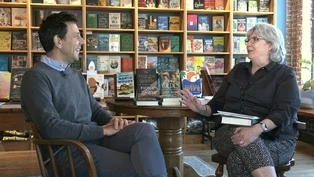
A Continued Conversation with Evan Friss
Clip: S8 Ep6 | 17m 14s | Hear more fascinating stories about bookshops and find out what's in Evan's freezer now! (17m 14s)
Providing Support for PBS.org
Learn Moreabout PBS online sponsorship











Support for PBS provided by:
Write Around the Corner is a local public television program presented by Blue Ridge/Appalachia VA