Write Around the Corner
Write Around the Corner: G. M. Malliet
Season 8 Episode 2 | 27m 7sVideo has Closed Captions
G. M. Malliet, Agatha Award winning author, shares about her two British mystery series.
G. M. Malliet, Agatha Award winning author, shares about her two British mystery series: the St. Just series and the Max Tudor series.
Problems playing video? | Closed Captioning Feedback
Problems playing video? | Closed Captioning Feedback
Write Around the Corner is a local public television program presented by Blue Ridge/Appalachia VA
Write Around the Corner
Write Around the Corner: G. M. Malliet
Season 8 Episode 2 | 27m 7sVideo has Closed Captions
G. M. Malliet, Agatha Award winning author, shares about her two British mystery series: the St. Just series and the Max Tudor series.
Problems playing video? | Closed Captioning Feedback
How to Watch Write Around the Corner
Write Around the Corner is available to stream on pbs.org and the free PBS App, available on iPhone, Apple TV, Android TV, Android smartphones, Amazon Fire TV, Amazon Fire Tablet, Roku, Samsung Smart TV, and Vizio.
Providing Support for PBS.org
Learn Moreabout PBS online sponsorship-[Woman VO] This program is brought to you by the generous support of the Secular Society, advancing the interests of women in the arts in Virginia and beyond.
♪ ♪ ♪ ♪ Every day (every day), every Day (every day), every day ♪ ♪ Every day I write the book ♪ ♪ ♪ ♪ -Welcome.
I'm Rose Martin and we are Write Around the Corner in Alexandria, Virginia, with Agatha Award Winner G.M.
Malliet.
Now, you might know her from her mysteries that are absolutely fantastic.
Today, we're going to follow DCI St. Just and a Max Tudor.
Do you know Max Tudor?
A vicar who was a former MI-5 agent.
So we can't wait to get involved and learn all about her.
So hi, Gin.
We'll call you Gin.
-Is that okay?
-Yes, please.
-So welcome to Write Around the Corner .
-Thank you.
I'm so thrilled to have you here.
-Thank you very much.
-Well, it's so nice to be here in the space that you create all of these great mysteries.
And so with each of the series, and you've got several of them, and we'll talk about the books a little bit later.
But let's go back and think about how you got started in writing and wanting to create mysteries for people all over the world to enjoy.
-I just always loved writing mysteries, and that turns out to be the key to any writing venture-- write what you read, what you love to read.
When I started out, romance novels were what sold and that is still true, romance outsells mystery.
And I did try, but that just, I just, I thought it was ridiculous, that-- for me, it just was ridiculous.
Any more romantasy is what sells, and that is really beyond me.
I don't even understand the definition of that genre.
Anyway, what I always loved was mystery, and that came a bit from my sister, who was a nurse.
And on the night shift, she read Agatha Christie, and she introduced me to Agatha Christie.
-Ah.
-And that was pretty much it.
-And you've lived all over the world and all over the United States.
How has that contributed to the story lines that you write?
I mean, I--we love the-- the London-British setting of these, but you pull in other places of the world and sometimes too?
-Here and there, I do.
I love to travel.
I grew up in the military, so I was used to moving around.
I liked moving around.
I also like rules, as I just discovered.
I was just doing the taxes, and I love the little, "Oh, there's 17 cents missing here" kind of thing.
I have that kind of brain that pays attention to just anything and collects, like lint, anything that goes on.
So in a foreign country, I'm always just gathering intel, and it ends up in a book somehow.
I don't quite know how it's going to work in the book, but it ends up in there.
-So the details; you love the details.
-I do.
I love that new freshness.
Because, you know, you stare at a screen a lot, you see the same people all the time.
You go overseas, and it's all fresh.
-Well, and I love the fact that I read something about you that you get great ideas from people watching and just stepping back and observing them and what they're doing and what they're thinking.
-It's called eavesdropping.
-[laughs] Yeah.
-Yeah.
And I do that.
Once in a while I'll work in a coffee shop, and one scene I practically lifted out of the coffee shop into an earlier book, because these three men were just so priceless, trying to one-up each other.
It was just a very funny conversation, so.
-And you were able to take that and say, "Perfect."
-"You're going in the book."
-You're going in my book, right.
So I read that you were in a book club at one time, and it had three men and three women.
-Um-hmm.
That does not work.
-Yeah.
And you had an interesting thing about how books were chosen and what kind of happened.
What's that story?
-It just--we ended up reading what the men wanted to read.
It was classic, classic stuff.
It wasn't always against our wishes to read the book, but somehow, we had to choose a book that was not cozy, or, you know, that we felt they wouldn't read.
Now, that's unfair to the whole genre, because of a lot of, I think, my books are male and female would both enjoy.
But there is this stereotype that it's all, you know, cats and things.
-And that's too bad, right?
-Yeah.
Because you think about a good mystery and it's for everybody.
And that's one of the things that Carol and I both love about your books, is that it doesn't matter which series that we were into.
If it was Death and the Old Master from the St. Just series, and I'm--we're in-- I'm into it and totally involved in it, or if it's Max Tudor, and I can't wait to find out what he's involved in next.
So it is, it's-- I think it's attractive to both men and women.
-Oh, thank you.
-And I think the other thing I like is that, you know, we can read it and feel good about it.
And sometimes I might laugh at some of the things they're doing, and other times, I'm going to be really intrigued with what they're doing.
And does that come from your people watching or from just how you want to interpret characters, or what things you want them to do?
-I don't know.
The laughter comes from me trying to keep myself entertained during the long slog of a book.
And a really good week, I'll have one laugh a day, just something that I-- that delights me, and I couldn't tell you really where it comes from.
It's just part of the process of you're in the story, and you see the situation, and you realize how ridiculous it is or potentially could be.
And I'm just enjoying myself and that, those are-- those are good moments.
-And I think that's important to realize.
If you're having fun, and it seems like it's interesting, and you find yourself giggling and you're coming up with it, you're like, "Okay, other people are gonna get this."
-Hopefully, yeah.
-And so your background traveling around because you were military, but you spent quite a bit of time in Oxford, and you then got a degree from Cambridge.
Is that the love of everything British is why they're set in the British countryside?
-Yeah, I did not grow up in England, so this, I just sort of landed there and loved everything about it.
I'd read a lot of, you know, Charles Dickens and Jane Eyre , and I'd read all these authors and loved them, so I was primed to really love the country.
It's the British use of language that intrigues me.
They're funny people.
They--I think maybe they don't always know how funny they are.
They're just witty, quick-witted people, and I love their use of language, so.
Robert Bernard, there's a big, you know, big shelf of his books in this house because I'd read everything of his and thought that that's what I want to write, something like that.
-Well, and I love that use of language in your books, because I'll find that even some of the sayings, or some of the words that you choose, or some of the way they may end a sentence, you're like, "Oh, that's really clever," or "That's really fun."
And it's authentic, but it takes us into the English countryside too.
It takes us into the place.
So your perfect day.
I read your perfect day is getting up and going to the gym and then six to eight hours at the computer, and a day that would be the absolute best would be a day that you would have nothing else to do but write.
-That's still true, except going to the gym.
-I don't-- -[Rose] Take that part out?
-Yeah.
I fell off -[Rose] Okay.
-the wagon there, so to speak.
It got very cold, and too cold to walk to the gym, so that's my excuse.
But yeah, any day where I don't have to be at the dentist or anything, just anything.
Just all I have to do is sit at the computer and dream, that's a good day.
-That sounds amazing, right?
Sitting at the computer and dreaming.
-Yeah.
-And just letting it flow.
So you do like stories with a beginning, a middle and an end.
So when you think about--I read you, you like to approach writing in a sideways, crab-like fashion, trying to kid yourself into the fact that you're not writing, you're just making notes.
-That's kind of it.
Yeah.
The beginning of the book, that's the fun part, when you--you're not committed to anything, and you're just playing around with it and seeing what works and, you know, aimlessly wandering around; that is the part I love.
Once you actually have to write the book, that's a little harder.
I don't mean to make it sound all fun and games, it's a little bit harder to do.
-Well, you have to put things in an organized fashion, which gets me to the fact of outlining.
Is it true that you had to write a screenplay or a play at one time, and they wanted an outline first, and you were like, "Hmm, I don't know.
I might just write the play first, -and then turn in the outline."
-Then you do the outline.
Yeah, something like that does happen.
I just wrote a proposal for a book, and I do know the ending.
The proposal forces you to know that, though.
Otherwise, it's just a bunch of word salad that you're hoping someone will be intrigued by.
But you need to know where you're going with it.
Otherwise, you do waste an awful lot of time.
I don't outline per se, you know, chapter one, paragraph two.
I do have to know the ending, and sometimes I write the ending first.
I have done that because that's so intriguing to me that we're going to get there, but now we're on page one.
[laughter] And the characters, do they drive kind of the flow of the story sometimes?
-I do know that the character names are really, really important, and until I get the name right, I don't know a lot about that character.
I can't expand on that character.
-Is that a feeling you get?
-Yeah.
-Because some of the names are so authentically British and are so, you know, some of the names I've never heard of before.
So as I'm reading through them, I'm like, "Oh, that's interesting."
So it does catch me as a reader.
-There's a Nussknacker -in this book.
-[Rose] Yes.
-I'm pretty sure it's made up.
Yeah, I do a lot of research to make sure I'm not actually using a name that will offend somebody.
There's that.
But the British have this wonderful, they just have these wonderful names and their villages, especially.
You know, Upper North Slaughter River, or say, you know, just these crazy, cobbled-together things that always have a history.
They have a reason.
Yeah, I'm trying to think of... JD Rowling came from, it was something like Chipmunk Sodding.
And she said, "We always called it Sodding Chipmunk."
-You know, just stuff like that.
-Yeah.
I have a neighbor who lived over in England, and they used to go to a train stop that was called Giggleswick.
-Yeah.
-And you think, "Oh my gosh."
Like, "That is so interesting."
And you'd think it was made up, but it was real.
-Yeah.
And the Romans or somebody came up with it.
It wasn't just, you know, someone with a sense of humor in the 20th century.
That was it.
-How do you keep the characters so fresh in a series?
-That's hard.
It really is.
A series hits book 25 or so, and it loses its audience.
I mean, this is, you know, an established fact.
It's hard to keep that going.
You tend to move them around, put them in a new setting, acquire new villagers in my case, like the Max Tudor books, because it's a village of, I think, 200 people, and you kill off three or four of them per book, -so you have to bring in new.
-Right.
-[laughter] -Right.
Absolutely.
Well, I love the fact that you said all of the characters are after truth and justice.
-Where you getting that?
-They're seekers.
Oh, well, we did a lot of research about you.
So I love the fact that, you know, that's something that is, continues through your books, that they're always looking for either that right or that justice, or digging just a little bit further to push it, you know, to find it, to find the answer.
-Um-hmm.
I think Max Tudor, especially, is a-- just loaded with integrity kind of man, and he--he's a bit of an innocent in a way.
He doesn't see why everyone can't just get along, and why the world is the way it is, even though he's a former MI-5 agent, so you think he'd be a little more hardened than he is.
But he really believes in truth and justice and making the world a better place.
St. Just is the same way.
He's a little harder edged kind of guy, and I think it just makes him angry when people don't behave.
He just takes it personally, they don't behave.
And he's a policeman, so he's in a position to do something about it.
-Yeah, he likes to hold the line for like people, what the right and wrong might be.
-Yeah.
-So is it true that you sometimes find yourself easily distracted if you're caught in a writing moment that it's like, "Oh, a shiny thing, or a pull on my sweater," or something that just to break away.
-Oh, Amazon, eBay.
-[Rose] Yeah.
- I know.
Yeah.
-Unfortunately, online distractions or research online.
You get stuck on a word and go down that rabbit hole of exploring that word.
But, yeah, it's easy to-- I call it taking a break.
I don't call it distraction.
-Right.
Okay, that's right.
I think that's great.
Taking a necessary mental break to recalibrate.
-Yeah, I can't think about this anymore.
-Yeah.
Gonna go do something else.
-Right.
So on the, you know, when you're coming up with different kinds of scenes, I said, I love this fact that I read about you with humor: "Humor seems to come out of nowhere, "but it does seem to crop up "during the first or second drafts.
"If I write something that makes me laugh, "I'm so happy.
"I'll trust others will laugh too.
"Otherwise, I feel be better served "reading something educational, like the instruction manual for a new colander."
[laughter] -Yeah.
I mean, that's absolutely true.
I regard what I do as entertainment and nothing more, and I think that's really important.
-And the other thing I loved was you said, "Don't invent a character you wouldn't marry."
I'm like, oh, she's putting character traits and value systems and things into these important characters that they're that important, that we do fall in love with them, right?
We do become attached to them in a way that we want them... we want them to win, and we want them to find the truth.
-Yes.
I'm not a fan of the hardened detective with a drinking problem and the daughter who won't talk to him, and it's become a bit of a cliché, but I also am not as maybe sympathetic to that as I should be.
I just want this almost unrealistically good cop, good priest, trying to do their best to solve a crime.
-And that's what I loved about your books, too, is you could get lost in not only the place, but I could get lost in the story.
And you're rooting for people, right?
You're rooting for people, but yet I never quite know.
So you kept me going as to, "Oh, what--what's-- what is really happening here?"
So let's take Death and the Old Master .
So the first book that we're going to talk about, and, you know, you have us on a campus, you have a series of paper packages that someone gets from a relative, and they kind of put them away, and then what happens?
-Yes, it's the Old Master of Oxford College.
He's an art expert.
And his aunt dies and leaves him-- well, she's actually having to move into a nursing home, and she says, "Take these with you."
He takes it home over protest.
He knows it's probably just junk, -but he brings it to his office.
-[Rose] Yeah.
And sure enough, there's something in those packages that they're wrapped in brown paper.
They are paintings, and one of them might be worth a lot of money.
-It might be.
And I loved his name too, Sir Flyte Rascallian.
-Yeah.
-And so then we hear about him as Sir Flyte.
But, so we've got these mystery packages.
One of them might be something good, but then there's some other people that come in who want to necessarily, maybe take a look at those paintings, or he's unwrapping them, and he's-- they're like, "Well, no, they're really nothing."
So we don't know.
Are they something?
Is it someone famous?
Is it something worth a lot of money, but some--someone else wants to get involved, to kind of evaluate the pictures, right?
-Yes.
Yes.
He's suspicious because-- because of the way the master is acting, he thinks the master is on to something, and he wants to get hold of this.
-And I love his name too: Ambrose Nussknacker.
So then, of course, the Old Master comes up dead.
-Yeah.
-So then it's like, "Okay, what is going on with these paintings?"
And is there something, or then... how do you, like, take the initial murder of what's going to happen and then weave in the fact that there's this Old-- and I love the fact that he's an Old Master, and this may have come from an Old Master.
-That was--I love that.
-Thank you.
-And I thought that was really fun.
So how did you weave that through to kind of thinking, "Okay, we're gonna take this on a little bit of a journey?"
But then historically have to be kind of accurate too.
-Yes.
This was sort of a mishmash of everything I'd encountered in the previous year, without giving too much of it away, that that element came into it.
Also, we had traveled to Bath, England, and met a true eccentric, wonderful, wonderful man who was an art expert and had written many books on the subject.
So he--a little bit of him came into the book.
Again, it's just this process of kind of put everything in the blender and then you get a book at the end of it.
-Yeah.
-But he was, yeah, he was wonderful, wonderful character.
I don't want to use his name in case he doesn't like the portrayal, but there are bits of him in it.
And I thought, okay, Master, Old Master, setting in Cambridge, all in--all these elements put together.
Also best of Hardwick.
The college is called Hardwick College.
And she was--it ended up being in a short story with Mary, Queen of Scots.
It's just--it's a mess in here.
It was just a lot of-- -I think it's fascinating in there.
So the fact that you're sitting there dreaming, it'd be great to have a video camera, see what's going on in there.
Off camera, you had mentioned that you've got a character that was based on someone, a famous actor.
-Well, yes.
When I invented Max Tudor, when he came to my mind, he was Hugh Grant, as he appeared in Bridget Jones's Diary -to put you in the time frame.
-Yeah.
-And I think we all know Hugh Grant is probably not going to turn into a priest -any time soon.
-[Rose] Right.
-But it was-- he had that charisma and that abundant charm, that just over-- he comes to the village as my character, Max Tudor, and just overwhelms the women and can't do enough for him, they all want to volunteer for the altar guild.
And, you know, he's just-- he just has that charisma.
But luckily for him, it's not gone to his head.
He's aware of it, but he doesn't manipulate people.
-Well, and his wife is interested in some very different kinds of things too.
-Yeah.
-So what's her character like, and how did you kind of put them together?
-His wife is a New Age, the owner of a New Age shop called Goddess Spell.
There's three S's in the middle there.
And she's just... one of these grounded women, very--not pious or holy, but just very in t-- in tune with nature.
And she has, because it's modern day now, she's selling online her crystals and her rocks and, you know, all the paraphernalia.
We used to have this shop like this in town, and I loved it.
But that--they're too--they're both very spiritual people in, you know, different fields; you know, plowing different fields.
-[Rose] But yet they match perfectly.
-Yeah.
-So they're like a perfect coupling for yin and yang and each other's, you know, a perfect match.
How about The Washing Away of Wrongs ?
So you fall in love with Max Tudor, and he is-- his bishop tells him, "Something has happened, "and we need you to just go and you're kind of undercover, "but kind of not undercover, and find out if this death was actually accidental or natural."
-Yeah, the man's wife doesn't believe it was accidental or that it was natural causes.
She thinks there was something going on.
That book came from the title, which was irresistible.
I can't believe no one's ever used that title, The Washing Away of Wrongs .
It's based-- there's an old Chinese book written by a forensic scientist like way back-- I don't know, 12th century.
-Yeah, I was reading that, 13th century China.
-Like, yeah, -[Gin] Yeah.
actually forensic medicine.
-Yeah.
-Yeah.
It's a wonderful book.
I mean, it's probably becoming a best seller again, because I think it's more in the wind now.
But with that title, I thought, "Okay, here's the title now.
What's the book?"
I wanted Max to be-- to return to his college, that now we're in Oxford.
To use that setting, which is based on the college I was at there.
It was a wonderful opportunity to talk about the scouts who really keep the place going, and the porters.
The porters always show up in these books lately.
Just the wonderful mix of people in these colleges.
It's not all-- well, the students are, you know, from everywhere.
There's a nice mix there.
But it's not all intellectuals talking about Mars.
It's, again, the people that are the engine keeping it running underneath.
Those are the ones that are a lot of fun to write about.
-Well, and I can't wait to go back and read some of the earlier parts of these series, because they're amazing.
So it's been-- they were really, really fun to get to know these characters.
And even thinking, you know, "I know him."
Like, "I want to see what's happened.
Why did he leave MI-5, and why is he now in, you know, a vicar, and what other adventures does he get involved in?"
Would you be willing to read something for us?
-Sure.
Sure, I will.
-[Rose] Okay.
What are you going to choose?
-This is St. Just.
-[Rose] Okay.
-And he's the policeman.
- Death and the Old Master .
-Yes, yes.
Chosen, honestly, at random, but it introduces several of the characters.
"They found Rufus had returned to his rooms "from breakfast in Hall.
"Reluctantly, he admitted them, "having made clear with a theatrical sigh "that the novelty of being interviewed "by the police was wearing thin.
"'We are here because you seem "'to have remarkable powers of observation for one so young,' said St. Just.
"'I wonder if you could describe for us the dinner "'you were invited to that evening, "the evening of the night the master died.'
"'Was murdered, you mean,' said Rufus Penn.
"'Why didn't you tell me that in the first place?'
"'We have our methods,' said St. Just obscurely.
"'What was talked about?
"'Anything unusual that happened?
"'Anything at all you noticed?
Would you mind taking "'those bud things out of your ears?
"Thank you.'
"Sergeant Fear kept his eyes firmly on his notebook.
"Rufus Penn's remarkable powers of observation "seemed to be focused mainly on himself.
"But the blatant flattery "was a tried and true technique of St. Just.
"It often worked.
"The larger the ego, the more often it worked.
"'There was nothing unusual about it,' "said Penn, taking the flattery in his stride.
"'And I really must insist, "everything that night was unusual,' "said St. Just mildly.
"'When a murder is involved, nothing is ordinary.
"'Again, I'm sure that you would notice anything amiss "'out of all the people at the table "'at this dinner party.
"'Let's go through it again in more detail.
"Who was with you at this meal?'
"He knew the answer, but he wanted "to give Rufus Penn's mind room to roam "and hopefully wander off the established path.
"Even better, for him "to contradict anything he'd said before.
"St. Just would give him every opportunity "to put his personality on display.
"'Well, all right, there were only four of us.
"'As I said before, there was Dr. Pat, "the woman in charge of women's studies.'
"'By that, you must mean "'Professor Patricia Beadle-Batsford, "head of the university's Department of Women's Studies.'
"'Right.'
'Quite famous, as I understand it.
"'It must--I must say, it's not an area "I know a lot about.'
"In his notebook, Sergeant Fear wrote down the remark "and underlined it.
"Next to it he wrote, 'I'll bet.'
"'Then there was Ambrose Nussknacker.
"'I've also told you this before.
"'He's a curator of a little museum "'and art gallery up on Castle Hill.
"'He's an entertaining guy, "'and of course, with both him and me at the table, "the conversation ranged over our areas of interest.'
"'I'm sure the ladies enjoyed that,' said St. Just.
"Any irony flew straight over Penn's head.
Clearly, the women's enjoyment was not of interest to him."
-I love it.
I'm hooked.
-So thank you so much.
-Oh, you're very welcome.
-My special thanks to G.M.
"Gin" Malliet for inviting us here to her home in Alexandria and for giving us a little taste of just two of these fantastic mystery series.
Check out more of our conversation online and tell your friends about us.
We're going to be sticking around and asking her a few more questions and learning a little bit more.
Until next time, I'm Rose Martin and I will see you Write Around the Corner .
♪ Every day (every day), every Day (every day), every day ♪ ♪ Every day I write the book ♪ ♪ ♪ ♪ ♪ Every day, every day, Every day I write the book ♪ ♪ Every day, every day, Every day I write the book ♪ [Woman VO] This program is brought to you by the generous support of the Secular Society, advancing the interests of women in the arts in Virginia and beyond.
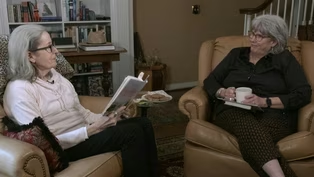
A Continued Conversation with G. M. Malliet
Clip: S8 Ep2 | 15m 23s | Learn more about the stories behind G. M. Malliet's British mysteries! (15m 23s)
Providing Support for PBS.org
Learn Moreabout PBS online sponsorship













Support for PBS provided by:
Write Around the Corner is a local public television program presented by Blue Ridge/Appalachia VA