Write Around the Corner
Write Around the Corner - Jean Meltzer
Season 6 Episode 3 | 26m 45sVideo has Closed Captions
We'll talk with Jean about her rom-com novels that are full of traditions, joy & humor.
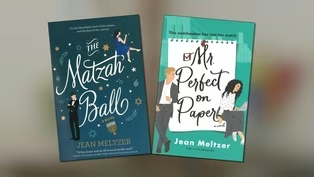
We visit with Jean Meltzer in Herndon, Virginia, to talk about her two novels, Mr. Perfect on Paper & The Matzah Ball. Her sweet and quirky Jewish romantic comedies are full of vibrant traditions, joy, and humor.
Problems playing video? | Closed Captioning Feedback
Problems playing video? | Closed Captioning Feedback
Write Around the Corner is a local public television program presented by Blue Ridge/Appalachia VA
Write Around the Corner
Write Around the Corner - Jean Meltzer
Season 6 Episode 3 | 26m 45sVideo has Closed Captions
We visit with Jean Meltzer in Herndon, Virginia, to talk about her two novels, Mr. Perfect on Paper & The Matzah Ball. Her sweet and quirky Jewish romantic comedies are full of vibrant traditions, joy, and humor.
Problems playing video? | Closed Captioning Feedback
How to Watch Write Around the Corner
Write Around the Corner is available to stream on pbs.org and the free PBS App, available on iPhone, Apple TV, Android TV, Android smartphones, Amazon Fire TV, Amazon Fire Tablet, Roku, Samsung Smart TV, and Vizio.
Providing Support for PBS.org
Learn Moreabout PBS online sponsorship[♪♪♪] -♪ Every day every day Every day ♪ ♪ Every day I write the book ♪ [♪♪♪] -Welcome, I'm Rose Martin, and we are Write Around The Corner in Herndon, Virginia with Jean Meltzer.
Her smart, quirky romances are something you're absolutely gonna love.
Full of vibrant Je wish traditions, lots of joy.
You know, Jean is chronically fabulous.
And I'm gonna say that, Jean, you're chronically fabulous.
She believes in happy endings, and her books are a joy, and so is she.
-Aw... -Jean, welcome to Write Around the Corner .
-Thank you.
I'm so excited to be here, Rose.
-And thank you for inviting us here to your home.
It's wonderful to be here.
-You are most welcome, and you are welcome anytime.
-Well, thank you.
So I'm-- I was amazed to read that you remember an early time with reading.
So actually, remember learning your ABCs?
-I absolutely remember learning my ABCs.
I remember sitting in preschool, and the teacher, on the board, putting A, B, C. And I guess from there, it's sort of the trajectory of my life.
I was always attracted to the-- to language, to the English language, especially.
-You're like, what are these?
They're letters.
And they're kind of fun.
-Yeah.
-And then, there was a time in sixth grade where you wrote a story, and you had your first audience for a story you wrote?
-Absolutely.
Mrs. Laquda in sixth grade was my English teacher.
We had been given an assignment to go home and sort of write a fairy tale.
And I remember going home and really like pouring my heart into this fairy tale.
And when I came in to school the next day and handed it in, my teacher, I guess, had read it, and was like, "This is very good.
Would you like to read it to the class?"
And, of course, I was like, "Sure."
And all the students began laughing.
And it became this thing I started to do, where I would write these stories, and bring it into school.
And everybody would be like, "Jean's with a new story.
She's got a new story."
And Mrs. Laquda absolutely set the trajectory for me of becoming a writer.
I think that was when I knew that this was something I was gonna do my whole life.
And when my first book got published, I actually sent a copy to her with a note, and I've sent every book since, and will continue to do so.
-Oh, that's a wonderful story.
Did she reach back?
-Yes, she did.
Yes.
You know, that she was so proud, and that she remembered me.
And that, actually, I had visited her a few times when I had worked in television, when I won the Emmy.
And she actually, amazingly, had kept in her drawer, ten years after the fact, when I went back in, like, '22 or whatever, all my writings from sixth grade in a file marked "Jean."
-Oh, isn't that sweet?
-Yeah, so I have all those writings.
-Were your parents readers?
Writers?
-So no, my parents are both doctors.
And... but, you know, it was interesting.
My parents, my sister became a doctor, and my other sister became a lawyer.
So, you know, a traditional Jewish household in that education was very important.
And that, you know, there were certain careers that were safer than other careers.
But my father... my mom was very worried that I wanted to be a writer, but my father said, "She's talented, and it will take her where she needs to be, so we should support her in this."
And because of that, they supported me in going to NYU Tisch where I studied Dramatic Writing.
-And then you did some screenwriting training.
And so, tell us how the Emmy came to be at the age of 24 years old.
-So... that's an interesting story.
So I wound up selling my first format to the Discovery Channel when I was 23.
And it was sort of like a news magazine for teenagers.
And I wrote the first episode for the pilot.
And that episode eventually went into the, I guess, the halls of the Emmy voting people, and it won an Emmy at 24.
So it's very exciting.
We were nominated a few more times, but I did not win again.
But it was definitely a slow-motion moment.
Very cool to win an Emmy, and to be able to call my mom and say that, that we won.
-Well, and what an achievement.
Congratulations.
-Thank you.
-But your story takes a different turn, because then you're thinking, "Gosh, I'm living my goals.
I'm this highly successful person.
I'm 24 years old."
But then I read, "I'm living my goals, but not living my values."
-That's exactly what happened.
So when I was 15, I kind of knew exactly what I was gonna do with my life, which was, I was going to be a TV producer in Manhattan.
I wanted wood floors with white walls.
I wanted to eat pasta from Balducci's, like, I had a dream, you know what I mean.
And by the time I was 24, I kind of had all these things.
I had my television show, I had my apartment... -You had your Emmy.
-I had my Emmy.
I had, you know, I was living this thing I thought I wanted, and I was really unhappy.
I was utterly unhappy.
So the joke was on me.
So I kind of made a decision in that moment that I had been living for my goals, but not for my values.
And so, I knew I needed to move forward living for my values.
And so, at that moment, I sort of became, I returned to the only value system I knew, which was Judaism.
And I began a process of sort of studying and returning to my religious roots, which ultimately led me to make my mom cry by quitting my job and moving to Israel to study to become a Rabbi.
-And so, you were in rabbinical school for five or six years?
-Yeah, about five or six years.
So, different schools, different seminaries.
But yeah, about five or six years.
-And so, then your life takes another turn, because, you know, you're dealing with this chronic illness.
And I'm gonna see if I say it right.
So it's ME/CFS, and it's Myalgic Encephalomyelitis.
-Yes, it is a mouthful.
No one can say it.
Myalgic Encephalomyelitis.
Even I have trouble saying it.
-ROSE: Uh-huh.
-Most people know it by the moniker "Chronic Fatigue Syndrome."
Which, for a lot of patients, is sort of a problematic name, because it doesn't really describe the full weight of disability that people with ME/CFS live with.
But that was an excellent attempt.
-It was an attempt.
-Yeah, it was excellent.
Great, great effort.
-So, living with a chronic illness and balancing out life, you really thought to yourself, how am I gonna prioritize where I want to go and what I want to do, and yet be respectful of my body... -Yeah.
-...of what I know I can handle?
-Well, no, I hadn't learned that lesson yet... -ROSE: Okay.
-...at this point in my life.
I was absolutely pushing myself too hard, and I was getting more and more disabled.
So, by going back into my mind, the year 2010, I believe it was, my disease that I had been diagnosed at 18, you know, I was still trying to live normally.
I was still trying to have all the things everybody who's normal have: the full-time career, the relationships, you know, social life, whatever.
I was just trying to be normal.
But my body was not with ME/CFS, which is a very disabling... Seventy-five percent of people can't work full-time with this disease.
So I was making myself sicker and sicker and sicker.
And till eventually, 2011 about, I became-- 2012, I became almost completely homebound.
Which meant, the highlight of my month or two months was to go to the grocery store for 30 minutes.
So-- and this lasted for about two years.
And if you think the pandemic or lockdown was bad, imagine two years where you maybe only leave the house six times.
So it was a totally difficult time, it was a dark time.
But at some point in that process, I knew that if I didn't figure out a way to be joyful in my situation, I was going to die from this situation.
And so, I made a decision in that moment that even if the rest of my life was just being my husband's disabled wife, even if it was, I never had a career or children, that I was going to hold on to my joy.
And that joyfulness, that holding on to my happiness, no matter what, finding my worth, finding my value, ultimately led me into writing books, and writing The Matzah Ball.
-Well, and that's such a beautiful story.
And I love the one line where you-- your father says to you, you know, "I think you should write books.
But don't make it a Jewish book, because no one will buy those."
-Right, exactly.
You know, my dad and I, we had sort of a, he was my biggest champion.
But we were also a little bit like, what's the saying?
Oil and water?
Oil and water.
-ROSE: Right.
-So, you know, I think when my dad was like, "Don't write a Jewish book", I was like, "Well, how can I-- how can I work this?"
So yeah, I wound up...
He was very, you know, unfortunately, he died, my father, in March, but he was very, very proud of everything I accomplished... -Oh, I'm sorry.
before he died.
Yeah.
-Yeah.
And I know what it's like to have a champion and then to lose one.
-Oh, God, yeah.
-I love this... this saying that you said, "Chronic illness brings you to your darkest places and strips your identity away.
The way to survive it is to find a way to hold on to your joy..." and that's your message to the entire world.
"Find a way to be happy and find the good."
And I learned so much by reading your books, and by meeting you that depending, not depending on what you're feeling or what anyone is dealing with, you've got a greater message that says, "You know what?
Embrace it.
Embrace the joy and find your way."
-Yeah, I... we are living in a time right now where there's so much toxicity, so much anger, we thrive on it, right?
Our society is thriving on it.
And I guess if my message is anything in my books, it's that it's okay to cut that out and say: "Joy is important, it's necessary.
Read the books with happy endings.
You know, find what makes you joyful."
And because that is important in life too.
It's maybe more important right now than ever.
-Well, and I love the fact that you didn't read a romance book till in your 30s.
-Yep.
-And then, you're like, this isn't escapism.
-Yes.
Yes.
Turn off the TV, everybody, and let's just find a way to be happy.
-Totally addicted.
So yes, I wound up reading my first romance in my 30s, and it was part of this, like joyfulness.
I didn't want anything sort of negative, toxic.
And romance, like, hit the bill, right?
-ROSE: Yeah.
-And I just went from, you know, Indies on Kindle, to Harlequin, to-- I was reading everything.
And I haven't really looked back.
I mean, I still read a wide swath of material, but romance is definitely my happy place because it keeps me emotionally in that place of goodness.
-And so, were you writing all the-- even during those dark times?
-So I was not able to write at the worst.
I maybe only got about 30 pages out at the worst two years.
And then, slowly, as I got a little better, I was able to, my brain fog cleared up, I was able to write more.
And I-- but I did.
I was writing for years, just stories for myself.
Not planning on publishing, not taking them out.
I was really just doing it as an act of joy for myself.
-So then, you're thinking, I'm gonna maybe make something more out of this.
So you're-- I understand that you are an outliner, and you know the ends of every book before you even start?
-Yes.
-Is that true?
-Yes, absolutely.
I write a huge, like, ten-page outline, all the skeletons, all the beats.
I'm a screenwriter, so I do a three-act structure very much into the hero's journey.
I'm very proud of, like, my ability to plot and those outlines, but also, I'm a child of the '80s and '90s.
I love a big swoony ending.
I love an ending that makes you feel, like, "Ah..." -Yes.
-Like, relieved, you know, like, you got all your beats hit.
You're just happy.
So for me, the way you make a great big swoony ending is a great outline that builds to that big swoony ending.
-And that's true, because you feel that way when you're done reading your books.
But you're also teaching us along the way.
I learned so much about Judaism.
And I learned so much about, you know, Yiddish and Hebrew.
And I learned about, you know, chronic fatigue syndrome in a way that the characters were teaching me without throwing it in my face just living it.
-Yeah.
-You know, and so, beautifully done, and so entertaining to read.
-Thank you.
You know, I think what I love about my books is that they provide access points.
I am totally understanding of the fact that not everybody has a Jewish community or a Jewish friend that they can ask these questions to, right, or say like, "What's it like to go to a Shabbat dinner?
Or what is a Shabbat dinner?"
And my hope is that my books just allow everybody to see this beautiful world that I come from, this wonderful community.
And, you know, my book, Matzah Ball , especially, has been compared to My Big Fat Greek Wedding a lot.
And they said-- and the point of that is, you didn't have to be Greek to understand My Big Fat Greek Wedding.
And you don't have to be Jewish to understand The Matzah Ball and Mr.
Perfect on Paper .
It's a world, it's a community, and I just invite everybody to join me in it.
-And they have characters and families.
-Yeah.
-And that gets tricky with family members, right?
So we all have a Bubbe, maybe, or we all have a character in our family that we can say, "Oh, my gosh, so it's not just my family that's loud and crazy, or doing some of the things that are embarrassing me."
Right?
-Yes.
-So you make them so much relatable, you know, to us and no matter what community you live in.
But I also think you-- there's a sensitivity that you give us in the books to be respectful of people's individual, you know, whether it's a disability or a reaction or an interest.
So, was that a conscious effort on your part to make sure you weave that into your stories in such a way?
-Absolutely.
I mean, I'm very aware of the fact that I'm representing the Jewish community.
I'm very-- especially as a, you know, I was an ME/CFS advocate long before I ever wrote a book with a character who had ME/CFS.
So for me, I'm very aware of the damage that can be done, the hurt, you know, that I don't want to put out things that are falsehoods or untruths, but also, there's-- books are an incredible opportunity to place people in other people's shoes.
So it's a great opportunity.
You know, I wouldn't understand chronic illness if I didn't have it.
So-- but when I write a book like this, and I explain that like, you know, you can look totally normal, but then tomorrow, I'm gonna crash.
It's much easier to understand that when you're reading a book than for me to just say it in conversation.
It puts you in those character's shoes.
So yeah, I'm always thinking about my audience, and thinking who's reading and what they expect to see, I'm very conscious of not doing damage.
-Well, and I think the reader, you know, the readers appreciate that too.
And your process to work this through, I was amazed to find out that like it was ten years in the making, but once you put it out there, it's kind of like, it took off and within a week.
Is that true?
Like you had an agent.
It was bought, and it was rolling along.
-It was wild.
It was literally the first agent I queried.
I had gone on Publishers Marketplace.
I saw a woman had sold a Christmas book at auction.
And I was like, "I'll never..." You know how it is in publishing.
I was like, "I'll never hear from this person.
I'll just send an email."
True story, nobody knows this.
You'll be the first to know.
-Okay.
-The book wasn't even done.
I had not done the epilogue.
That's how I thought I would never hear from this person.
-Wow.
-So I heard back right away, send it in.
And I was like, "Uh-oh..." -I better finish.
-I was like, "Honey, hold my beer.
I gotta finish this epilogue."
So quickly, I like, you know, I'd sent in like the first three chapters or something like that.
And then, like within an hour, they were like, send it back in.
And then two days later, I heard from them.
"We want to talk to you."
They offered, they were the first people.
They turned out to be the greatest agents ever, Carolyn Forde and Marilyn Biderman at Transatlantic Agency.
And about two weeks later, the book sold with multiple interested parties.
It was a combination of the skill set being right, and the timing being right.
So the publishing world was open to books like mine, but also my skill set had finally, I think, met the level that it needed to be.
-And what's the Jewish word for "the timing was right"?
- Bashert .
-Yeah?
It was bashert .
Absolutely.
-It was bashert .
Yes.
It really did feel like the stars aligned, like everything in my life had led to that moment.
-And that was the first book, The Matzah Ball .
And there's a lot of Rachel in that book that is also Jean.
-Yes.
-So I think the character, I think I love the fact that you put yourself in your characters, and what you're living in your characters.
So, in The Matzah Ball , that's an interesting story about a writer who's got a secret passion for Christmas.
-Yes.
-But, you know, in The Matzah Ball ... -I love Christmas.
-Yes.
And so I-- you know, I love the fact that that's one of the things that you touch on in this, yet teach us about, you know, Hanukkah, and then find a way to make all that happen.
And then, you're-- the next book there, your most recent book was... - Mr.
Perfect on Paper .
-Right.
But again, you do that wi th the main character having, you know, a general anxiety disorder.
-JEAN: Yes.
-ROSE: So are you gonna make sure that, you know, we can-- people can find identifiers in that book.
So with her having an-- a general anxiety disorder, you know, everything kind of makes her crazy at the time.
-Yep.
Yes.
-And then so, introduce the characters, introduce the storyline to our viewers.
-So, Mr.
Perfect on Paper is about a third generation schadchaniyot or a matchmaker who finds her private search for love, inadvertently thrust into the national spotlight when her Bubbe shares her list for the "Perfect Jewish Husband" on national television.
Now, this is a list that's never supposed to see the light of day.
It's a list she made when she was turning 34 drunkenly with her sister.
It's an embarrassing list.
But of course, because we're in a romcom, it goes viral.
And next thing you know it, there's a whole TV show going on.
And she finds her heart, as she's looking for this perfect Jewish husband, she finds her heart drawn more and more towards Christopher Steadfast, the totally charming, but also really not Jewish, reporter following her story.
-That is a great synopsis.
So we're getting into the life of Dara.
So if we think about Dara, she's in her 30s and single.
But yet she owns this amazing dating company, app... -Yes.
-And so, she's like, okay, she's telling everybody else how to be successful and find dates and find the perfect husband, but yet, she hasn't found one yet.
And is this, I'm sure with Jewish families as just with other people's families, you've got the relatives who were all getting involved, getting them fixed up, what's going on.
And so, she also has this baggage with the anxiety disorder, right?
-With anxiety disorder.
Yes.
-So, when she's trying to figure everything out, when you're doing her character, what were the important things to have for Dara?
-So for me again, much like Matzah Ball, Mr.
Perfect on Paper was inspired by my own life story.
I was a rabbinical student, I was deeply committed to my faith when plot twist, I fell in love on a cruise, with a soldier who also happened to not be Jewish.
And it began this whole journey of, like, really making me sort of rethink some of the values I had been grown up with, some of the things, but also this idea that you could be deeply committed to your faith and fall in love with someone outside of your faith.
On top of that, I have anxiety disorder.
I have generalized anxiety much like Dara.
I was diagnosed very young.
It is-- I'm not ashamed of it.
It's been part of my whole life, runs in my family.
But my mother was a psychologist, so it was handled.
However, my husband, the soldier, is completely fearless.
Nothing scares him.
He gets on a plane, he doesn't think it's gonna crash.
I mean, he drives, he doesn't see danger everywhere.
I mean, this is not my life, I see danger everywhere.
So, for me, I wanted to draw on this idea of, what does it mean to love your faith, but fall in love with someone outside of your faith, this cultural balance.
We grow up when we live between two civilizations.
This is not just the Jewish experience, you know.
-Right.
-There are lots of cultures who have this experience.
But also, I wanted to really analyze what is fear, you know.
What is, you know, Chris, the male character, definitely has its own anxieties.
They might be more rational, but they both have to overcome these fears in order for their love to happen.
And finally, I just really love the idea of taking a super Jewy, Hoboken, you know, millionaire lady, and pairing her with an almost stereotypical romance character, this sort of Southern, single dad, widower, he's a gentleman.
You know, and I... just seeing the sparks fly.
You know, it's like Virgin River meets Seinfeld .
-And nothing that she would have actually looked for?
-Right.
-But then, you take us on this fantastic journey of all of these blind dates that are disastrous, and things happen... And I mean, it really is laugh out loud.
-Thank you.
-As I'm reading through the book, and some of the things that happened to her, some of the interactions, some of the surprises, so you can sense the anxiety... -Yeah.
-...through any situation that's gonna be ready, he's almost ready to back off, almost ready not to do it... -Yep.
-...what she sees as far as danger.
So, those two main characters, then there's a series of sub-characters that really enrich the story.
-Yeah.
Well, I love Bubbe's, obviously.
I was very close with my grandmas growing up.
My Grandma Julie is very much Bubbe Miriam.
She was a dancer, and all these things.
And so, I-- yeah, I-- because of my close relationship with my grandparents, they always make a huge sort of splash in my books.
And also, my grandmother was one of five girls.
So when I talk about the ChallahBack Girls... -ROSE: Yeah.
-...it was very much... this is what I grew up with.
Loud, boisterous, strong Jewish women who gave... -It's like the Golden Girls on steroids.
-Oh, it is absolutely the Go-- And they come armed with baked goods.
-Right.
Or, as you were saying earlier, they send their children to the buffets to do things.
-Right, to steal the shrimp.
Yeah, yeah.
-Like to steal the shrimp.
-Yes.
That's what my grandma used to do.
She, yes... "Never trust a Bubbe with an oversized pocketbook" is based on my real-life experience.
-Would you be willing to read something for us from Mr.
Perfect on Paper?
-I would love to.
Yes.
So this is the scene where our darling Bubbe decides that she needs to help her granddaughter who has been sort of a shut-in with her anxiety, not dating.
You know, she needs a little kick in the tokus, as we would say.
And so, she decides on this event where they're gonna be on television together, that she is going to out her list for the "Perfect Jewish Husband."
So we are in the scene with the studio.
"Dara was certain that her Bubbe Miriam had finally lost it.
"They were on live television, after all.
"Smack-dab in the middle of an interview.
"It was not the time to be pulling out drawings "from one of her many nieces and nephews.
"'Can we get a close-up on that?'
Chris asked, "popping up from his chair.
"It was only when Dara looked past "the poorly rendered images of kitty cats and flowers "that her heart stopped.
"She knew exactly what her grandmother was holding.
"It was a list she'd created drunkenly "with her older sister, Shana, "on the evening of her thirty-fourth birthday.
"It was also a list "that was never supposed to see the light of day.
"Dara quickly surmised what had happened.
"She remembered Shana taking the list home that evening, "stuffing it into her pocketbook, "before joking that she was retaining it for 'safekeeping'.
"Her nieces and nephews - "likely handed the list as scrap paper "during some event to keep them quiet - "seemed to have turned it into a canvas "for one of their many drawings.
"And it was only a matter of time "before they showcased their artwork to Bubbe Miriam.
"Dara's heart stopped at the realization.
"Time slowed as the heat of the studio lights "bore down on her.
"A cameraman stepped into frame "as her grandmother held the crinkled paper "high in the air for everyone in the studio "and watching at home to see for themselves.
"'The Perfect Jewish Husband.'
"Christopher Steadfast returned to his seat "behind the interview desk.
"'So Miriam, tell us what you have there.'
"Miriam smiled wide.
"'My beautiful and extremely wealthy granddaughter "has created a list of everything she would like "in a future Jewish husband.
"I was wondering if anyone would be interested in hearing it.'
"Dara decided to stop this fiasco.
"'I don't think anybody is really interested in hearing--' "Chris interrupted her, 'I'm interested.'
"Dara swallowed hard.
"Even though she had just met Christopher Steadfast, "she had been watching him for years on Good News New York.
"His outright unwillingness to put an end to this balagan "felt like a personal betrayal.
"Dara quickly considered alternative options.
"She could tackle the old woman, grabbing the list from her hand, "tearing up that stupid piece of paper.
"On second thought, she decided against it.
"Miriam Rabinowitz was not just her beloved grandmother; "she was one of the most respected schadchaniyot "in their Jewish community.
"Besides, how would it look for Dara, "creator of the world's most successful Jewish dating app, "to be violently attacking her 89-year-old grandmother on national television?"
-Jean, that is such a perfect passage because it lets us know your humor that when you write, you know, and even the bringing in Dara's disability is just there.
You've been a delight.
Thank you so much... -Thank you.
-...for being on Write Around the Corner .
-Thank you so much for having me.
It has been an absolute blast.
Come back anytime.
-Well, special thanks to Jean Meltzer for inviting us here to her home in Herndon, Virginia , sharing her great fun romantic comedies , Mr.
Perfect on Paper.
And we're gonna talk a little bit more about The Matzah Ball later .
Make sure to check out our interview online, and tell all of your friends about us.
Until next time, I'm Rose Martin, and I will see you Write Around the Corner .
-♪ Every day every day Ev ery day every day every day ♪ ♪ Every day I write the book ♪ ♪ Every day every day Every day ♪ ♪ Every day I write the book ♪ ♪ Every day every day Every day ♪ ♪ Every day I write the book ♪
A Continued Conversation with Jean Meltzer
Clip: S6 Ep3 | 16m 57s | We'll dive deeper into Meltzer's romantic comedies & hear a reading from The Matzah Ball. (16m 57s)
Providing Support for PBS.org
Learn Moreabout PBS online sponsorship













Support for PBS provided by:
Write Around the Corner is a local public television program presented by Blue Ridge/Appalachia VA