Write Around the Corner
Write Around the Corner - Jordan Thompson
Season 4 Episode 4 | 27m 49sVideo has Closed Captions
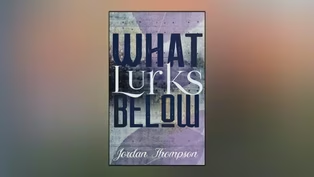
We visit Troutville, VA, to talk with Jordan about her debut novel, What Lurks Below.
We visit Troutville, Virginia, to talk with Jordan about her debut novel, What Lurks Below. It's a beautifully written dystopian fantasy that shows courage, holding on to your beliefs, and the tenderness of true sibling love.
Problems playing video? | Closed Captioning Feedback
Problems playing video? | Closed Captioning Feedback
Write Around the Corner is a local public television program presented by Blue Ridge/Appalachia VA
Write Around the Corner
Write Around the Corner - Jordan Thompson
Season 4 Episode 4 | 27m 49sVideo has Closed Captions
We visit Troutville, Virginia, to talk with Jordan about her debut novel, What Lurks Below. It's a beautifully written dystopian fantasy that shows courage, holding on to your beliefs, and the tenderness of true sibling love.
Problems playing video? | Closed Captioning Feedback
How to Watch Write Around the Corner
Write Around the Corner is available to stream on pbs.org and the free PBS App, available on iPhone, Apple TV, Android TV, Android smartphones, Amazon Fire TV, Amazon Fire Tablet, Roku, Samsung Smart TV, and Vizio.
Providing Support for PBS.org
Learn Moreabout PBS online sponsorship[♪♪♪] -♪ Every day every day Every day ♪ ♪ Every day I write the book ♪ [♪♪♪] -Welcome, I'm Rose Martin, and we are Write Around The Corner at New Reflections Salon in Botetourt County.
Yep, we're social distancing, and we are in a hair salon.
We're with debut novelist, Jordan Thompson.
Jordan has written an amazing book.
It's a dystopian novel, and it highlights courage.
It highlights choice-making.
It highlights true sibling love, and it got me from the very first paragraph.
Jordan said, "Well, of course, during the pandemic, if she can't be cutting hair while the salon was closed, she may as well be writing books."
Here we go.
Hi, Jordan.
Welcome to Write Around The Corner .
-Hi.
Thank you so much for having me.
-We are so excited, and we loved your book.
-Thank you.
I'm so glad.
-I wanna start out with a review.
"A whimsical yet sad story of hope and faith "unfolds in What Lurks Below by Jordan Thompson.
"Amelia is a hero, not only to herself, "but to her young brother, "and finally the world she comes home to.
"Rich with imagery and suspense, "Jordan has brought a fallen world to life and left us cheering the heroine on."
And that's the book, What Lurks Below .
So, where did the idea come from?
-The idea came from a dream that made no sense at the time.
And it was very vivid, and it was very vague.
And I didn't understand what it was, but I really couldn't shake it, so I wrote it down.
And.
then I just left it.
And I was working on another book at the time, but I just couldn't shake this idea that I'd had in a dream.
And so, a year passed, and I picked it back up.
And I just felt like it was something the Lord needed me to write.
And I didn't know what to do with it.
And I said, "Lord, you know, you're gonna have to give me the words on this one 'cause all I have is this little snippet that makes no sense."
So, I just started writing and trying to flesh out this little idea.
And that's pretty much where it came from.
-So, is the book parallel to the dream?
-Just a little bitty snippet.
Just one little snippet that I had of Alex, Amelia's little brother, that's where the whole thing came from.
Just one little snippet, that's all I had.
And then, I built the book around it.
-And you built it from there.
Oh, wonderful.
And we're gonna get to the book in just a second.
So when I was looking up Jordan, Jordan as a young girl.
You went to Mary Baldwin.
-I did.
-And graduated with a degree in English.
-Yes.
-And in this book, your little brother, Mason?
-He's older.
-Oh, he's older, but Alex.
-Yes.
-So as a character in the book-- -Sure.
Yes.
-Mason is that smart kid, right?
It's just the two of you?
-Yep.
Just the two of us.
-Readers, writers, growing up, what was that like?
-I mean, we were both readers.
He was just so intelligent.
And I was more creative, and he would tell me like, "I'd trade my autotheism and some of my intelligence for your creativity."
And at the time, I was like, "Well, I'll trade, you know, your intelligence so I don't have to study as hard to get these grades."
And so, that was kind of our dynamic, where he was a little bit more responsible and, you know, a little more intelligent in school, and I was kinda like more creative like, let's read a story.
-So, in a way, that relationship between Amelia and Alex in your book, and the relationship between Jordan and Mason, are we gonna see parallels through the story?
-You will.
Yeah, he's gonna be the one that, "Let's try harder.
Like "Let's retake that test that we didn't really get a good grade on."
And then, she's like, "Why, you know, it's probably fine the way it is."
Like, "Let's just eat our dinner and have some fun."
-And what about your parents?
Writers, readers, encouraging reading and writing from a young age?
-They encouraged reading big time.
Neither of them were big, you know, fiction readers.
But they were big on reading.
Anytime we went to go to the library, if I wanted a book, you know, Dad would be the first one to buy it.
And then when I started scribbling in notebooks in the sixth grade, he was all about it.
And he would just encourage me so much, you know, "Keep writing.
Keep writing."
And so, he was-he was a big encouragement during the whole thing.
-So, was sixth grade about the beginning of the storytelling and putting it down on paper?
-Yes.
Yes, sixth grade.
-Do you remember the first time that you actually shared a story that you authored with your friends or with your family?
-I didn't share much, but that first story that I started in middle school, I did share with one of my friends on the school bus.
She liked to write stories, too.
So we'd switch our little notebooks on the way to school in the mornings, and we'd read each other's stories.
But then after that, I became very possessive.
I was very self-conscious.
So, anything I wrote, I just felt-- like it wasn't good enough, and I didn't want to show even my parents, who were very supportive.
I was just.
I was nervous, and so I kept it in until I felt like I had something that was good enough.
And I still didn't really share it at that point.
I just shared with, you know, agents and publishers in that process.
So, the first thing they really read was this finished copy.
-So, are you pinching yourself right now?
This finished copy, after keeping everything so tight for so long?
-Yes.
-Now, this is out in the world.
-Yes.
Yes.
So, when I finally told, you know, my friends, like here at work, I told them about, you know, this book deal and this book I'd written, they were baffled.
They didn't know that I wrote, even though I had my laptop with me and in between clients, I would, you know, scribble down little scenes when I could.
So, nobody knew except, you know, my husband and my parents, and my brother.
Nobody knew, so then when I said like, "Hey, I've got this book that I wrote, and it's being published," everyone's like, "What?"
-[Rose chuckles] -So that was kind of fun.
-I bet that was.
You remember when the box arrived with the books in it, and you had a chance to look at it for the first time?
-Yes.
-What was that moment like?
-Oh, it was beautiful.
It came in the mail; I knew it was coming 'cause the publisher had sent me a message that, you know, "It was on the way."
And so, I kept checking the mailbox, and then it came, and I remember texting Mary, my publisher.
And I said, "I'm just gonna sit with it all day."
And I did.
I just sat with it on the couch, and I sat in the kitchen.
I just wanted to hold it.
-Well, it's beautifully written.
-Thank you.
-Beautifully written.
-So, as you're writing the book, who was kind of your go-to then?
Did you just keep the whole thing in?
Did you bring your husband into the fray-- nobody?
-Nobody.
-So, it was a surprise.
They saw it for the first time in hard copy, published.
-Yes.
-And then they read it, and what was the feedback?
-I had really good feedback.
So, my husband, he is not a reader, but he likes imagination.
He likes adventure.
So, he slowly but surely read it.
It took him awhile.
But, you know, we were on lockdown at the time.
You know, there's nothing to do but read.
So, he really enjoyed it, and he gave me some great feedback.
And then, like my grandma and a couple of my friends, they read it in one sitting.
And they were all just so excited.
That was fun.
It was very encouraging.
-Well, as wonderful as the book is, there are some creepy moments in there, right?
So, that had to be a little bit of surprise to your family who were like, "You know, Jordan didn't even tell us she's writing a book, and she has this explosive language and descriptive way about her."
That I'm sure they were like, "Where did that come from?"
-You know, my family, they know my creepy side.
Now, my friends, not so much.
But, you know, you're your most comfortable self at home.
So the little dark sense of humor and the little snide remarks there, they weren't surprised.
But my dad keeps mentioning to my husband like, "You might want to watch out.
Like you might want to be extra nice."
-'Cause she does have her own little shadow side, right?
-Mm-hmm.
-So, your nanny was also a very influential person in your life.
How so?
-Yes.
Nanny is a prayer warrior.
She.
she says, you know, she can't do a lot.
She can't get up and go, but she can pray because it doesn't cost her a dime.
So when we need prayer, we call Nanny.
So, if there's anyone who knows like the prayer world, the struggles, you know, that not everybody sees, it's Nanny.
So, that was in the back of my mind.
You know, just prayer and, you know, what goes on that we don't see, and how important it is.
-That's true.
And that theme comes through in your book also, through parts of that book that we'll get to in a second.
When you're looking to go from that dream and then get it down on paper, what was that process like for you?
-It was a strange process and probably not one that I would recommend to lots of other authors.
I wrote, they call it, by the seat of my pants.
And so, I just wrote straight through.
And, you know, for me, it worked really well.
It's probably not something that I could do again.
But I just wrote down like some little bullets of what I wanted to incorporate, and then I just wrote the story straight through.
And then I went back through, you know, with editing and tried to shape up the best I can, but then when I gave it, when I, you know, got the publishing deal, my editor, Lydia, she's fabulous-- she was able to bring everything full circle.
Like, you know, flush this out, you know, this needs to be a little more specific and not quite so vague.
And, you know, maybe develop this character a little bit more.
So, she took it from, you know, "Oh, this is a good story" to like, "this is like an enchanting book that somebody would wanna read."
-That's a beautiful word.
Yeah.
"An enchanting book" which captures, I think, your love of fantasy and magic and enchantment and that world that brings us to another place.
When you're thinkin' about that process, when you wrote it all down, did you know what was going to be happening, chapter to chapter?
Did you outline at all?
Bullet at all?
Nothing at all?
-No.
-You were free-wheeling it all the way through.
-Yes.
Truly, this was a work from the Lord.
Because like I said, when I started at first chapter, I didn't know.
And it wasn't until the book was finished that I realized what He had done.
This story that He had created.
So, it was just really interesting for me to see because it really was by the seat of my pants.
-And I read that you came across a book to help aspiring writers that you said it'll save you a lot of tears.
It'll save you a lot of heartache.
-Yes.
-What is it?
-Oh, heavens.
What is it called?
- Story Engineering for writers.
-Yes.
-Okay.
- Story Engineering is a really good one.
Also, Save the Cat!
For novels, they're really good.
The two of them, you know, if you don't understand one, you'll understand the other.
And it's-- they give examples of how to fix, you know, a weak plot, a weak story, a weak character arch.
And 'cause, you know, we read all these wonderful stories that we love, and then when we go to write our own stories, it's like, "Hmm, something's lacking, and I don't know exactly what it is."
But those books, they will help.
And then, you know, we're not lost as writers.
There's so many resources in the publishing.
well, the writing community.
It's very friendly.
So, there's usually someone to help, someone to suggest a book, but that's what I would suggest, is those two.
-And it also helped, didn't it, with having too many words.
Getting-- be enabled to go ahead and like edit, edit, edit.
-Yeah.
Yes.
-Because you've gotten-- you've gone off in a different direction.
-A tangent, a bunny trail.
Yeah.
So, that can bad, too.
You know, you think you wanna have this big book with all these words, but then, you know, if they're not the greatest words, then you're just confusing everybody.
-Or if it confuses the story.
-Sure.
-'Cause you wanna keep the reader hooked like I was.
From the very first paragraph, I read it in one sitting.
-That's awesome.
-And it got me all the way through.
So, what about the publishing journey?
So, it's your first book.
-Yeah.
-You're not quite sure.
You've got this yearning, and you got this story.
What was the publishing journey like for you?
-Publishing journeys, they're not pleasant.
I tell people, if you wanna get published, go lay down in the nearest highway, and just let every car run over you 'cause then you'll be ready 'cause it's painful when you see all the rejection letters come in.
So, I used QueryTracker, the website, and you can plug in all of your criteria of your book and then search for agents and publishers.
And you can submit to, you know, everyone who fits the criteria.
I mean, this book, it got rejected like 120 times.
-Really?
-Yeah.
It was-- -And you never gave up?
-No, because the best advice I read was authors give up too easily.
They think, "Oh, I've got ten rejections.
Clearly it's not good."
But it's interesting, if you go online and look up your favorite authors, how many times they were rejected, and it's encouraging.
You know, 'cause it could be your favorite book, and someone rejected it 50 times.
So, that was-- that's what kept me going was-- -And we've had that experience with some of the writers, and they'll pull out a rejection letter that they've saved.
And now they're New York Times bestsellers.
So hold on to some of those letters.
-Yes.
-Because I'm not sure you're gonna be cutting hair for very long, Jordan.
They may be missing you here once the world has a chance to see what a talented writer you are.
-Thank you.
-So, the process, from beginning to end, from the dream until you're sitting with that copy, how long?
-I'd say, I probably queried for about six months.
Yeah, probably about six months.
-But, then how about the editing and the revising until it was published, the cover done.
-Yeah.
-And then, you actually had it in your hands?
-I signed a contract August of 2019.
Book was released April of 2020.
So, it took that many months.
And that's truly just a fabulous publisher and a great editor, and, you know, cover design.
It's a team experience.
-All right.
Let's dig in.
So What Lurks Below .
[Jordan] Yes.
[Rose] There's so many ways to take this title after you've read this book.
-[Jordan] Hmm-mm.
[Rose] And was that your intent in choosing the title that it was so metaphoric all the way through the story?
That you could go back to the beginning, the middle, the end, any of those scenes, and there's something lurking below.
-I didn't pick this title.
-You didn't?
-No.
-How did that come about?
-I'm not great with titles.
I'd slap something on it for the sake of queries.
It was my editor, Lydia.
She came up with it.
She was like "I don't think this is very good, like title-wise.
Here's a list of better ones that I've come up with."
And so, we all kind of agreed that What Lurks Below was fitting.
Just because there are so many layers.
-Yeah.
-And so, yeah, I didn't come with this.
That's Lydia, all the way.
-Well, it's so good that I wanted to go back and even like get part of the story again because that first paragraph.
to grab people for the joy that you're-- that you're getting ready for.
"It happened on a Thursday, "or what would have been a Thursday Before.
"Back before They banned the naming days.
"Now, there's no need for such things, or so They say.
"Each day is the same as the day Before.
"Why waste precious brain power "keeping up with which day is which?
"But, as I said, it happened on a Thursday.
"It was one of those days "when only half the leaves had fallen from the trees, "and the ones left in suspension waved to me from across the way in hues of copper and burgundy."
And it goes on and on and on from there.
So, when I saw that paragraph and I see the capitalization of 'before' and 'they', I'm like, "Where is she goin' with this story?"
But it was-- it was brilliant the way that you developed the characters.
So, let's give everybody, and it's a hard book to describe without givin' it away.
-Hmm-mm.
-So, we've got a sibling pair, and.
describe Amelia and her relationship with Alex.
-So, Amelia is Alex's-- she calls him her brother.
They live together.
You know, with their aunt, the person they call their aunt.
And she is fiercely protective of Alex because she knows so much that he doesn't know.
And she's torn between protecting him from, you know, the authorities that be, but also protecting him from what he doesn't know that he needs to know.
-So, let's give everybody a little clarity.
Because they're living in a colony.
-Yes.
-And the ages and the kids and even the workers, everyone has colored outfits and colored uniforms.
-Right.
-This Aunt Liz is not really related because children were taken from their parents.
And what was the reason for that?
-They wanted to see what happens when we take out the love.
When we take children, you know, from people who love them fiercely and give them to people who, you know, they're not malicious, but they don't love them.
What can we do with this?
-That emotional detachment.
-Yes.
-Okay.
-It's all about fairness, unbiased, giving, you know, what can we get from the perfect environment?
-And Amelia remembers before-- -Yes.
-she was in here.
And then, Alex doesn't even have any understanding of what a tree is.
Or what the sky looks like.
So, they're living in the colony in a place called the Tin Cup.
-The Tin Can.
Yes.
-The Tin Can.
-And so, what it is about the Tin Can?
-So, the Tin Can, it's- everything's metal.
It's completely different from the world that Amelia remembers of, you know, like wood, and trees, and cloth, and fabric.
So, everything's metal, and everything's very clean.
It's like, you know, just a white blanket, and it's nothing on the walls.
And it just all sharp edges, and they can only go outside once a week.
-But it's not really outside, is it?
-She doesn't trust that it's outside.
And you really don't know, and, you know, they have these fake trees that, you know, they're metal.
Everything's metal.
And she doesn't even trust that the sky that they're seeing is even the sky.
And so, she's very skeptical.
She wants to go out in the fresh air, but she still doesn't trust it.
And that's all that anybody at colony knows.
It's just this little patch of "outside."
-Well, and I love the fact that you brought in that her deductive reasoning is that I don't hear the raindrops.
This is all metal.
I don't hear the raindrops on the roof.
And when I go outside, the sky looks artificial, and I don't feel the breeze or smell things.
But yet, it's so tender.
She wants to teach him about what it was like before and the real world.
And they've got a really special ritual.
What's that ritual?
-When Aunt Liz vacuums the apartment, they know that the vacuum cleaner interferes with the microphones in the ceiling.
So, they scurry under the bed, and they have a few minutes.
And that's when she tells him the 'before' stories.
And she tells him they're real, but he doesn't think they're real.
He still just thinks that they're stories.
But all the while, she's just slipping him bits of truth through the story.
-And he has no frame of reference though.
-Yeah.
-So, think about that.
That's what got me, too.
I'm thinking, how could you describe that to someone who's never seen it?
So, there's so many beautiful messages starting from that very beginning about choices and about good, and about caring for other people.
How important was that for you to weave that through the story from the very, very beginning?
-Well, it's important because we all have a choice.
We all-- we face choices every day.
But Amelia remembers the big choices.
She knows that there's just a lot more going on.
And how do you teach love to someone who isn't really being loved?
How do you teach like caring and compassion and making the correct choices when it seems like all of your choices are just laid out for you?
Because every minute of the day for them is just planned out of where they're supposed to be.
So, there's-- it looks like there's no choice, but she's trying to tell him there's a lot more.
-And there is.
And again, the title What Lurks Below .
You've also built in such descriptive other-- from the main characters, the shadows.
And those things that challenge us, and the problems that come along in life.
But you do it in such a way that people see the beauty and the light.
And the fact that it's okay.
Right?
It's okay that we have these things, and it's also, you know, be confident in yourself and know that it's gonna turn out all right if you put in the effort.
-Yeah.
-Where did all that come from?
That was beautifully written.
-You know, it's hard being that age.
You know, Amelia, she's right around, you know, 12/13, and that's a hard age.
Those are those middle school years.
-Yeah.
-And, you're faced with a lot of choices, a lot of weird pre-pubescent things.
And, you know, it's easy for us to write off the kids and say, well, they don't know.
That's not reality.
But, you know, for that age group, it is.
And we struggle, and sometimes we do make the wrong choices.
And sometimes we fall, and, but there's mercy.
And there's forgiveness and grace.
And that what's important to remember for ourselves and for the young people in our lives.
That you're gonna fall, but we're gonna get back up.
And we're gonna try again.
-And the other message I loved is the fact that they're, no one's alone.
Like, even if you think you're in that sterile unforgiving and unemotional environment, there's always someone or something right there that's willing to reach out and help you.
So, you know, they have this life in the colony.
And they have this regimented, you know, one day play time outside.
They have their classes.
They, you know, they respond to the Council who are the governing body, I'm assuming.
And there's a little bit-- that dystopian fantasy part comes in there with realizing, do the Council remember because they're older?
And I was questioning that, too, reading it.
And then there's some things that happen in the story that you really keep reading because you're wondering, are they gonna be okay?
Because the second half of this book takes a turn, and it will have you not only on the edge of your seat, but it will have you reading page after page after page to see how things are reconciled.
It's kinda-- I heard you describe it as kinda clean and edgy.
-Yeah.
-What does that mean?
-So clean and edgy.
That is Monster Ivy Publishing's whole motto.
That's every book you're gonna pick up from Monster Ivy, it's clean, but it's edgy.
So, you don't have to worry about foul language.
There's nothing-- it's not sexually-charged.
It's not inappropriate in any way, but by removing that, you don't remove the edginess.
The-- there can be creepiness, magic.
The things that we deal with in our daily lives that aren't pretty, they're gonna be stuffed into these books.
-Yeah.
It's the fantasy, the challenge, a little bit of, you say the shadows.
-Yes.
-There's a character in here called the Bewitcher.
-Yes.
-That, you know, we wonder about people that we come into contact with in our daily lives all day long, and I think that's the other thing.
It's written as a fantasy, but yet, we can make parallels, any one of us to anything that's happening every single day.
-Yes.
-What do you want the readers to take away from it?
-I want readers to know that there is more going on than what we see.
I didn't realize when I was writing this book that I was crafting the whole thing around Ephesians 6:12.
That teaches us that we do not struggle against flesh and blood.
We struggle against the authorities, the powers, the evil powers, and the heavenly places.
And that's what Amelia deals with in this whole book.
She sees what's working behind the scenes.
You know, the evil powers, the stirring up of all this conflict.
And that's what we deal with every day.
There's so much going on in the heavenly places that we don't see, but that's where prayer comes in.
That's how we prepare ourselves.
And that's where the armor of God comes in that Ephesians 6 is about.
We put on our armor, and we fight our battles in the heavenly places.
-It's-- again, it's so beautifully written, and you've done such an amazing job.
Would you be willing to read a section for us?
-Yes.
Absolutely.
-Set us up and tell me what you've chosen.
-Okay.
I'm gonna read you part of one of Amelia's stories that she shares with Alex under the bed.
-And we know that's a special time, right?
-Yes.
So, they're under the bed.
It's the only time that they can just speak frankly to one another without being concerned what someone might be overhearing.
-Okay.
-Okay.
"She came to me from far away, I say, resuming my story voice, "the voice of the garden that he loves so much.
"Or, at least, it felt very far to her.
"In truth, I'm never as far away "as people would like to believe.
"After her escape, she had to brave the forest to get to me, "and, yes, this took bravery.
"A forest, I explain, "knowing that Alex hasn't a clue what a forest is, "is a place of giants born of soil "with fingers that reach and grab for you.
"They move with the wind at my command.
"They twist and sway, reaching for the heavens, "for you, for me.
"It's in this particular forest that the girl found herself.
"And for one lonely night, it became her haven.
"For others, the ones from whom she was escaping, "were afraid of the forest.
"They couldn't see what she saw.
"And though they tried to pretend otherwise, "it terrified them, infuriating them.
"She knew this; she used this.
"She was gifted, this young girl with a knack for mischief.
"She could see what exists on the other side of the veil.
"The things others could only feel.
"That's what scared them.
"The inability to see through her eyes.
"When you seek the garden as the girl did, "you must be prepared.
"There are creatures outside my stonewalls "that lie in wait, "ready to snare the unguarded souls.
"These creatures take many forms, "morph into any shape, "and blend into any surroundings.
"Outside, there are predators in the night "that howl and shriek the sound of your nightmares.
"Inside, they shroud doorways and curtain windows.
"They coil around souls they've already snared, "whispering lies that deteriorate the mind.
"Inside the forest, the girl found many things "for which she had no name.
"She called them the Shadows.
"The Shadows hid between the giants, the trees.
"They snaked out to grab at her heels.
"They hovered over her path to distract her, "turn her around so she would lose her way.
"If she lost her way, they knew she would be at their mercy.
"And mercy is not something the Shadows are known for.
"But this particular girl was clever.
"She could feel me, her old friend, the garden, "calling to her.
"She could feel the safety of my embrace, "and so she called back to me, reached for me.
"Then suddenly, she could see the shadows more clearly, "see them creeping up to trip her feet "before they were upon her.
"She saw them surround her, trying to cloud her vision, "and she reached for my light.
"The girl fought hard, "though she had no lamplight to hold aloft "and force the shadows away.
"When they reached for her ankles, she jumped.
"When they whispered directions of a false trail to safety, "she covered her ears and shrieked in protest.
She ran on."
-Hmm.
You picked such a beautiful section.
And it leads into some of the things that we didn't talk about, that we wanted people to be able to read in the book without giving it away.
Did you have a favorite part that you wrote of the book?
-My favorite parts were the stories, were Amelia's stories.
Those were fun to write 'cause to me, it kinda reminded me of those old-school fairy tales, like the Grimms' Fairy Tales .
They're a little bit ominous, and you don't get all the details.
But they're fun.
They're like fun fairy tales.
So that was my favorite part.
-And what's comin' next?
-There's no sequel as of now.
I do have something else in the works that I'm workin' on.
So, that's my focus right now, but maybe one day, the Lord will give me the rest of the story like He did the beginning.
-It sounds like you're living in the moment and just letting it unfold.
-Yes.
-I think you are on your way.
-Thank you.
-And it'll be interesting to see.
Like I told you earlier, I'm not sure how much longer you're going to be cutting hair.
I don't know how many people would say, though, during the pandemic, "If I can't get to the salon, I can't cut hair, why not write books?"
-Why not?
-I don't know.
-Plenty of free time.
-You did, and you did an awesome job.
-Thank you.
-Thank you so much.
-Yes.
-Special thanks to our debut novelist, Jordan Thompson, and her book, What Lurks Below and also to New Reflections Salon, where Jordan spends a lot of her time.
We're appreciative that they've let us be here this afternoon.
To find out more of our conversation, Jordan and I are going to continue talkin' about the book, talkin' about her influences and the rest of her work.
Check us out online, and I would be so grateful if you'd tell your friends about us.
I'm Rose Martin, and I'll see you next time, Write Around The Corner .
[♪♪♪] -♪ Every day every day Ev ery day every day every day ♪ ♪ Every day I write the book ♪ ♪ Every day every day Every day ♪ ♪ Every day I write the book ♪ ♪ Every day every day Every day ♪ ♪ Every day I write the book ♪
A Continued Conversation with Jordan Thompson
Clip: S4 Ep4 | 10m 27s | Found out about how Botetourt County influenced Jordan's book. (10m 27s)
Providing Support for PBS.org
Learn Moreabout PBS online sponsorship













Support for PBS provided by:
Write Around the Corner is a local public television program presented by Blue Ridge/Appalachia VA