
Write Around the Corner
Write Around the Corner - Louis Bayard
Season 7 Episode 6 | 27m 44sVideo has Closed Captions
We talk with Louis Bayard about his work of historical fiction, Jackie and Me.
We explore the early life of Jackie Kennedy Onasis before she was a Kennedy and before she was Jackie O when we talk with Louis Bayard about his work of historical fiction, Jackie and Me.
Problems playing video? | Closed Captioning Feedback
Problems playing video? | Closed Captioning Feedback
Write Around the Corner is a local public television program presented by Blue Ridge/Appalachia VA
Write Around the Corner
Write Around the Corner - Louis Bayard
Season 7 Episode 6 | 27m 44sVideo has Closed Captions
We explore the early life of Jackie Kennedy Onasis before she was a Kennedy and before she was Jackie O when we talk with Louis Bayard about his work of historical fiction, Jackie and Me.
Problems playing video? | Closed Captioning Feedback
Where to Watch Write Around the Corner
Write Around the Corner is available to stream on pbs.org and the PBS app.
Providing Support for PBS.org
Learn Moreabout PBS online sponsorship[Announcer] This program is brought to you by the generous support of The Secular Society, advancing the interests of women and the arts in Virginia and beyond.
[♪♪♪] -♪ Every day every day Every day ♪ ♪ Every day I write the book ♪ [♪♪♪] -Welcome, I'm Rose Martin, and we are Write Around The Corner in Washington, D.C. with Louis Bayard.
Now, his book, Jackie & Me , takes a peek into the life of the Jackie we didn't really know, not the Jackie O., not the Jackie Kennedy, and let's go back to 1951 and see what it's all about.
Hi, Lou, thank you for joining us.
-It's my pleasure.
Thank you for coming such a long way.
-Oh, it's beautiful, and what a great day to be here.
-Beautiful day.
-And for opening up your home and introducing us to your puppy, Hugh.
-Yes, and he's checking us out right now, just to make sure everything's okay.
He's your new co-producer, right?
-Absolutely.
-Yeah.
So, when you were thinking about writing, was that as a young child?
Was that something that happened later in life?
When did it happen?
-I think it probably started as a young kid.
I was a voracious reader.
I think every writer begins as a reader, and at some point, you think, oh, it'd be kind of cool to write stories that make people feel the way I feel about some of these.
I mean, I loved Mark Twain.
I loved Charles Dickens.
I loved a lot of those people.
But I just sort of tucked it away into like the things that I could be, like, you know, a tennis star that was pretty quickly scotched, or an archaeologist, movie director.
But that was the one that kind of hung on.
Then in high school, I had a teacher who encouraged that, and I think every writer has a teacher, too, somewhere in their background, who kind of encouraged me to work at it.
And then, it just kind of grew from there.
And then in college, Joyce Carol Oates was my thesis advisor.
I wrote a book of-- -Wow!
-Yeah, I wrote a book of short stories for my thesis, which is like the coolest thesis you can imagine.
And it just kind of went from there, but it's just been a long, long process.
-So, it was encouragement from others?
Did you grow up in a family of writers or readers?
-Definitely readers, for sure.
We were encouraged to read.
Both of my parents wanted to be writers.
Both of them actually created a book between them.
Two books between them, I should say, but they didn't quite make it there.
So, I always had this sense that I was doing the thing that they had wanted to do all along.
And it was nice that they lived long enough to see me have a little bit of success in that direction.
-And they lived kind of vicariously through that, right?
-I think so.
-The publishing of it?
-I think so.
I think they were proud.
Although, they weren't the type to say that out loud, but I think they were.
But there's also a little bit of bittersweetness about succeeding at something that eluded them.
I mean, they had successes in other ways, but I think both of them would have loved to become published writers, for sure.
-Well, and you and your partner have two boys.
Are they showing writing?
-Yes.
-Not at all.
-Okay.
-They don't even particularly like to read.
I will say my older son, he has started writing a novel.
And it's interesting because he thinks you can write a novel without reading in the first place.
So, he just thinks it happens.
You just throw some words on a page.
And he's been learning that that's not necessarily the case.
But I'm fascinated to see him try to put one together.
I think he's realizing that it's a little harder than he originally thought.
-Not as easy as you make it look, to think that he could do it just like Dad does it.
-Well, he just sees me sitting in that chair over there.
That's my red writing chair by the window.
And all I'm doing, you know, it's not a very fascinating thing.
It's just somebody staring into a screen and clacking away for hours.
Sometimes talking to himself, which makes me sound a little mad probably when you're in the next room.
I read my work aloud a lot.
And I do the voices.
I will do accents sometimes.
So, I think for a while, they must have thought I was just basically insane.
-What does that do for you to be able to read it out loud as you go?
-I feel like I hear things better than I see them, in some ways.
I can hear when a sentence isn't working.
I can hear when there's too much fat in a sentence, or in a paragraph.
I can hear things that my eye doesn't catch somehow.
So, I wind up reading the whole book out loud one way or another.
Because I just feel like that's the best way to edit.
It's one of the things I tell my students when I used to teach in college level creative writing.
It's like, read your stuff out loud.
It's amazing what you will catch.
-That's interesting.
And so, it's true that you actually have the laptop on your lap.
-On my lap.
I'm one of those weird people who put the laptop on the lap.
I'm just more comfortable that way, for some reason.
Yes.
Yes.
-And you know the endings, but not how you're going to get there?
-I usually know the endings.
Sometimes, the ending gets changed.
But I feel like I need to know the ending, so I know I've gotten there.
Otherwise, I could just keep wandering in the desert.
And I usually know some stations along the way.
But how I'm going to get there, I have no idea.
-Something I read about you or heard about you, it was really fun.
You're like, you know what the best way for me to work is that I know the ending because I have deadlines.
And deadlines are going to come.
And it's like, okay, I'm done.
-Oh, yeah.
No, that also, it's amazing how deadlines concentrate a person's mind.
So, I'm always aware of when the book is due.
And sometimes, I will just block it out that way.
Like, this needs to get done by the end of April.
Whatever it is, whatever happens, needs to happen by the end of April.
So, I'm sure you found too, the more you break something down into component pieces, the easier, or at least the more approachable it becomes.
The idea of writing an 80,000-word book just blah, is terrifying even to a writer.
But if you can break it down into its components, into the chapters and parts and those other things, it becomes easier.
A thousand words a day, you know, one step at a time.
But it's a long haul.
It's a marathon.
-I found it fascinating that you research for chunks, like a couple of months, just enough to get you kind of into the mode of it.
And then you let your imagination in the book kind of tell you where it's going to go.
Explain that process.
-Yeah, well, I research upfront just to get a handle on this world.
All of my stuff is historical, I should say.
So, I have to kind of recover these lost worlds.
And I do that usually through research.
Sometimes I go to the place in question.
But, you know, Victorian London doesn't really exist anymore.
1818 Paris doesn't exist.
So, you find them in books.
I live six blocks from the Library of Congress, which is a wonderful resource.
And, yeah, I just kind of immerse myself for a little bit, then start writing, because I always want to keep the story in mind.
The story is the important thing.
I start writing, and as you said, the story tells me what I still need to learn, which is often considerable.
And I never really feel like an expert on anything I write a book about.
I learn enough to be able to tell the story in a way that feels real.
But I'm not an expert about Jackie or Edgar Allan Poe or Teddy Roosevelt, or any of the real-life people I've written about.
I just learn enough to be able to tell a story that has them in the center of it.
-Well, and I love the fact that you look for, maybe in the past, some of those historical figures and the unknown stories, to give yourself the flexibility and the creativity to fill in the gaps.
So, it's someone we might know, but it's stories we don't know.
-Yes, that's exactly it.
History tells us so much, but only so much.
And there are lots of places where history falls silent.
There are whole peoples about whom history has fallen silent.
But even with famous people, as you said, Abraham Lincoln had a really interesting relationship with his best friend, Joshua Speed.
A very intense relationship that historians have long been wondering about.
What was the nature of this relationship?
So, nobody knows.
There won't be any smoking guns.
Nobody was in the rooms where this stuff was playing out.
So, the thing that a novelist can do is go into those rooms, imagine his way in, imagine how it played out, and come up with a story around it.
-You know, it's got to be challenging in a way to take well-known figures and then know pieces of the story, and then to keep it true and interesting without going down too many creative jaunts that make it, oh, that couldn't possibly have happened.
Instead, you keep us hooked to be like, well, that probably did happen.
I think the way you craft it, I believe that.
I think that happened.
-Well, that's good to know.
-Is it a challenge for you?
-No, it's part of the fun, is taking these people that we think we know and imagining them in a certain situation.
In Jackie & Me , for instance, I'm thinking of the wedding negotiation that happens between the Kennedys and the Auchinclosses at Newport.
You know, the Auchinclosses are old money, and the Kennedys are new, and they come together, and there's all sorts of class issues going on, there's all sorts of conflicts happening underneath it.
Nobody was present for those discussions, so I just imagined thinking about what was Joe Kennedy like, what was Hugh Auchincloss like, what was Mrs. Auchincloss like, you know, the nature, just thinking about these characters and then putting them together and see what happens.
The key for me is to think of them as fictional characters.
That gives them the freedom and the autonomy to kind of play with each other, and to make things happen on the page.
-And that scene was one of my favorites.
So, let's backtrack... -[Louis] Okay.
-...to meeting young Jackie.
-[Louis] Yes.
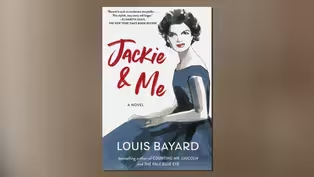
-And so, first of all, the cover is beautiful.
-Isn't it?
-And it's very eye-catching.
I love it.
[Louis] Yeah, I love it.
[Rose] But we get to know not only Jackie, but a person in her life an d in the lives of the Kennedys that really stayed in the background for so much of history, but was a real person.
-Yes.
His name was Lem Billings, and he was John F. Kennedy's best friend from high school through the end of Kennedy's life.
And that was really how he saw himself.
He had his own career in advertising.
He was financially independent, but he saw himself as, his job, as being Jack's best friend.
And he was, as you say, by design, in the background.
He's this Zelig-like presence in a lot of White House photographs from '60 to '63.
It's like he just is walking through the Rose Garden or in the back of the Oval Office, just sort of there, looking on.
But again, I think that was by design because he didn't want to be seen.
Part of that had to do with the fact that he was a closeted gay man.
And that was when I first learned about him, I was amazed.
Like, wait, Jack Kennedy's best friend was a gay man.
And apparently Jack knew, Jackie knew, and they were fine with it.
They were very "live and let live" in a way that was unusual for that era.
-Well, in a way, Lem really dated Jackie all the way through because, you know, Jack, they weren't there.
So, I love the relationship that they grew so close.
Even her ideas early on, you know, I never knew that she was the camera girl, right?
-Yes.
-And like struggled between, you know, her mom saying, oh, no, you've got to get married.
And her way of growing up with old money and very debutante kind of way your life's going to go.
And Jackie having that conflict between both marriage or career.
-Yeah, this is early '50s.
So, you were expected, a woman of Jackie's class and caste would have been expected to make a good marriage.
But the one thing she said in her yearbook for Miss Porter's School for Girls, where she went to high school, her goal in life was not to be a housewife.
So, there was a part of her that was yearning for a career.
She got a very prestigious scholarship with Vogue magazine.
Same scholarship that Joan Didion would win ten years later.
Very prestigious, very competitive.
That kind of fell through.
But then she got this job as an Inquiring Camera Girl for the Washington Times Herald, which was the long-expired Hearst newspaper of that day.
And she would just, it was man-on-the-street interviews.
She would go up in this Graflex camera, heels and stockings, pearls.
And she would just waylay people on the street, which was, for an introverted person like Jackie, would have been difficult.
Ask them questions, take down the answers, go back to the office, develop the film herself.
Her fingernails grew green from the fluid, the developing liquid, and then, edit the column down.
It was six columns a week.
So, not a Pulitzer gig, but a sign that she really did value independence and a career.
But at the same time, she was not herself financially secure.
She didn't have a lot of money of her own.
She and Lem had that in common.
So, she would have also known that there was this financial insecurity that had to be addressed at some point.
So yeah, again, she's a young woman pulled in two different directions.
-Well, and I found it interesting that with meeting the Kennedys, that she was almost, I don't know, groomed in a way, but also it was a tryout, you know.
She was auditioned to make sure if this was going to be the person, and she kind of went along with it.
What's that story?
-Yeah.
She wasn't just groomed.
She was hazed, in fact, by the... -Oh, the sisters, yeah.
-...by the Kennedy sisters.
Yeah, they kind of had made a rough go with her in touch football, which is the Kennedy ritual.
I think, that yes, I think they had to make sure that she had the right stuff, you know, to be a politician's wife.
And so, they would have invited her.
They invited her over at the Fourth of July.
That really happened.
And they just kind of, you know, subject her to the... -I love the word "hazing."
Because it actually, you describe it that way.
-Yeah, yeah.
Ethel was the worst.
Her future sister-in-law, Ethel, was the hardest on her of all, supposedly.
But she has a scene with Joe Kennedy in the basement of the Hyannis Port home in a doll room.
This too actually happened, although we don't know exactly how it played out.
But he basically lays it down for her.
This is what, you know, you can expect.
This is what we would expect of you.
It's very much a business arrangement.
The thing to be clear about, I think the book does make clear, is that Jack himself doesn't want to be married.
Jack Kennedy is a very happy bachelor.
He has no need to get married.
It's his father who's pushing this, who's really engineering the whole thing, and pulling these strings.
If it had been up to Jack, he never would have been married.
So, there are a lot of complexities going on here.
You have a very attractive man in Kennedy, who's considered the primo bachelor of America at that time.
And a very attractive young woman.
But they didn't know each other that well.
And it's up to Lem, in the context of the book, it's up to Lem to kind of seal the deal.
To make sure she doesn't bolt and run.
To make sure she doesn't, you know, have any undue expectations about what's waiting for her.
-And they have some really vulnerable conversations between the two of them.
And I love the way you had us kind of sitting there in the room during their exchanges, where they were raw and honest.
And some of it just took you to a place that I felt like I got to know both of them in a way that I never knew them before.
So, I think that adds a lot to the story, too.
And along with finding out that there were people in her life before Jack.
-Oh, yes.
Oh, yes.
-And so that, you know, she had a love interest and let it go.
-She had, yes.
John Marquand Jr., he was the son of J.P. Marquand, a famous American novelist.
He himself was an aspiring novelist.
They had an affair of some sort in Paris.
The book is partly about alternative lives, alternative destinies.
So, there are a lot of different paths that Jackie could have taken that would have given her a very different future.
And maybe there's some place that Lem theorizes that there's some place where, where that future is actually happening.
That alternative path is playing out in some parallel world.
So, yeah, there were a lot of options and a lot of contingencies that could have broken in a different way.
-And she was introverted, as you mentioned earlier.
I think the other thing that is so touching was the closeness that she did share with Lem.
So, in a way, he was her best friend, right?
He was the one that she was talking to, and questioning and wondering and... -Yeah, you know, they had a lot in common, I think much more than she would have had in common with Jack.
They were both aesthetes.
They were art lovers.
They were Europhiles who cared a lot more about art than, you know, playing football.
And they were outliers.
They were people who grew up amidst great wealth without having any of their own.
And so, I think they would have bonded.
It's the Summer of Sundays , basically.
He comes down from Baltimore and they travel through Washington, D.C., circa 1951.
And, yeah, that's the heart of the book, really, is their growing relationship.
-Well, and I love the scene about the Ferris wheel.
-Oh, yes.
-Yeah, so, you know, she can be this amazing woman.
But when it came to the Ferris wheel, there's a fun scene in the book.
So, we won't ruin it for the readers.
-Yeah, yeah, yeah.
-So, when you think about Lem and his relationship with Jackie, and actually he kind of sacrificed his life, really, in servitude to the Kennedys.
-In some ways, yes.
As I said, he had his own career.
But, yeah, he definitely considered the Kennedys his true family.
-And he had a room at the White House, right?
-He had his own room at the White House.
He was there every week.
The Secret Service just basically, you know, waved him through.
And he was proud of that status.
You know, he didn't want to be an ambassador.
He didn't want to get any kind of official title in the Kennedy administration.
He thought his job was just to remain Jack's friend, his release valve, the guy he could just play backgammon with.
He thought that was his role in life.
And then, after Jack died, he then became a kind of self-appointed surrogate father to the next generation of Kennedys and kind of helped... he saw himself as training them to become the next great leaders.
Interestingly, Bobby Kennedy Jr. was the one he thought would go the furthest.
So, it's been interesting to see how that progression has gone over the last few years.
But, no, he was truly dedicated to the family.
And they to him.
They were very fond of him.
And they respected him and his loyalty to them.
And so, I think he had a wonderful time in a lot of ways.
But no kind of partner, no lover, no kind of private life.
He was very much just that guy in the back.
-Well, and when you think about the Kennedys, the huge personalities, and the big ambitions, and then how Jackie's going to kind of fit into that along with the need for security, you know.
She was, in your words, you know, shy and introverted and wanted to please, right?
Whether it be her parents or the Kennedy family.
-Yeah.
-Sometimes felt like an outsider.
-Yes.
And, you know, again, as you said earlier, this is not Jackie Kennedy.
This is not Jackie O.
This is the kind of inchoate, liminal version of Jackie, you know.
She's just out of college.
She's just a year or so out of college.
So, she's still a work in progress.
-Yeah.
-She's trying out new hairdos.
She's trying out new clothes all the time.
She's trying to figure out who she is, how to present herself to the world.
You know, when we see her in the White House, she's so immaculate.
She's so created and polished.
So, it was interesting to imagine her before she got there.
The first version of this cover, they gave her sort of like a tiara and pearls, very elegant.
I said, that's not this Jackie.
This Jackie is not going to have pearls.
She's not going to have, you know, she's not going to look glamorous.
She's a career girl.
[Rose] And she's young, and she's finding her way.
You know, the scene we started with when Joe Kennedy was talking about the wedding, when you think about the old money and the new money and how he convinced their family about which direction the wedding was going to go down to her wedding dress, I think you read that scene and you're thinking, really?
Oh, my gosh.
So, I'm excited for the reader and our viewers to read that book, read the book and to read that scene and some of the others that you really take us into a world that we can create, too, through our imaginations because in a way, we were sitting there, you know, we were listening.
-And that dress you mentioned, that's so iconic.
I mean, it's such a famous dress.
-[Rose] Right.
-It was designed by a Black designer, Ann Lowe, I believe, was her name.
There's a book about her.
But Jackie hated the dress.
She didn't pick it.
Joe Kennedy had it designed for her.
She didn't even have a say in what she wore that particular day.
So, it just shows-- -Isn't that hard to believe?
Really?
-Yeah, can you imagine?
-I mean, when you think about who she is and the Jackie O, Jackie Kennedy that we know, that she didn't pick her wedding dress and actually didn't like it.
-Didn't like it, no.
Didn't think it was flattering to her figure, and yeah, but that's the dress everyone remembers.
-Well, and I'm curious where you try to be sensitive but forthright in letting us know the young Jack Kennedy and the distance he had and felt for her, and the fact that he was happy being an eternal bachelor.
-Oh, yeah.
-And made no bones about it.
-Yeah, and he wasn't, you know, he wasn't a person who was capable of great emotional intimacy, at least, I think, with a woman.
And maybe that was more common with men back in those days.
But yeah, I think it was very hard for him to be open.
And certainly, as the book makes clear, he had no intention of stopping his philandering once he got married because his father didn't do that.
That was the model.
You get married, and then you have women on the side, and that was-- He was completely expecting to do that and, of course, did that.
It was a very troubled marriage initially, in its stages.
The rumor is that at one point, Joe Kennedy offered her a million dollars just to stay in the marriage, which I guess I would have taken.
A million dollars back then would have been quite a lot.
But yeah, so I think as the book makes clear, they're in for some choppy waters, this couple.
It doesn't end the way a Jane Austen marriage novel would, where everyone just goes happily off into the distance.
It's like, no, there's a lot of trouble ahead.
And, of course, as we know that, of course, being modern 21st century Americans, we kind of know what's waiting.
And I think it gives a certain poignancy to what happens just before the wedding, all the second thoughts that she's having and all the fears.
-And told in Lem's voice... -Yes.
-...was a really great way to take us out of preconceived notions of people we thought we knew, and families we thought we knew.
And to a person that, for me, for one, I had no idea Lem existed... -Yeah.
-And then to be able to hear it from his point of view and his interactions with Jackie.
I loved it.
I mean, love the book, love the way you took us on the journey through her story.
-Yeah, I just think-- -[Rose] Or his story, too.
-Yeah, yeah, his story, too.
I mean, I couldn't imagine finding Jackie's voice, for some reason.
I wrote a book about Lincoln, and I couldn't imagine writing through Lincoln's eyes because they're both so mysterious in some ways.
I think that's why Jackie is such an enduring figure.
There's something really enigmatic about her, something that we don't know, that we can't figure out.
And so, I thought, but Lem would be an ideal, have the ringside seat on what was happening, and would have a certain perspective on everything because he knows all the players and all the parties.
-The book kind of ends with the wedding, but then you take us a little further, and we'll leave that up to the viewer to find out how Jackie and Lem's relationship evolved, and went on from there.
Would you be willing to read something for us?
-Sure, sure.
This is the very beginning of the book.
It's narrated circa 1981 by Lem, so he's looking back 30 years, over a 30-year distance.
But this is how the story begins in 1981.
"Of all places, the East Village.
"Miles from the Upper East Side, "and there she was, sauntering down Avenue A "in a linen skirt and black blouse.
"The Nina Ricci sunglasses "clamped on like aviator's goggles, "the carriage nowhere more equestrian "than when she stepped over the snoring, splayed drag queen.
"Was she coming or going?
"Catching a flick at the Hollywood Theater, "or meeting a friend at old Buenos Aires?
"There was no way of asking, "with the gentleman-thug from the Secret Service "following ten feet behind.
"I could have damned the torpedoes, I suppose, "but I'm embarrassed to say that at the sight of her, "I did what every other New Yorker does.
"Stopped and gawked.
"As if she were some golden hind, "trotting out of a glade.
"Imagine my frustration.
"Some six years have passed since I last gazed on her-- "her, I mean, and not her immaculate Christmas cards.
"So, it was startling to have the universe, "after all this time, "grant me such a clear angle on her, "and in the next breath, withdraw it.
"One second, I mean, she was coming straight at me.
"The next, she was turning the corner at East Sixth, "her shoulder bag swinging after her.
"Now it's certainly possible that, before she made the turn, "she caught sight of me.
It's also possible that, even if she saw me, "and this is the scenario that haunts me a little, "a few hours after our crossing, she didn't know me.
"I bring that up because "I don't cut the same figure I used to.
"Since we last laid eyes on each other, "I've become a stouter specimen, slower.
"I've watched friends of long standing "pass me in the street without a second glance.
"And in my mind now, I imagine myself "somehow slipping past the Secret Service goon "and stealing up to that sunglassed figure "and murmuring in her ear.
"'It's Lem,' I would say.
"And Jackie, having failed until now "to connect the spectacle before her "with the man she used to know, would hear my voice, "climbing always higher than I mean it to, "and would call up every inch of her breeding "and say something like, "'How perfectly lovely to see you.'
"The thing is, it would have been lovely.
"And really, if I had gone to "all the trouble of approaching her, "if I had risked the full hail of Secret Service bullets, "I wouldn't have squandered the moment "by asking her something as banal as, How are you?
"I mean, there are whole news organizations "dedicated to exploring that question.
"Photographers have been legally enjoined "from pressing it too hard.
"Maybe all I would have said was, 'I'm sorry.'"
So, it'll take you the rest of the book to figure out what exactly he's sorry about.
-That was a perfect section to read.
Perfect section to read.
And thank you so much for sharing Jackie & Me with us, for being on the show.
It's been a joy to be here with you.
-Thank you for coming.
It's been a pleasure having you.
-My special thanks to Louis Bayard for inviting us here to his home in Washington, D.C. to discuss his book, Jackie & Me .
I, for one, learned a little bit more than the history books ever taught me about this amazing woman and the people around her.
Check out more of our conversation online for questions for Louis and about some of his other books.
Tell all of your friends about us, and I will see you next time Write Around The Corner .
[♪♪♪] -♪ Every day every day Every day ♪ ♪ Every day I write the book ♪ [♪♪♪] -♪ Every day every day Every day ♪ ♪ Every day I write the book ♪ -♪ Every day every day Every day ♪ ♪ Every day I write the book ♪ [Announcer] This program is brought to you by the generous support of The Secular Society, advancing the interests of women and the arts in Virginia and beyond.
A Continued Conversation with Louis Bayard
Clip: S7 Ep6 | 13m 1s | Hear more details about the Jackie Kennedy story. Plus find out what's next for Louis. (13m 1s)
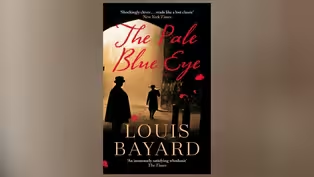
Louis Bayard - The Pale Blue Eye
Clip: S7 Ep6 | 3m 36s | Louis Bayard talks about the movie based on his novel, The Pale Blue Eye. (3m 36s)
Providing Support for PBS.org
Learn Moreabout PBS online sponsorship











Support for PBS provided by:
Write Around the Corner is a local public television program presented by Blue Ridge/Appalachia VA