Write Around the Corner
Write Around the Corner-Malcolm Smith
Season 4 Episode 2 | 27m 48sVideo has Closed Captions
We discuss Appalachian Fiddler Albert Hash: The Last Leaf on the Tree.
We visit beautiful Grayson Highlands State Park to talk with Malcolm Smith about his book, Appalachian Fiddler Albert Hash: The Last Leaf on the Tree. It's a story that entertains and educates about Appalachian music and values.
Problems playing video? | Closed Captioning Feedback
Problems playing video? | Closed Captioning Feedback
Write Around the Corner is a local public television program presented by Blue Ridge/Appalachia VA
Write Around the Corner
Write Around the Corner-Malcolm Smith
Season 4 Episode 2 | 27m 48sVideo has Closed Captions
We visit beautiful Grayson Highlands State Park to talk with Malcolm Smith about his book, Appalachian Fiddler Albert Hash: The Last Leaf on the Tree. It's a story that entertains and educates about Appalachian music and values.
Problems playing video? | Closed Captioning Feedback
How to Watch Write Around the Corner
Write Around the Corner is available to stream on pbs.org and the free PBS App, available on iPhone, Apple TV, Android TV, Android smartphones, Amazon Fire TV, Amazon Fire Tablet, Roku, Samsung Smart TV, and Vizio.
Providing Support for PBS.org
Learn Moreabout PBS online sponsorship[♪♪♪] -♪ Every day every day Every day ♪ ♪ Every day I write the book ♪ [♪♪♪] -Welcome.
I am Rose Martin, and we are Write Around the Corner at the homestead of the beautiful Grayson Highlands State Park.
I'm here with Malcolm Smith.
And we're in this beautiful location because Malcolm has written a fascinating book about Appalachian Fiddler Albert Hash, The Last Leaf on the Tree.
It's a book that entertains and educates about Appalachian music and Appalachian values.
What a great day to do this.
Malcolm, welcome to Write Around the Corner.
-Oh, thanks for having me, Rose.
This is exciting out here in what they call the high atmosphere.
-And what does that mean?
-Well, just up in the mountains on a beautiful day, you know, and Bill Monroe, the great bluegrass musician said, "This is the place you get that high lonesome sound, you know, in the music," and it's certainly feeling that way today.
-And it kinda takes you back, doesn't it, to the time that Albert was workin' and creating music, and as a nine-year-old little kid, created that first fiddle.
[Malcolm laughs] What were you doing at nine?
-Oh well, not that, that's for sure.
I was-I was doing a little bit of farming 'cause I'm a western Kansas boy.
But-- -Well, let's start there.
Tell us a little bit about your background.
-Yeah.
Well, I-I grew up way out in Western Kansas.
My dad was a family farmer and, you know, I went to-- early on, I went to a one-room school before consolidation happened, and then went to the big High School.
And from there, I entered college at Kansas University and saw the big city ways and the big city of Lawrence, Kansas.
And-- About that time in my life, I was exposed through-- there's a great big Music Festival in Kansas called the Winfield National Flat-picking Championships.
And during college, I went to Winfield, made a pilgrimage down there for a week to listen to some of the best musicians in the world.
-Had you ever had an experience with flatpicking or the music or any of the people before that?
-I had not really.
I'd heard in my family-- my grandfather was a Kentucky fiddler, but I didn't get to know him that well before he died.
He died when I was very young.
And, but I always heard about that from my mother.
And then, when I heard old-time music for the first time was at this festival, probably 40/45 years ago.
And it just blew me away when I heard the mountain music and the high lonesome in the voices and the great fiddling that was there.
And at that time, I didn't understand that there was a distinction between old-time music, what we call in Virginia, old-time music, and what bluegrass music was.
-And what is the distinction?
-Well, it's very clear distinction.
Um... First thing is that you have to know old-time music came first.
And it grew up right where we're sitting, you know, in these mountains and hollers of Virginia, Tennessee, North Carolina, and which all come together, you know, right here where we're sitting in.
And it was primarily fiddle and banjo music.
The banjo had started to become popular right during the Civil War, and the fiddle, of course, was brought here by the many immigrants in the 1700s.
And the two merged right along the New River and all through these hills.
And that began what we call old-time music today.
The biggest distinction, though, is that always old-time music was about a party.
It was about-- -Really?
-Yeah, about having a party, having a dance, celebrate, and sometimes, it was the backdrop to hard work like barn-raising and bean stringing and those types of things.
Corn shuckings were famous venues for old-time music.
Uh, or just a Friday night at the Rugby Fire Department, you know-- -Uh-huh.
Sure.
-To celebrate a week's work, and that-that is community.
It's all about community.
So, when we get together as old-time musicians, we played together to support the dancers.
And, this is just so important to keep a historical tradition alive.
So, we study where these songs come from and who first played them and what they were thinking about when they, you know, you hear a fiddle tune like, you know, The Old Gray Mule or whatever it is, and there's a story behind that.
And as you play that music, you try and think about that story and remember it, and pass it on.
-And, you know, that brings me to something that I want to hear your thoughts on because stereotypically, the mountain music, the old-time music and the bluegrass music, they associate and stereotype people as hillbillies.
And that can be a very derogatory term.
So, I'm curious, what did it kind of mean back in the early, you know, some of these early Bristol sessions or some of these early times that people were just getting together?
And then, it's transformed so much today, and what are your thoughts on that?
-Well, it was a stereotype, in fact.
But, you know, a lot of the mountaineers who played music accepted that stereotype.
I mean, they just ran with it, you know.
-So, it wasn't derogatory at that time?
-Well, it-it was.
From the beginning, it was a term but it's sort of like other terms that certain cultural groups have taken and made their own.
Hillbillies become that way, I think, in this part of the mountains.
And, in fact, one of the most famous old-time groups from Galax called themselves The Hillbillies .
And it was, you know, commercially viable to do so.
-[Rose] Yeah.
-And because it was a time in the country when this old-time music really roared up, we were in between World Wars.
There was-- had been a pandemic, you know, in 1917.
-Yeah.
Right.
-And people were looking for a simpler way of life.
-Sure.
-Just like I think a lot of people are right now, you know.
So, I think this book I've written about an old-time musician and his way of living here in the mountains during the industrialization of the Blue Ridge, I think that it has some themes in it that are really important to think about today.
-Well, and that's true because you hit on a lot of those Appalachian values and some of those things, and that connection to the community, and that connection to where you live.
When we think about the book, I read that you did over a hundred interviews to get this ready.
Yeah?
-I did, with the help of a good friend of mine and my minister, Edwin Lacey.
Edwin, this was really Edwin's book.
It was his idea.
He had met Albert Hash as a young banjo player.
His dad would drive him right up the road you came today from Wytheville and take Edwin, as a budding young, incredible musician, up to Albert's house on Sunday afternoons.
He'd hold forth, and people would come from all over the mountains to jam with Albert and play with him, and many times, Edwin made that trip.
And when he was a senior in high school, Edwin Lacy, who's now a full-time Lutheran Minister down in Baltimore, but from Wytheville, he came up.
And one Sunday, he brought a tape recorder and said, "Albert, you're gonna be my final project for high school."
And he recorded two hours of an interview with Albert.
And that's where the book started, right there.
We had two-- two hours that nobody had really ever heard of Albert talking about how he grew up, the music, things like that.
And then one night, I had moved down here from teaching up-- I was a college professor teaching education for many years in the north, but I was coming down here every summer because, you know, back in college, I'd fallen in love with old-time music, and I couldn't get enough of it.
And right here is the hotbed, you know, Galax and Mount Airy and, you know, and Tommy Carroll's tradition.
And there was, you know, the Galax Fiddle Convention and the Elk Creek and all these fiddle conventions.
I'd spend all summer just in my little camper going from them.
And when I quit teaching, I decided to move down here.
So, I wouldn't have to have that awful 11-12-hour drive every summer.
And I bought a happy little cabin on a beautiful creek in Carroll County.
And one night, I was invited-- we-- Edwin started a church, a very special church in Virginia that's still going, even though sadly, he's not at it anymore.
But it's called the Wild Goose.
And it was-- the premise from the beginning was one, to take a church over in Indian Valley that had been abandoned.
One of the Childress churches which are really important this area.
He was a Lutheran missionary who was from the area who built many rock and beautiful churches in the area, and really sort of worked hard to-- worked with to build community in the Blue Ridge.
And the Presbyterian had asked Edwin to find a way to incorporate Appalachian traditions and study into the church setting, and to maybe get some of the hippies from Floyd and Blacksburg to come to a different type of church and expand their ministry.
So, he ripped out all of the pews in the church and got a good friend of mine, Mac Traynham, who's an incredible banjo builder and world-renowned old-time musician.
And they ripped out all the pews, put in rocking chairs and started having communion out of mason jars.
-Ha-ha.
-And The Wild Goose attracted me.
I actually first came to write a story about it for a magazine.
And then, later I stayed, and when I moved down here, I became a member.
Well, one night, we were having a cookout.
-Here comes the inspiration for this book.
Okay, all right.
I'm getting there with you.
-All right.
I'm sorry.
That was the long way of getting there, but, you know, it's a beautiful afternoon.
And I love to spin a yarn.
But I was at a cookout with the church, and we were playing our instruments.
As I said, Edwin was a consummate banjo player from this area, and Mac Traynham was playing his fiddle.
And we were having a great time.
And all of a sudden, Edwin leans over to me real close around the campfire and says, "I need to talk to you."
And I immediately thought, "Oh my God, what have I done?"
You know, the preacher needs to talk to me.
My preacher - oh, no.
And anyway, after we were alone on the way back to our cars that evening, he started telling me about this book, about Albert Hash.
And he said, "I just know I'm not going to have time to finish it.
I haven't even started on it."
Really, he had done three interviews of some of the people, luckily, that have passed on now, about it, who knew Albert well, and he had the two hours of recordings of Albert that he had digitized.
And he gave me a huge box of stuff that Albert's doctor had given him-- -Wow.
-And said, "Write this book."
And I was retired, looking for something interesting to do, and I kind of bit into the idea.
-Well, and you love the topic.
Right?
-I did.
Yeah, yeah.
-And you love the music, so.
-And I-- but I didn't know anything about Albert Hash.
You know, he said, "Write this book about Albert Hash."
I said, you know, "I've heard a recording of Albert once, and I know who e Whitetop Mountain Band are."
You can't live in this part of Virginia and not know about the Whitetop Mountain Band that Albert started with his brother-in-law, Thornton Spencer.
And so, we went.
He said, "Let's do our first interview."
And I got my little video hand camera, and we went to Rugby, Virginia, just down the road from where we're sitting.
And we went way back up in the country on a twisty road.
And there was a house with a little shop outside, and he said, "You're gonna like this."
[laughs] And he took me inside and introduced me to Wayne Henderson.
-What a treat!
-I about dropped my teeth.
I couldn't believe it.
And Wayne, when we told him what we were gonna do, that I was gonna write the book, Edwin was gonna support me and help me get this book done, Wayne got so excited.
He jumped out of his chair and came over and sat down, and immediately started telling us stories.
And about 12 hours of recording later, we pulled ourselves up off the floor because we were laughing and crying and listening to one of the master storytellers in the world, Wayne Henderson.
Also, for those who don't know, the greatest guitar player-- guitar builder alive.
-And that's a link to Albert also.
-It is.
-Absolutely.
-And later, I'll read you a little passage about that.
But Albert was the reason, Wayne told us, that he built his first guitar and then-- -And I love the story you have in here about Albert thinking he was gonna make a guitar and Wayne like, "What on earth are you doing?"
-Yeah, yeah.
And Wayne-- but Wayne didn't just attribute, you know, starting to build guitars to Albert.
He dedicated in some ways the way that he runs his shop, the way he runs his life, the kindness and gratitude, you know, Wayne plays for every, even though he's this musician who's played Carnegie Hall besides building guitars that are worth thousands and thousands of dollars.
He plays every charity, you know, and he gives a lot of the money he makes on the guitars to the Junior Appalachian Musicians program.
And all of that is in the spirit of Albert, even the fact that before COVID, you'd walk into Wayne's shop, and he couldn't get any work done all day because there's all these guitar loafers, I call them, hanging out in there.
That was the way Albert worked.
He loved to have people learning from him and standing around.
But now, clear to this day, and Wayne's built his over 800th guitar, he uses on every guitar a pocket knife to cut some of the wood away that Albert Hash had used.
-Taught him to do.
Which is such a trademark of that.
-Yeah.
-And I was thinking about, you know, the fact that, let me think on, one of the parts you say, "The Appalachian people had such a genius for making things they couldn't afford to buy, they often ended up with a better version."
And wasn't that true when Albert started with his first guitar at age nine?
-Yeah, first fiddle.
-[Rose] Out of just-- first fiddle, I mean-- but barn wood and then, you know, trade it for those strings.
But think about it, you know, that's true, the things that weren't able to be afforded, they figured out a way to make 'em.
I wonder if you believe that that value system almost still holds true now.
-I think it does.
-That it's not a disposable, you know, part of society.
-We have more-- in this part of Virginia, in southwest Virginia, and in through the mountains here, we have more of luthiers, you know, instrument builders than almost anywhere else in the world.
And Albert Hash, in many ways, is directly responsible for that because he showed so many people that you could do it.
But this is more important.
And Wayne puts it this way in the introduction that he wrote to the book.
And I think Wayne really opened my eyes when he told me, when he went to Albert's house for the first time, when Albert pulled out this beautiful fiddle that he'd made from Appalachian spruce that came from just a couple miles up from here up on Whitetop Mountain, when he pulled out this beautiful fiddle and it had a beautiful head carving of a parrot, and he turned it over and he had inlaid a full peacock, -Yeah.
-you know, with all the feathers aglow.
And when he pulled out this beautiful thing, Wayne understood, as a teenager, for the first time in his life, that something that was utilitarian, useful, you know, something that could get this beautiful sound out of it could also be-- and he said this, "It was the first work of art he had really seen."
So that you could build something that you could spend hours playing, but it also could be this incredible thing of beauty.
And in his mind, that just clicked.
-Yeah, and when I think about Albert and transitioning to your book, he starts out as this frail kid with the brothers, but yet, he's taking care of Mom.
But he's a kind and a gentle soul but a brilliant, absolutely brilliant genius from early on.
And he showed that so many times through his life, didn't he?
-And that was when I, as I got captured by this story that really wrote itself through the telling of all these people that I met, hundred hours of interviews, the first thing I could tell after we had them sign the release form so we could use the material, the first thing they would tell me is, "Oh, Albert was the nicest man I've ever met, and Albert was a bona fide genius."
And they would tell us those two things.
And it got so funny, it was just a private joke between Edwin and I because when we walked in, we knew that was gonna be the first thing-- -And it's so funny because in your book, you talk about how when he left for a while and went to work in the machine shop, that he would create the machines in his head first and then engineers would have to follow him around to make plans.
-That's the kind of mind he had.
Yeah.
-[Rose] Wow.
-He worked for an electric company, and they assigned one of the-- one of the people we interviewed, Jerry Smith, lives over in the North Carolina side of the mountain we're on.
Jerry's job was just to follow Albert around and-- -Yeah.
-write down everything that he designed because he could design it in his head.
-And it wasn't just machines though, it was grandfather clocks.
-Yeah.
-And no matter what it was, when you think about Albert and the fact that that generous spirit had his shop open, that he would teach anybody anything, he was even giving away fiddles if people couldn't afford 'em.
And then, he ends up at the Smithsonian and the World's Fair.
I'm thinking this humble kid-- -Yeah.
-Right here, what made it so special?
-Well, he grew up in abject poverty.
But I think it embodies what people who stayed during the Industrial Times in the mountains like Albert were-- you know, Albert left only during World War II to do an alternative service work.
And he learned machine at a bomb factory.
And that was the only formal training he'd had, besides what he'd gotten at Mount Rogers High School.
And I think, like so many people, he took that little bit of knowledge that they gave him and he just expanded on it.
-Yeah.
-My goodness!
He built-- anybody who walked into Albert's house would remark about the grandfather clock he had built from scratch with all wood moving parts in it.
I mean, can you imagine how-- -Right.
-He had to figure the gear ratios and how all of that went together.
That's the kind of mind he had, and, you know, he was so humble about it, too.
He'd say, "Oh yeah, I made that fiddle.
It was really easy how I did it."
He said, "I just took a piece of wood and cut away anything that wasn't a fiddle."
[laughs] -Right.
Isn't that something?
Yes, everything that wasn't part of that.
But let's pivot to the music because the way that he would work that bow and create those notes-- -Yeah.
-really made it a very distinctive sound.
How so?
-He had what a technique that Paul Brown, who's a great musicologist, and other people have called circular bowing.
And so-- and that's what he would teach to people.
And it's a very powerful stroke that starts on an upstroke rather than a downstroke.
And then, you get a circle going, and it's just a way to get your right arm really powerfully rubbing against those strings that emanate sound, and he learned that early on.
He was listening to some very powerful fiddlers, Gid Tanner & His Skillet Lickers , and a whole host of people on a photograph that his dad had given him.
He also listened to the mountain fiddlers.
-Oh, right.
At the Galax mountain-- at the festivals, he used to win all the festivals.
-Right.
But he-- but early on, he had a great uncle who lived just over here at Whitetop, and his uncle could play a fiddle so fast and furious that when Albert heard his great uncle's fiddle music for the first time, he covered his ears and went running down off the porch down the road in ecstasy, just screaming.
-Yeah.
Would you share something from your book with us?
-Yeah, I'd love to.
I want to read you about the time that-- this is about how Wayne Henderson got started, but it says everything about Albert, I think.
Um...
It's in a little part of the book called The First Henderson Guitar.
And Wayne is featured prominently in here because he, I think, embodies Albert so much, but anyway.
"At the youngest of ages, Wayne became fascinated "with the music of one of his neighbors "and his dad's close friends, E.C.
Ball.
"Now there's a real famous name in old-time music.
"Ball had been recorded in 1938 by Alan Lomax "at the Galax Old Fiddler's Convention, "and later in 1941 with his wife, Orna, "on his porch in Rugby.
"EC had also played in a popular string band "called the Rugby Gully Jumpers "that had included Wayne's father, "Walter Henderson, on fiddle.
"Wayne became enamored with the sound of the guitar, "just like Albert, at age five, "and EC often let Wayne hold and carefully examine "his old Martin guitar.
"Wayne's first attempt to make a guitar involved a snuffbox, "a piece of wood for the neck and some fishing line.
"In fact, he wanted so badly to own his own guitar "that at the age of 15, "in a manner ironically similar to Albert, "Wayne stole out to the barn with a flat wood "from the bottom of his mom's dresser drawers, "which I understand he later got a spanking for, "and he used an outline of EC's Martin guitar "and then tried to bend the sides to go around, "just like he'd seen, meticulously fashioning a neck "from wood lying around the barn, just the same as Albert had done."
And well anyway, "Wayne found some hoof glue in the barn "and tried to put the creation together.
"But once he tried to put the strings on it," and this is what every luthier learns at one time or another, it exploded.
"And when Wayne's dad walked out to the barn, "Walter Henderson had no idea what his son was up to.
"But when he came out to that barn "and found Wayne totally crushed and downhearted, crying, "he knew right away how to remedy that dilemma.
"I know someone who can help you with that," "he told Wayne and took him right over to Albert's new house "in Lansing, North Carolina.
"He had Wayne gather up the pieces of exploded guitar "and bring them to Albert.
"Albert first took Wayne into the shop "in the school bus, and reached in a drawer "and pulled out his favorite fiddle, the Screaming Eagle, and let Wayne hold it."
-We have so much more to talk about.
Oh, this-- from the screaming school bus to all of the fiddles that he made.
I think one of the things I love, before I let you go, was the way that you kind of captured Albert's essence.
"Albert's own legacy is like the creeks and streams "that flow down from Whitetop and Mount Rogers, "shaped by the mountains and yet doing much shaping of its own.
"As the years since his death have flowed on, "his influence on old-time mountain music "and on Appalachian fiddle-making "appear to deepen and broaden.
"If a legacy is measured by the transference "of one's gifts to future generations, then the legacy of Albert Hash has just begun."
Hmm.
Malcolm, thank you so much.
-Oh, thanks for having me.
That time went by way too quick.
-Yeah.
Well, we're gonna have you stick around.
So, my special thanks to Malcolm Smith for sharing his amazing story, Appalachian Fiddler Albert Hash, the Last Leaf on the Tree .
We've got so much more to talk about.
I really want you to make sure to stick around because we're gonna extend this conversation.
Tell your friends all about us.
I would sure appreciate it.
I'll see you next time.
I'm Rose Martin.
I'll see you next time, Write Around the Corner .
[banjo music] [banjo music fades out]
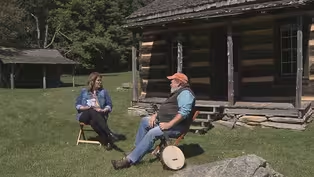
A continued conversation with Malcolm Smith
Clip: S4 Ep2 | 25m 51s | We dive deep into the stories of Albert Hash. (25m 51s)
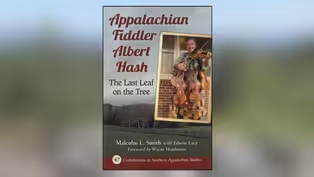
Clip: S4 Ep2 | 2m 9s | Find out how Appalachian Fiddler Albert Hash: The Last Leaf on the Tree got its title. (2m 9s)
Providing Support for PBS.org
Learn Moreabout PBS online sponsorship













Support for PBS provided by:
Write Around the Corner is a local public television program presented by Blue Ridge/Appalachia VA