Write Around the Corner
Write Around the Corner-Mitchell James Kaplan
Season 5 Episode 4 | 28m 17sVideo has Closed Captions
Kaplan's novel, Rhapsody, takes readers on a musical journey in the 1920s.
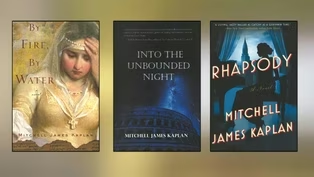
This week, we’re in Roanoke talking with Mitchell Kaplan. His novel, Rhapsody, takes us on a musical journey in the 1920s and explores the relationship with George Gershwin and Kay Swift.
Problems playing video? | Closed Captioning Feedback
Problems playing video? | Closed Captioning Feedback
Write Around the Corner is a local public television program presented by Blue Ridge/Appalachia VA
Write Around the Corner
Write Around the Corner-Mitchell James Kaplan
Season 5 Episode 4 | 28m 17sVideo has Closed Captions
This week, we’re in Roanoke talking with Mitchell Kaplan. His novel, Rhapsody, takes us on a musical journey in the 1920s and explores the relationship with George Gershwin and Kay Swift.
Problems playing video? | Closed Captioning Feedback
How to Watch Write Around the Corner
Write Around the Corner is available to stream on pbs.org and the free PBS App, available on iPhone, Apple TV, Android TV, Android smartphones, Amazon Fire TV, Amazon Fire Tablet, Roku, Samsung Smart TV, and Vizio.
Providing Support for PBS.org
Learn Moreabout PBS online sponsorship[???]
-?
Every day every day Ev ery day every day every day ?
?
Every day I write the book ?
[???]
-Welcome.
I'm Rose Martin, and we are Write Around The Corner in Roanoke, Virginia with author Mitchell James Kaplan.
Mitchell's latest book, Rhapsody , will take us on a musical journey with a brilliant musician/pianist, Kay Swift.
She always dreamed of becoming a composer.
She was married to financier James Warburg, but she was also George Gershwin's lover for the last ten years of his life.
It's gonna be a fascinating interview.
Hi, Mitchell, welcome.
-Hi, Rose.
Thank you so much.
[Rose] So, I'm fascinated by the book, but before we get to the book, I wanna know - I read that you were enthralled and fell in love with words at a very early age.
Is that true?
-When I was little, my mother was, she was earning her doctorate in Literature at UC Irvine.
And she was reading Shakespeare and Yates and Blake.
And she didn't have a lot of time for other things.
So, she managed to combine that with child rearing, and she would read William Blake poetry to me at bedtime, my bedtime.
And that's part of it, and Wallace Stevens, I remember when I was a kid, becoming just enthralled with the mystery of his poetry.
And then later, when I was about 12, 13, I went away to boarding school and my parents, my family fell apart at that time and books became my refuge.
So, I was just reading Hawthorne and Emerson and Melville, and I just was.
lived in those worlds.
It was my refuge, as I say, from I think, the kind of pain that adolescents go through and that I went through.
-That had to be a very, very difficult time.
And so oftentimes, I hear - and I know for myself, that you get lost in a book and it can make all the difference in the world to take you to someplace else.
-Yeah.
I mean, it's such a rich subject.
Why is imaginary life so important to human life?
The way I see it, when we're dreaming at night, for example, we don't know that this reality exists.
We live in that world.
It's just as real to us in every way as this world is when we're not dreaming.
So, I feel, imagination is absolutely an essential feature of human existence.
We can't even exist without it.
So yeah, I think it's an essential part of everyone's life.
And so, I've tried to place the proper amount of value on it that it deserves, without wanting to detract from the value of what we call reality or to deny the importance of science and all the things that relate to our material universe, which is also beautiful.
-Right, and they're all interconnected, aren't they?
-Yes, in some mysterious way.
I've just wake up from dreams and I ask myself, where did that come from?
Who are those people?
How did I get into that place where I've never been, where these people are talking with me and interacting with me whom I've never met before, who don't necess-- or who do resemble people I've known.
They may come from my past or whatever.
But maybe they're people I've never seen before.
And the other thing I think about this is that I believe that I am in some way, some part of me, an important part of me, is reflective of everything I've experienced in life.
The pain we talked about that I experienced as a 12-, 13-, 14-year-old and also the adventures that I've experienced in my dreams.
I think they all contribute to who I am.
And I don't know where those dreams come from and there's a great mystery in that that is enriching.
-Do you remember your dreams?
-I wake up every night and I remember them.
But I don't write them down.
So, I remember vague images.
But frankly, I think they affect me, and they affect me long-term, whether or not I remember.
-How so?
-Well, just the same way real life memories affect me.
I may not remember who is sitting next to me in fourth grade, but it could be that that person said or did something that is still affecting me to this day, commented on my eye color, or something less flattering.
[laughs] Not that my eye color is flattering.
[laughs] -I think you have very nice eyes.
-I wasn't trying to elicit flattery there.
[laughs] -So your early years, by having such a wide exposure to literature and poetry, is that where your first love of literature and poetry then came from that resonated with you to where you just find that the words, the creation of words, and how they blend and convey messages is so important.
-You know, I also played the flute since a young age, and I still do.
And music has always been a huge part of my life and where does music end, where does the sound of words start?
Even without meaning, words have a musicality.
And when you add the meaning, there's an additional musicality.
But, for example, rhyming, you can create these machines out of words that have an inner logic, that have nothing to do with the meaning.
The logic comes from the rhythm and the rhyming patterns.
And I just find that fascinating.
Does that come from my mother reading poetry?
I think in part, it does, and let's give credit where credit is due.
I'm grateful for that.
But as I said, it was also a refuge.
I notice adolescents.
When my own son was an adolescent, he and his friends are reading a lot.
And it occurred to me that yeah, they need that.
-I think it is so important.
You talked about chaos and that role of chaos in life and in work, and even in music.
Expand upon that a little bit and how you're influenced.
-That has a lot to do with kind of my thinking about aesthetics and my thinking about how novels are written, how music is written.
I really believe there has to be a kind of an interplay or a struggle between chaos and order in a work of art.
And it's also a struggle - now we're getting a little into you know, my actual process.
But it's a struggle between the conscious, deliberate intention of the creator of the work and something that comes through association, that comes out of the material that the writer is working with or the composer of music that comes to the writer.
And that's the mysterious part of it.
You know, Homer refers to the muse, there is that sense that there are forces at play that are beyond just the conscious mind, whether they belong to some other universe or the unconscious mind or whatever, but where do dreams come from, again?
And in dreams, there's a lot that seems chaotic but there are also sign posts, things that we recognize, feelings that recall, that tie in with our lives.
So, as you mentioned, that interplay between the deliberate and the unconscious, or between chaos and structure, that's very, very fruitful for me in any work of art.
There has to be a sense of repetition and change also which ties in with that.
You hear that most obviously in the classical symphony where there's a very specific form in the structure of a symphony.
You've got the A theme, the B theme, the development of both themes modulating into different keys, going into different areas musically and resolving at the end and repeating the themes, maybe in a new way at the end.
That's a very clear, very limpid, very well-structured, methodical kind of way to create a work of art.
And it's during that development portion that things happen that you don't expect, so.
-Is the same thing happened when you're creating a new story?
Is that the same process?
-For me, there is the initial "aha" moment when you realize, this is the story I'm writing next.
-Does it come from a dream?
-It comes from - it can come from a dream.
But when - I'm talking about - not the next scene but the next book.
So sometimes, the scenes do come from - definitely very, very often, the scenes come to me when I'm laying in bed at night or in the morning.
Or I wake up in the middle of the night and I'm thinking about it.
And I do flesh out my scenes while I'm laying in bed.
So, in the morning, I pretty much know what I'm doing.
-And so you write in the mornings?
-Yes.
I write early in the morning, four in the morning.
I get up at four and most of my kind of creative work is done by say, ten or so.
After that, if I'm working on my book, it's gonna be editing and rewriting, which takes plenty of time.
But the actual, initial creative works, happens during my sleep and then after I wake up.
But also, that aha moment can just come about because of a fortuitous circumstance.
In the case of Rhapsody , I had finished my first novel, it was in the process of being published, I didn't really know what I was gonna write next.
And it was early in the morning, dark outside, four in the morning.
And I had 300 discs in my CD player, and it was set on Shuffle.
And it was playing low in the dining room of the house where we lived at that time.
And Rhapsody in Blue came on and I pictured my father sitting in front - or standing in front of the stereo when I was a little boy, playing the clarinet.
Playing that opening well on the clarinet that ushers in this piece of music, and I started crying.
And my father had died a couple of years earlier and he was right there in the room with me.
And I knew that was my next book.
-Hm.
That's beautiful.
-So, where does that come from?
Does that come from-- why did the CD player pick that record?
-Hm-mm.
-[Mitchell chuckles] -Well, you were meant to write Rhapsody .
You know, who knows if that's-- -When you're writing a historical novel like that and you're doing your research, and then these characters are speaking through you, you really do feel like you're doing - your work is in the service of those people who want their stories to be told.
In my case, I was reaching back to my father and his generation and their music.
But through them, to the previous generation, the music that he was absorbing as a kid that really came from earlier, but that he loved his whole life.
-Hm.
And actually, music was a passion for him but that wasn't his livelihood, right?
He played around, played in clubs and things, but he also had a different job.
-Yeah, well, he earned his way through medical school playing jazz clarinet.
And he became an eminent cardiologist at UCLA.
And he continued playing clarinet, he played just beautifully.
He played like Benny Goodman.
He's an amazing clarinetist.
So yeah, I grew up - and he loved music, you know.
So, our home was filled with jazz, classical, and The Beatles and everything else.
-Hm.
That had to just be an amazing time filled with so much music.
Is that where you picked up the flute initially?
-Well, my parents didn't give us a choice.
We were gonna play an instrument.
-Okay.
-And I picked the flute.
I was eight or nine when I started playing flute.
-Oh, but you stuck with the flute all the way long?
-Yeah.
Now I have an alto flute and a concert flute.
And I've actually been playing in different venues where I'm talking about Rhapsody .
So, we'll have a pianist or guitarist, and we'll play a few numbers that kind of bring back the period.
-How long did it take you to bring Rhapsody to print?
-Well, the book was sold before I wrote it.
So, I pitched it-- -I love this story, share with everybody.
-Well, really what happened, I don't know which story you've heard, how much of it you've heard in detail.
But I had finished my previous novel, Into the Unbounded Night .
And I showed it to a publisher and editor at Gallery Books - Simon & Schuster.
And she said, "I love this book," and she was aware of my first book also had done well and won prizes and things.
She said, "We wouldn't know how to market Into the Unbounded Night .
It's kind of a niche book.
It's not exactly what we do, but I personally loved it.
And keep us in mind whatever you write next.
Just I'd love to hear from you."
And I said, "Well, as a matter of fact, I've just started another book and it has to do with George Gershwin and the woman who was his main love interest during the last ten years of his life.
And her husband, this love triangle, 1920s New York, the rise of jazz, Harlem Renaissance," I told her all that.
She said, "Send me an outline in 50 pages," and I did.
And that's it, we signed a contract, and they told me I had a year to write it.
So, I wrote it in a year and then I spent another year rewriting it.
I hope that's a story you're-- -That's the story I knew.
That's the story I knew, and I was fascinated by the fact that with 50 pages and an outline, you got the contract for the book.
And see, again, it was just meant to be, meant to be.
-Yeah.
I think it was the right editor also.
She had a passion for this period, for this music, for the kinds of personalities that are involved with the story.
And we, I think, we really developed a great dialogue about all of this, and it was great to work with her.
And that part of it was meant to be, yeah.
-I love the personalities in this story starting with Kay, moving to Jimmy, moving to George.
And I found that I learned a lot about the time period because your research was so detailed for-- including the things that became unexpected in the book.
How much time did you actually have to spend researching that to make sure that you filled each page with all of those details?
-Well, for me, I don't really divide things up that way.
It's all part of the process.
It's all - I don't think of research and then write.
It's not like that for me.
I'll read several biographies.
In this case, I read several biographies.
And then, you start getting a sense of the people.
And then, those people start talking to you.
And so, by that point, pretty early in the process, I know the arc of the book.
I kind of know where I'm starting, where I'm going, where the climax is.
But I'm every bit as fascinated with these people and with these events as I want my readers to be.
It's absolutely a journey of discovery for me.
And that's how I feel it has to be.
If I don't feel that excitement, I don't think it's gonna come through to the readers.
-I think you're right because as I'm reading it, I'm falling in love with the story and the people and the time period.
So, the main characters - let's go ahead and introduce Rh apsody to all of the viewers.
So, who is Kay Swift?
-So Kay Swift is the daughter of an opera critic in New York.
And he writes for a newspaper, at that time, it was a big newspaper in New York.
They live the kind of artistic, intellectual, bohemian life where what mattered more than anything else was classical music.
And Kay became a proficient pianist.
She was really a star at the Institute of Musical Arts which developed into what is known today as Juilliard School of Music.
Her family had a background, Protestant family, her grandmother had written hymns that were used in this kind of Anglican Protestant church in America.
So, there was a musical, very much a huge musical component to her family culture.
There was, I think, a sense that music was their ticket into high society.
I think that was an important part of it for them.
They didn't have the money, so they had the culture.
That's where Kay comes from.
-And so, in comes James Warburg.
How does she meet him, and then how does he become this pivotal, I guess, sense of stability in her life until - we'll get to George in a minute.
-Yeah.
So, James Warburg was an immigrant, but he was an immigrant from a family that was tremendously wealthy and powerful.
But I have to say it's a Jewish family, and the Jews in New York at that time were painfully aware of the fact that anti-Semitism was very, very palpable, and it was omnipresent in New York.
They couldn't get away from it, no matter how many mansions you owned and how many famous paintings adorned the walls of those mansions.
And even if you own the banking empire, and you're doing business with the largest industries in Europe, which the Warburg Company, that's who they were.
Nevertheless, they were uncomfortable.
Things are getting bad for the Jews in Europe.
They'd always been bad, but they were getting even worse.
And some of the members of this family came to New York.
And so, Jimmy was born in Hamburg, came to New York as a young boy, went to Harvard, class treasurer at Harvard at a time when very, very few Jews were admitted to Harvard.
There was an official limit of the number of Jews-- -[Rose] Oh, really?
-Yeah, a quota.
But he was so - his family was so powerful and wealthy that I think it was a no-brainer for Harvard.
[chuckles] -Hm.
And you tell some great stories in the book about Kay and Jimmy and their interactions.
And they had to deal with some things and even getting their relationship off the ground because of the different backgrounds and because of the different societal structures and pressures and things of both families, right?
-Even Kay and George later on.
-Okay, so let's talk about George.
-Okay.
-So, I'm really interested.
-So George comes from the - I mean, let's just put it this way.
The number of wealthy Jewish families in Europe was infinitesimal, very, very small.
But of course, this huge mythology develops about Jews having power and wealth.
But the majority of Jews in Europe were very poor.
And George Gershwin comes from one of those backgrounds.
His parents are immigrants, and they came from Russia.
And he grew up really all over the place, Brooklyn, the Lower Eastside, Harlem.
They were just, you know, his father occasionally was making a living, occasionally wasn't making a living.
They were making ends meet, and his life was lived as much on the streets as in the house.
His neighborhoods were more of the kinds of neighborhood where people are shouting from windows at each other and there's music playing everywhere.
And he was exposed to a lot of different kinds of music, growing up.
-Well, and that comes through in your book because where you said he's all over the place, his musical style is so opposite of Kay's musical style, the fact that they came together and developed this relationship.
What did you really want the reader to understand about Kay and George and even Jimmy?
How the three of them?
[Mitchell] Well, earlier in our conversation, I mentioned that classical music was the ticket into high culture in America for Kay's family.
I mean, they wouldn't have thought of it in such kind of a vulgar way.
But I think functionally, that's one of the way - they loved music, I'm not denying that.
But music does serve to kind of identify groups like tribes, social class.
These are actually-- socioeconomic class is a tribe.
You belong to this tribe, that tribe.
You can belong to the Irish immigrant tribe.
You can belong to the Jewish immigrant tribe.
You can belong to the wealthy kind of global consciousness tribe which was really Jimmy's tribe.
George was a man who is exposed to the earliest forms of what would develop into jazz before almost any other white person.
He lived in Harlem.
He was a self-taught pianist.
He taught himself piano by putting his fingers in the keys of the player piano at his friend's house, where they had Scott Joplin rolls in the player piano.
So, he learned to play Ragtime , and he became extremely proficient just that way.
Then, his parents, when they found out that he was really good at this very unique form of piano playing that wasn't that well-known yet, they had him take classical piano lessons.
So, he starts learning classical piano.
They move up to Harlem and he starts kind of playing hooky, leaving school to take jazz lessons from some of the great early jazz, stride, boogie woogie pianists, and learning these different types, and he was just attracted to that and loved it.
But all his life, he was fascinated with Latin music, with Irish music, with different kinds of ethnic music and as well as European music.
Kay, what happened is, Europe destroys itself in World War I.
And the European dominance of world culture falls apart.
And everyone looks to America because now America dominates the world, militarily and economically.
So, everyone's looking to America for dominance, cultural dominance, as Fitzgerald pointed out the time.
Where the money goes, there the culture goes.
And I think Kay and Jimmy felt that it was incumbent upon them to play a big role.
He had studied poetry at Harvard and history.
He wasn't that interested in banking.
He just did it for a living.
It was - he inherited the role.
He got very good at it, and I think became somewhat passionate about it later.
But, he loved poetry, he loved the arts.
Kay was, as I said, a star at the school that was to become Juilliard.
So, they had all this knowledge of European art and culture, and they knew that they - and they had the power and the money and the visibility.
They knew that they had a role to play.
But they didn't have a lot of firsthand experience of what was really happening on the cultural scene in New York at that time and in America which was this burgeoning of these different folk musics among the immigrants who had come from the poorer classes which were the majority of immigrants in America.
-Well, and you tell it so beautifully in Rhapsody .
Would you be willing to read us something?
-Okay, yeah.
So, I'm gonna read to you from when Kay first hears George Gershwin.
And this is right there where they're discovering a different kind of music.
That discovery is gonna be powerful and important for Kay.
-"A hush fell over the audience.
"They had never heard anything like this.
"At first, Katharine was not quite sure what to make of it.
"Then she realized she was holding her breath "and wondered why she was doing so "during a piano concerto, or whatever this was.
"How many concertos had she heard "performed on this very stage?
"She could hardly count them.
"She exhaled.
She inhaled again "and repeated the exercise until it felt natural.
"As natural as.
as breathing.
"Or almost.
"Gershwin played like a self-taught virtuoso.
"Everything was wrong, his posture, his fingering, "the distracted expression on his face.
"But when Katharine closed her eyes "and set aside all she had learned "since early childhood about the code-bound ways "in which individual notes, rhythms, melodic figures, "and harmonic progressions "were supposed to cavort with each other - "when she allowed the music to justify itself - "somehow everything sounded right, too.
"How could that be?
"She opened her eyes.
"His fingers tapped the keys repeatedly; "scurried up and down, passing each other; "meshed together; "flew apart to opposite corners of the keyboard.
"Swaying, smiling to himself, "Gershwin appeared not to be thinking about "his hands or the sounds they produced.
"Yet, despite his apparent mindlessness, "each note sounded confident, even the phrases "that conveyed wistfulness, longing, and sorrow.
"At times, Katharine wondered whether Gershwin was improvising "or performing passages he had meticulously composed.
"She failed to notice the moment when the music persuaded her "to stop thinking and just listen.
"What she heard then "was a man pouring his heart out to the world.
"At the height of the soaring, lyrical passage, "two-thirds of the way through, "Katharine forgot about the funny parts, "the exuberant parts, "the piano-against-orchestra quipping and cajoling parts.
The sadness and the beauty of it enveloped her."
-Hm.
I can just close my eyes and listen and hear that music coming through.
You've done a beautiful job on this book.
Thank you so much.
Thank you so much for sharing this.
-Thank you.
-My special thanks to Mitchell James Kaplan for sharing his book Rhapsody , the story of Kay and Jimmy and George Gershwin.
If you haven't read the book yet, please go ahead and get yourself a copy and transport yourself back to this time of fabulous music.
I'm Rose Martin.
Please tell your friends about us.
You can catch more of my conversation with Mitchell online.
I'll see you next time, Write Around The Corner .
-?
Every day every day Ev ery day every day every day ?
?
Every day I write the book ?
[???]
?
Every day every day Every day ?
?
Every day I write the book ?
?
Every day every day Every day ?
?
Every day I write the book ?
A Continued Conversation with Mitchell James Kaplan
Clip: S5 Ep4 | 22m 23s | We dive deeper into Mitchell Kaplan's novel, Rhapsody and more. (22m 23s)
Providing Support for PBS.org
Learn Moreabout PBS online sponsorship













Support for PBS provided by:
Write Around the Corner is a local public television program presented by Blue Ridge/Appalachia VA