Write Around the Corner
Write Around the Corner - Pete Fanning
Season 4 Episode 5 | 27m 4sVideo has Closed Captions
We visit with Pete Fanning to discuss his YA book, Justice in A Bottle and Runaway Blues.
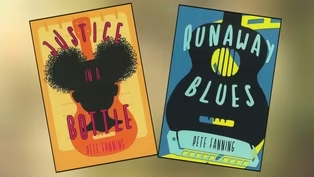
We visit with Pete Fanning in Lynchburg, VA, to discuss his books, Justice in A Bottle and Runaway Blues. Both of these YA books have powerful messages and they're not just for kids!
Problems playing video? | Closed Captioning Feedback
Problems playing video? | Closed Captioning Feedback
Write Around the Corner is a local public television program presented by Blue Ridge/Appalachia VA
Write Around the Corner
Write Around the Corner - Pete Fanning
Season 4 Episode 5 | 27m 4sVideo has Closed Captions
We visit with Pete Fanning in Lynchburg, VA, to discuss his books, Justice in A Bottle and Runaway Blues. Both of these YA books have powerful messages and they're not just for kids!
Problems playing video? | Closed Captioning Feedback
How to Watch Write Around the Corner
Write Around the Corner is available to stream on pbs.org and the free PBS App, available on iPhone, Apple TV, Android TV, Android smartphones, Amazon Fire TV, Amazon Fire Tablet, Roku, Samsung Smart TV, and Vizio.
Providing Support for PBS.org
Learn Moreabout PBS online sponsorship[♪♪♪] -♪ Every day every day Every day ♪ ♪ Every day I write the book ♪ [♪♪♪] -Welcome, I'm Rose Martin, and we are Write Around The Corner in Lynchburg, Virginia with a wonderful author, Pete Fanning.
His two books, Justice in a Bottle and Runaway Blues, both cover issues that really do affect all of us.
And these books are not just for kids.
Justice in a Bottle is a heartfelt story about a teenager.
And she dreams of being a great journalist.
And there's an old sicker man, who is hoping to learn to trust in the human race again.
His name is Mr. Melvin, and he offers Nita a story, a series of books that he calls his memoirs.
She finds a tale of secret love and heartbreak.
But there's a message.
And it's, it's never too late for the truth.
Pete's second book is Runaway Blues .
And in this book, 13-year-old Caleb is going on an adventure of a lifetime with his grandpa.
Two things Papa can do really well.
He can tell a story, and he can play the blues.
When Caleb finds his grandfather, all spruced up with his guitar slung over his shoulder, he's not sure if this is real, or one of those moments that the dementia has kinda kicked in.
Well, they go on their adventure, and what they find not only changed Caleb's summer, but it changes his entire life.
Pete Fanning, welcome to Write Around The Corner .
-Hey, Rose.
Thanks for having me.
-We are so happy.
And thank you for this beautiful setting out here in Lynchburg.
It can't be any prettier.
-Yep.
One of my favorite places.
-So, you live in this beautiful area.
And congratulations, you and your wife have a new baby girl.
-Yes.
Bella.
-Bella and a rambunctious little guy, Simon.
We had a chance to meet him.
-Yeah, yep.
Keeps me young.
ROSE: How fun.
How fun.
So, as a young family, when you're thinking about writing and then you take yourself back to your early childhood, were you a lot like Simon?
Were you more of an introvert?
Were you writing stories?
What was it like?
-Um, I would say, I was more of an introvert outside of the house.
I think my parents would probably say a little differently inside the house.
But, um, yeah, yeah, I was definitely thinking of stories, if not writing them.
Always, you know, reading something.
But yeah, I mean, it was-- I wasn't like out there like my son, Simon, not at all, so.
-So, Simon is more of a conversationalist, maybe.
I hear-- or rather, you peg yourself as, no, you are not a conversationalist.
-Right.
Right.
-Why do you-why do you say that?
-Um, Simon's just outgoing, fearless and, you know, ready to take everything head on.
I'm more of a wait and see, take that approach.
And I don't know if it's the older you get, but, you know, you just find the solitude a little-- I guess especially with the baby in the house, it's-- you take a quiet moment when you can get it-- -Whenever you can find the solitude, right?
-Yeah.
-So, you read a lot as a child.
And are you still reading a lot of different kinds of things right now?
-Yes.
I read-- I don't wanna say whatever I get my hands on, but I don't just read like what I write.
I'll just read whatever grabs my interest.
It's always kind of been my thing.
But yeah, you know, I try to read when I can.
-What's on your nightstand right now?
What are you reading?
-Uh.
[laughs] Hope Never Dies .
It's Barack and Joe Biden.
It's kind of a bro mystery story.
It's totally fiction, and it's cracking me up.
-Okay.
And what are you reading to Simon?
-What are we reading?
Simon is reading Diary of a Minecraft Zombie .
ROSE: Okay.
-It's a series, which is actually written by a dad and his 12-year-old son.
And he's-- I think he's on like the ninth one by now.
-Well, and I love something, speaking about dads, you had said how close you are to your dad.
And there was something I read that you said, you know, the moment that you saw him turned out to be, you know, kind of like the best moment for you.
So that was always a really special relationship, huh?
-Oh, oh, yeah.
My dad was probably my best friend until, I don't know, through middle school at least.
Until I became that kinda-- you know, the teenage years where, you know, how that happens.
But, yeah, no.
Dad and I, we had some adventures.
We were every weekend and he was so young, you know.
So, we had a special relationship.
Still do I like to think.
-Well, and your dad was a disc jockey, and he left you quite a treasure, huh?
-Yes, I have all of his records, thousands of records in my basement.
And my favorite is the little 45s, have the dates they were played, the '80s.
They have requests, dedications, just from some random wedding he was doing or whatever.
So, it's more than just like a record I play, you know.
It's kinda cool.
-But you also have the player so you can play them?
-Oh, yeah.
Oh, yeah.
-And you can listen to them.
-Yep.
Simon knows how to flip a record.
The basement is all-- it's pretty analog down there.
It's-it's-- -That had to be kind of fun to go back and think about, you know, piece of his world and the different types of music.
So, is there a particular genre that you really like in music or kind of like books, everything?
-I mean.
oh, yeah.
Oh, yeah.
I went through stages as a child.
But, you know, I grew up in the '80s, and it was-- I was all hip-hop, all the time.
Just grew up with it.
Never really veered away, now I'm kind of a cranky old man, so I don't like the newer stuff.
But blues, went into blues music as I got older.
A little bit of rock, but, yeah, it's just I love the blues music.
And as embarrassing as it is, as I get older, I'm starting to like the jazz and everything else.
-Well, I like jazz.
And I'm older, but that's all right.
I'm going to-- that's not embarrassing.
You can go ahead and love jazz.
-I was on Pandora the other day, and it was like you're most listened to was Count Daisy.
And I'm like, ROSE: Yeah.
[laughs] "I'm not that old."
-But, you know, whatever.
ROSE: The old is new again.
You can't-- you can't beat good music whenever it is.
So, during the writing of these two books-- PETE: Yes.
-You know, I hear a lot of stories about how people keep themselves busy or they totally get away from everything because the writing is consuming.
But that wasn't you.
You actually taught yourself to play an instrument?
-Yeah.
I bought a $40 acoustic guitar.
And I think by this point, I'd lost hope the book would ever see the light of day.
So-- -Oh, so this was just kind of a diversion?
-While we're writing yeah, I was like, "You know what?"
And I learned a few standards, did a little YouTube, did a little listening.
And not great, but I can pluck out some chords and sit on the car port, and, you know, I'd sing the blues bought my own book.
So, it was-- -So, that's fun.
Yeah.
-It was.
It was a lot of fun.
-I like that.
Well, and I read somewhere that, you know, part of writing is taking yourself into other worlds so that people kind of grab into that world with you.
And I read somewhere that someone had asked you, okay, so if you could travel to any fictional book world, and I loved what you said here.
Do you remember what you said?
-I don't.
ROSE: Okay.
"I'd travel to the kingdom of wisdom and jump to the island of conclusions."
And I thought, "Oh my gosh, is that kind of cool?"
So, let's go there for a little bit.
-Yeah.
That's not original either.
t's from The Phantom Tollbooth .
ROSE: Yeah.
-I must've been reading that, another read, like I picked up somewhere and just couldn't put it down.
And I've got to read that to Simon.
He will love that one.
ROSE: Yeah.
-But I just fell in love with that book.
-Well, and it's kind of fun, right?
So, the kingdom of wisdom, don't we all really think, like we wanna go to a place, and then we're gonna wanna know, right, the answers.
And then I love that jump to the island of conclusions.
PETE: Yes.
-And I think, you know, I'm gonna go on this journey.
I'm gonna learn it all, and I'm gonna get it.
It's almost gonna be a little painless, and then I'm gonna leave, you know, wiser and smarter.
-And the older I get, if nothing else, I've learned how little I actually know.
'Cause I knew it all in my 20s, but yeah, as I got older-- ROSE: Right.
And you know, I think Simon might remind you that as he gets a little bit older, you're not gonna believe how old you get, and then how he's gonna think, "You really don't know anything."
The older you get.
I don't know if that was the way it was with your dad, but it gets to be the point of thinking, "Gosh, you know, that advice, dad.
You're just out of it."
-Yeah.
Oh, yeah.
That's-- -Hmm.
And you know, I love the pieces of advice you give yourself and the things that we read in your blogs, A Father Knows Little .
And is that a little cathartic to tell your story because you get really personal.
And you know, you let us know everything that's going on as almost a diary for the whole world.
-Yeah.
I mean, I guess I was thinking nobody's reading this anyway.
But, no it's more-- I didn't wanna have one of those blogs where it's like, "Look at our perfect little family."
You know, how people-- like you could post things and everything looks perfect.
And it's like, "This is real, you know.
I'm clueless in some things.
ROSE: Yeah.
-And I'm trying to work my way through it, you know."
-Well, has your wife read it to know what you put about her in there about her pregnancy troubles?
Or some of the things that are happening?
I'm just saying, you know.
Or your in-laws, have they read it?
-Yeah.
Well, my wife loved it.
ROSE: Yeah.
-She used to want me to keep going.
I don't-- I'm not, you know, it's hard to juggle everything.
But my wife loved it.
She was like, "This ought to be a book."
And I'm like-- -Yeah.
-"I don't know if the world needs another dad book."
-But it's fun, and I love the way you describe it here.
-It is fun.
-"Thanks for stopping by.
"Feel free to laugh at my neurotic thoughts, "illogical rationale, and idiotic rantings.
I'm a work in progress, and progress is slow."
And I love that.
And I think one of the things we learn about people through their blogging is not only their personal relationships and how they feel about different kinds of issues, but we kinda learn about pet peeves or things people do or don't do.
So, I've just got to ask you if this is still true with Simon that when it comes to Christmas decorating and your Christmas tree, that you still would love to put it up late and take it down early.
-No.
That has definitely changed.
ROSE: Okay.
Good.
-That's how I grew up, though.
ROSE: Yeah.
-It was the battle between my mom and dad about, dad was the day after Christmas, which is his birthday.
And she was like the sixth or the seventh.
And then, you have like a young kid who enjoys it so much.
ROSE: Yeah.
-I've learned like, "Hey, we're gonna watch Halloween movies in June.
We're gonna, you know, we're watching Scrooge all-year round.
I used to call him elf because we were doing Christmas all the time, you know, when he was four or five years old.
So, tree goes up a little bit after Thanksgiving.
Comes down January 5th, 6th.
ROSE: Yay.
Good.
So, I'm glad.
When I read that part of your blog about, "Oh, maybe they're taking it down Christmas Day.
I'm like, oh, I don't know Pete.
We're gonna have to ask about that now that you have little people.
-Once you look 'em in the eye, it's like, no, it'll stay.
ROSE: Yeah.
-It's fine.
-So, let's transition to the books.
What was the process like for you because you dabbled in lots and lots of articles, smaller types of stories to find your space right here in this kinda YA zone with these books?
-Yeah.
As far as the books, like you said, I was doing blogs, and I was doing, like a little website where it's like that you earn money by the clicks, and you just write different little things.
And then I wrote a short story, and it was like something clicked in the fiction.
And I just fell in love with it.
So, of course I write the first novel because you have to write the first novel that's pretty much autobiographical.
You know, it's just all about you.
And my grandmother read it, and she was like-- I think she was 90 at the time, 89, but she was still writing, reading.
And she was like, "You do the younger parts really well."
And I was like, "Oh."
And that was when I was like, "Really?"
It was like the first constructive criticism.
It was like, you know, "You do this really well."
ROSE: Yeah.
-So, I took that, ran with it, and I've never really looked back with the middle grade YA.
It's just kind of like just what I-- what clicked and what I liked and.
-Well, and even though they've got that YA middle grade kind of label to them, it's not-- these books are just not for kids.
I loved them.
And Carol and I both each said, gosh, when we compared notes, we read it one sitting, and found that the topics that you cover are really applicable to all of us.
And I think what I loved about it is that they're tough topics, but you handled it in a way that kids or young adults, and even adults would read it and say, "Hmm.
You know, I didn't think about it."
So, was it hard to tell a story like that without the violence or without the graphic content in a way that you wanted to make sure that that really tender age of that pre-teen teenager would understand the story and appreciate it?
-Yeah.
And it's funny because I don't-- I don't know if it's just the way my brain works, but I never once like focused, it wasn't actually-- I don't outline.
I don't even plot.
I mean, I just-- there's lots of drafts as I write.
But anyway, I never really-- it was never like, let me cut this out because it's too much of this.
I mean, there were a few parts in editing that they were like, "You know, this needs to go."
But I don't know, it just really-- I really get into the story, and I just, and I tried my best, you know, to see it from a younger perspective, and just went that way, you know.
-So, what came first, the story or the characters?
-With Justice, it was definitely the character.
-And is it true or false, she's actually the favorite character you have ever wrote.
Is that true?
-What am I working on now, but no, yes.
ROSE: Yeah.
-I would say, yes, because, you know, what it went through with this book easily, yes.
ROSE: Yeah.
-And how many drafts and the story got rerouted-- -How long did it take to get it from that initial idea, character development to having it published?
-The short story would be probably four years.
Because I went back, I got some-- it was originally written in first person.
It was called like Earl Melvin The Magnificent Liar .
And it was about an old man, you know.
And as it came on, I learned some things, you know.
I changed.
I backed away.
I had an agent tell me she loved the story.
She's like, "You can't.
We can't do this."
And I totally understood.
And-- -Why?
Why couldn't she do it?
-I mean, she just said she couldn't sell this in the environment right now, you know, a white male.
ROSE: Yeah.
-.writing as an African-American female.
She actually suggested that-- need to be white.
And I was like, "I don't think that's a good-- you know, she's not.
ROSE: Right.
-But anyway, it did make me-- I left it alone for months, maybe a year.
Came back, wrote it third person.
Everything started clicking in third person.
Gave her some quirks, the inner critic, you know.
ROSE: Yeah.
-Made her a journalist.
There was a lot of journalism talk goin' on that I'm sure affected it.
So, definitely that got in there with the journalist, and it grew from there.
It was, you know-- it was just run into a wall, change, you know, change things.
But she-- her friendship with Mr. Melvin never changed.
That's the one part that-- and that's what I think the story's about.
Like there's race, there's violence.
You know, there's all this stuff, but it's their friendship that, to me, is the story.
-Well, and when you were developing that friendship, was that based on any true memoirs or any true people that you actually heard that story from?
-It actually-- my wife is a teacher.
We would talk at dinner.
There was a student that she would talk about every single night.
And this was younger, third grade, second, third grade.
And that was kinda like the origins of Nita, and she kinda came out of that.
But it wasn't anyone I knew personally.
It was just, you know, the girl, and then, what if, what if, what if, you know.
And then-- -And what about Mr. Melvin?
-Mr. Melvin is loosely based on a sixth-grade gym teacher I had.
But he was never in trouble or anything like that.
ROSE: Right.
-That's who I saw.
But no, I've gotten a lot of people.
I had one person review it and said that the book was tryin' to be-- was tryin' a lot to be-- I'm blankin' here.
Harper Lee, To Kill A Mockingbird .
And I only wish I had that lofty expectations for a book, you know.
I appreciated it.
It wasn't.
I mean, she wasn't sayin' it's like that.
She was like, "This book is aspiring to be that."
-Well, you handled a really tough concept, right, with her and her neighbor.
And you talked about the talent, and I love the fact that you just said that because I wrote down a quote of yours.
"Occasionally, someone will tell me "I'm a talented writer.
"No, really it happens.
"And when it does, I thank them graciously, "but I feel like a fraud "because I should probably tell them a secret.
"It's not so much talent, or a gift, "or some magical ability, but a grind.
"It's work.
"And just like anything else, the harder you work, the better you get."
And I love that because what we've been talking about is the constant revisions and the constant drafts.
And I think for people to realize that, when you write a book, it's not just, "Oh, I'm gonna throw this on some paper.
I know it's amazing, and I'm gonna send it off to a few, you know, agents and publishers and I'm gonna get a book deal."
- [laughs] Yeah.
-It doesn't happen overnight.
-You know, I thought that, and I ended up sending them to my stepmother, who had to plough through these drafts of early stuff I wrote.
You know, I just knew it was great 'cause I was having so much fun doin' it.
Which I think is most of it because.
-And you want to have fun.
Yeah.
-.we wouldn't do this, if it wasn't fun.
-Right.
-'cause it's so much work.
Yeah.
I would send her chapter after chapter, not of this, but before this, you know, there were-- I mean, you know, there's probably been 25 books that I've gone through not even half or even somethin'-- something you could read.
-But the dream came true.
-It did.
It did.
-The dream came true.
All right.
Let's chat about Justice in a Bottle .
So, introduce us to the characters.
[Pete] Okay.
Well, there's Nita Simmons, aspiring journalist, go-getter.
She's-- her confidence is at a low after getting a piece of retraction.
-Because she didn't follow the facts in her journalist club.
-She didn't follow the facts.
-So, she's a journalist in middle school.
-Yes.
-And that's all she wants to do is write and tell stories.
-That's it, yeah.
-And she kinda finds herself with the bigger stories, right?
She doesn't wanna do the soccer team, all this stuff.
-No.
-She's uncovering the big ones.
-Yeah.
She wants to be the big-time journalist goin' after the hard-hitting stories.
And her principal warns her, you know, and she gets the retraction.
And.
then she ends up, you know, comin' across these memoirs of her neighbors, who actually, you know, it's not spelled out, but, you know, he's reachin' out.
He knows, you know, his health is failing.
Anyway, they end up, she's interviewin' her neighbor.
And she ends up, they just become-- it's almost like a grandfather kinda relationship.
And she convinces him to come out with the story.
She writes the story.
It goes viral.
She-- -Let's give everybody a little more.
-Yeah.
-So, her mom, single mom.
-Yeah.
-And the neighbor, kind of keeps to himself, but he spent 20 years in prison.
-Yep.
-And then through reading these memoirs, she kinda finds out why, and realizes that she's not okay with that.
Part of the way you wrote her character was this sub-character that plays in her head.
And don't we all have that?
Who is that?
-Oh, yeah.
Mr. Hack.
Mr. Hack is based on someone I know for sure, but no.
He's the-- he's her editor-in-chief that resides in her head.
And he's constantly pushin' her, sometimes in the wrong direction, sometimes, you know.
But he's her confidence, her backbone, and keeps her straight, and keeps her on the story.
-And I love that.
PETE: He's just fun.
-The way you wrote her, yeah.
And before we move to the other one, I wanna-- I love this quote from you.
"Mary was in love with Earl Melvin, "and she wanted to shout it from all the mountaintops.
"Mr. Melvin was in love, too, but he'd been told all his life to just whisper."
And ooh, that's gonna be amazing because as we learn about the story and what she uncovers about that time with the racial division, and the things that he went through, it's beautifully written, that relationship, and how it develops.
And I think that readers and our viewers are absolutely gonna love it.
So, the second book I wanna talk about, I loved just as much as Justice in a Bottle, and it's Runaway Blues.
Again, we have a young pre-teen, but this time it's a boy, and a grandfather.
And they're dealing with something that is also very tender.
Introduce us to the characters.
-Well, yeah, it's Caleb Wallace, whose grandfather, Clem Wallace, has just been diagnosed with early-onset dementia.
And Caleb's always at the assisted living facility.
He's got a crush on the nurse there.
But he also-- his grandfather's more of a father figure to him as his father's not in the picture.
So, he visits every day.
He's just trying-- he's struggling to learn, you know, about what's going on with his grandfather's brain, why he spaces out.
Sometimes he's in a different place.
And so, Grandpa's a blues player, and Caleb wants him to teach him how to play guitar.
That's kind of his goal.
And.
but his grandfather keeps talkin' about stories in the past.
And when he brings up Robert Johnson's harmonica and 15, Peachtree, and he's got the address in his head, and he wants to go on a trip.
And Caleb's not sure what's goin' on, but he goes along for the ride, and they end up in Mosby, Arkansas.
-And you know, in the mind of a little boy, I can imagine, when he shows up at the assisted living and his grandpa is in that suit with the guitar slung over his shoulder, he's thinkin', "Are we just kind of goin' down to the community room?"
-Yeah, yeah.
-And then he realizes they've got bus tickets.
-Yeah.
-And he's like, "My mom is really gonna be mad."
-Well, yeah.
He leaves because he's like, "Okay, we'll go around the block, on the bus.
You'll get your outing."
And sure enough, you know, Papa Clem pulls out, you know, a hundred bucks, and they're off.
-Yeah.
And I love the fact how you brought the blues and the musicality, but also the tenderness of this relationship that, it was an adventure, but yet they both felt safe, even though they were going into totally unknown territory.
-Yeah.
And several times, Caleb wants to pull the plug, as I say in the book.
ROSE: Right.
-And he just can't get himself to do it, you know.
I wanted him to kinda be fighting it, 'cause-- and also, you know, especially once they found, you know, there could be family.
ROSE: Right.
-though the math's not adding up.
And so, he's intrigued.
Yeah.
ROSE: Yeah.
-Would you read something for us?
-Yes.
Yes.
-Sure.
-I have a part from Justice .
ROSE: Okay.
-Where we were talkin' about-- we were talking about Nita's confidence.
And this does mention Mr. Hack briefly, so I'll just put that out there.
This is Nita.
She's met Mr. Melvin.
She's learned about the memoirs, but she's hesitant after the retraction.
So, she goes to see her favorite teacher.
"Nita found Mrs. Womack in her class after school.
"Mrs. Womack's eyes shine.
"They always shine.
"Even after school on a Friday, "especially after school on a Friday.
"Mrs. Womack greeted Nita with a bright smile.
"Nita's eyes dropped to the floor.
"She never missed a deadline, and now here she was, "showin' up with nothin' but faith, "after a retraction no less.
"Where was Mr. Hack when she needed him most?
"When she'd been sitting in the principal's office, "he'd been out to lunch.
"After talking Nita into chasing down another wild story, "he was nowhere to be found.
"Nita stood completely alone with nothin' to show for herself "but the buzz of emptiness in her brain.
"Well, maybe not emptiness.
"The conversation with her neighbor "was still echoing around up there.
"Mrs. Womack held out her arms, 'Well?'
"Nita sighed.
'I need an extension.'
"Mrs. Womack waved her off.
"'Nita, you can keep the laptop as long as you need.'
"Mrs. Womack kept a laptop in the room, "a loaner for students on assignment.
"The loaner could be checked out for one week at a time "for classmates in a pinch, but Nita couldn't help noticing "how hers was the only name down the rows on the log.
"Everyone else had a computer, "and Nita figured it out long ago "that Mrs. Womack did this for her.
"At first, she'd been embarrassed about it, "but then she'd only become more determined to be the best.
"Nita closed her eyes.
"Her toes curling up in her shoe.
"'Thanks, but I meant for my piece.'
"Mrs. Womack lowered her head to get Nita's full attention.
"'Nita Simmons wants an extension.'
"She clapped her hands and popped back up.
"'Oh, this must be good.
Oh, this is better than good.'
"Nita looked up.
"Mrs. Womack's bright red smile "poked and prodded at the corners, "daring Nita to smile.
"She did, but it didn't last.
"'It's-- I mean after what happened last time, well, I'm not so sure.'
"Mrs. Womack wouldn't hear it.
"'Listen, I know you may have some doubts right now, "but I want to tell you something.'
"She took a seat at the edge of her desk.
"'You're an excellent writer.'
"She glanced around the room, "then lowered her head and whispered, "'Probably, the finest writer I've ever taught, okay?
"There, I've said it.'
"Nita tamed the second smile, but her heart leaped.
"She stared at her feet "so she didn't look like a dog begging for a treat.
"'Tell that to Mr.
Abraham.'
She sighed.
"'You have a gift, Nita.
"'You also have a ferocity that's sometimes needed "'to get a story.
Oh, and stubbornness, too, "you've got that by the truckload.'
"She stepped forward and found Nita's eyes.
'Extension granted.'"
-Hmm.
You wrote such beautiful books, and they are not just for kids.
Thanks so much for spending time with us to share the stories, the process, a little bit about your life.
I'm grateful.
-My pleasure.
-They were good.
-Thanks, Rose.
-Special thanks to Pete Fanning, for inviting us to this beautiful location and for sharing two great books: Justice in a Bottle and Runaway Blues.
Both cover some really great issues.
And again, I'm gonna tell you, it's not just for kids.
I'd like all of you to pick up these books and read 'em and share them 'cause there's something for all of us to learn.
So, for me and for Pete Fanning, thank you so much for joining me.
We're gonna stick around because Pete has other books coming up, and I've got lots more questions to ask him.
So, check out more of our conversation online and tell your friends about us.
I'd be grateful.
I'm Rose Martin, and I'll see you next time Write Around The Corner .
[♪♪♪] -♪ Every day every day Ev ery day every day every day ♪ ♪ Every day I write the book ♪ ♪ Every day every day Every day ♪ ♪ Every day I write the book ♪ ♪ Every day every day Every day ♪ ♪ Every day I write the book ♪
A continued conversation with Pete Fanning
Clip: S4 Ep5 | 14m 8s | Learn more about the characters in Pete's books and find out what's next for him. (14m 8s)
Providing Support for PBS.org
Learn Moreabout PBS online sponsorship













Support for PBS provided by:
Write Around the Corner is a local public television program presented by Blue Ridge/Appalachia VA