Write Around the Corner
Write Around the Corner - Roland Lazenby
Season 7 Episode 2 | 28m 2sVideo has Closed Captions
We meet up with Roland Lazenby to talk about his latest book, Magic.
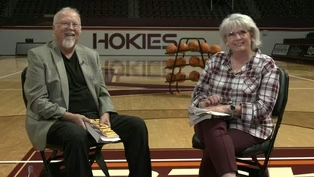
We meet up with Roland Lazenby on the basketball court at Virginia Tech to talk about his latest book, Magic: The Life of Earvin Magic Johnson.
Problems playing video? | Closed Captioning Feedback
Problems playing video? | Closed Captioning Feedback
Write Around the Corner is a local public television program presented by Blue Ridge/Appalachia VA
Write Around the Corner
Write Around the Corner - Roland Lazenby
Season 7 Episode 2 | 28m 2sVideo has Closed Captions
We meet up with Roland Lazenby on the basketball court at Virginia Tech to talk about his latest book, Magic: The Life of Earvin Magic Johnson.
Problems playing video? | Closed Captioning Feedback
How to Watch Write Around the Corner
Write Around the Corner is available to stream on pbs.org and the free PBS App, available on iPhone, Apple TV, Android TV, Android smartphones, Amazon Fire TV, Amazon Fire Tablet, Roku, Samsung Smart TV, and Vizio.
Providing Support for PBS.org
Learn Moreabout PBS online sponsorship[Announcer] This program is brought to you by the generous support of The Secular Society, advancing the interests of women in the arts in Virginia and beyond.
[♪♪♪] -♪ Every day every day Every day ♪ ♪ Every day I write the book ♪ [♪♪♪] -Welcome, I'm Rose Martin, and we are Write Around The Corner in the amazing Cassell Coliseum at Virginia Tech.
And our author today is Roland Lazenby.
He takes a deep dive into the life of Earvin “Magic” Johnson.
He's a tall boy with a charismatic smile, who dared to dribble.
Hi, Roland.
Welcome to Write Around The Corner .
-Hi, Rose.
Thanks for having me on the show.
-Well, I'm especially excited to be here at Cassell Coliseum in Virginia Tech because as a Hokie myself, and you actually were a Hokie too.
-Yes, I taught here for 11 years.
I've taught Media Writing.
-Well, we're proud to be Hokies, and we're proud to be here in this basketball arena.
Has basketball always been something for you?
I know you told me your dad played basketball early on back in the ‘30s.
Were you a player too?
-You know, I played a little bit.
I-- I was fortunate enough to play a year of college football at Virginia Military Institute.
I wasn't much, but it was my Super Bowl, as I like to tell my grandsons.
And I really began writing because of my father.
I always played pickup basketball and loved it.
But when he died in 1981, I really began playing, and suddenly, I was in the writing program at Hollins, and I was making a list of books I might do.
And number seven on the list was about basketball, and that changed my life.
And suddenly, here I am, all these years later, haven't written a lot of sports books, but a lot of basketball books.
-So, basketball, the influence came from your dad?
-It did.
A very powerful thing that, and this was probably when I wrote Michael Jordan: The Life .
-Mm-hm.
-His relationship with his father was very unusual, but it drove so much of the passion in his life.
And when I was writing, it was a 700-page book I wrote on Michael Jordan that came out from Little, Brown in 2014.
When I was writing that, I was opening all of this revelation in my own life.
Now, I was aware of some of it, but I really wasn't aware of the full power or the imprinting that a parent-child relationship can have.
-What's the special takeaway from that revelation of your relationship with your dad?
-Well, in that case, you know, in Michael's case, it was fatherly disapproval.
I mean, his father loved him dearly, but did not approve.
-What about in Roland's case?
-Same thing.
And I realized that I also enjoy writing about women.
I enjoy writing about the mothers and grandmothers and family members of great competitors, because it's fascinating to me.
-Was it always a sports environment growing up when you were a little boy, going to sporting events and learning about sporting events?
-Yes, I had an older brother, ten years older than I was.
I still have him.
His name's Hampton, and he was quite the guy in sports.
And my father had been quite the guy.
So, that was a family value established pretty deeply in our lives.
-But it still included your mom.
-Yes, she was... -Was she the writer, or the reader?
What was the impact that she had?
-She read lots.
She read lots of things, and had fanciful ideas about things.
She had great imagination, and she was an artist.
She enjoyed painting, and those kinds of things.
-You know, it's interesting, I was reading that you coined the term “Coaching Tree”?
That came from you?
-Well, that's sort of, that's-- No, I don't think...
I coined the idea... and this is so far off in the weeds about basketball.
They would say that if you had an assistant coach and you were a head coach, let's say you're Knute Rockne at Notre Dame, and you had an assistant coach, who, as often is the case, the assistant coach gets a head coaching job and goes on and does well, then that person is in your coaching tree.
Well, I spent years in and around sports teams, covered all of them.
And I said, it's not just the assistant coaches.
So many of the players really pick up from great coaches, everything they're-- they're going to learn about the game.
And we see that today with a guy like Steve Kerr, who's a great coach for the Warriors at Golden State.
And he played for Phil Jackson, where I really got to know Steve well, and then he played for Gregg Popovich in San Antonio.
And so I said, Steve Kerr was a part of their coaching tree.
And, you know, I'm an, I'm sort of an old hillbilly from Wytheville.
And I've never been a power player in writing about the NBA.
I've had my media credential.
And sometimes, the chosen ones, the reporters and writers, they don't appreciate a guy there doing a book and doing interviews.
It's just a very territorial business.
-Did you have a hard time breaking into that?
Let's say, because I know you did a book on Kobe, you did a book on Michael, and the book today on Magic Johnson.
Did you have trouble getting inside that world and getting the interviews?
-No, I'm from Wytheville, and I went to VMI.
Wytheville, as the great writer, William Gibson, who is from Wytheville, as William Gibson told me when I interviewed him back in the ‘90s, he said, “Wytheville is a hard little corner of the planet,” and it was.
I'm very, very proud and happy to have grown up there.
You were challenged at every turn in life.
And it, it was a tremendous thing for me.
And I had an older brother, who was very challenging.
And of course, then I went to Virginia Military Institute, where-- and I'm watching my grandson, 53 years later, go through it right now as a rat.
It's a very challenging physical, mental, emotional environment.
-So, you had all these years to prepare and almost condition yourself to get into this world.
But basketball wasn't the same then as it is now.
So, you know, this was a big book.
I'm curious as to how you kept all the interviews straight, how you kept all the details straight.
What's that process for you like, when you're just starting on-- starting a book, or it's a journey over several years, to make sure you've got your timelines and your facts and your people and who said what straight?
-Like I told my friend Beth Macy, being a writer, and she already knew this.
She is so brilliant, anyone who read a newspaper in Roanoke could see it.
And I had her to my journalism classes when I was teaching because of it.
It's sort of like being an air traffic controller.
You have so many things just zipping around in your head.
And Beth, of course, would have post-it notes and things around her writing environment.
It's quite a challenge.
But I would be remiss if I didn't mention my wife, Karen.
We've been married 48 years.
She-- from the very earliest days, she's a computer whiz, can figure out anything, loves to keep track of things, but she's not afraid of a lot of the drudgery of this too.
-Is she your first reader or to tell you, “Okay, you need to leave this out.” Or, you know, “I think you ought to go in a different direction, or you're getting way too wordy on this.” -She's my first listener.
-[Rose] Okay.
-So many of my books involve lots and lots of interviews, and she will transcribe interviews.
She doesn't transcribe all of them.
-Mm-hm.
-But she has transcribed a lot of them.
In the early days, I did them all, and I still do a lot of them, but, and I'll hire outside transcriptionists.
Today, in the age of technology, you get the rough draft depending on what you use.
It's just hard to describe.
She is such a force of nature.
And-- -You're lucky.
You're lucky to have her.
I hope you appreciate that.
-Oh, lucky doesn't cover that.
-Oh.
You mentioned Beth earlier.
We love Beth, and have had a chance to have her on the show a couple of times.
-Right.
-And a remarkable talent.
-She's amazing.
-So it's great that we gave her a shout-out.
So, when you have your process, I understand, I heard something from a mutual friend of ours that said, “You know what, you've got to ask him about going in the tube.” Going in the tube for research.
-Well, that's-- that's what I told Beth.
-[Rose] Yeah?
-And it's not just the research.
You live encased in this world when you're doing a major project, and Beth would joke and message me, “I'm in the tube.” And that really is like the air traffic controller thing.
You are so wrapped up so tight and trying to balance and counterbalance.
Writing, I got my master's in that wonderful writing program at Hollins.
-It is a wonderful program, and I hear so many amazing things from writers who had a chance to participate in it like you did.
-It is, and I learned that writing, in so many ways, is about voice, your writing voice.
And when you're a journalist, incorporating those voices from the interviews, and that's a big thing.
But the other thing is, the tube is the synthesis of all the things, especially when you're doing-- a biography is a lot of perspectives.
It's so many people when they interview me, they start asking, “Well, this is Magic's book, how much time did he spend talking to you?” A lot of major figures, I've interviewed them a lot.
But when I start doing the biography, they go, “Oh, no.” -Sure.
That's not really something that they want to jump into.
What about deadlines?
Do you set your own internal deadlines and external deadlines?
So, for example, when you had mentioned Magic and this book, and getting all the interviews done, how do you keep yourself organized in that respect?
-It is a major challenge, and part of it is, you're in the tube.
And that's a wonderful thing.
But, as you get older, I have a saying now that I'm, I just turned 71, and I'll talk to people and I'll say, I've been a ghost in my own life in-- and I'm not a guy given to a lot of regret.
I sort of live my life and do what I do, and I'm sort of Popeye.
I am what I am.
But, as you age, you look at lost moments and things that you can't have back, whether it's family vacations, or my son had a baseball game for the city championship, and I was supposed to get a call from Michael Jordan.
And, what do you do?
And so I said, I have to take this call.
Of course, Jordan didn't call.
And I missed my son-- and my son had a fun day playing.
They won the city.
It was just a rec league game.
-Sure.
-But it's just like me saying I was a deep sub on the football team at VMI.
That was my Super Bowl.
-[Rose] Yeah.
-So, whatever your sports moment is, that's your Super Bowl.
-And as a dad, your heart had to kind of hurt, right?
Because you're-- you didn't-- you missed that game while you were waiting for a really important call, and that didn't happen.
So then, you think about your choices when you're writing, and a commitment to writing a biography that's, you know, almost 800 pages, and then your sources and your material.
Do you ever look back at former interviews for a different book, that they may have said something that didn't apply to that book, but then you were able to use it like for Magic's book?
Your interviews from years ago?
-All the time.
In fact, during the pandemic, and this goes back to my wife, Karen.
During the pandemic, when I was working so hard on this, I had like, I don't know, 300 cassette tapes from the ‘80s and ‘90s.
And a producer in Los Angeles had optioned those, because those are valuable interviews for all kinds of documentaries, and I've done them for everything.
But a lot of them, back in those days, I was writing a lot of text for picture books.
And I was getting these wonderful in-depth interviews.
But I was working so hard and moving so fast.
And you can't really search a cassette tape efficiently that I've ever found.
I had all of these interviews I'd done, especially in 1990 and '91 with the Lakers and all the key people.
All these interviews, a really precious interview of Magic Johnson that I'd never heard.
All kinds of my interviews from the ‘90s.
My wife went in.
It was quite a process to digitize all of those tapes.
-Wow.
-And then, we had a searchable database.
I found so many because I was just this guy trudging around the NBA, often driving around in my 1984 Chevette Diesel.
I had my media credential that allowed me access to the locker rooms, access to the games, whether it was the NBA Finals, the championship series, or a regular season game.
So I was there, I could talk to everybody, but I was not some bigwig.
-And now you have this treasure trove of, you know, history, documented history that, you know, I'm sure will be just not only a treasure for you, but a treasure for generations to come as people come and go out of the sport, and out of our lives, that so many people have made an impact on.
-One of the things that has always been special is listening to the interviews I do, and I do lots and lots and lots.
I'm the world's greatest interviewer, and I'm the world's worst interviewer.
And I would always tell my students that because a lot of teaching writing is teaching interviewing, particularly for nonfiction.
But I would interrupt people, I would get excited.
And I had to remember, keep my mouth shut.
But what I have to say is, listening to those interviews is powerful.
Listening to those long-lost recorded interviews for this book, that was really emotional.
-I bet it was.
I bet the-- going back to a time capsule of, you know, thinking about how you want to frame it, because when I read Magic , and I'm looking at the life of this young guy who had to deal with racism, and had to deal with discrimination at a young age, and yet had a great love and a charismatic personality, and bright eyes and a big smile and loved to dribble.
So, when you think about starting a massive biography, you had a careful opportunity to blend the history of everything that happened to him through starting out in being bussing and going to school.
-You know, we're in Blacksburg, and while Magic was in high school in Lansing, Michigan, and much of this evolves around the things that happened to Magic and his family during bussing.
And it was very different in the North than it was in the South.
-Just a second.
Why don't we tell the viewers a little bit about his family as we go into it?
Because I think that makes an important framework for what he was dealing with, with his mom and his dad and his brother.
-Right.
His mom and his dad were married and had seven children.
And Magic was the youngest boy.
Now, his father had three other children by a previous relationship.
But they ended up in Lansing, Michigan, because of the job he found in the auto industry.
And so, the family was there when this bussing came along, in-- starting in 1972, and the family was in an integrated part of the city where the schools were-- were balanced and integrated.
But they had literally an all-white high school where suddenly Magic and his siblings, particularly his older siblings, were bussed to this all-white high school.
And there was rock throwing and trouble that really went on for the next four years.
It had a big impact on Magic's siblings.
It set up some decisions in his life.
And right at that time, we're in Blacksburg.
I was a 24-year-old Varsity Head Coach at Blacksburg High School right here.
The year before that, I had been an Assistant Football Coach at Peabody Junior High School in Petersburg, a school that was largely Black.
And that had been-- and I was in a program that was set up for kids coming out of Corrections back into the-- into junior high school.
It was-- it was an incredible and powerful experience.
-And you know what, I think that experience, for you, helped you frame Magic's life and what was he-- what was it like for him going to school and what was it like for him, you know, in picking Michigan State and going to college.
So, let's-- let's fast forward a little bit to get-- to get to Magic Johnson, his early life, he was always a leader.
And he was showing charisma, he gets to Michigan State, you know, there, didn't win a lot of championships going through that.
So we, you know, we want to take a very brief look at that history from Michigan State, then the coin toss, you know?
The coin toss, was it a coin toss to, I don't know, is he going to be in the Lakers or is he going to be a Bull?
And we just see a life of Magic unfold along with how we got that famous name.
-You know, it's, it was amazing.
My teaching and coaching in-- in the public schools, I met so many amazing adolescents in that mid-‘70s period.
But I have to say that the Magic Johnson I met through the eyes of his coaches and teammates, and the whole story of that age, and it hadn't been told before.
He was literally one of the most-- one of the very, most impressive adolescents I'd ever encountered.
As a writer, years later, looking back, and that really reflected a lot for me in that time.
And then, his story took off.
He ended up obviously at Michigan State, and then they-- they win a national championship.
And he, he's in his hometown and it's like a betrayal.
But he, he has to turn pro, the time is there.
-You know, what's interesting to me is that, okay, tucked into this book.
Like I didn't realize that charisma of the talent that he could pass behind his back without looking, and people were coming just to watch some of that happening.
I didn't realize that basket players weren't always tall, you know, and that that all-- that all happened later on.
So, I think he, in a way, defined basketball in another way that we see it today.
But, you know, it was basketball, it was being a businessman, it was having so many things in his life that brought him, that brought him to the superstar that we know today.
-And what I really wanted to do in all this is, is get the emotional shards.
It's-- I always felt it was almost like I was doing archaeology.
-Yeah.
-And I'd uncovered, and I was looking for all of the integration moment.
And really, this story, the, the granular story, because basketball in many ways, is a huge cultural story for this country.
And I wanted to look at how we-- and I was able to trace Magic's family back to the 1830s in North Carolina.
-I love that part of the book early on when you give us the history of not only his family and slavery, but you also, I mean, his relatives who were enslaved, but also the history of basketball and what happened during some of the different matches and the points and, you know, the rivalry between he and Larry Bird and all of that.
But there's a, there's a word in-- throughout the book that you use very often, it's called “Showtime.” What does that mean?
-Well, that is what he created with the style that he played in.
We have-- we've had Showtime players before.
And their array of them, I mentioned in the book, Marques Haynes, Bob Cousy, all kinds of players.
But Magic at 6 ft 9 in, almost 6 ft 9 in, he was incredible.
He could look one way, throw the other.
He ignited basketball in Michigan.
-Will you ignite everybody's interest in Magic Johnson by reading a portion of this fabulous book for us?
-I will.
I will.
-[Rose] What are you going to choose?
-[Ronald] Thank you.
I'm going to choose a part of the prologue that deals with his mother Christine when he first got the nickname.
“He was just fifteen “when the nickname appeared in the local paper.
“It was the kind of thing “that set off alarms with Christine, “his deeply religious mother.
“'Magic?'
A name like that left her cold.
“It was blasphemous and immediately unsettled the world “that she and her husband, Earvin Sr. had worked so hard “to establish for their seven children.
“A name like that opened the window to the thought “that things might not be just in God's hands, “but in the devil's too.
“The nickname presented its own collection of problems; “one that, as she feared, would stretch to forever.
“In her spiritual journey, she had read the Bible often.
“'Magic' was not a word that held power there.
“Her world was about faith, love, and forgiveness, “things that everyday people could have and hold “and bring into their lives “to help them endure the things that couldn't be endured.
“‘Magic?'
She worried that the name “would put bad ideas into my head,' “Johnson would say, bad ideas.
“Somehow it all eventually led to the notion “that he could have unprotected sex “with literally any and all that he met.
“And the record would show that he met many.
“The mere nickname let his mother to glimpse “all the wonder and heartache that lay ahead.
“She shuddered at the thought of it.
“Sure, he loved basketball, “loved every second, minute, hour of his life, “which had been such a good thing, “a blessing that he had it.
“But now this?
“‘Magic,' a name like that set her to praying.
“As for her son, a name like that “was another sort of flashing neon sign.
“His reward, as a mere teen, “for turning a dead empty, soulless gym “into ground zero for celebration.
“Not surprisingly, the crowd picked up the sobriquet “almost immediately.
“It rolled from the news pages, right under their tongues.
“‘Magic!'
“It became a chant that would ring through the decades in arenas all over the world.” -Roland, there's so much more to talk about with Magic.
We know how much he loved women and the fact of the HIV that, you know, he's become not only through his foundation, but was the first athlete to really have to deal with that.
Would you stick around and we can talk a little bit more about Magic?
-Of course.
Thank you, Rose.
-My special thanks to Roland Lazenby, and to the folks here at Virginia Tech to let us visit Cassell Coliseum and sit right here on the floor.
And especially to Bob, who's the facilities guy here at Cassell Coliseum.
You know, there's so much more to learn about Magic.
There's so much more to talk about.
Please join our extended conversation online where we're going to hit all of those topics with Roland.
Tell all of your friends about us.
I'm Rose Martin, and I will see you next time Write Around The Corner .
[♪♪♪] -♪ Every day every day Every day ♪ ♪ Every day I write the book ♪ [♪♪♪] -♪ Every day every day Every day ♪ ♪ Every day I write the book ♪ -♪ Every day every day Every day ♪ ♪ Every day I write the book ♪ [Announcer] This program is brought to you by the generous support of The Secular Society, advancing the interests of women in the arts in Virginia and beyond.
A Continued Conversation with Roland Lazenby
Clip: S7 Ep2 | 23m 24s | Roland and Rose talk more in depth about Magic Johnson. (23m 24s)
Providing Support for PBS.org
Learn Moreabout PBS online sponsorship













Support for PBS provided by:
Write Around the Corner is a local public television program presented by Blue Ridge/Appalachia VA