Write Around the Corner
Write Around the Corner-Sadeqa Johnson
Season 5 Episode 1 | 28m 55sVideo has Closed Captions
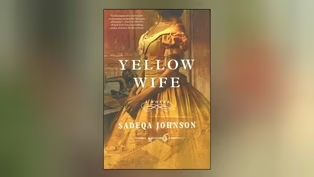
We talk with international best-selling author Sadeqa Johnson about Yellow Wife.
For our season 5 premiere we travel to Richmond to talk with international best-selling author Sadeqa Johnson. Her book, Yellow Wife, was one of O Magazine’s most anticipated historical fiction books for 2021.
Problems playing video? | Closed Captioning Feedback
Problems playing video? | Closed Captioning Feedback
Write Around the Corner is a local public television program presented by Blue Ridge/Appalachia VA
Write Around the Corner
Write Around the Corner-Sadeqa Johnson
Season 5 Episode 1 | 28m 55sVideo has Closed Captions
For our season 5 premiere we travel to Richmond to talk with international best-selling author Sadeqa Johnson. Her book, Yellow Wife, was one of O Magazine’s most anticipated historical fiction books for 2021.
Problems playing video? | Closed Captioning Feedback
How to Watch Write Around the Corner
Write Around the Corner is available to stream on pbs.org and the free PBS App, available on iPhone, Apple TV, Android TV, Android smartphones, Amazon Fire TV, Amazon Fire Tablet, Roku, Samsung Smart TV, and Vizio.
Providing Support for PBS.org
Learn Moreabout PBS online sponsorship[♪♪♪] ♪ Every day every day every day Every day every day ♪ ♪ Every day I write the book ♪ [♪♪♪] -Welcome.
I'm Rose Martin, and we are Write Around the Corner just outside of Richmond, Virginia, with Sadeqa Johnson.
She is an internationally best-selling author, the recipient of the National Book Club Award, the Phyllis Wheatley Award, USA Best Book Award for Fiction, and one of O Magazine's Most Anticipated Historical Fiction Books for 2021.
Wow.
Her latest novel Yellow Wife is a work of historical fiction, and this was actually inspired by a real-life story.
It's a page-turner full of he artache, sacrifice, and love.
The opening quote from William Wilberforce is very, very appropriate, I think: "You may choose to look the other way, but you can never again say that you didn't know."
Let's welcome her.
Sadeqa, welcome to Write Around the Corner .
-Oh, my goodness.
It's such an honor and pleasure to be here with you today.
-Well, this is such a fabulous book.
Before we get to Yellow Wife , let's wind back to Sadeqa, her personal life, being in school a voracious reader, right?
-Yes, yes.
-[Rose] Yes, and libraries were one of your favorite places.
-Oh my gosh, I lived for the library as a kid.
Literally, I dressed up every Monday, and I had a special purse for my library card-- -[Rose] Oh!
-and I walked to the library.
I checked out seven books, and I read a book a day, and I went back the next week and did the same exact thing.
-I love that.
How long did that last?
-That was probably through middle school.
Yes, when I got to high school, my dad was then buying books for me.
So, I got an upgrade.
I was able to have my own library.
But in middle school is when I was mostly at the library.
-Public libraries, aren't they the best?
-Oh, they are.
They are.
-They open up worlds to everybody that we can go anywhere we want, right-- -That's right, yeah.
[Rose] --in through the pages of a book.
Were your parents readers?
-They were, and I remember we had a library at home.
It had a lot of their textbooks from college.
My mom was a romance reader.
My dad was a little bit more serious with his reading.
But they definitely introduced me to books and helped to foster my love for reading.
-So, how have you carried that through with your own children?
There's three, right?
-There's three of them.
And so, when they were very, very little, it was much easier because I had control of their schedule.
And so, I sat them down every night, and we read two or three books before they went to bed.
As they got older, it's been a little bit trickier.
There's so many things distracting these kids between their phones and television and social media.
And so, it's been a little bit more difficult, but I insist every summer that they at least read three books over the summer.
-Oh, you do?
-[Sadeqa] I do.
-Okay, so now, though, they've got Mom the author.
Are you a celebrity at home, or are you like, "Mom, I need something.
You're not really a celebrity here."
-I'm totally "Mom, what can you do for me?
Mom, what have you done for me lately?"
That's the mother I am.
-"Mom, too much time with the books."
-Yes, exactly.
Actually, my middle daughter told me the other day-- I missed something, because I never do-- and she says, "Oh my gosh, Mom.
You're starting to get a little bit famous.
You're missing events now."
-[Rose] Ooo!
So she kind of tossed it back to you, huh?
-She did.
-Oh, I think that's-- that's sweet though, right?
-Yes.
-So, your background is in publishing, right?
And being a publicist and working in that world, I know you've probably answered a hundred times how that's really helped you, but my question is, you know, the chances that you had to meet a lot of really wonderful people and work with them, I'm sure you had some influences.
And I've already know them, but let's share with the viewers, so you can tell them a little bit about the history of who you had a chance to work with.
-Well, I started off in publishing right out of college.
And let me just backtrack and say, I didn't even think I was going to graduate from college.
-[Rose] Oh, really?
-That was not the goal.
The goal was to move to New York City and to be an actress.
That was really what I wanted.
I thought I was going to be in school for about two or three weeks, I would be discovered, I would be on Broadway, and then that would be it.
But I actually graduated and realized that my dad was not going to keep putting money in my bank account, and that I needed a j-o-b.
So, I said what is it that, you know, what would make me excited?
What would get me up every morning?
And because I love books, I started looking for a job in publishing.
-Now, were you going to interviews-- I mean, going to auditions?
-[Sadeqa] I was still auditioning, yes.
-[indistinct] Yes, that spark was still there.
-And what I decided was that I was going to schedule all of my auditions during my lunch break so that I could still have the best of both worlds, but I could pay for that New York City apartment.
So, my first job was as a publicist, or as an assistant publicist, at Scholastic Books.
So, I had the pleasure of working-- -I love kids' books.
-[Sadeqa] Yes.
And I worked with JK Rowling's, the Harry Potter books-- -[Rose] Wow.
-which was a phenomenal experience.
-And you're just brand new out of college?
[Sadeqa] Brand new out of college.
And she was brand new, so when I got to work with her, nobody knew who she was either, which was great.
I worked with Walter Dean Myers, I worked with Ruby Bridges, Dave Pilkey, and it was just a wonderful experience for a young girl out of college.
And then I transitioned over to adult books, and there I was working with the heavy hitters at GP Putnam's Sons.
So, it was Nevada Barr and Catherine Coulter and Bishop T.D.
Jakes, and I just-- Amy Tan.
People who I loved to read was actually right in front of me, I was talking to them on the phone, and it was like sometimes I would have to pinch myself, like, "This is the best job in the world."
-Yeah.
Were you picking their brains when they were on the phone, getting a little personal advice along the way?
-So, back then-- I was very fortunate that this was pre-COVID, so we used to ride in the car with them to the Today Show and Good Morning America , and I would have this one-on-one time with these New York Times bestselling authors.
So I would ask them questions-- "What's your writing schedule like?
How'd you get an agent?
How'd you get started?
How do you plot your novel?"
And I was sucking up all of this information because I knew that when it was my turn to be the author, I wanted to know what I needed to do.
-Did you realize then, "Someday it's going to be my turn"?
-I did.
I did when I got into publishing.
I was thinking like, "Okay, I'm here to learn, I'm here to soak this up, because eventually I'm going to be on the other side of the table."
-That's wonderful.
I love the story about you closing your office door at four o'clock.
-Yes.
So, I did not have a computer.
So, what I would do was was that I would write on the train on the way into New York City-- I lived in New Jersey at the time-- so I would handwrite the story.
And then when I got to work, I would do what I needed to do, and then at four o'clock, I would close my door, pretend like I was working on something really personal, like really important, and I would key in the story.
I would run to the printer, grab it off because it was those shared printers, you know, that we used to have back in the days, and I would take it on the train, and I would edit on my way home.
And so that was my writing schedule.
And then every Saturday when my husband was in college, I would write from 9:00 to 2:00 or 9:00 to 12:00, depending on how long he was gone from the house.
-Now is that where it started for you to go back, printing things and then retyping for your edits-- which amazed me-- -I know.
-that you were printing them.
And is it true?
Is it true?
-It is absolutely true.
And actually, one of my first writing teachers-- his name is Jackson Taylor, this was a tip that he gave us-- every time we had a writing assignment, and it would only be a two-page assignment, he would say, "Every single draft, print it, take a look at it, make your edits on the page, and then retype it."
Because when you retype it, you're revisualizing the story.
It's going back through your body.
You don't want to put in things that you don't feel like it because you were kind of lazy.
So, we self-edit as we're retyping it.
And that's still a practice that I do.
I retype the first few drafts of every novel.
Once it gets to my agent, then I stop, but when I'm just working with it by myself, I stop, I print it, I look at it, and I go back and I retype the whole thing again.
-You know, it's obvious after hearing that because the book is so tight.
There's no extraneous words.
Like, you did in under 300 pages, which could very easily have gone into more, right-- longer, drawn-out descriptions that-- they were succinct, and it was tight, and it kept me going.
This was a one reads-- one sit-down, one read, same thing with Carol, like the co-producer.
-Wow!
-We both did it in one sitting and we compared notes and I'm like, "Yes, I did the same thing."
So, that's really a testament to you and your skill and how tightly the story is told, so that I didn't want to stop.
I just kept it going.
-Oh, that's awesome.
Because, you know, you spent one day with the book, and I spent two and a half years writing it.
So that always makes me feel good, but also, it's kind of unfair.
-Yes.
So that effort was great.
Like I did it on a Sunday afternoon on my patio, which was wonderful.
-Wow.
-So, you're in New Jersey.
I think this part of the story is kind of fun, too.
You just got that inner knowing, some inner voice saying, "It's time to pick up roots."
-Yes, we were-- my husband and I were already planning to move.
We were standing-- I was standing in my-- we were living in Springfield, New Jersey, at the time.
And I was standing in my kitchen, and I heard this voice that said, "Move."
And because we were already moving, it felt like move, move-- move out of the state.
And when I tell you everything just happened so quickly.
This was February of 2015.
By March 2015, we had picked out our house.
By June, we were moved into this very house, this very porch that we are sitting in, and it was like, "I don't know why we are here, but there's something that is pulling us here."
And then nine months later, I was on the Richmond Slave Trail, and that was when I discovered Yellow Wife .
And it all just kind of came together at that point, like, "Okay, I was supposed-- there was a calling."
There was a calling on my life higher than anything that I could know or understand, and just by saying yes to it, I was able to tap into that energy.
-That's wonderful.
Did your husband think you were crazy along the way?
Like, "I don't know what you're feeling called for, but I'm in it with you, because it's something strong."
-Yes.
You know, we are risk-takers.
He's an entrepreneur, so he's taken a lot of risk in starting different businesses, and so, when I said, "I think it's time to go," he was like, "All right, I'm just going to trust you on this one."
-But Yellow Wife was a risk too, because you didn't start out in historical fiction.
-Not at all.
And actually, it wasn't anything that I had planned.
I was happy writing contemporary fiction.
My first three novels were based on things that I knew about.
You know, my first book, Love in a Carry-On Bag , long-distance love story.
My husband and I, we started off long distance.
My second book was a book about a woman who was drowned in her skin with these three small kids-- ding, ding, ding.
-Yes, three small kids.
-[Sadeqa] That was me.
And the third book was something that I had overheard.
So, there was experiences that I could base for myself into these books.
So, when Yellow Wife came, it was like, "How am I meant to do this?
How am I meant to write a story that took place over a hundred years before I was even born?"
I was petrified.
-Well, and I'll get to that message that you got about doing that from your interior designer in a minute.
But let's back up, because now you're here in Richmond.
You know you're here for a reason, but it hasn't unfolded yet.
And you're ready to go out on an adventure because you love adventures, and love to explore a new town.
-That's right.
-So, take me to the day you're like, you have friends in town, let's go explore.
-All right.
So I had some friends from New Jersey come down, and they brought their kids.
And we were literally just looking for an activity that we could do with them and their kids.
And so, someone suggested we take a walk on the Richmond Slave Trail.
And the Richmond Slave Trail was founded in 2011.
There are 17 markers along the trail, and it talks about what it was like for the enslaved people as they came into Richmond, Richmond being number two in the slave trading industry behind New Orleans, which was number one, so there's a lot of history here.
So, we're walking on the Slave Trail, and I mean, really, it's like a field trip.
It's a historical field trip for the kids.
They're taking turns, they're reading the markers, we're correcting their English.
-[Rose] You're having a good day as a parent.
-We're having a good time.
I'm feeling good about myself.
And then we get to the marker that starts talking about the Lumpkin's Jail.
And it was described as a punishing center and holding site for enslaved people.
In fact, between 1844 and 1865, over 200,000 enslaved people pass through that particular jail.
And-- -You know, those words don't seem quite strong enough-- punishing center and holding cell.
Really a lot worse, it was a lot worse than that.
-Yes.
It was very horrific.
And something said, "Sadeqa, pay attention" as the kids were reading that, because then it said he was married to a Black woman.
And while he was one way, he was called the Bully.
He was called the Devil.
This was the Devil's Half-Acre.
While he was one way in that world, with them, he was kind and considerate.
And I kept thinking, what was life like for Mary Lumpkin?
Because we know as an enslaved Black woman, she had no agency over her life.
So, I kept thinking, like, was this a marriage of survival for her?
Did she love him?
What was that day-to-day, what was her day-to-day world like?
And then she has these five children.
And just to paint the picture, we're on three-quarters of an acre right now.
So, a half-acre is not-- -Let's get a visual of that.
-Yes.
-Right.
-A half-acre is not a lot of space for there to be a jail, where fellow enslaved people are being punished and separated from their families.
-And tortured.
-And tortured.
And there was the tavern where he conducted business, there was the home in which she raised their children, and then there were the outhouses.
So, every day, these children are being exposed to these contradictions.
What was she telling them?
And those were the questions that were swirling in my head as we continued along the trail.
-And those questions maybe weren't yours, right?
-[Sadeqa] Yeah.
-Because you were there for a reason.
The questions as they kept going, so then what happened?
You're on the trail, and?
-So, we're on the trail and these kids said they were tired, they were ready to go home.
And I'm like, "No!"
-"We're not done with all 17."
-"We're not done!
We're not done!"
So, I made a deal with them.
I said, "Listen, we don't have to walk the trail, but I need to see the site of the Lumpkin's Jail."
So, we got back in the car, we drove to the site, and right now, it's a parking lot.
And I remember just standing there and just trying to feel this energy.
Right next to the Lumpkin's Jail, there is the sacred African Burial Ground.
And during that time, when the enslaved people died, there was no ceremony for them.
They simply waited for the bodies to pile up and then they shoved them in the ground.
And so, as we're walking this particular land, the energy is palpable.
My friend says, "Don't you guys feel that?"
He's like, "I feel something."
And so, he started to pretend like he was playing the African drums.
And then, the kids, they started stretching their bodies and they're dancing, and I'm like, "It feels like a celebration, it feels like a coming home."
Then I thought, "It feels like the ancestors were waiting for us."
Then I had another thought-- "No, I think the ancestors were waiting for me."
-That gives me goosebumps.
-"They want me to tell their story."
[Rose] Yes, that gives me goosebumps.
-And that was not what I had set out to do.
-The realization when it hits you, you're like, "No, I'm just on a little visit.
I'm teaching the kids about something.
We're going to see the markers.
I write contemporary fiction."
-That's right.
-[Rose] "I don't do this kind of work.
So, thank you for bringing me to Richmond.
It's been nice meeting you."
But it wouldn't let you go.
-Yes, it wouldn't.
It felt like it got in the car with me and followed me home, because I became obsessed.
I was literally in my kitchen just Googling everything I could find out about Mary Lumpkin and Robert Lumpkin, and the Lumpkin's Jail.
It just wouldn't leave me alone.
-So it was time to write it.
And your interior design friend, what [indistinct] advice did she give you?
-Yes, so I was outlining it and I was looking at it and I was thinking about it, and I could see this story turning into fiction.
But I was afraid.
And I had a friend, she's an interior decorator, she came over to the house and she said, "What are you working on?"
And so, I'm telling her about the story and how I feel.
And she says, "Sadeqa."
I said, "But I'm so scared."
She said, "Sadeqa, the thing that scares you most is what you're supposed to be doing next."
-That's powerful.
-It was, because it opened the door for me to say, "The very least I can do is give it a try."
-Figure-- you were drawn to Richmond, you were drawn to the [indistinct], the least you can do is do your part now, right?
Everybody's working really hard.
So, your part in the process-- I understand you, when you talked about the fact that you retype your drafts and you outline them, I was fascinated that you go over with your agent with ideas and kind of tell the whole story out first.
-That's the only way I can do it at this point, because I need to speak it out to make sure that it makes sense.
So, what we do is we book kind of a session where we talk for about an hour, and I literally just vomit everything in my head to her.
And then she's like, "Uh-huh, uh-huh, uh-huh."
-This had to be a surprise to her because she's used to, you know, Sadeqa, contemporary fiction.
And you come with this story of the Lumpkin Jail and the enslaved people and Mary, and you want to tell her story.
So, let's dive into Yellow Wife.
So, you sit down, and you're going to tell the story.
True or false-- you actually used names of people who were in the ledgers and of ancestry for the book?
-That is absolutely true.
And actually, in fact, the name Pheby, I went to go visit the Shirley Plantation right here in Virginia and Charles City.
And I was standing in the kitchen house, and they had a ledger on the wall that listed the names of the enslaved people who had worked the land, along with their purchase price, sometimes their ages, sometimes if they had family connected to them, if the woman had had a child.
And I looked up and, you know, characters will tell you when you don't have the correct name for them.
And so, I was fooling around with a name for her, and it just wasn't sticking.
And I looked up on the wall and I saw the name Pheby spelled with a "Y," and I thought, "That's it.
That's it."
-Bingo.
-It just, everything in my body said that was her name.
Other names came off of different slave ledgers that I found online.
In addition to, I had a cousin who had done our family tree.
And so, I dug back into the 1700 and the 1800s, and I took some names off of that tree.
-Let's dig into the characters-- strong women, every single female character that you have in here, from Pheby to Mama Ruth as a medicine woman to even, you know, Miss Delphina, who I don't like, but she's still a strong woman, right?
-Yes.
-So, there are so many.
Is that something that you found in the research, that these women just had to survive, so naturally their instinctual presence was to be a strong woman, or is that something you created for the women?
-I would say my instincts as a writer is always to write about women.
I think one of the themes that goes through my story is that there's always going to be a woman who has to overcome an insurmountable challenge-- what it's like for her as she's going through it and what it's like when she reaches the other side.
So, that's kind of a thread through my story, but with Yellow Wife , history made it easy.
You know, the story was inspired by Mary Lumpkin, and I saw from what I could research that she was a strong woman, and that she had to overcome a lot.
Now, I weaved fact and fiction together to create Yellow Wife , but I did lean in on some of those historical characters that I found in the story.
-So, let's get into the story.
Pheby has been promised that she can be freed at 18.
It's not going to happen.
Who are the other characters that are in the world that are making such an impact?
-Well, I would say Pheby is most influenced by her own mother.
Ruth was the medicine woman.
She was a woman of substance.
She had healing properties, she could sew, she also had the eye of the master of the plantation and his ear, and so she could make different things happen on the plantation.
-Pheby's waiting for that time that she thinks it's all going to be okay, but life doesn't turn out the way she thinks, and life doesn't turn out for a lot of people the way they think.
But she's not dissuaded by that.
And she somehow, even being this enslaved woman and then how this journey takes her, she finds love.
So, you brought in, you know, with this harrowing experience, there's a love story.
-Yes, yes, there's always a love story.
There's always a love story in any form of human interaction.
You could always find a love story.
And for me, it was very important for the readers to see these people as human and that's a human emotion, is love.
I love writing about love, you're going to find it in every single one of my books.
But it was the light in the darkness of the story.
-You know, and that's true-- I love that light in the darkness because as I wasn't able to stop turning the pages, I was horrified at a lot of the events, and what people were subjected to and what was done.
And those scenes, as hard for me to read, I kept through it, you know, and I'm sure with you writing, it was the same thing.
But then you did, you took us in places through her journey that I wasn't expecting to go.
And you took me, you know, emotionally, you took me up and you took me down.
Would you be willing to read for us?
-I would love to read a little bit for you.
Is it okay if I start at the beginning of the book?
-Absolutely.
-All right, that is my favorite.
So, just to set it up, Yellow Wife, as you've mentioned, is the story of Pheby Delores Brown.
She's lived a sheltered life on a plantation, with her father being the master of the plantation and her mother being his favorite enslaved person.
And she's promised freedom on her 17th birthday.
But a series of events take place and instead of what she's been promised, she's thrust into the bowels of slavery where she ends up at the Devil's Half Acre.
So, I'm just going to start right from the beginning.
And I dedicated this book to my children.
-Oh!
-[giggles] Out of all four books, it's the first one that they got.
My husband gets all the books.
-Okay.
-But they got this one.
So, "Part 1, Bell Plantation, Charles City, Virginia, 1850.
"The Bell Plantation.
"Mama believed that the full moon "was the most fertile night of the month, "and that everything she touched held God's power.
"Each full moon, she dragged me out "in the middle of the night with her to hunt for roots, "plants, seedlings, and rare blossoms "to use for healing.
"I did not understand why God's power "could not be found during daylight hours, "and as I trudged behind her, the March cold overwhelmed me.
"Even my thick wool shawl was no match "against the country freeze.
"Fear of the woods made my feet clumsy, "and as I tripped over fallen sticks, "scratched my shins on the spiky brush, "and bumped my head on low-hanging branches.
"Mama, on the other hand, moved with skill and confidence, "like the earth parted a path and presented the way for her.
"Even in the dark, she knew where to stop for herbs "and how to avoid the dangerous ones.
"We had only a small lantern to guide us, "and when I asked how she knew where things grew, "she responded, 'My gut be my light.'
"We slipped through the thicket, past the drafty cabins "where the field hands slept on pallets "stuffed with hay and husk.
"I heard dry coughs and a low whine "from a hungry baby.
"Farther down toward the James River, "we traveled through the clearing "where we met on Sundays for church.
"Then over the hill along the side of the cemetery, "peppered with sticks to honor our dead.
"As we traveled deeper into the woods of the plantation, "the thick forest blocked the light of the moon.
"I could hear the growls and grunts of unseen animals, "and fretted over running into hungry raccoons or red foxes, "or stepping on a poisonous snake.
"I tried to clear the worry from my mind "as the land flattened out, "but then something pricked my ankle.
"Before I could call out, Mama stopped suddenly "and reached for my hand.
"'This here is a black walnut tree.
"Grow deep in the woods, so you gotta know where to look.
"Cure for most everything.
"Ever unsure, come seek this tree.'
"Mama handed me the lantern, "then pulled a blade from her satchel "and severed a piece of bark.
"She brought it to her nose, "then ran her tongue along the inside of it.
"'Husk stain anything it touch.
After we make a tea for Rachel, "rest we use to dye those sheets for the nursery.
"Just hoping we ain't too late to save that girl.'
"Mama reached into her bag and pulled out a red ribbon.
"'Go on and mark it, so it be easy to find when you come without me.'
"I reached up and tied the ribbon on a skinny twig, "knowing I had no intentions of roaming these woods "without my mama.
"We stopped at the sick house on our way back home.
"That morning, Rachel, the house servant, "had been moved from the big house "to the sickroom on account of her high fever.
"Even though Master Jacob's wife, Missus Delphina, "knew Mama worked plants better than anybody, "she refused to bring her up to the house "to tend to Rachel when she got fever with lockjaw.
"Rachel grew up on Missus Delphina's "family's plantation, and came with her "to Master Jacob's as a wedding gift from her mother.
"Since Missus Delphina looked down on Mama's medicine, "she called in a white doctor for Rachel, "which Mama said was a waste of good money.
"'He ain't know nothin' 'bout doctoring no field hands.'
"And Mama was right.
"Now that the white medicine had failed, "Missus Delphina had no choice "but to move Rachel to the sick house.
"When we entered the room, "even I could look at Rachel's pale body "and see death coming for her.
"'You ready the hot water?"
Mama asked the sick nurse, "who nodded her head and pointed to the boiling pot.
"Mama reached into her sack and pulled out "the bark and leaves from the black walnut tree.
"Then she pinched off a sprig of snakeroot "and crushed up the stems.
"'Let it steep for 'bout an hour.
"Then make her sip every time she open her eyes.
"If she make it through the night, there be hope.'
"Mama removed a few balms and poultices "from her medicine satchel for the other patients, "then gently pressed Rachel's forehead "with the palm of her hand and whispered, "'Lawd, look on Rachel with eyes of mercy.
"Restore her to wholeness and strength.
Thy will be done.'
-Oh, Sadeqa.
Sadeqa, that was just beautiful.
Thank you so much.
-Thank you.
Thank you.
-[Rose] Thank you so much.
I'm so pleased that you are here today, and that we had a chance to talk about your book.
-Thank you.
-My special thanks to Sadeqa Johnson for inviting us here to her beautiful home outside of Richmond, Virginia, and for, I know, at least opening my eyes to pieces of history that I thought I knew but I really didn't.
I hope you can stick around for more of our interview with Sadeqa on the book Yellow Wife .
We'll be getting into the title and so much more.
Tell your friends about us.
Check us out online, and of course, I'll see you next time Write Around the Corner .
♪ Every day every day every day Every day every day ♪ ♪ Every day I write the book ♪ [♪♪♪] ♪ Every day every day every day Every day every day ♪ ♪ Every day I write the book ♪ ♪ Every day every day every day Every day every day ♪ ♪ Every day I write the book ♪
A Continued Conversation with Sadeqa Johnson
Clip: S5 Ep1 | 14m 55s | Learn more about the characters and time period of Yellow Wife. (14m 55s)
Providing Support for PBS.org
Learn Moreabout PBS online sponsorship













Support for PBS provided by:
Write Around the Corner is a local public television program presented by Blue Ridge/Appalachia VA