Traverse Talks with Sueann Ramella
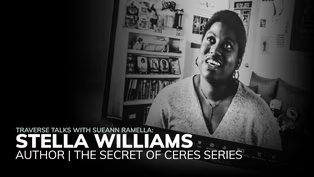
Writer Stella Williams
11/10/2021 | 22m 14sVideo has Closed Captions
Stella Williams On Diversity In Literature And Art's Impact On Community.
Author Stella Williams shares how her love for reading at a young age drove her to write about stories that showcased characters that looked like her. They talk about everything from Williams’ background in anthropology, details of her new book, and her work with kids in juvenile detention. Listen to her episode now or stream Traverse Talks with Sueann Ramella, wherever you get your podcasts.
Problems playing video? | Closed Captioning Feedback
Problems playing video? | Closed Captioning Feedback
Traverse Talks with Sueann Ramella is a local public television program presented by NWPB
Traverse Talks with Sueann Ramella
Writer Stella Williams
11/10/2021 | 22m 14sVideo has Closed Captions
Author Stella Williams shares how her love for reading at a young age drove her to write about stories that showcased characters that looked like her. They talk about everything from Williams’ background in anthropology, details of her new book, and her work with kids in juvenile detention. Listen to her episode now or stream Traverse Talks with Sueann Ramella, wherever you get your podcasts.
Problems playing video? | Closed Captioning Feedback
How to Watch Traverse Talks with Sueann Ramella
Traverse Talks with Sueann Ramella is available to stream on pbs.org and the free PBS App, available on iPhone, Apple TV, Android TV, Android smartphones, Amazon Fire TV, Amazon Fire Tablet, Roku, Samsung Smart TV, and Vizio.
Providing Support for PBS.org
Learn Moreabout PBS online sponsorship(suspense music) - [Sueann] A good romance, throwing some paranormal activity, maybe magic and a werewolf were, too, and all bite.
(softly giggles) But it wasn't until recently that characters in romances, especially paranormal romance, look like me or other people of color.
Stella Williams is a paranormal romance writer of Secrets of Ceres books.
She created Serpentine Creative to help writers of color get published.
And she's our guest for this episode of Traverse Talks.
(guitar playing) So Stella Williams, thank you for being with us.
Your latest series that you have is called "Ferocious a secret of Ceres".
It's a paranormal romance, private investigator, and a security force officer work together, sparks fly.
Can you describe the world of Ceres to us?
- [Stella] So Ceres itself is this like magical sanctuary kind of its own little bubble that lives outside of our current reality.
So they kind of travel back and forth between their reality and this magical sanctuary, and our day to day lives that we know in our real world.
- [Sueann] And there's a young character that goes missing and so they have to look for her.
What else can you tell us about the plot, starting with the first one?
- [Stella] Well, the first book is like any first book, just an introduction to the world of Ceres and the aura, which is what I named the magical people.
And in my head, it's kind of like a parallel between the discrimination that minorities have in the real world with their own version of discrimination in the world of Ceres.
It's really hard not to give a spoilers for it, but it basically it's your standard romance of boy meets girl, girl and boy don't really get along, but through trying to find a solution to the main problem, they realize that they actually are a perfect fit.
- [Sueann] That's right they're hot for each other.
When you were young, you used to read stories and then you would write your own versions, your own endings.
Why did you do that as a child?
- [Stella] I was the youngest of four kids and I was always being at my sister's practices and all of that stuff, so I had a lot of like alone time.
And when reading became like, not enough for me, I just started picking everyday things, being something that happened during my day, something I saw happen at the practices, on TV, you know, whatever I wanted to change started writing that down.
It was kind of my way of controlling my world when I didn't feel like I had control.
- [Sueann] As a kid, but now as an adult, you know, I read in some interviews that you write the stories you wish you had.
So I'm wondering as a child, if you were already trying to do that.
- [Stella] I would say not really.
I felt like I was much more as a child in a fantasy world.
I wasn't really worried about, you know, representation or anything like that.
As a kid, it was more just like, I didn't like the way that story ended, so I'm gonna write it this way.
But definitely as an adult, you know, with writing, they say the best writing comes from the heart, and for me, that means, every book I write has a piece of me in it.
And to be true to myself, I have to write characters that look like me, that talk like me, that look and talk like my friends, family, etcetera.
And not to say that any of my characters are based a 100% or even 75% or 50% on anyone I know personally, but what I write now, I wish I had just a little more representation of that when I was a kid.
It would have helped me develop my sense of self a lot faster, instead of having to force myself into these narratives, being able to just have it there in my face, you know?
- [Sueann] Yeah.
Well, I'm just thinking about some of the fun books we read, romance novels.
The first one I read was "The Gentle Conqueror", and a red-headed pale skins gal saved by, you know, barbaric white guy and no Asians.
(Sueann laughs) But how exciting it was when you came across a story that had somebody like you.
And I feel like our kids have more of that than we ever had.
So I think it's fantastic that you are a writer representing all the people that you have in your life, but particularly in this niche of paranormal romance, how did you, were you always attracted to this niche?
- [Stella] Yes.
Even as a kid, I was attracted to like darker stories.
I think I read all of the Sherlock Holmes in like third grade.
- [Sueann] Wow.
- [Stella] I just got that big 600 page book and like read it all in one night.
Loved Edgar Allen Poe.
I was really lucky to have a school librarian that I could go to and anything I was interested in reading, she would get for me.
- [Sueann] And you studied social anthropology and you use your background and your studies to create these diverse world.
So how has studying people in, you know, history help you create these worlds, that are technically other worldly?
- [Stella] One of the things about studying anthropology that you learn, is that no one culture is the same.
There are cultures out there that do sound other worldly.
They have different social norms, different beliefs that might sound completely crazy to you, but makes perfect sense to them, you know, and being able to immerse yourself in that culture and open your mind up to it, in order to study and understand is really what you're doing when you write fantasy.
Well, at least for me, my characters talk to me, so I listen to them and I get cues based on my training with social anthropology, about how their world is set up, what their social norms are.
And that's what helps make my worlds so realistic because without that expertise and without that knowledge, I'd probably be forcing my own social norms and everything into these stories, which might not drive with the theme of my characters.
- [Sueann] Hmm, interesting.
And what are some interesting anthropological facts or discoveries that turn you on?
- [Stella] Oh, man.
It's been so long since I've been in the anthropology sphere.
I do get my entrance peak whenever they're like, "oh, a new tomb was discovered", or "we finally figured out how they got this specific kind of dye in this time period".
And with my Secret of Ceres series, that's very helpful, because the sanctuary was created by different magic users from different Isles of magic and different parts of the world.
So all of these histories are kind of mishmashed together to create this new society and culture.
So knowing that like spiny detail that, "oh, they did have this color of pigment".
So I can write that into my world of Ceres and it be realistic.
- [Sueann] Mhm, yeah.
Now you started Serpentine Creative to help promote diversity in literature.
What are some barriers you see that people of color have when it comes to getting published?
- [Stella] Mostly the idea that there isn't a market for books featuring minority characters.
- [Sueann] How is that even?
(laughs) - [Stella] I know, I know.
And I wish, there's been a lot more push for big firefighting publishing companies to pick up more minority stories, even still it's few and far between where you find a story where two minority characters are the leads.
Interracial, especially with romance, interracial romance is really huge, but I have nothing against, I myself am in an interracial marriage.
So, but you know, growing up, we had Brenda Jackson, Beverly James, that's it.
- [Sueann] Hmm.
- [Stella] I mean, there's more than that, but those were the two I remember being super mainstream as far as romance.
- [Sueann] Do you think it's because in the publishing world, I know we have a lot of white folk in the publishing world making choices, but is it just, it's like denying that people of color have erotic feelings and enjoy being entertained in paranormal, like, you know, this kind of situation here, maybe just such a disconnect?
- [Stella] I think so.
One of the, I had reviews that said that, "this would have been a good book, but I couldn't relate to the characters".
- [Sueann] Really?
Okay.
(laughs) - [Stella] So, and I'm like, well, okay, I'm sorry you didn't relate to the characters, but in my head, I have to think, okay, well, why didn't you relate to the characters?
Was it because of their personality?
Or was it because I described them as dark skin, dark eyes, you know, they both slaying, you know, but at the same time, they were still doctors, lawyers, detectives, productive society members, you know.
It's crazy some of the things you see people say about books with characters of color, like, it's not realistic that she's a doctor not struggling, you know, married, she doesn't already have at least one kid by the time she's 30.
The craziest things you could think of people find the nitpick.
- [Sueann] Yeah.
Your world is so small if you say something like that.
- [Stella] It is hard.
There are still barriers, and people still think it's okay to say these things to authors of color and about characters of color.
And, really what I try to do with Serpentine Creative and through my YouTube channel is gave a voice to authors and a safe space for authors of color who write marginalized characters in such a niche genre that have that recognition and have that space without that comment of, "oh, I just can't relate" or like "it's fantasy, right?"
But there still has to be a level of realism.
And it's really hard to balance that when you have to be frank, racist saying that it's not realistic to have characters of color be able to do all of these fantastical amazing things.
- [Sueann] Yeah.
(whimsical music) Now, you like your characters have a different side to your life.
Stella Williams is your pen name and the everyday you is Nisha McSwain Franco.
- Yes.
- I say that, right?
Yes, so, and you do some great work with kids in juvenile detention in the Tri-Cities.
So can you explain what you do for the kids in juvie?
- [Stella] Yes.
I work with a program called "Hope Builders", and our mission is to create a tool to community pipeline versus a school to prison.
- [Sueann] Ah!
- [Stella] And so what I do with the kids is, I go in and I share my expertise with writing.
This month is an old novel writing month, so I have a group of five or six students that are participating this year.
- [Sueann] Oh, great.
- [Stella] Some of them aren't, you know, the best students, you know, they're like, I never really thought about writing my own books.
I don't like writing for school, you know, but when I started breaking it down, like you can literally write what ever you want, you know.
You can just pick a genre, pick a name and just write to your heart's content, no boundaries, no rules, just completely being yourself and getting stuff down on paper.
And it's been really interesting, seeing different ways that it's helped them open up and express different feelings and emotions in a way that they, not to say that they were never taught before, but maybe not fully exposed to before.
- [Sueann] Hmm.
- [Stella] And hopefully that'll be the start of them being able to look different pathways and how to handle things, and maybe they won't be repeat visit pairs that do went back to the center.
- [Sueann] Mhm.
- [Stella] And thankfully, we've gotten some community support to be able to create a second location outside of the juvenile justice center.
So that way we're putting in this kind of roadblock.
Like, okay, we know that it's been shown to turn kids around, who've already had the misfortune of ending up in the states.
Now we have a set up outside of that space to maybe prevent them from getting to that point at all, or hopefully provide a space where students who weren't introduced to it in the juvenile justice system, have a place to go outside of the juvenile justice system to get that same level of community compassion.
And it's a really, really great opportunity, not even just for the children in our community, but also us adults, as representatives of the community, to be able to make a difference and volunteering for like 30 minutes or an hour once a week, even.
- [Sueann] Yeah.
- [Stella] You never know, I might be sharing these writing experiences with these kids now and inspire future authors.
- [Sueann] Oh yeah.
I'm wondering, how you started to have a heart for the kids in juvenile detention?
- [Stella] I've always been the type of person to get involved in volunteering and helping out in the community.
My family's always been super active as teachers, community workers.
So for me, every place I move, I try to find my space, whoever that is, whoever needs the most help.
And if you're so happened, I ran into Jordan Cheney at a writer's conference and he was like, "hey, you're pretty cool, I'd like to have you come in and talk to some students I work with".
And it was supposed to just be like a one-off thing, but I went and I saw the possibilities and I just became invested.
And it's kids.
They're just kids.
- [Sueann] Yeah.
They're just kids.
- [Stella] A lot of people forget that when they hear juvenile detention center, you know?
- [Sueann] Yeah, it's quite a name.
What do you wish people would understand about those kids?
- [Stella] That they are just kids, that they made mistakes, that they got mixed up with the wrong people, were in the wrong place at the wrong time, you know?
And they're still young.
They still have growing and learning to do.
And if you write them off now, they're never going to grow and learn.
They're gonna be caught in this cycle and speed into the multi-billion dollar prison industry.
When I would much rather see them grow and learn from their past behaviors and become productive members of society and be able to leave that behind them.
- [Sueann] And you probably have read their writing.
Do you see some common themes or anything that really tugged at your heart that you can share?
- [Stella] I think for the most part, it's their general idea that no one cares.
- [Sueann] Oh.
- [Stella] You know, their parents care, their friends care, but no one cares about their neighborhood.
No one cares about what they're doing, how they're doing in school.
You know, no one cares if they're going through a hard time, no one cares if they're hungry, if they're working jobs under the table to help their families survive, nobody cares about that.
So it doesn't matter what they do because their life is just gonna fly under the radar in general.
And that's one of the reasons I keep going back, I wanna show them that I do care, I'm here.
I'm not the only one who cares, I'm just the only one right now that has the time to be in here with you.
And hopefully we'll have more people that wanna help them be a part of the programs, both in and out of the juvie.
- [Sueann] And for those who are listening, how can they?
If they're around the Tri-Cities area in Washington, or outside, how can they help with Hope Builders?
- [Stella] Well, we're always accepting donations of art supplies, boardgames, notebooks.
And if you would like to volunteer time, I can be contacted at hopebuilderstfjjc@gmail.com.
I know that COVID kind of put a stop on volunteering, at least in the juvenile justice center.
So it's a little heartbreaking that we've kind of had to take a step back because of COVID, but I'm really, really looking forward to getting our programs back up and running at the pace that they were before.
- [Sueann] Yeah.
Yeah, I'm still, too.
And the Pasco City Council selected you to be on their art commission.
What work do you hope to accomplish with that?
And does it tie back to your authorship?
- [Stella] Not necessarily with my authorship, but definitely with my drive to bring diversity into the art space just in general, but with this position, I hope to be able to advise the City Council on the creation of new art, on new legislation and signing codes and all of that, so that it is a more open city for arts.
- [Sueann] What do you hope to see art does for your community?
- [Stella] Art itself is an expression of its people, of the artist.
So we can have a true representation of what Pasco is in a visible way.
There's a vibrant art culture.
There's amazing history.
The Pasco that no one really aware of, unless they've lived here, their entire lives, which I myself have not.
I've only been in the Tri-Cities for three or four years now.
And I'm hoping that once we are able to get these art affiliations and murals, that Pasco will become the same kind of vacation destination that like Richland and Kennewick kind of are, you know, for festivals and just a cute little place to kind of walk through, maybe get a little something to eat and drink, check out the farmer's market, you know, just having that open community feel.
- [Sueann] Nice.
All right, Stella, what are you writing about now?
But I know you are busy with family and all that.
So when you find time to write, what are you focusing on?
- [Stella] Oh, I always have like three projects going on.
(Sueann and Stella giggle) Currently, I'm working on the final book of the Secret of Ceres series.
And then planning to branch slightly outside of paranormal and romance.
And I'm working on a thriller right now.
I'm really excited about it.
I've been working on it for like two or three years now in between my romance project.
I'm excited to see if it turns out to be something that I feel comfortable with publishing or if it's just something that I just hold close to my heart and just let it on my shelf for a little bit.
- [Sueann] Yeah.
Well, thank you so much for your time.
I really appreciate it.
And for your books and also your community work.
- [Stella] Thank you so much for having me.
- [Sueann] You bet.
(Sueann giggles) Bye.
- [Stella] Bye.
(upbeat bright music) - [Sueann] That's author Stella Williams, who helps writers of color get published with her consulting site Serpentine Creative, I'm Sueann Ramallah.
And thanks for listening to Traverse Talks.
(upbeat music)
Author Stella Williams - Conversation Highlights
Video has Closed Captions
Clip: 11/10/2021 | 3m 25s | Conversation highlights from novelist and community volunteer Stella Williams. (3m 25s)
Providing Support for PBS.org
Learn Moreabout PBS online sponsorship













Support for PBS provided by:
Traverse Talks with Sueann Ramella is a local public television program presented by NWPB