
WWI Statue Turns 100
Clip: Season 1 Episode 221 | 2m 51sVideo has Closed Captions
The "doughboy" statue in downtown Monticello turned 100.
The "doughboy" statue in downtown Monticello turned 100.
Problems playing video? | Closed Captioning Feedback
Problems playing video? | Closed Captioning Feedback
Kentucky Edition is a local public television program presented by KET
WWI Statue Turns 100
Clip: Season 1 Episode 221 | 2m 51sVideo has Closed Captions
The "doughboy" statue in downtown Monticello turned 100.
Problems playing video? | Closed Captioning Feedback
How to Watch Kentucky Edition
Kentucky Edition is available to stream on pbs.org and the free PBS App, available on iPhone, Apple TV, Android TV, Android smartphones, Amazon Fire TV, Amazon Fire Tablet, Roku, Samsung Smart TV, and Vizio.
Providing Support for PBS.org
Learn Moreabout PBS online sponsorshipA statue in south central Kentucky celebrated a big milestone this weekend.
That Doughboy statue, which stands in the center of downtown Monticello, turned 100 on Saturday.
Doughboy is a nickname for American soldiers who fought in World War One and to the residents of Monticello.
The statue is more than just a downtown fixture.
You talk about Monticello.
The first thing they say is the Doughboy.
Coming back in August, a group of people in the community realized that this 100 year anniversary was coming up and we wanted to do something to commemorate it.
So with lots of different entities involved, we came up with really what I think was pretty good plan and ended up being a real good program because this is being a main fixture in Monticello 400 years.
It's something that those of us who live here see almost daily.
I've been away from Monticello for 20 years.
I come back today just for this.
And every time I come back, I don't go around the bypass.
I don't do any of that.
I come by this man because that is Monticello to me.
He is my soul.
He's protecting us.
And that's what this is all about.
It is a physical presence in hopes of thanking them for what they've done.
You know, you can say it as often as you want to, but when they can look at that and think somebody cared enough to put up a monument.
My great grandfather, Homer Alexander, is commemorated on the doughboy.
His registration card has an X on it.
He couldn't read or write, so he did the X And then, if you'll notice, it says his mark.
And then someone put his name beside of it.
My great grandfather was one of the wounded Homer Alexander on there.
But also there are men that have been killed in World War One.
This is everyone that served in the military, in the armed forces of some type.
He is them and he he is there watching over them.
And every I mean, my brother served.
My dad served.
Their names are not on there, but they recognize who this is and what this is about.
This is about every one of them.
Order of.
Some.
According to the national World War One museum, the term doughboy might originate from American military operations on the Mexican border, when soldiers would find themselves coated in white adobe dust.
Adobe's quickly became known as doughboys, as many were redeployed to Europe during World War One.
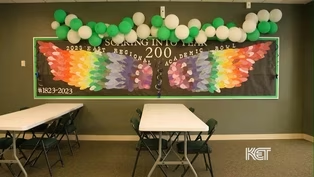
Video has Closed Captions
Clip: S1 Ep221 | 3m 31s | Kentucky School for the Deaf celebrates bicentennial. (3m 31s)
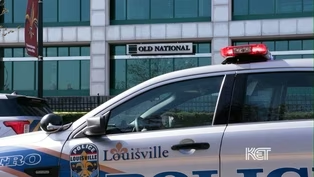
Video has Closed Captions
Clip: S1 Ep221 | 6m 52s | Mass shooting at Old National Bank in Louisville, Kentucky leaves 5 killed and 9 injured. (6m 52s)
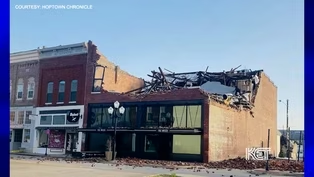
Video has Closed Captions
Clip: S1 Ep221 | 3m 11s | Hopkinsville is still dealing with the aftermath of a windstorm late last month. (3m 11s)
Providing Support for PBS.org
Learn Moreabout PBS online sponsorship
- News and Public Affairs

Top journalists deliver compelling original analysis of the hour's headlines.

- News and Public Affairs

FRONTLINE is investigative journalism that questions, explains and changes our world.












Support for PBS provided by:
Kentucky Edition is a local public television program presented by KET