
xBrooklyn Rocking Iowa
Clip: Season 3 Episode 308 | 6m 43sVideo has Closed Captions
Musician-turned-lawyer Tobi Parks left Brooklyn for Iowa to start the venue xBk Live.
Looking for a new adventure after years in New York City, Tobi Parks specifically chose Des Moines to be her home. Since her arrival, Tobi quickly made an impact on the local arts scene with her music venue xBk Live.
Problems playing video? | Closed Captioning Feedback
Problems playing video? | Closed Captioning Feedback
Iowa Life is a local public television program presented by Iowa PBS
xBrooklyn Rocking Iowa
Clip: Season 3 Episode 308 | 6m 43sVideo has Closed Captions
Looking for a new adventure after years in New York City, Tobi Parks specifically chose Des Moines to be her home. Since her arrival, Tobi quickly made an impact on the local arts scene with her music venue xBk Live.
Problems playing video? | Closed Captioning Feedback
Where to Watch Iowa Life
Iowa Life is available to stream on pbs.org and the PBS app.
Providing Support for PBS.org
Learn Moreabout PBS online sponsorshipLet's go.
1 ... 2... 1-2-3-4.
[Tobi Parks] You know the great thing about music?
It's a common denominator.
It doesn't matter what your politics are or what your, you know, general beliefs are.
You know, you can be the polar opposite of what I am and my politics, and we can all like the same song.
♪ I'm much more of a fan of calling people in than calling people out.
Right.
And I think music is one of those things that is a real connector.
Really, our motto is like, just don't be a jerk.
You know, come into the space, enjoy the music, enjoy the community, get to know somebody that you might not otherwise know or get to talk to, but you know, like all of my entire career has always been this sort of like I've wanted to do music, which I'm really thankful for because it's been able to sort of grow into the different things that I've been doing.
But it all started from wanting to just play ♪ [cheering] You know, I started playing quasi professionally, if you will, at age 14.
I mean, that was my first job playing in these bar bands in my small hometown in rural southeast Missouri, and just continued to do that.
And I moved to New York because I wanted to play professionally.
That was the goal.
But, you know, I also like to eat food.
So I had to have a job.
I had reached out to a friend of mine that worked for a major label, tired as a temp, worked in copyright publishing, that kind of stuff.
There's a lot of things I love about New York, and I miss it every day, you know?
But my wife and I have two kids, and were living in New York City, and it is really hard to raise kids in New York City, though I considered myself a New Yorker for for a long time.
There's just something about a midwestern sensibility that I never kind of caught up with that in New York at that time, our prerequisites for wherever we were going to move would be someplace where gay marriage was legal and someplace where we had family.
And by default, it was Iowa, because my sister in law had left New York and came to be a professor at Drake.
So coming back here felt a lot like coming home.
And Patti Smith had given this interview, and she was talking about the nature of art and culture.
And the other thing that she said that really stuck with me is like, you know, the next art revolution isn't going to happen in a city like New York or LA or Chicago.
It's going to happen in some of these secondary and tertiary cities.
And that's exactly what I felt when I came here.
So I came out to visit based on my wife kind of pushing me like, just go check it out.
And I was like, listen, I'm not leaving any place where there's not a creative community, a place where I can't make music, whatever, and totally fell in love.
And again, I had no idea what I was going to do when I got here.
So some of the things that I did is I remember going downtown and looking at some of the older buildings that were around, and I'd been accepted to law schools and then had started an artist incubator called Station One Records, kind of a nonprofit record label in partnership with The Social Club.
And Drake just so happened that that building next door, the folks that owned it, were looking to sell it.
I happened to have just sold my house in New York.
And, you know, my wife and I had some money and we're like, okay, well, let's try and do this.
So when I first moved, I kind of jumped into all of those things at once.
And that kind of the iterative steps of that sort of led to what I'm doing now.
♪ ♪ ♪ [Bill Rogers] There is such a wealth of talent in Des Moines, in the central Iowa music scene.
It's underrated.
Being a small venue that we are, we are able to really, connect one on one to a lot of to to patrons and artists alike.
So I think that that kind of really makes a big difference in cultivating community.
[Tobi] You know, we're capped at 250 for that venue.
But I think that's the thing that, you know, I want people to really understand is like, small venues are here around community building.
We're presenting artists that are just kind of bubbling up.
And, you know, we're the first step before they get to Val-Airs or, you know, the arena is like, you have to have a network of the small spaces like mine before you can even get to those next steps.
Yes.
You know, we opened in September of 2019, the world's worst time to open a music venue because we were open for six months.
And then Covid came.
I don't rely on next as my primary income.
I'm an attorney by trade.
So after the pandemic, I actually went back to work at Sony full time.
It was working for them, so I was able to kind of keep things afloat.
And I also got heavily involved with the National Independent Venue Association, and we lobbied the federal government for a $16.4 billion grant program to save independent venues.
And that $16.4 billion is the biggest federal investment in the arts in American history.
Why?
They gave it to a bunch of concert promoters, I don't know.
And right as we came out of the pandemic.
So I rented the office upstairs in the firehouse building, which is adjacent to the club, had an idea originally of turning the downstairs into like a cocktail lounge, like the entire space.
And I was like, oh, well, wait a minute.
There's a door that connects to this patio.
Let's make it more of an extended piece of xBk.
So now we have the annex space, which is half the first floor of the firehouse.
[Bill] Well, the annex is much smaller, obviously, but we're able to host, trivia nights and open mic nights.
Poetry we have we've had lectures.
It's a lot more of a community space.
♪ ♪ I sort of owe this to my therapist from many, many moons ago.
I remember living in New York City and being so frustrated of like, you know, I moved here because I wanted to be a musician and I just can't figure out how to do that.
I can't figure out how to pay my bills to do that.
And she was like, well, you're still working in music, though, right?
Like, isn't that what you want to be doing?
And it was an epiphany to me.
You know, being a musician or working in music can look different ways.
♪ ♪ If you build value for your community and you build value for the people around you, you'll be able to sustain yourself, you know?
But you have to look at it from that perspective, and not so much from the dollars and cents.
Maybe I might be wealthier if I looked at it more at the dollars and cents, I don't know, but this seems to be working out pretty well for me.
♪ ♪
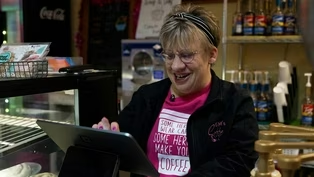
Em’s Coffee Company: An Iowa Coffee Shop Brewing Community and Opportunity
Video has Closed Captions
Clip: S3 Ep308 | 7m 3s | In Independence, Em’s Coffee Company brews opportunity and community. (7m 3s)
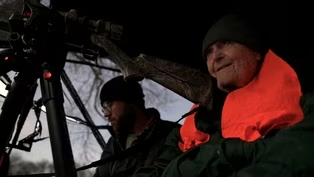
The Legacy of Iowa DNR Biologist Ron Howing in Wetland Preservation
Video has Closed Captions
Clip: S3 Ep308 | 7m 19s | Trace Ron Howing's legacy with the Iowa DNR in wetland preservation in the Prairie Pothole Region. (7m 19s)
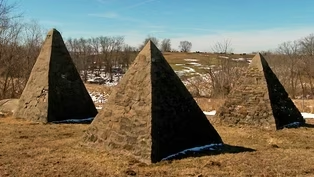
What Are the Great Pyramids of Avery? Iowa’s Hidden Mystery Explained
Video has Closed Captions
Clip: S3 Ep308 | 3m 31s | In rural Monroe County, three pyramids reveal one man’s unusual vision and legacy. (3m 31s)
Providing Support for PBS.org
Learn Moreabout PBS online sponsorship













Support for PBS provided by:
Iowa Life is a local public television program presented by Iowa PBS