
Year in review: ABJ’s notable 2023 stories
Season 52 Episode 1 | 26m 46sVideo has Closed Captions
American Black Journal’s thought-provoking conversations and notable guests from 2023.
From commemorating the anniversary of a historic civil rights march to conversations around police brutality, African Americans’ contributions to the arts, the impact of climate change on Black and brown communities, and stories on Detroit’s Black church community, American Black Journal reflects on some of its significant stories from 2023.
Problems playing video? | Closed Captioning Feedback
Problems playing video? | Closed Captioning Feedback
American Black Journal is a local public television program presented by Detroit PBS
Year in review: ABJ’s notable 2023 stories
Season 52 Episode 1 | 26m 46sVideo has Closed Captions
From commemorating the anniversary of a historic civil rights march to conversations around police brutality, African Americans’ contributions to the arts, the impact of climate change on Black and brown communities, and stories on Detroit’s Black church community, American Black Journal reflects on some of its significant stories from 2023.
Problems playing video? | Closed Captioning Feedback
How to Watch American Black Journal
American Black Journal is available to stream on pbs.org and the free PBS App, available on iPhone, Apple TV, Android TV, Android smartphones, Amazon Fire TV, Amazon Fire Tablet, Roku, Samsung Smart TV, and Vizio.
Providing Support for PBS.org
Learn Moreabout PBS online sponsorship- Coming up, we've got our New Year's Edition of "American Black Journal."
We're gonna take a look back at some of our notable guests and thought provoking discussions from 2023.
We'll share some of our conversations about racial justice and civil rights, African Americans in the arts, and the Black Church in Detroit.
So, sit back, relax, and enjoy this special episode of "American Black Journal."
- [Narrator 1] From Delta Faucets to Behr Paint, Masco Corporation is proud to deliver products that enhance the way consumers all over the world experience and enjoy their living spaces.
Masco, serving Michigan communities since 1929.
Support also provided by the Cynthia & Edsel Ford Fund for Journalism at Detroit Public TV.
- [Narrator 2] The DTE Foundation proudly supports 50 years of "American Black Journal" in covering African American history, culture, and politics.
The DTE Foundation and "American Black Journal" partners in presenting African-American perspectives about our communities and in our world.
- [Narrator 1] Also brought to you by Nissan Foundation and viewers like you.
Thank you.
(upbeat music) - Happy New Year, and welcome to "American Black Journal."
I'm Stephen Henderson.
As we begin 2024, we're looking forward to bringing you another year of interesting guests and important conversations that impact the African American community.
Today we're taking a look back at some of last year's guests and topics.
Let's start with our discussions about racial justice, civil rights, and the killings of unarmed African Americans by police.
Lots of people are saying, "Well, this is Black police officers killing a Black man, somehow it's different," but it fits very squarely into the narrative that you have been trying to get people to pay attention to for some time.
- Yeah, and not just me, but there have been activists across the country and across the world, that have been saying this since long before I started having these conversations with you.
The problem isn't the prejudicial thought.
Prejudice is a problem, right?
But it's the way the prejudicial thought is interwoven into systems in our country, that transition prejudice into the historicism, that make a prejudicial thought into racism, right?
And allow that privilege, and allow that social hierarchy to be maintained, that allow power to be exerted.
And what we see in our system of policing, is a very clear example of how, when you found something on the basis of bias, when you found something on the basis of the criminalization of Black and Brown bodies, that at a certain point there becomes, there's an internalization of that thought, of that system, into individuals, regardless of their racial ethnic identity.
And so what has been really, unfortunately, very clearly displayed in this situation, is how this system of policing is deeply, utterly, completely at the root flawed.
- So first I'd like to say, Stephen, the actions of these officers were just disgusting and appalling, for me.
Excessive force is a disregard for life and has no place in law enforcement at all.
And I would have to say my thoughts are with the family and every impacted by Tyre Nichols' death.
I would have to say that there needs to be more accountability, there needs to be more transparency in law enforcement, there needs to be better training, intervention programs, as well as crisis intervention, mental health co-response, the data-driven enforcement.
We need to come together, and we need to make sure that we're open for listening to our community for the needs, as well as providing these services that we know are so desperately needed in our communities.
- [Narrator] It's been 60 years since the Walk to Freedom was held in Detroit.
This is the march that concluded with Dr. Martin Luther King, giving his famous "I Have a Dream" speech for the first time.
The streets of Downtown were flooded with people, young and old, Black and white, who all believed in racial and economic justice.
Lifelong activist, Dorothy Aldridge, was just 20 years old at the time of the march, but she remembers it well.
- There is well integrated.
And then, you know, at the time the mayor of Detroit, Mayor Cavanagh, was a white person.
So there was no conflict between Blacks and whites as such.
No, none whatsoever.
- So, tell me what was going on in the City of Detroit in 1963?
- In 1963, of course there was the question about police harassment, police brutality of the young people in Detroit.
And the march was called in particular, to talk about housing, to talk about jobs, and to talk about schools, because the schools were slowly being integrated.
Now, one other thing I want to add, that Medgar Evers had just been killed in Jackson, Mississippi.
And so that was another one of the things that spurred interest in the march.
- [Narrator] Aldridge first became an activist at a young age, just as many Detroiters did.
She said it was the Montgomery Bus Boycott, and Emmett Till's death, that pulled her into the fight for equality.
Aldridge heard about the march when she was a member of the Northern Student Movement in Detroit.
- What was the first thing you can really remember thinking and feeling, as you're joining this march?
- Oh, much excitement.
For one, it was a beautiful, beautiful day, and no one expected these many people to show up.
- So the march, where did it start and where did it end?
- It started at Warren and the Woodward area, and then went all the way downtown to Cobo Hall.
- How do we know that the things that we're experiencing here in Detroit, that Detroiters are experiencing in particular, and that Black Detroiters are disproportionately affected by, how do we know this is about climate change?
How do we know that there's a connection between the way that, you know, the environment has altered, and been altered, and the hardship that we see in cities like Detroit?
- Yeah, we can definitely see it.
We see it every single year through the flooding events.
We can see it through our health even.
We know that from 2017 to 2019, 16.2% of Detroit adults, and 11.11% of Michigan adults had asthma.
And that means that the asthma rates in Detroit were 46% higher than for, you know, for those Detroiters, than Michigan residents as a whole.
So the fact that that's happening, means that people are being impacted by air quality issues, pretty predominantly in areas where Black and Brown folks are living.
And that directly relates to climate change and how folks are impacted by air quality, specifically when we think about greenhouse gases that we're trying to particularly get a handle on, as we're trying to mitigate those impacts.
- Jamesa started talking about the flooding events, or the heavy rain events that we've had in Detroit.
And there are specific ways that that impacts the health and wellbeing of Detroiters, for lots of reasons.
One reason is because there's not enough relief when there are emergencies like that in the city.
We know that we have lots of renters, and the relief is not available to renters.
So there are ways that having these heavy flooding events exacerbate asthma, because of mold now, that can be present in the home from the water being in the home, water intrusion in the home.
But there are other ways that this impacts folks, that we may not think about as much.
One example is increase in lead poisoning among children.
When we find that there's not relief from these flooding events, then folks are left to their own devices to figure out how to dry out their homes.
One of those ways is, beyond having neighbors and friends help to come and clean up, you also are opening and closing your windows to try to air out your home.
And so that is introducing more lead dust into the air.
80% of our homes in Detroit are pre-1978, and so there's a lot of lead paint still existing in a lot of our homes.
And so it's not just what happens from the rain, right?
It's also what happens from residents being left to their own devices, to try to solve the problems that come along with climate change.
- The contributions of African Americans are vast and diverse when it comes to the arts.
Throughout the 55 years of this television program, we have spoken with talented artists, and highlighted creative projects.
Last year was no different.
From an Oscar winning costume designer, to Motown Records' legacy in the Civil Rights Movement, and the 50th anniversary of hip hop, we continue to shine a light on African American culture.
Take a look.
I think there's always a debate about when hip hop starts, when it kind of diverges from other forms of music.
How do we pinpoint that 50 year anniversary?
- Yeah, I mean, so hip hop's chronological roots certainly need to be connected to the 1970s.
You see, so that puts us into that half century mark.
But of course, as you well know, I mean, music is informed and influenced by that which comes before it.
And with hip hop, we certainly see that made manifest in the use of sampling, for example.
I mean the throwback, the inheritance.
But, it is a unique form of Black cultural expression that is born in the post civil rights, post Black power, really almost post disco age.
And it is now, much to the chagrin of many doubters early on, half a century old.
- So Berry Gordy organically embodied social justice and equality and equal rights, and sometimes faced a little bit of flack for that inclusivity, during such a tumultuous time.
How did he naturally achieve those goals of the civil rights movement of social justice and equality for everyone, through Motown Records?
- I don't know that he ever set out to achieve a goal of civil rights.
I think what he did so brilliantly, was to one, establish a business and an enterprise where he could empower other people, not just Black people, but mostly people of color.
I think what he definitely did, was he was able to create a music with the intention of creating music for all people.
So at no point was Berry Gordy trying to just make Black music for Black people.
He was trying to make music for all people.
Things like love and joy and hope and peace, things that everybody could relate to, that resonated.
He didn't realize it was gonna resonate, 'cause it was being made by young people, with young people all around the world, then become the sound of young America.
And in doing so, started to create this unity, this coming together of people who looked very different, had different backgrounds.
And my favorite quote is when Junius Griffin says, you know, "Motown music allowed Black and white people to look at each other and say, 'There's a little bit of you in me, and there's a little bit of me in you.'"
And the power of that, that's what helped advance the Civil Rights Movement.
- And of course, in 1963, we know that Berry Gordy, Motown Records, recorded the first version of the "I Have a Dream" speech in Detroit in 1960, of June.
And then later he recorded the speech in August, 1963, the march, the great march on Washington.
What impact has those recordings, have those recordings had on us today?
- Well, I mean, those recordings are the reason we have access today, and that's what makes it so powerful.
Motown, as an independent record label at the time, was in a position to document those speeches.
And then later Berry Gordy would give the rights to those speeches to the King family.
So I think it was a really, it was a foresight that Berry Gordy had that this was important to put in the right hands, so that the world can have it, you know, in perpetuity.
- So you are the first African American woman to win two Oscars.
- Yeah.
- I mean, just saying that, it's kind of - Surreal.
- remarkable, right?
- Yeah, thank you.
- But the work that took you to that moment, is also really special.
I mean, it's special to so many people.
Talk about "Wakanda."
(laughs) - Yeah, well I worked really hard, and you know, when I met Ryan Coogler at Marvel, I had amassed a lot of images on my computer in a Dropbox.
I didn't know that once you got into the Marvel studio, that you couldn't open things like Dropboxes.
You know, they have a firewall.
And I'm kind of a little concerned, because I'm in an interview, and I can't open the images that I collected over days (Stephan laughs) to show him.
And he was sitting there very relaxed.
And now that I've worked with him on two movies, I see that disposition.
I can remember this disposition, even though it was new to me then.
He was very laid back, he was very patient, and he said, "Ruth, I'm really glad you're here.
I was a little boy growing up in Oakland when "Malcolm X" came out, and I remember it was a family environment in the theater.
People were excited about the movie opening.
I went with my family, I sat on my dad's lap and watched "Malcolm X," and I remember as a little boy seeing the costumes."
And when he said that, you know, what I was concerned about on that Dropbox, was no longer important.
- [Stephen] That's not the issue, right?
- Yeah, and I realized I could contribute something to this young man, together.
We created this world together.
It was a very collaborative field.
So by the time it was released, the trailer came out, I was sitting there watching, and I immediately started getting like text messages, and tweets and all kinds of stuff.
And I thought, "Wow, this is really gonna be big."
And then, there I was on the Oscar stage.
- 2023 was our third year bringing you monthly episodes that focus on the Black Church in Detroit.
Our discussions have included an amazing group of African American faith leaders in our city, and we've focused on a wide range of topics.
This series is produced in partnership with the Ecumenical Theological Seminary and the Charles H. Wright Museum of African American History.
Here are some of the highlights from last year.
- Yes, my name is Reverend Lawrence W. Rogers, and I'm the 24th pastor of the Historic Second Baptist Church of Detroit, located at 441 Monroe Street, Downtown, Detroit.
And the congregation was established in 1836.
It is the oldest Black church in the Midwest, and definitely the oldest Black congregation in the state of Michigan.
The church itself predates the establishment of Michigan about one year, so Michigan filed this charter to become a state, a year after Second Baptist gathered together as a congregation.
Second Baptist freed some 5,000 formerly enslaved people.
We did it in two ways.
So we would hide people in our basement, and then we would smuggle them in a wagon with a false bottom, to the Detroit River.
And one of our members, his name was George T. Baptiste, he owned a steamboat, and we will put them in the steamboat and help them to cross the Detroit River.
- Before Harriett Tubman, there was these churches.
Before the writing of "Uncle Tom's Cabin," before Abraham Lincoln with the Congress, there was a St. Matthew's Episcopal Church, Second Baptist Church, and Bethel AME churches, helping these fugitive slaves cross Detroit River, for freedom on there.
There was a time capsule.
When one of our three churches, we had a church down in Congress & St. Antoine, by the Blue Cross building, our first one in 1850.
Our second one was up in Paradise Valley, where the Ford Fuel is, and the third was up on Woodward Avenue.
But when they tore down our second church, to build Ford Fuel, they found the time capsule, they unearthed that time capsule, and told us all of this more deeply hidden information before was represented there.
And there was something that said, "Nowhere in this country, among the colored group of Americans, were there more upstanding, courageous, and elegant high class of men and women, who pioneered the city of Detroit, from the year 1830 to the time of the Rebellion and Civil War."
- [Stephen] Detroit Public Schools Community District, has a faith-based initiative that matches churches with schools, to provide support like tutoring and mentoring and clothing drives.
The program also includes a faith-based council, that meets with school leaders to exchange information and ideas.
- As this administration started, I think it's been over five years ago now, with Dr. Beatty, we were very intentional in our conversations, and recognizing that our churches have always been champions for our schools.
They've always been involved in some informal way, working on issues.
The coalition leading up to us being able to secure a local school district with an elected board, including leaders like Reverend Simmons, they were always present.
And so what we wanted to do, was formalize those relationships.
We wanted to make sure we had a council.
That was the first thing that was representative of every religious order, where that was a platform that they had direct access to the superintendent.
- For the past few decades, New Prospect has been one of the churches on the frontline of social justice in Detroit.
And certainly support of our school system is a part of that.
And we have adopted Pasture Elementary School, which is adjacent to our church campus, as a school that we will serve continually.
We will meet needs in terms of afterschool tutoring, we will continue to meet other human needs.
When parents come to us for basic life necessities, because there's a shortage and there's insecurity, we are available.
- As you know, it is a mandate of the Christian Church to teach.
Jesus, as he departed the disciples, tells us in Matthew 28 to go and teach.
It's interesting, he says in that passage to go teach, not preach.
Baptize, but teach.
Teaching is an integral part of what it is to be a church.
- Growing up as the daughter of a pastor, I wanna know at what point you became aware that that was who your father was, and what he did, and what it meant, and what it meant to you.
Like, what was the point where that started to really sink in?
- Yeah, thank you, Stephen.
Great question.
I have to say, I probably noticed it, I was aware of his role, really very young.
I'm gonna go as early as maybe four years old.
It just became very distinctive, being in the church as a little kid, running around kind of the space that he held as pastor, right?
There was something, even as a little kid, that I got, was really a special, special experience.
And then it began to really impact me in some substantive ways, at different points in my various life cycles.
So it meant one thing to me when I was a little kid, and as I became a teenager, my father literally was the coolest parent ever.
And so there was a particular pride in knowing that he held so much regard and esteem in the community.
And it just shone a light on me, in terms of opportunities made available for me.
And again, in my adult years.
And even though he transitioned over 21 years, Stephen, I tell you, even in this moment, every time I go outside the walls of my office or my home- - You feel that.
- I still feel it, I still feel it.
- Yeah, yeah.
Charles, same question to you.
Tell me about realizing that this was who you were and where you come from, and how important that all was.
- Well, when I was very, very young growing up in the 70s, I'll tell you what struck me first, was my dad always wore a suit to work.
And I remember just on TV looking at the icons of that era, he reminded me of George Jefferson, because George Jefferson always had this three piece suit on, - He did.
(chuckles) - and, you know, it kind of, he reminded me of that.
He didn't have overalls or, you know, some casual, he was always overdressed everywhere.
He was always overdressed.
And somebody said he was born in a suit, but I think that's a rumor.
(Stephen chuckles) So, you know, he would just wear a shirt and tie for no reason.
"But Daddy, what are you doing today?"
"Well, I'm not sure."
"But why do you have on a shirt and tie?"
You know?
But when I got older, I believe what impressed me most of all, was this whole idea of what he was doing, was always community oriented.
There was always something having to do with community.
And then the pastoral visits, you know, the hospitals in the middle of the night.
I never knew him to have office hours, and there was never really a day off.
And we really didn't take that many family vacations.
We were usually at the convention, the Progressive National Baptist Convention.
So I would just hope for a pool.
(Stephen laughs) But, I think even then I didn't understand the full significance of what being a pastor meant.
- And of course, you can see all of these conversations in their entirety, at americanblackjournal.org.
That's gonna do it for us today.
We thank you for being loyal viewers.
We always wanna hear from you, so connect with us anytime on social media.
Take care and we'll see you next time.
(upbeat music) (upbeat music continues) - [Narrator] From Delta Faucets to Behr Paint, Masco Corporation is proud to deliver products that enhance the way consumers all over the world experience, and enjoy their living spaces.
Masco serving Michigan communities since 1929.
Support also provided by the Cynthia & Edsel Ford Fund for Journalism at Detroit Public TV.
- [Narrator 2] The DTE Foundation proudly supports 50 years of "American Black Journal" in covering African American history, culture, and politics.
The DTE Foundation and "American Black Journal" partners in presenting African American perspectives about our communities and in our world.
- [Narrator] Also brought to you by Nissan Foundation, and viewers like you.
Thank you.
(bright music jingle)
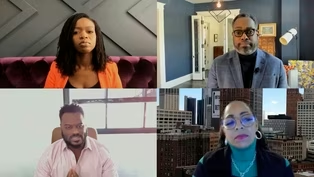
Tyre Nichols’ death: A roundtable about racism
Video has Closed Captions
Clip: S52 Ep1 | 2m 40s | Two women reflect on the 1963 Detroit Walk to Freedom (2m 40s)
Providing Support for PBS.org
Learn Moreabout PBS online sponsorship
- News and Public Affairs

Top journalists deliver compelling original analysis of the hour's headlines.

- News and Public Affairs

FRONTLINE is investigative journalism that questions, explains and changes our world.












Support for PBS provided by:
American Black Journal is a local public television program presented by Detroit PBS