One-on-One
Yolanda Sealey-Ruiz, PhD; Chief Adam Waterbear DePaul
Season 2025 Episode 2785 | 27m 51sVideo has Closed Captions
Yolanda Sealey-Ruiz, PhD; Chief Adam Waterbear DePaul
Jacqui Tricarico sits down with Yolanda Sealey-Ruiz, PhD, educator, poet, activist, and award-winning author, to discuss her advocacy for equal access to quality education. Chief Adam Waterbear DePaul, Director of Education and Tribal Storykeeper of the Lenape Nation of Pennsylvania, talks about the nation’s efforts to preserve its culture through education and community engagement.
Problems playing video? | Closed Captioning Feedback
Problems playing video? | Closed Captioning Feedback
One-on-One is a local public television program presented by NJ PBS
One-on-One
Yolanda Sealey-Ruiz, PhD; Chief Adam Waterbear DePaul
Season 2025 Episode 2785 | 27m 51sVideo has Closed Captions
Jacqui Tricarico sits down with Yolanda Sealey-Ruiz, PhD, educator, poet, activist, and award-winning author, to discuss her advocacy for equal access to quality education. Chief Adam Waterbear DePaul, Director of Education and Tribal Storykeeper of the Lenape Nation of Pennsylvania, talks about the nation’s efforts to preserve its culture through education and community engagement.
Problems playing video? | Closed Captioning Feedback
How to Watch One-on-One
One-on-One is available to stream on pbs.org and the free PBS App, available on iPhone, Apple TV, Android TV, Android smartphones, Amazon Fire TV, Amazon Fire Tablet, Roku, Samsung Smart TV, and Vizio.
Providing Support for PBS.org
Learn Moreabout PBS online sponsorship- [Narrator] Funding for this edition of One-On-One with Steve Adubato has been provided by Holy Name.
The New Jersey Education Association.
The Russell Berrie Foundation.
Making a difference.
EJI, Excellence in Medicine Awards.
A New Jersey health foundation program.
The North Ward Center.
The Turrell Fund, a foundation serving children.
New Jersey Sharing Network.
Delta Dental of New Jersey.
We love to see smiles.
And by PSEG Foundation.
Promotional support provided by CIANJ, and Commerce Magazine.
And by New Jersey Monthly.
The magazine of the Garden State, available at newsstands.
- This is One-On-One.
- I'm an equal American just like you are.
- The way we change Presidents in this country is by voting.
- A quartet is already a jawn, it’s just The New Jawn.
- January 6th was not some sort of violent, crazy outlier.
- I don't care how good you are or how good you think you are, there is always something to learn.
- I mean what other country sends comedians over to embedded military to make them feel better.
- People call me 'cause they feel nobody's paying attention.
_ It’s not all about memorizing and getting information, it’s what you do with that information.
- (slowly) Start talking right now.
- That's a good question, high five.
(upbeat music) - Hi everyone, I'm Steve Adubato.
Recently my colleague Jacqui Tricarico and I traveled with our team to do a series of interviews down at the 2024 New Jersey Education Association Convention Annual convention.
We talked to educators, educational administrators, authors, poets, people engaged in a whole range of activities, impacting our kids, impacting our schools in the world of education.
Here now are those conversations.
Jacqui, myself and some really interesting people in AC.
- Hi, I am Jacqui Tricarico, Senior Correspondent for "One-on-One" here at the NJEA convention in Atlantic City, and I am so pleased to be joined now by Dr. Yolanda Sealey-Ruiz, who is an educator, poet, activist, award-winning author, and here to talk to our educators in New Jersey here at the convention.
So great to have you with us.
- Thank you for having me.
- I wanna start by going back first, let's go back first to your life, your childhood, and when and where you knew that education was something that was going to drive you through your career, through your life.
- Absolutely.
It started early, the age of 13, but I didn't continue on that path.
I remember saying to people, "I wanna be a teacher."
And the first thing they would say is, "Well, teachers don't make money.
Why would you wanna do that?"
And, you know, I think it kind of influenced me a little bit.
I grew up in the South Bronx, the birthplace of hip hop, at a time when it was such a amazing cultural force for young people.
And I knew that education was important to me.
So I knew very early on that that was going to be my career.
But I ended up going into corporate America.
I went on to college, although I majored in English, but I ended up working for places like "The New York Times" and "Businesweek" and NYU.
And I got to a certain point, I said, "You know, I have to teach."
So I remember being at "The New York Times" and beginning to teach high school at night.
And so I've always had like this corporate persona in the daytime, but the draw and the passion for the classroom led me to teach at night.
And so I've had these kind of two trains running, you know, until I just decided, when I would go back for my PhD, I just decided, no more corporate.
I'm doing this all the way.
- And you've been an educator since.
But also, do you feel that being an educator also means that you need to be an activist, that you need to be a cheerleader for everyone that you see, all the different types of kids that you see in your classroom?
- Oh, absolutely.
I actually consider myself a scholar-activist.
That scholar identity has come with being in the academy.
And I am concerned about all young people flourishing.
And I am also concerned, of course, about the way Black and brown children have not had fair access to great education.
I'm talking about en mass, so I'm not talking about special programs that pull them into certain schools.
And I'm talking about public school systems that are working as wonderful as private school systems.
So that's been my focus really for these past, I guess I've been a teacher for almost 30 years, - So how are you doing just that, because I've watched some things that you've done and something that you talk about that I found really interesting is this archeology of self and getting educators to really look inside to see who they are because I mean, let's be honest, racial honesty isn't uncomfortable for us- - Absolutely.
- as people, it's uncomfortable to talk about or to even look inside and admit if we have racial biases, even if they're there.
So how are you helping educators do just that when it's so uncomfortable?
- Well, I'll tell you, actually, the approach that is best, and it is across all cultures, is beginning with storytelling, really thinking about our lives and telling those important stories that we've come to know ourselves as ourselves.
But I find that easing people in to having them think about stories or prompts, I'm about to do a workshop today talking about the excavation of the self, and we have to know who we are if we're going to really be open to who the children in front of us are.
So it's a practice.
So I'm trying to, if you will, if let's say going to the gym that you have to exercise that muscle.
I'm trying to get folks to exercise the muscle of self-reflection, of telling their own stories, so that when they're in their classroom, they can practice it and they can create a space for the children to do the same.
And there's a beautiful part of humanity that comes out in that when we put all the things aside that we're told how we're different and we see each other as humans through our own stories, it works.
- Give some examples of what teachers can do today, look, watching this program, the message that you're bringing here to the convention, what are some things that they can do today to just better the way that they're communicating with their students and what they're doing in the classroom?
- I would say, and I would say this to all teachers, listen to your students.
Your students will tell you when, and not necessarily verbally, but you'll know when they feel comfortable in a classroom, when they feel like they can take risks, and to be humble enough, right, to really pay attention to that.
In terms of doing the self-reflection, I say this to my teacher education students, anyone who is going to serve a child or be in front of a classroom, you must know yourself.
So I ask them, are you in some form of therapy?
Now, therapy doesn't have to be just talk therapy.
It could be group therapy, music therapy, some people are part of fitness clubs as therapy.
But there has to be a way that you're doing some level of self-reflection on who you are, where you are, and what you want to achieve.
And that becomes an opportunity for you to bring that into the classroom.
What I'm trying to say is we have to be humble enough to tell the truth, to do self investigation.
And if we do not practice it personally, there's no way we're going to do it professionally.
- How does that all stem to what you call critical love in the classroom?
- Ah, critical love.
Love is the answer.
- The base.
- It is the base of everything.
And the critical love, I'm influenced by bell hooks, who talks about every child in the classroom should experience love.
I'm influenced by Reverend Martin Luther King who says that love without justice is anemic.
And so when I think about what does it mean to love a child or a person who's not related to you, or a child who's not your own, it's really being dedicated to their human flourishing.
And so I define critical love as a profound and ethical commitment to the communities, to the people that you're serving.
So even if I have massive differences, as your teacher, I need to be committed to your success.
I need to be committed to, when you're in my classroom, it is a space that you will discover more about yourself.
And so that's what I mean by human flourishing.
And love, for me, has to be at the base of that because where there's love, there's forgiveness, there's grace, there's a level of kindness and empathy that we don't often exercise if we don't start with love.
- We're in a country that I think we can all describe as quite divided right now.
How can we take all these concepts, and especially archeology itself, to reflect and then still give love, expel love to other people around us, no matter, you know, some of those things that should be unsaid, but now people are talking too much about in terms of who you voted for, who you didn't vote for, and how can we use all that to just be more compassionate people all around?
- Well, everyone, I hope, has experienced love at some point, felt loved, has given love.
So first and foremost, we have to connect to that feeling.
And then we have to be honest about, why can't we have those feelings?
Because we're talking about children.
What prevents you from having that type of feeling towards another child?
And then we can begin to, "Well, they don't practice the same religion."
"Okay, and?"
"Well, they don't quite look like my own children."
"Okay, and?"
So what I'm saying is we have to begin with that radical honesty before we can get to the invitation of critical love.
So there's really no way around it but to go through it.
And that's why it's important that my method is to go through storytelling, because no one wants to, I don't want to be in a soapbox and no one wants to hear anyone speaking from a soapbox and doing the wagging of the finger.
So how do we, as humans who have made a decision to teach, so at some point in our lives we've said, "I'm going to do this.
And that means I'm gonna be teaching children.
I'm going to be committed to children who are not my own."
I try to get them to tap back into that.
When you first decided you were gonna become a teacher, what motivated you?
What were you feeling?
Because we know that it's eroded over time.
Systems erode it, things that we see in the world erode it.
So I try to get people back to that original thought, that original story about why they chose to teach in the first place.
So some of my excavation activities is telling a school story, telling a teacher who was important to you.
And we also, I also ask about race stories, name stories, because names are so important.
And names are also a window into culture and also into how children and adults feel about themselves.
So when we spend this time together telling each other's stories, that's how empathy actually fills a space.
- Storytelling can be done in so many different ways, and I know it can be done through a lot of ways when it comes to arts education too, really ingrained.
And I know you use storytelling in a lot of different ways, especially with your poetry.
Talk about how you see arts education playing a huge role in what you're discussing right now.
- My goodness.
Art saves lives.
And artist?
And everyone is an artist.
I mean, Picasso said that "Every child is an artist."
- I had that written on my wall, on the wall in my daughter's playroom.
"Every child is an artist."
- It's really important for children to see that.
And sometimes they have experiences where they're told that they're not or they feel that they can't.
Art, as I said, saves lives in the sense that art gives us permission to take risk, whether it's visually, whether it's musically.
An artist have a very special role in this society to tell the truth.
And so oftentimes people will paint something, or a child, if you think about psychology, when a child is going through something difficult, depending on the age, the psychologist will ask them, "Well, can you draw me a picture about how you're feeling?"
Because what they may not be able to say, they're able to show in their art.
And so this is why it's important for us to ask questions.
When budgets are cut, why is art and music, those very, very important topics and content areas that actually connect to the human soul, why are they cut first?
So we really need to think about advocating for arts, but more importantly, figuring out every teacher, whether you're teaching math or science, how do I infuse arts into what I'm doing?
Because arts is a portal that opens up the opportunity for children to express themselves in powerful ways.
- Yolanda, it was so great to hear your perspective on all these really important things.
I think we all need to take a look inside ourselves.
And at the end of the day, like you said, love.
That's the base of it all.
Thank you so much- - Thank you.
- for taking the time to speak with us.
Really appreciate it.
- Thank you.
Thank you for having me.
- We'll be right back after this.
- [Narrator] To watch more One on One with Steve Adubato find us online and follow us on Social media.
- Hi, I'm Jacqui Tricarico, Senior Correspondent for "One-on-One," here at the NJEA convention in Atlantic City.
And I am so pleased to be joined by Chief Adam Waterbear DePaul, director of education and tribal storykeeper of the Lenape Nation of Pennsylvania.
First describe for us what your role is with the Lenape Nation of Pennsylvania.
- Well, you can actually break that down into three roles.
- Okay.
- I am one of our four chiefs, and my role as a chief is separate than my other roles.
The four chiefs of our nation, we're there to support the nation, make decisions, hear our membership, and lead the nation in a good way, in the way that our people want to.
My other two roles as tribal storykeeper, I consider myself kind of a repository of our cultural stories, our mythological stories, so people can use me as kind of a reference when they want to know more about our stories.
And as director of education, I work with colleges, universities, school districts all throughout our homelands and beyond on things like curriculum development, working Native American Indigenous studies into the curriculum, and also establishing reading sections in their libraries of authentic, good literature, arranging speakers and things like that.
- So through that educational component that you've been working on, what have been some of the roadblocks that you've faced in making sure that curriculum is in schools in Pennsylvania around your people and the stories and the Natives of the land?
As well as, I know that book banning has impacted you and your work as well.
Describe that.
- Over the past few decades, I feel like we've been making slow, but steady progress in the districts with administrators that have been open and wanting to teach accurate history, that understand that a lot of what they've been teaching is unacceptable and sometimes just downright insulting.
And it's been, like I said, slow, but nice to see that progress.
In my experience, we have recently hit the first time where, in a lot of places, we're moving backwards and very fast.
Now, this is totally dependent on districts.
I work with districts who are just incredible in reaching out to us and still going above and beyond and working in that initiative.
And next door, there can be a district where they are throwing out any book or curriculum that mentions Native Americans.
And that's very disheartening.
- Understandably so.
When we're talking about the education of the Lenape people, what are some of the most important things we should know and that we should be respectful of?
- The most important thing above all else is that people understand that we are still here.
And it's painful to have to say that.
But the general perception is that all of the Lenape in their homeland were either killed or forced out of their homeland.
And we absolutely have incredible nations of our diaspora who were forced out and have lived those terrible journeys in places like Wisconsin, Oklahoma, Canada, and they need every bit of recognition they can get.
But people also need to know that many of us never left, and we've been maintaining our community and our culture here since time immemorial and we're still here.
And we are more than happy to work with the public, and especially educators, on helping people realize that.
- When it comes to state recognition, New Jersey does recognize the Lenape.
Pennsylvania does not.
Describe what that recognition means and why it's so important.
- Yeah, all kudos to New Jersey.
We look to you.
Our people in Pennsylvania look to New Jersey folks as an example.
They've recognized two nations of our people.
Now, what state recognition means, by virtue of itself, is nothing.
There is, because we're not talking about federal recognition, where there are federal standards of what it means.
State recognition is entirely up to the agreement that the nation ends up making with the state.
- What are some of the things you're looking for?
- The main things we are looking for are things that help us continue our role and our culture as environmental stewards and as the Indigenous people of this area.
Our nation specifically, now and it's important to realize that when I answer this particular question, I'm just talking about the Lenape Nation of Pennsylvania.
Different nations have different views.
- Not all Indigenous people?
- Right.
And not even all Lenape people.
- Right.
- Right?
We have different self-governing nations.
Our nation is not interested in casinos.
Our nation is not interested in a lot of those kind of monetary-based things that sometimes can be part of recognition.
The things that move us the most are, one, we want a voice or a seat at the table for any projects that would come in and harm our homelands, the Delaware River, the watershed.
- That are direct impacts on environmental issues?
- Exactly.
And nobody, not even the state-recognized folks in other states, can just point their fingers and say, "That can go through and this can't."
We don't expect that.
But right now, nobody even has to acknowledge us.
There's no Lenape voice in these discussions.
That's something we would like to see change.
We have incredible craftspeople who do traditional crafting and present their items to the public and sell those items to raise money for our nation.
Because, of course, we have no outside funding.
And you know, we have, for example, our youth come in and volunteer at our trading post, at our powwows, where they help sell some of these items our people make.
And all day, they have to sit next to a sign that we by law have to have hanging up that says, "These are not Native American crafts."
Because only recognized nations have the right to identify themselves as such in their art.
And like so many of these things, there's goodwill somewhere in those rules, right?
We don't want anyone just running out into the woods, tying a feather to a stick and say, "Look, I'm a Native American artist."
But the laws in place completely disregard those of us who have not earned the favor of the government enough to be recognized by them.
- Well, now I'll veer into the storytelling aspect of your role.
Oral stories are so important for all types of people, family heirlooms, traditions.
How are you preserving those right now, even aside from not being recognized as a nation within Pennsylvania?
How are you preserving those and making sure that those are still a foundation of what you all are doing?
- Well, this is, I mean, this is the perfect place for me to be.
Because it was an opportunity for me to marry my cultural life with my academic life.
So within my community, I am one of our many storytellers.
I'm happy to participate in ceremonies.
I'm also involved in our youth group.
So I get to spend a lot of time telling our stories to our people in a way that will make sure they pass on within our culture in the oral tradition, in the way our people always have and the way it's meant to be done, so our stories continue to live with our people.
And in my academic life, that's also my wheelhouse.
I teach world mythology, and of course, I have a specialty in Lenape mythos.
So I get to do a lot of academic work in that area, which, A, helps me educate the public about our culture, which is wonderful, and B, gives me an opportunity to dive even deeper and discover even more about our own stories that might be buried in old academic records.
- How do you keep up the stamina and the resilience to keep fighting for what you're fighting for here?
I know you said to our producers that not all Indigenous people are on the same playing field as you.
And I know through the years, a lot of people who are Indigenous have kinda hid.
There was a time where they made sure that they stayed separate because of so many reasons, personal and otherwise.
- Yeah.
- What keeps your fight going?
- Well, first of all, that's very much the case with us too.
We have the major Lenape groups who are still in our homeland, New Jersey, Pennsylvania, and in Delaware, our genealogy, our history goes back to people who had to hide their heritage, who were forced to assimilate in order to be able to stay here and not be forced to leave.
So that process of hiding under the most dire circumstances, that's ingrained in our people here.
And that can sometimes, in itself, be something very challenging to wrestle with.
Where does my personal stamina come from?
It comes both with seeing the revitalization and the reinvigoration of our people, youth and elders, from the steps we have been able to take, and the hope that, with every setback, with every unanswered phone call we get, with every refusal to discuss this kind of thing, there will be a time where, if we keep up this momentum of educating the public, of working with people, there will be a time where we will be able to push through that.
And our elders, who have lived that life, some of whom remember being in the Indian boarding schools and abused until the culture was taught out of them, and who lived through those hiding times, and to see them look at us at a place like this or speaking at a university and say, they are just often speechless.
But you can see the importance, the significance that hits them of, our people are becoming known again.
People are not forgetting us anymore.
That's such an incredible feeling, especially for our elders.
And then our youth coming up in the culture, coming up, seeing ourselves out there speaking- - This next generation.
- Working, knowing that we are part of New Jersey, Philadelphia.
It's not, "Oh, the Lenape are people who used to be here."
Or there's, you know, this place, there's this state or there's this region, and then there's the Lenape, which are like part of the academic study of that region.
Seeing our youth be able to come up in an environment where they don't feel much more out of place, at least in their social lives, than, you know, people of German or Swedish or any other ancestry.
That gives, that is invigorating, and that gets us through, well, I can say definitely personally, and I'm sure it's not just me, that gets me through a lot of the disappointment that can come with some of the struggles.
- Thank you so much for educating us more about the Lenape.
Thank you so much, we appreciate you joining us.
- Thank you for having me.
- So for Jacqui Tricarico, myself and our entire team down in Atlantic City at the 2024 New Jersey Education Association Convention, we thank you so much for watching, We’ll see you next time.
- [Narrator] One-On-One with Steve Adubato is a production of the Caucus Educational Corporation.
Holy Name.
The New Jersey Education Association.
The Russell Berrie Foundation.
EJI, Excellence in Medicine Awards.
The North Ward Center.
The Turrell Fund, a foundation serving children.
New Jersey Sharing Network.
Delta Dental of New Jersey.
And by PSEG Foundation.
CIANJ, and Commerce Magazine.
And by New Jersey Monthly.
- (Narration) Healing is never just about medicine and technology.
It has to go further than that.
It has to combine science with humanity.
It has to be our best medicine, combined with large doses of empathy, kindness, dignity and respect.
It has to be delivered by people who love what they do and who they do it for.
Holy Name.
Great medicine, soul purpose.
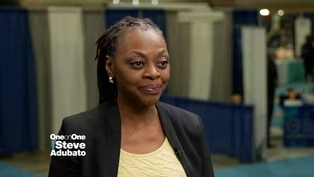
Advocating equal access to quality education for all
Video has Closed Captions
Clip: S2025 Ep2785 | 12m 39s | Advocating equal access to quality education for all (12m 39s)
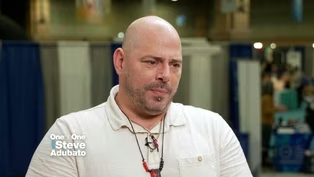
Preserving the Lenape Nation's culture through education
Video has Closed Captions
Clip: S2025 Ep2785 | 14m 2s | Preserving the Lenape Nation's culture through education (14m 2s)
Providing Support for PBS.org
Learn Moreabout PBS online sponsorship
- News and Public Affairs

Top journalists deliver compelling original analysis of the hour's headlines.

- News and Public Affairs

FRONTLINE is investigative journalism that questions, explains and changes our world.












Support for PBS provided by:
One-on-One is a local public television program presented by NJ PBS