
You Can't Stop, You Won't Stop, You Don't Stop
Season 6 Episode 9 | 26m 45sVideo has Closed Captions
Bill Stephney talks about his life, career in business and as a Hip Hop pioneer.
Host John E. Harmon, Sr., CEO of the AACCNJ, talks with Bill Stephney, Principal, Broad Market Media, LLC, Sr. Advisor L!ft Studios. He worked on major films and with talents like Chris Rock and Def Jams Russell Simmons. A Hip Hop pioneer, he helped develop careers of artists like L.L. Cool J, Public Enemy and the Beastie Boys. Pathway to Success highlights the African American business community.
Problems playing video? | Closed Captioning Feedback
Problems playing video? | Closed Captioning Feedback
Pathway to Success is a local public television program presented by NJ PBS
You Can't Stop, You Won't Stop, You Don't Stop
Season 6 Episode 9 | 26m 45sVideo has Closed Captions
Host John E. Harmon, Sr., CEO of the AACCNJ, talks with Bill Stephney, Principal, Broad Market Media, LLC, Sr. Advisor L!ft Studios. He worked on major films and with talents like Chris Rock and Def Jams Russell Simmons. A Hip Hop pioneer, he helped develop careers of artists like L.L. Cool J, Public Enemy and the Beastie Boys. Pathway to Success highlights the African American business community.
Problems playing video? | Closed Captioning Feedback
How to Watch Pathway to Success
Pathway to Success is available to stream on pbs.org and the free PBS App, available on iPhone, Apple TV, Android TV, Android smartphones, Amazon Fire TV, Amazon Fire Tablet, Roku, Samsung Smart TV, and Vizio.
Providing Support for PBS.org
Learn Moreabout PBS online sponsorship- Support for this program was provided by Horizon Blue Cross Blue Shield of New Jersey.
- Hello, this is John Harmon, founder president, CEO of the African American Chamber of Commerce in New Jersey.
And thank you for tuning in to Pathway to Success.
Today's guest is Bill Stephanie, principal Broad Market Media, LLC.
This gentleman has done so much to impact music television to Bill.
Let's, let's unpack your story.
- Great.
Thank you John, for having me.
- So let's start, you know, where are you from?
- That's a good question.
Probably from many places.
I was, I was born in Harlem family, then moved to the Bronx briefly, which is where my mother is from.
And then grew up on Long Island, moved back to the city, came of age in Brooklyn.
In fact, I lived down the street from the notorious BIG, the, the rapper, biggie Smalls.
And then when I got married, had kids, I came out to beautiful leafy green, New Jersey.
- So you come from a big family?
Small family, - Three kids, my mother, my father, and a brother and a, a sister.
- You know, what was it like growing up in New York within those various boroughs that you resided in?
- There were so many varied experiences now for my family.
My father being Theodore was from Harlem.
And my mother, Estelle, she was from the Bronx.
So we had a separated, sort of bifurcated cultural New York experience.
Harlem had its its own sort of culture that we're all aware of that, that came out of the Harlem Renaissance.
Going through the, the 1960s, the Apollo, I would get my hair cut in Harlem every week coming from Long Island to Harlem, because my dad didn't trust any of the barbers immediately on Long Island.
I love it.
We had to go to Lennox Avenue and then every weekend I wound up spending time with my mother's relatives who were Afro Puerto Rican and, and Afro-Cuban - In - Co-op City.
- Okay.
- In the Bronx.
And that had, its its own wonderful, rich cultural Afro-Latino experience.
For those who are baseball fans, there was a player named Bobby - Bonia.
Yes.
- Who played for the Mets.
Yes.
Played for the Pirates, known as part of the Killer Bees with, with Barry Bonds.
That's my first cousin, that's my mother's - Nephew.
When did the entertainment or music bug connect with you?
- I was sort of born into it, John, my, my dad started in the mail room of a magazine called Sports Illustrated.
When it debuted in 1954.
He was just right out right outta the army, and he worked his way up through the years into the position of being an editor for the photography department.
Many of the great photos, sports photos, my father was a part of the process of making sure those photos made it into the magazine e every week.
He was also a wonderful emissary for the magazine.
He would hang out with Muhammad Ali, Larry Holmes, Joe Lewis, Reggie Jackson, Joe Tory, just so many great sports personalities from that era became a regular part of my childhood.
- I tell you, that's the story in itself.
So power of Music, where would we be without music?
Kind of respond to those two, two questions.
- Ojs had a song called I Love Music.
And one of the lyrics from that song goes, music is the healing force of the world.
- Yes.
- It's what binds us.
- Understood by every boy and girl, - Every man, woman, boy, and girl.
Okay.
And the, the melodies, the, the rhythms.
Music is the transcending international language for, for all of us.
- So did you play any instruments?
- I was forced to play violin when I was six, seven years old in school.
And then I chose the trumpet.
So I not only played trumpet in many funk and r and b bands when I was 11, 10, 12, 13, 14, 15 years old.
But I started to play guitar and then I played bass and my dad was a drummer, so we always had a drum set in the basement.
So I played drums as well.
So I was sort of, you know, a multi instrumentalist when I was a teenager.
Yeah.
A more, a wannabe prince, but not even near that level of talent.
- So any influencers in your life?
- For those of us who were growing up, began during the 1970s in the New York area, we all listened to one major radio station, WBLS.
- Mm.
- And there was a radio DJ on that station named Frankie Crocker.
Franker Frankie - Crocker, yes.
- The chief rocker.
The chief rocker.
He would say, when Frankie Crocker isn't on your radio, your radio isn't really on.
So we just flowed and, and were in awe not only of his personality, how how he carried himself, but also the great variety of music that he played.
Part of the reason why I I think we hear so many different forms of music sampled and influenced in hip hop over the course of 40 or 50 years is because Frankie Crocker was playing an incredible variety of music from Earth, wind and Fire to Parliament Funkadelic, to obviously James Brown.
James Brown Funk becomes so influential that, again, it, it ignites folks to think about dancing, break dancing in the Bronx.
And that's really how we get hip hop.
- So before we get to that hip hop question a little bit more about how did you get involved in the entertainment industry?
- A combination of sort of inheriting the connection to media through my father, and then in high school I was awarded a, a scholarship to attend a Delphi University to study media and, and communications.
The Urban League of Long Island, along with a radio station, WLIR and a university on Long Island.
A Delphi University came together to devise a scholarship for an African American student to encourage, and this is, you know, some years ago, diversity in media.
And it afforded me four years of study at Adelphi, a paid internship at WLIR.
And you know, I also very quickly became the program director of our college radio station playing hip hop very early on.
- Can you talk about the development of hip hop in New York?
- Yeah.
So hip hop, depending on who you speak to, basically begins in the, the early 1970s, largely in the Bronx and in Harlem, but also other parts of, of the city, other boroughs and Brooklyn and Queens, and even on Long Island.
Hip hop was a, a multidisciplinary arts culture developing in the boroughs at, at that time that included DJing, MCing, what we call rapping today, art on the Street, that's referred to as, as graffiti and break dancing.
The notion of hip hop is based on the concept of battle.
- Okay.
- You know, I, whatever you're doing creatively, I'm gonna one up you because, you know, I want the crowd to wave their hands in the air.
We even likely just don't care.
So whether you're a dj, whether you're an mc, whether you're a break dancer, or even if you're doing your art, I'm going to do whatever it is that I can to create something that makes the audience excited.
- So you talk about the dj, you talk about the, the spinning on the ground, doing the break dancing.
- I, I didn't do any spinning on, on the ground, - But, but James Brown, - You know, the beats that, that James Brown gave the world, and there's a great drummer from the jbs.
The jbs were the backing band for James Brown by the name of Clyde Stubblefield.
There's very influential song from from James called The Funky Drummer.
- Yes.
- And when you hear that, that beat, that beat break, that would be so infectious.
- Yes.
- That again, it, it would drive teenagers to just start dancing and, and create moves right there on the spot.
That, that was the ingenuity of the music and, and the rhythms that were an incredible combination of the experience of African American music you hear in the States, but also retentions from West Africa.
The, the rhythms, how we'd hit the drum, the importance of the drum itself.
James probably exemplified that better than any artist or talent that we've ever had.
- You know, his music was not only entertaining from a dance perspective, but it also connected with what was going on politically, the Civil rights movement.
He talked about being more independent and, and doing for yourself.
But let's talk a little bit about, about the various roles from your professional career.
- Sure.
So at a Delphi University, at my, at my college radio station, I, I played hip hop on the radio as a air personality.
I referenced already for Crocker, I wanted to be the hip hop version of Frankie Crocker in, in college radio.
We were kind of lucky in a way that Long Island itself didn't have its own version of a, a great black urban radio station like WBLS.
Our College Station sort of served as, as the replacement for that.
And I, I did kind of become for Nassau County and Suffolk County on Long Island, the hip hop version of Frankie Crocker that led to me developing sort of a profile within the, the hip hop industry run DMC in their first interview ever in the world happened on my college radio station.
They went from there to writing about the music and wrote for a couple of magazines.
I wrote an article about Curtis Blow.
At that point, Curtis Blow was managed by a guy named Russell Simmons, and I wound up becoming friends with him.
He formed a, a company called Def Jam Records with his partner Rick Rubin.
And when they achieved a big joint venture deal with Columbia and CBS records, they called me Wow.
To come and, and help them and serve as their promotion person.
They have these new young acts.
One, a teenager out of Queens named LL Cool J - Wow.
- Then a, a punk rock hip hop group out of the Lower East Side in Brooklyn, named the, the Beastie Boys, a a singer sort of crooner by the name of Orange Juice Jones, who had a song called The Rain.
So I was the promotion guy for, for all of these wonderful acts.
And then Rick Rubin, the founder and partner of Def Jam, says, well, we wanna sign one of your college classmates who's also a rapper.
He goes, the name Chucky d he has a great voice.
So I went to Chuck and said, yeah, Rick wants to, to sign you.
What, what can we do?
And we went into the lab and we came up with the idea of a political rap group called Public Enemy.
You know, I've been lucky enough to work with so many incredibly talented people that have allowed me to be part of their creativity, - Civil rights movement, your role in that.
- All of the blessings that I've had for, for my career, which I, i I cherish, would not have happened without the struggle, without the fight, without the blood, sweat, and tears of folks who came before us.
I've always felt that I, I had a responsibility to address issues of, of social impact in my art, which explains, you know, working with Public Enemy, working with Spike Lee, working with Chris Rock, I, I spent some time working as the chair of the state Advisory Committee for New Jersey for the US Commission on Civil Rights, where we investigated, you know, many issues related to civil rights impact within the state, I, immigration, incarceration, education, but all of that really comes out of what, what I feel is a responsibility to, to give back and support our communities.
- Well, bill, I tell you, this is great.
So we're gonna take a break here.
We'll be back in a moment.
- For more information, please visit our website.
- Welcome back to Pathway to Success.
You know, bill, I just listened to you and you took me back.
I'm dancing a little bit in my seat, music is playing in my head.
We're gonna pivot a little bit from music and talk about your involvement in the film industry.
- My first real experience just happened by me sitting in my office at Def Jam when Spike Lee came to have a meeting with, with our company about directing videos for, for our acts.
This is before his first film, she's Gotta Have It.
So at, at that point, I informed him that I was in the studio, in fact, working on my own music project with my college classmate, Chuck D. And that project was Public Enemy.
I'd love to stay in, in touch with you.
So a couple of years later, I'm living in Brooklyn about five blocks away from Spike when Spike rides his bike over to, to my apartment.
And he had a script and there's a script about the hottest day in, in Brooklyn that inspired racial strife and, and anger.
And that that script that I still have to this day was for the movie Do The Right Thing.
And he wanted Public Enemy to create an anthem that would drive action throughout the movie.
And that song turned into Fight the Power by, by pe, by the group.
And I really had my first experience creating music for, for a Hollywood film.
From then, I, I went on to actually serve as a marketing advisor for a company, Miramax Pictures, when they released a film called A Rage in Harlem, that starred Force Whitaker, Robin Gibbs and Gregory Hines.
That was a great experience.
I was connected to that opportunity by two wonderful brothers, Warrington and Reggie Hudlin, who then also came back to me and said, well, now that you've done marketing, we want you to be a music supervisor.
And I said, yeah, I'd love to be a music supervisor.
That sounds fantastic.
What's a music supervisor?
And they said, well, it sort of is how it describes that you're gonna supervise music for these two films that we're about to do for Paramount Pictures.
One star is Eddie Murphy called Boomerang, and the other is an animated feature based on a comedian who had been in the Hudlum Brothers first film house party.
His name was Robin Harris, off of his routine called Babies Kids.
So I was the, the music guy, not only behind those two films, but also the soundtracks for, for both projects.
For Boomerang, the soundtrack was still to this day, one of the highest selling film soundtracks of all time.
The song End of the Road by Boys to Men Spent about 15 weeks number one on the pop chart from the soundtrack, Tony Braxton actually debuts her career on that soundtrack.
The Boomerang soundtrack was produced through LaFace records by the two producers, LA Reed and Babyface Edmonds.
- Wow.
Well discuss your new documentary.
- Yeah, John.
So I appear in a documentary about hip hop coming up on Long Island called The Sixth Borough, a documentary to tell the story, not only of the great groups that, and acts that have come from Long Island at one point was probably hip hop's most prolific area.
- Wow.
Now let's come on another side of the Hudson and talk about Newark, New Jersey and this connection to music.
- When we think about the, the capitals of, of black music, of urban music, of great pop music, many folks don't think about Newark, New Jersey in the same regard.
And through a documentary that I was invited to work on by civil rights lawyer and activist Julius Williams, he has decided to tell the story of the music coming out of Newark, New Jersey.
Newark has been one of the hubs of of r and b, black music, gospel, jazz, dance music as well for, for decades.
It's the city that produced through its churches, in my view, my favorite singer of all time, just angelic voice, Whitney Houston, but also in terms of buttery jazz vocal Sarah Vaughn, the Broadway singer, songstress r and b Dance Disco Melba Moore, the rapper's lords of the Underground Red Man.
And you could also say as an adjunct to, to the city, places like South Orange in, in Maplewood, currently csa, Lauren Hill is from, from South Orange.
Maplewood, naughty by nature is from East Orange and Queen Latifah's from Newark in Irvington.
- Can you talk about the significance of art in the communities and then also talk about cuts to that those, those resources that fund these arts initiatives.
- Arts are, are like blood, you know, for a body that the body circulates with our, our blood communities circulate through art without art.
I I don't know how, you know, society, communities, areas, neighborhoods, you know, how, how do we operate?
So when there are factors that, that eat into that cut away to the support of, of our arts, it can have a just a devastating effect just on the health of how, of how, how we live.
We know of how the arts ex impact our young people.
Cuts, you know, sort of become, i I I think almost suicidal for our society.
- You know, if I ever hear of a hearing about the arts and the significance, I'll make sure I make you aware because I've not heard many people frame the value proposition for the arts the way you have and how it could be potentially leverage the impact so many different areas of the community.
And so I thought that was fantastic.
- Yeah, John, we, we have a vibrant arts scene.
You know, we're not only the guard state, we're the art state.
New Jersey is so attractive that leading film companies and networks and streaming companies are now running to the state because they just see how vibrant our scene is here.
- You're also an educator.
- Yeah.
I was selected a couple of years ago through a long time friend and, and colleague Dan Charnis, who's an associate professor at the Clive Davis Institute of Recorded Music at New York University, NYU.
He invited me over to, to teach about the business of music, the business of black music.
I've been also able to conduct classes about film, music and soundtracks as well to show you how things go full circle.
So the current chair of the Clive Davis Institute is a man named Nick Sansano.
Nick Sansano was the engineer for all of our early public enemy records.
Wow.
- Talk a little bit about Lyft Studios.
- So last year, actually, as I had conducted a, a public conversation at NYU with my longtime creative partner, Chuck D, there are some incredibly innovative gen gentlemen who attended the that talk.
Two guys, Raul Mera and Matt Hooper, who are longtime innovators and investors, thinkers, creators.
They've have been working with an investment venture firm and wanted to create a media studio that could tell the stories of the climate change startup companies that they've been investing in.
So from that partnership, they invited me to join them to create a company called Lift Studios that in essence, again, creates compelling storytelling for innovative companies, especially those focused on the challenging issues of, of climate change.
We wanted to tell the stories about our, our climate, you know, how can we create more sustainable ways to improve our lives - For small businesses today who are, you know, trying to navigate with the, the ground shifting beneath them.
Any words of advice you might have for them?
- I, I would quote the longtime hip hop phrase, you can't stop.
You won't stop, you don't stop that.
You have to be in many respects as a small business person, and I am to, to this day, almost ruthless and obsessive when it comes to opportunity.
And that goes from edu- educating yourself, availing yourself of new technologies and education about new technologies.
As we see AI now becoming ever present, don't be scared, be informed.
Make sure you understand how the technology works and can apply to, to what you are doing.
Network, network, network.
You gotta meet people in order to connect to that next opportunity.
And you know, there are no guarantees for anything, but you have to keep on going.
You have to keep on trying.
- That's, that's kind of wrap it up with this, you know, what is the future for Bill, Stephanie, what are you up to?
- You know, the future is, you know, staying active that, you know, I feel lucky that, you know, I'm still here.
There are many of my colleagues that have come out of hip hop who left us too early, have fallen into difficult times so that I get to do the things that I do on an everyday basis while still being a dutiful husband to, to my wife and to our three kids every day.
Man that you wake up is a blessing.
- Bill, thank you so much for being with us today.
- Thank you, John, - Until the next time on your Pathway to Success.
Thank you for tuning in.
Today's message is the significance of the Arts and the upcoming gubernatorial race in the state of New Jersey.
The state of New Jersey is, I would probably say one of the leaders now incentivizing bringing film and television to the state of New Jersey.
And we are very competitive in the, in this region, in this country, in that regard.
And we must continue to encourage the arts.
This interview today with Bill Stephanie was just amazing.
It, it, it brought back so many memories and now you look at those individuals that he referenced where they are today.
Similarly, as we look at this next gubernatorial race, it's all about mutual benefit.
We talk often talk about how blacks have been over-indexed one party versus the other without really sitting down, laying out an agenda that can be agreed upon for some reciprocity.
So I would encourage you notwithstanding who you decide to vote for, that you, you vet that individual.
You, you look into their heart and their soul discern as best you can, their word is gonna be their bond.
So look at their agenda, challenge them with questions.
Your interest is on the ballot if you put it on the ballot.
Thank you.
- Support for this program was provided by Horizon Blue Cross Blue Shield of New Jersey.
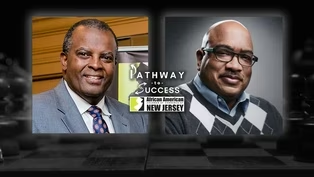
You Can't Stop, You Won't Stop, You Don't Stop
Video has Closed Captions
Preview: S6 Ep9 | 29s | Bill Stephney talks about his life, career in business and as a Hip Hop pioneer. (29s)
Providing Support for PBS.org
Learn Moreabout PBS online sponsorship
- News and Public Affairs

Top journalists deliver compelling original analysis of the hour's headlines.

- News and Public Affairs

FRONTLINE is investigative journalism that questions, explains and changes our world.












Support for PBS provided by:
Pathway to Success is a local public television program presented by NJ PBS