
Zendaya, Andrew Garfield and more
Season 16 Episode 2 | 26m 41sVideo has Closed Captions
Zendaya, Andrew Garfield, Cynthia Nixon, Bowen Yang, Courteney Cox, Faith Hill.
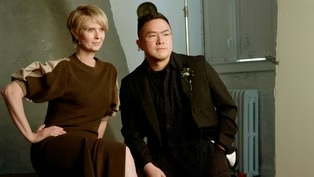
Zendaya ("Euphoria") and Andrew Garfield ("Under the Banner of Heaven") discuss carrying the emotional weight of dark stories. Cynthia Nixon ("And Just Like That") and Bowen Yang ("Saturday Night Live") share stories of writing and directing for television. Courteney Cox ("Shining Vale") and Faith Hill ("1883") compare their process for finding good roles.
Problems playing video? | Closed Captioning Feedback
Problems playing video? | Closed Captioning Feedback
Variety Studio: Actors on Actors is a local public television program presented by PBS SoCal
Zendaya, Andrew Garfield and more
Season 16 Episode 2 | 26m 41sVideo has Closed Captions
Zendaya ("Euphoria") and Andrew Garfield ("Under the Banner of Heaven") discuss carrying the emotional weight of dark stories. Cynthia Nixon ("And Just Like That") and Bowen Yang ("Saturday Night Live") share stories of writing and directing for television. Courteney Cox ("Shining Vale") and Faith Hill ("1883") compare their process for finding good roles.
Problems playing video? | Closed Captioning Feedback
How to Watch Variety Studio: Actors on Actors
Variety Studio: Actors on Actors is available to stream on pbs.org and the free PBS App, available on iPhone, Apple TV, Android TV, Android smartphones, Amazon Fire TV, Amazon Fire Tablet, Roku, Samsung Smart TV, LG TV, and Vizio.
Providing Support for PBS.org
Learn Moreabout PBS online sponsorshipClayton Davis: Have you ever wished you could hang out with your favorite Hollywood stars?
Andrew Garfield: The first thing I did was a Doritos commercial in Spain, and I thought I was done.
I'd made it.
Clayton: Variety Studio invites you to listen in as the most critically acclaimed actors working today discuss their latest role.
Courteney Cox: It's so intense.
I can't believe it.
Clayton: With Zendaya and Andrew Garfield, Cynthia Nixon and Bowen Yang, and Courteney Cox and Faith Hill.
Clayton: Welcome to Variety Studio "Actors on Actors."
I'm Clayton Davis.
Elizabeth Wagmeister: And I'm Elizabeth Wagmeister.
In this episode we're hearing from the actors who gave some of the year's most memorable performances.
Wherever or however you watch those shows, these are the biggest stars in television.
Major players from the Marvel Cinematic Universe, superstars Zendaya and Andrew Garfield reunite after the massive success of "Spider-Man: No Way Home."
Elizabeth: In the second season of "Euphoria," Zendaya gives an acting master class as a teenage drug addict, a role that already won her an Emmy.
Rue Bennett: I'm sorry.
I'm sorry.
I'm sorry, Gia.
I didn't mean to.
I'm sorry.
I'm sorry.
I'm sorry.
I'm sorry, but I need you to tell me where they are.
I need you to tell me where the pills are, mom.
I need you to tell me where the suitcase is.
Elizabeth: And fresh off his Oscar nomination, Andrew Garfield transforms into a devout detective who works to solve a murder in the limited series "Under the Banner of Heaven."
Jeb Pyre: Whatever you want to call it.
Allen has already admitted that he's lost his faith and-- Bill Taba: But if a lack of LDS faith gets man convicted, a lot of people heading to Draper prison, me included.
Jeb: I'm not saying that.
I'm saying leaving the church, that would have created a lot of grief in his family.
They would have put a lot of pressure on him to return to save themselves the humiliation of a wayward son.
And the Laffertys, they're kind of, like, Utah Kennedys.
Andrew: Having seen season two now of your show, "Euphoria," with our friend Sam Levinson, the brilliant creator, show runner, director extraordinaire that he is, and your incredible cast, but I just do want to start making you very uncomfortable and say that it is kind of one of the most remarkable things I've seen an actor do of recent memory because of its rawness, because of its agony, because of its unflinching vulnerability and access to a kind of woundedness and a kind of universal soul cry for meaning that you seem to just have an access.
How?
But how?
Zendaya Coleman: Well, thank you.
Andrew: No, but like-- Zendaya: No, but I mean that.
That means the world.
I really, really appreciate that.
Andrew: No, but for real though.
So how--'cause as an actor, how do you--like, so with that one I was like, are you okay, and how did you make sure you were okay while you were doing that?
How did you sustain access to that agony, access to that rage, access to that yearning?
Like, how did you do that?
Zendaya: I don't know.
You know, it's hard to say that there's any specific process for that, right?
I feel, like, when it comes to Rue, at least for me, my experience with her is I've been able and have had the privilege of playing her for a while, right?
So I've had the luxury of living in her skin and seeing through the eyes of an addict and trying to always kind of--I think the approach was to try to approach it as human as possible without ever shying away from the devastation and the ugliness of what that can create, and also 'cause it's not just about Rue, right?
That whole kind of opening, it's about an entire family and friends and loved ones that are affected by that pain as well.
And you have to show that and you have to go there.
Andrew: Yeah, my impression is that you had to do some real searching and figuring out how to portray this-- Zendaya: Experience.
Andrew: Experience of being an addict that Rue has in a way that is authentic that may not be within your own experience.
I guess I'm curious about how you kind of gained access to that 'cause it's so chillingly precise and authentic.
Zendaya: With certain characters, right, you have to search for them, and, you know, it takes you a little bit longer to like--for them to click in your body and you feel like, "Oh, I'm in their skin now," right?
With her it's something that just--it's, like, I don't have to think about it as much, right?
She's a little thing that just kind of takes over.
And I know when Rue is here, and--I don't know.
It's weird to say it like, "Oh, I have this love for this character."
But I do because I feel she represents so many people that I've met along the way that have shared their stories with me, and I feel, like, I carry that with her.
Do you know what I mean?
Andrew: I do, yeah.
Zendaya: She's a collection of a whole lot of people.
But when did you find time to shoot a television show?
Where?
You--this man-- Andrew: I was in Ca--I go to Calgary as well.
Zendaya: How did you do it?
So, you know, and then, you know--but with that comes like--there's a million different characters that you're jumping in and out of.
And how do you keep track of those people, and how do you--how are you able to separate or compartmentalize to a degree to make it healthy enough to say, "Okay, this is--I'm leaving them here, and then I'm moving on to this one, and then Andrew is going to be here, and I'm going to leave him here."
You know, how do you find that?
Andrew: It's a good question, and I want to deflect it.
And I want to bring it back to you, but I'll try and keep it on me for a second, but, like, I surf as well.
So it's about wave selection.
And I think--I don't know about how you--if you would agree with this, but I think if we're lucky enough--when I started out acting it was like, "I'll just take anything."
Zendaya: Yeah, right, right, right, "I just want to act."
Andrew: I did like--the first thing I did was a Doritos commercial in Spain, and I thought I was done, I'd made it.
I made, like, 2 grand for 2 days of work.
I was like, "That's like my life is set up."
Like, showing my father the pay stub, going, "I--" Zendaya: "I did it."
Andrew: But then we get--I think both you and I have gotten to a very privileged position where we get to decide and we get to have agency and choose.
And I think I find it important for myself to go, "Well, what am I called to?
What am I actually--do I need-- do I have a choice in this?"
I'm looking for the forgotten aspects of myself that I can activate.
Like this character I play in this, this guy Jeb Pyre, he's a Mormon detective, father, husband in the '80s in Utah, like, I-- Zendaya: There's some difference there.
Andrew: There's a gap.
There's a distance and--but that excites me as well, and I'm like, well, so where does that Mormon detective live-- Zendaya: Inside of-- Andrew: In me, and how can I live as him authentically, and how--and what parts of myself need healing?
Zendaya: The endurance that I think you have to have with a character and emotionally when it comes to a television show as well versus a film.
And I wanted to kind of ask you about, A, your experiences with that, and how do you find working on, like, a longer medium, I guess in that way?
Andrew: It's hard.
I found it really hard.
Zendaya: Really hard, yeah.
I could imagine.
Andrew: But it was a--it's heavy.
It's, like, the universe and the world that my character had to be dipped in, and stay in, and explore, and not flinch away from in pursuit of truth, in pursuit of doing right by this horrendous act of violence that took a mother and a young child, I think that is the thing that kept this character connected.
That was the north star and the light at the end of the tunnel.
He's actually struggling with the same thing of, like, "How do I keep this toxicity away from my family, away from my kids, away from my own being, away from my own soul?
How do I stay clean?"
So it was painful.
It was really, really painful and hard, but what I find is with the projects that I feel actually called to, they do give me some personal healing that I need in that moment or they're ex--I want to express something very particular in that moment, and it expands.
So I always feel like I'm given more parts of myself through the parts that I play.
Zendaya: I relate to that massively.
Andrew: I think that's the idea.
That feels really important 'cause I think as long as we have the longing, then some mystery happens where we find our way into, like, forcing the skin of that person around us or that skin emerges above our skin, however we want to describe it.
And so it's so hard to explain.
Zendaya: It's true 'cause--but I agree in the sense of that like I said the details, the circumstances might be different, but the pain is the same, the emotions are the same, the feeling of it is the same, you know, and tapping into those moments in your life, in your existence where you go, "Oh, okay, I know that feeling.
I know what that feels like."
Clayton: Two of New York's finest, Cynthia Nixon and Bowen Yang, both bring the spirit of the Big Apple in two of the city's most iconic series.
Cynthia Nixon steps back into her stilettos for a new phase of life in "Sex and the City's" revival, "And Just Like That."
Miranda Hobbes: I hope there's no traffic.
Brady Hobbes: Mom, my flight is at 2, yours is at 7.
We have plenty of time.
Miranda: Well, I like to get there-- Brady: Five hours early.
I know.
Miranda: So are you ever going to say anything about my hair?
Brady: Yeah.
It's cool.
What happened to all the gray pride?
Miranda: It's still there.
I just felt like changing it up again.
Brady: Oh, I thought you're just copying my look.
Miranda: Hey, I had it first.
Clayton: And Bowen Yang became the first featured player from "Saturday Night Live" to receive an Emmy nomination.
Now as a series regular he shows up every weekend with some of the most buzzy and hilarious character creations.
Iceberg That Sunk the Titanic: Let's do this.
First of all, you came to where I live and you hit me.
It was midnight, I was chilling, then I hear this Irish cacophony behind me.
I mean, not to be offensive, but, like, tanyanyanyanya.
I'm sorry.
That's what it sounded like.
Cynthia Nixon: Can I ask about performing live and whether it's like nothing for you or whether it's, like, excruciating?
Like, what is that like?
I mean, 'cause, you know, I'm on stage, and, you know, whatever, but I've rehearsed for, like, a month, you know, and I've had my script for maybe much longer than that, you know.
Like, how--I mean, it's obviously such a crucible of creativity, you know, that short timeframe and being shot out of a cannon, but like, I mean, does it-- Bowen: It feels, like, that.
It feels, like, being shot out of a cannon and it feels like--unlike theater, you know, you're sort of reading off a cue card, you're like--I always say, like, you're pitching to the rafters and, like, while also trying to, like, play to the camera and for the people at home.
There's just a lot mentally that you're sort of spinning on, you know, like, spinning plates on.
Cynthia: But are you terrified and are different cast me--like, is there a range of how nervous people are and-- Bowen: Totally.
I think there is this, like, high baseline of, like, frequency and nerves that everyone's like, "Okay, it's Saturday."
Like, and there's, like, loud saxophone music playing that really just, like, kind of gets you in the zone, but everyone--I think everyone now--like, this is just a very 2020s way of working at "SNL" now, but everyone, like, meditates, I think, everyone finds ways to, like, really, like, center themselves or, like, align their chakras, whatever, but I find that I still get this insane adrenaline rush anytime I go on stage.
There's only so much you can do all while going, wow, I was in bed half asleep thinking of this idea, and now it's on--it's going to be on TV.
Cynthia: And everybody is going to see it.
Bowen: Exactly.
And everyone's going to have an opinion on it.
It is always still, like, a very novel thing to me when, you know, you're on stage about to do this thing that you--that was just, like, a seedling of an idea when you were, like, half asleep on Tuesday, and now it's Saturday, and you're, like, on camera.
Cynthia: For--and millions of people are going to see it.
Bowen: Yes, and everybody's watching, yeah.
I wanted to ask you about "And Just Like That."
And I wonder how it must have felt for you to go back into playing Miranda as an actor who probably experienced closure many different times as you've played her, as you've ended each project, whether it was the show originally or the movies.
I imagine you've, like, gone through some moment with those things going, "Well, this is how I let go of her."
Talk about what it's like to get back into that person.
Cynthia: So when we finished the series after six years, we really--I mean, it sort of seemed like that was the end, you know, and then the first movie and the second movie.
And really for years after the second movie people would ask me on the red carpet and whatever, and I was like, "There will not be anything more, we're done."
Bowen: I believed you.
Cynthia: Well, I believed me too, but, you know, Kristin Davis always believed, and she would always say, "You never know."
So I guess for me--maybe this is a funny answer to your question, but I guess for me, like, she never--she lives within me.
She lives within me.
So it wasn't like we had to be reintroduced or go on dates or anything.
Like, we're good, but for me I guess the thing about Miranda, that the only downside to Miranda is when you're so identified with a character, other kinds of roles can elude you for a certain number of years until you get some distance from that.
Bowen: But you feel like you've got that distance just as you were, I don't know, maybe exploring other things.
Cynthia: Yes.
I mean, I got to do so many fun.
You know, I got to, you know-- Bowen: Be in a podcast with me.
Cynthia: I got to be in a podcast with you.
I got to do a DSA benefit.
I got to play Emily Dickinson.
I got to do all of these things, you know.
But I guess one of the great things about our show is that the characters have always been allowed to evolve and change and age, importantly.
So it was fun to go back to her with sort of everything that had happened to the actors and also to the characters in the meantime and--so you were a writer before--you were behind the scenes before we all got to see your amazing face.
Bowen: Just for one season, which was sort of, like, a little trial by fire, crucible that I think Lorne Michaels wanted me to walk through just so he can make sure that I was, like, decently equipped to do it on cam--to do something on camera.
Cynthia: And so when you were-- I don't want to say just a writer.
When you were a writer, did you interact a lot with the cast?
Did you know everybody?
Bowen: Oh, yeah.
Yeah.
There's a really collegiate quality to working there if you're on the writer or the performer cast level.
Like, you're supposed to really kind of commingle and riff and just, like, come up with stuff, like, as you're just talking, which I think is a really organic way to make something.
Cynthia: So now that you're on the show, do you write stuff that's not for you or you only write stuff that's for you?
Like, how does that work?
Bowen: Generally you write something that, like, you're sort of in peripherally or sort of holding the center, but, like, I always like it when it's some big ensemble piece, when, like, you're pulling in different people.
And I imagine that's what, like, makes acting as a job so fun, right?
I mean, going back to sort of shifting roles, I feel like you have established yourself as a director, but have--but being able to direct an episode, I mean, just, like, that was probably a really interesting experience.
How was that?
Cynthia: Yes, well, so certainly I had directed some things on stage, I had directed some plays that I--new plays or plays that I helped develop, but directing on a film is obviously a whole other thing, and there's an enormous--there's a camera, but there's also an enormous crew of people that are all looking to you for direction.
But having it be on the show that I'm not only already on, but I'm a producer of, but also that I have such a long history in, particularly for so much of the cast, you know, we've known each other for literally decades, and I was unprepared for how supportive everybody would be.
I mean, I assumed that they would be, you know, game and willing, but they were just--I don't know.
It was--they really just were excited, and I think, I don't know, it was almost like they were all my parents.
Bowen: Wow.
Elizabeth: Two of the biggest female stars of the '90s, Courteney Cox and Faith Hill, continue to evolve and capture audiences with their latest roles.
Elizabeth: Courteney Cox played one of our favorite friends in the iconic series.
She now brings her razor-sharp wit to play a writer in the horror comedy series "Shining Vale."
Patricia Phelps: What's up?
Terry Phelps: Nothing, nothing.
I'm just admiring your toddler trapped under a Toyota-like strength and our newly gouged floors.
Patricia: I know you don't want to hear this, but we have a ghost and I'm pretty sure she lives in this closet.
Gaynor, I'm sorry to freak you out.
Gaynor Phelps: I'm cool.
Terry: Okay, okay, let's assume we do have a ghost, Pat, and let's say that that ghost lives right there in this closet.
Do you really think that this armoire situation is the best way to keep her from haunting us?
Patricia: Don't condescend.
The armoire is a stopgap measure.
Terry: Great.
Ghost problem solved.
Let's have breakfast.
[loud banging] Clayton: A five-time-Grammy-winner, Faith Hill, has conquered the world of music.
She's now decided to tackle the world of television with a role in the post-Civil War western series "1883."
Margaret Dutton: I will not lose a child.
James Dutton: She's going to die, and it's going to cut us in two.
And if we don't accept it now, she'll die in some fort with some doctor.
She needs to see every sunrise and every sunset, and we will lie to her and we will tell her she's fine.
Faith Hill: I have to ask you this.
What was it like filming the "Friends Reunion?"
Courteney: It was incredible.
I loved--you know, I'm really close with everyone, but we don't all see each other, and that is--we had not all gotten in the same room in so many--like, only one time that were we all six together since the actual show, but walking unto-- Faith: Are you serious?
Wow.
Courteney: Yeah.
Ain't that crazy?
But the girls see each other a lot.
And I've seen--you know, we've seen each other separately, but yeah, walking on the stage at Warner Brothers was the most emotional thing.
I just immediately burst into tears.
And, I mean, so many things had happened.
So many years of being together.
I mean, you name it, we'd gone through it.
And I don't feel like I have closure on it because I don't--we're not going to do another reunion.
Can you imagine?
But I can't believe that I got that part and was able to make those friends and be a part of something that's still going on.
Okay, so how did you and your husband, Tim McGraw, come about doing "1883," which I love so much, by the way?
Faith: Really?
Courteney: It's so intense.
I can't believe it.
Faith: Yeah, it was intense.
The whole process was intense.
The training of it was intense, but it came to us, Taylor Sheridan, who wrote "1883," he had reached out to Tim and asked if we would be interested in doing a flashback on "Yellowstone," kind of telling the story of the Dutton family and how it began and where they came from.
And from that flashback came "1883."
So he called and said, "Would you be interested in doing an entire series?"
Yeah, like a prequel, like, telling the story of the Dutton family.
And we're like, "Sure, we would love to read something first, you know."
How--I don't know how this works?
Didn't want to say yes right away.
You never know.
You've been doing this.
You know.
You have amazing work, and you would want to read something first, right?
Courteney: Of course, yeah.
Or at least know what you're signing up for.
Faith: Exactly.
So he said, "Okay, sent first four, five episodes."
And after two, we were just like, "Oh my god, this is freaking insane."
And then they kept coming in, kind of, you know, dribbling in and so.
Courteney: Okay, so I will say, I mean, you're incredible in it.
Did you feel--well, first of all, you're a performer and you're this incredible singer that is beloved, and you have to go out on stage and feel so comfortable.
You're yourself.
Just you're being you with your heart right out there in all your songs.
Is it weird to act?
I mean, do you feel better?
Do you feel--not better, but you're behind a character.
Faith: I actually love to perform three songs in, and I stand near my band most of the time, and I'm constantly having to be reminded, "Oh, yeah, the audience is that way."
So I'm--I love performing, and it does come naturally to me three songs in, however playing a character was amazing.
It was rewarding, really rewarding, and to be able to do it with Tim was remarkable.
And we've been married for 25 years.
We have done--we've done everything together.
This was the first thing we had never done together.
Courteney: Never acted together.
Faith: Never acted together.
Courteney: He's really good in it too.
Faith: He's so good.
He's just--thank you, by the way, I'll tell him.
He'll love that you said that.
I'll tell him.
For me it was important that we were--Margaret was my character.
James was Tim's character.
We brought that to the set.
The first time we ever spoke the lines together was when the cameras started rolling and they said, "Action."
Courteney: Wait, what do you mean?
Faith: We never practiced our lines together.
Courteney: Oh, you didn't.
Faith: Never.
He wanted to.
Now, he would walk through the house and he would say something from an episode and wanting me to, like, pick it up and, like, follow right in behind him and, like, practice, you know, where it's work together.
I'm like, "Uh-uh, you're not going to trick me into this."
Because we're together all the time.
So I just wanted to be as natural.
That was my process with my husband because, you know, you know someone so well.
I mean, come on.
That was kind of a nice surprise.
And anyway it was a lot of surprises.
How was it coming back to television?
Courteney: I will say I was excited to come back and do something, but I had to be really cautious 'cause I had done one pilot.
I'm lucky.
I did--I'm not one of those actors that does pilot after pilot and then finally gets the series.
I never did that.
So I did one and I was like, "Oh, this--I don't really like it if it doesn't get picked up.
That's not fun."
So I was really careful.
And I read "Shining Vale," and I thought, "This is the best character I've ever played."
It was the richest, the most layered.
I love Sharon Horgan.
She's completely my sense of humor and style of writing and the whole thing.
And Jeff Astrof was on "Friends."
He wrote on "Friends."
And so I knew how funny he was, but I didn't know how incredible.
Faith: Do you ever get frightened when you're filming these shows?
Like, does something ever scare you, because I literally yelled a couple of times watching, well, many times watching the show.
Like, and I kind of knew what may pop out or something was going to happen, but do you, knowing what the script is and knowing what is coming, do you ever--were you ever surprised?
Courteney: Well, I am a real scaredy cat and everything kind of scares me.
So yes, when I would scream in the mirror and the windows, it was the way she was lit was creepy, and she's an incredible actor, but one of the things is it's very easy to jump out and scare me.
And the house was really--it's something was going on even on the soundstage.
So Greg would sometimes scare me just on the set, and then they would put that in, and then I can recreate it because I am--I'm a pretty quick screamer.
Faith: So you're easy, yeah.
Courteney: I'm a quick study for scaring, yes.
Clayton: We hope you've enjoyed our look inside Variety Studio "Actors on Actors."
Elizabeth: Please join us again next time.
Andrew: Sugar.
Zendaya: Oh, snap.
He is from--okay, dang.
Okay.
Andrew: Oh, darn.
Zendaya: Darn.
Darn it.
Andrew: Oh, fudge.
Zendaya: Fudgesicles, you know.
Bowen: Thanks for doing that.
Cynthia: Yeah, it was fun.
Bowen: It was fun.
Faith: Yeah, honey, let me tell you something--can I--honey.
I can call you honey 'cause you're from Alabama.
I'm a Mississippi girl.
We can talk about this all day long.
Where's the sweet tea?
Zendaya, Andrew Garfield and more (Preview)
Video has Closed Captions
Preview: S16 Ep2 | 30s | Zendaya, Andrew Garfield, Cynthia Nixon, Bowen Yang, Courteney Cox, Faith Hill. (30s)
Providing Support for PBS.org
Learn Moreabout PBS online sponsorship

- Arts and Music

Innovative musicians from every genre perform live in the longest-running music series.











Support for PBS provided by:
Variety Studio: Actors on Actors is a local public television program presented by PBS SoCal