
Zendaya, Nicole Kidman, Amy Adams, and more
Season 21 Episode 1 | 26m 39sVideo has Closed Captions
Andrew Garfield, Ryan Reynolds, Amy Adams, Demi Moore, Nicole Kidman, and Zendaya.
Andrew Garfield ("We Live in Time") & Ryan Reynolds ("Deadpool & Wolverine"), Amy Adams ("Nightbitch") & Demi Moore ("The Substance"), Nicole Kidman ("Babygirl") & Zendaya ('Dune: Part Two" and "Challengers").
Problems playing video? | Closed Captioning Feedback
Problems playing video? | Closed Captioning Feedback
Variety Studio: Actors on Actors is a local public television program presented by PBS SoCal
Zendaya, Nicole Kidman, Amy Adams, and more
Season 21 Episode 1 | 26m 39sVideo has Closed Captions
Andrew Garfield ("We Live in Time") & Ryan Reynolds ("Deadpool & Wolverine"), Amy Adams ("Nightbitch") & Demi Moore ("The Substance"), Nicole Kidman ("Babygirl") & Zendaya ('Dune: Part Two" and "Challengers").
Problems playing video? | Closed Captioning Feedback
How to Watch Variety Studio: Actors on Actors
Variety Studio: Actors on Actors is available to stream on pbs.org and the free PBS App, available on iPhone, Apple TV, Android TV, Android smartphones, Amazon Fire TV, Amazon Fire Tablet, Roku, Samsung Smart TV, LG TV, and Vizio.
Providing Support for PBS.org
Learn Moreabout PBS online sponsorshipAngelique Jackson: Get your popcorn ready.
Demi Moore: All right, rock 'n' roll.
Angelique: As Variety Studio brings you conversations between Hollywood's biggest movie stars.
Ryan Reynolds: If I'm gonna bomb, I wanna be the architect of my own demise.
Nicole Kidman: I'm willing to just jump off the cliff and try this, knowing that it may splat.
Amy Adams: I was so out of my league and I loved it.
Angelique: With Andrew Garfield and Ryan Reynolds, Amy Adams and Demi Moore, and Zendaya and Nicole Kidman.
Nicole: I feel so lucky to be here.
Like, I get to do this.
♪♪♪ Angelique: Welcome to Variety Studio "Actors on Actors."
I'm Angelique Jackson.
Clayton Davis: And I'm Clayton Davis.
In this episode, we're getting the inside scoop on some of the most memorable characters from the past year.
Angelique: Courtesy of the talented actors who brought them to life.
What happens when Spiderman meets Deadpool?
Get ready for Andrew Garfield and Ryan Reynolds, as they break down the art of breathing life into unforgettable characters.
In the romantic drama "We Live in Time," Oscar nominee Andrew Garfield gets personal as a man grappling with his wife's cancer diagnosis.
Garfield crafts an emotional journey that movie lovers won't soon forget.
Tobias Durand: And the second thing, I was guilty of focusing on the wrong thing--aspect.
Looking ahead instead of right in front of me, at you.
Angelique: Ryan Reynolds is back as the daring foul mouthed Deadpool.
Paired up with a claw-wielding Hugh Jackman in "Deadpool & Wolverine," Reynolds brings his signature wit while revealing a new depth to his iconic character, as he searches for a place in the ever evolving superhero universe.
Deadpool: I need you and, even more unfortunately, my entire world needs you.
male: You two are gonna -- fight?
Deadpool: You gonna take that from him?
Wolverine: Yep.
Deadpool: I could tell you have a sort of "don't get too close, I'll only break your heart" vibe going here, but every other Wolverine would have really hurt me by now, and I'm sort of on the ticktick, so, upsy-daisy, here we go.
Andrew Garfield: I think we've begun.
Ryan: We have.
I think, yeah.
Are you asking first or am I?
Andrew: So I was-- I had just watched the film.
I watched "Deadpool & Wolverine," I hadn't seen it.
Ryan: Watched it on your Apple watch, didn't you?
Andrew: I--no, I had--.
Ryan: 'Cause that's how I watched "We Live in Time," and I'm telling you, it was really hard to, like, hold, you know, the attention and stuff like that.
You're like, oh, this is like--how do kids do this?
Andrew: Could you just--so I, as soon as it started, I was like, there's no way.
There's no way--.
Ryan: That you're going to get through this.
Andrew: There's no way they allowed him to do all of this.
How did you--well, first of all, I think the audacity, because you're, like, the head writer on this film, which is kind of an amazing, you know, place for you to be.
Ryan: Yeah, I'm lucky to, yeah, be able to--yeah.
Andrew: You're doing something in writing that I don't think--I don't know anyone else who's doing in terms of peeling back the onion of the self-awareness and metaness and the layers of self-mockery are kind of impossible to decipher.
And it's really inspiring because it does feel like a new form, in a way.
How did you convince everyone that it would work?
Ryan: Oh, that's a good question.
I, you know, I look at, like, I look at authorship and control, or however you wanna frame it, as trust.
Like, you know, I have to--my--part of my job, well, several parts of the job, which is that I have to convince the studio, who was, you know, making a significant investment in, you know, mine and Shawn Levy's ability to land the plane on a dime.
And if I'm going to bomb or win, I want to have a say in it and I want to have some authorship.
And if I'm gonna bomb, I wanna be the architect of my own demise.
I don't wanna be a passenger on someone else's nose diving jet plane.
Andrew: Totally, so the Deadpool suit, because it's evolved since, you know, you first slung it on to now, and I'm just curious about the evolution of the suit.
Ryan: Well, you--the suit, as someone who knows what it's like to wear one of the full--mine, of course, is made of individually wrapped Gaelic toffees.
No, my suit--the suits are tough, but to me the suits are freeing in that I find it's clown work that I'm doing, that--.
Andrew: Yes, yes, yes.
Oh, I love--it's a great answer.
Ryan: So my--well, thank you.
My--I have to rely on my voice or micro facial expressions, where you would normally have this--.
I rely on my body for more macro expressions, and all of that comes from being obsessed with Jack Benny and Buster Keaton, Harry Lloyd, Chaplin, and Marcel Marceau, who's a mime, just saying to the people that don't know.
So the suits are very important.
For me, it's really--it's old-fashioned clown work.
In "We Live in Time," you are--there's so much humanity.
What is it about "We Live in Time," what is it about that interconnected relationship with Florence Pugh's character, Almut, that made you go, "Yeah, that--I have--that's--?
Andrew: Yeah, I want, oh God, I don't know if you feel this way, but I feel like, and it's obviously the thematic for the film, I've been initiated recently into a new visceral understanding of how short this visit is on this planet, in this body, in this miracle.
And I feel this crazy new urgency, like I only want to do the things that speak to my soul, that I feel like I am the vessel for to get into the world.
So like, I feel with that one, it was--just came across my desk and I was like, "Oh, -- this is definitely for me."
It was just that simple.
It was just like, oh no, this is definitely for me because of--I'm living this right now.
My dad is living this right now.
I have friends who are living versions of this right now.
And I don't know if anything matters more than love and a kind of awakening to how miraculous and how short and how sacred being alive is.
And I don't know about you, but I don't imagine I'm ever going to start something new and feel like I know how to do it.
I really don't think that's ever gonna--it's like, as I'm 41 and I'm like, I don't know, I'm still--it's just an old friend at this point.
Ryan: What is the nighttime skincare routine?
Because I--wow, what?
Okay, sorry.
Carry on.
I was--no, we didn't need that.
Andrew: The--thank you.
Yeah, it's--it--I remember I was in rehearsals for "Angels in America," that we were doing and, you know, it was like week two or week three of an 11-week process, and Tony Kushner comes to visit us in London and he's gonna sit through for our first rough run through of act one and two of part one of "Angels in America."
And we do it, and I'm like, "Hey, yeah, we got through that."
And I look at Tony, he can't look at me.
He literally cannot make eye contact with me.
It's like, I would rather not be alive in this moment.
Ryan: You just wanna walk straight into the ocean.
Andrew: Straight into the river.
There was the river right there.
It's full of toxic waste.
It's like, we either throw ourselves into the river, and then the other choice was to go to the next rehearsal and, like, live in that shame.
Ryan: This is exactly why you're you, because I think people--no, I'm just--take it.
Take it, Garfield.
Andrew: No, but I think it's all artists.
I think it's all creative people.
Ryan: But it is, though, because you see it in the work.
Like, you can't be great at something unless you're willing to suck at it and you get this chance to do something that you didn't do before.
It's the best feeling on earth.
You make intimate character pieces, like "We Live in Time," that you and only you were put on this earth to do, you know.
Sorry, you're getting it.
I'm--Garfield, I'm a big fan and I was nervous when I came here.
You went with the full blue.
I went with the UPS delivery sort of feeling.
I overthought it, I realize that, but that's because of you.
I was nervous.
I was excited.
Andrew: No, but seriously though, what's--what does the future hold for "Deadpool & Wolverine" and the franchise?
Ryan: I don't know.
I, honestly--I, you know, I'm not making this up.
I don't--my feeling is that that character works very well in two ways.
One is scarcity and surprise.
So, you know, it's been six years since the last one, and part of the reason is that it swallows my whole life, and I have four kids and I don't wanna be--I don't ever wanna be on a first-name basis with any of them--no.
I don't ever wanna be absentee and I don't ever wanna miss stuff.
I like, kind of die inside when I, you know, when I see their face and they have a competition or they do a sports thing or something and I missed it.
And I--so I was like, I--so I don't know what the future of Deadpool will be, but I do know that I made the movie--Shawn and I made the movie to have a beginning, a middle, an end, and be a complete experience instead of a commercial for another one, and I love that.
Andrew: Yeah, you can feel that.
Ryan: Yeah, and I think it's sort of, like, important sometimes to, you know, make space for a movie to just be a movie.
Clayton: Amy Adams and Demi Moore challenged society's relentless demands on women and mothers with a pair of powerhouse turns and surreal stories.
Oscar nominee Amy Adams is at her most ferocious in "Nightbitch," playing an overwhelmed stay-at-home mom who sometimes turns into a dog.
It's a bizarre plot, but Adam's relatability grounds the story in reality by tapping into the primal and instinctive nature of motherhood.
Mother: Do you ever feel like the big secret is that we are gods?
Jen: What?
Mother: We create life.
We make life.
We are so powerful.
I bet men are terrified of us.
I mean, look at you.
You are this miraculous goddess, growing bones as we speak.
Clayton: In "The Substance," Demi Moore plays an aging TV fitness guru who takes a back-alley drug to create a younger replica of herself.
As the daring body horror film dissects youth and beauty, Moore delivers a career best performance without a hint of vanity.
♪♪♪ ♪♪♪ ♪♪♪ ♪♪♪ Amy: I'm so happy to be here.
Demi: I'm thrilled.
I feel like we've met, but we've never really had, like, the calm or the quiet to really have a conversation.
Amy: No, absolutely, so I'm really excited to get into it.
So I'll get into it and be like, saw "The Substance."
As always, you're amazing, amazing.
So when you read the script, like, was it, like, you totally were there?
Like, what--.
Demi: I mean, you know, first of all, on the page I could just see that this was such a unique, interesting way of exploring the subject matter, which was the violence that we can have against ourselves, the way in which we can dissect, criticize.
And also, from a--from--just looking at it from an actor's perspective, doing something where there was very little dialogue, where almost none of my scenes--I wasn't having the opportunity to really play off of anyone else and having, really, no idea exactly how to approach that or what that would be.
Amy: Yeah, I mean, it took me a while into the movie to recognize how alone you were, and it was so powerful, and I so deeply resonated with that idea of sort of self-critical--.
Demi: The self-sabotage.
What's interesting is, stepping into something that was really also stripping myself down, really, knowing that this was kind of a depth of vulnerability and rawness that I don't know if I've ever had a chance to kind of step into, which makes me think about having watched you in "Nightbitch," which really, I feel like, equally goes to such a raw, vulnerable, untethered kind of space, of which you were, once again, brilliant.
So tell me what it is about this that made you want to do this?
Amy: So much about identity and about when you lose your identity, or when you're in a transitional space between who you were, but you're not yet who you're gonna be, and you're just sort of floating and trying to grab on to anything that feels like you.
And it's just--that feeling of being lost was so--.
Demi: I mean, it was very relatable.
Very relatable in that sense of losing oneself, particularly when your priority shifts so completely away and where it's entirely with somebody else in number one position.
And you're right about that question of: who am I?
Amy: Yeah, not recognizing yourself, really.
And that can be physically, that can be emotionally, you know.
And I love that she was such a smart, competent woman as well, you know, and she was someone with a really strong point of view.
Because I sort of identified with this idea of being somebody who really thinks she can do it all and get it all done herself and doesn't need help.
And she puts the outward appearance of having her -- together, really.
But also, she had a really unique narrative and she gets to turn into a dog and sort of, like, be in touch with, like, an ancestral rage.
Demi: That is the question.
Did she really become a dog?
Did she really go out and--.
Amy: I believe that she believes.
That is the question.
But I love how both of our films also deal with surrealism and mysticism and sort of these elements of sort of rage and, yeah, there's a lot of similarities and--.
Demi: It's very interesting.
It kind of, also, in dealing with women in general, there is a sense of it not being okay to be angry.
There's a limitation in a way.
Not that anybody's saying we can't, but kind of that it's been, like--in a way, like, the collective consciousness of, like, oh, that's not attractive, or that's--.
Amy: Yeah, I mean, I've had to--I don't know, you've raised daughters, and I've had to really work on being like, "Oh my gosh, you're such a good--no, don't say it.
You're a good person and I'm really proud of you," instead of "You're a good girl," because there was something about that, that I recognized that I was paralyzed by for parts of my life, yeah.
Demi: Like, oh, be the good girl.
And what does that mean?
That is very--.
Amy: And how do you betray yourself when you do that?
I have been very affected by your work throughout your career because I remember watching you and thinking, that's what it is to be a woman.
That's what--no, because you were strong and you were authoritative.
You always felt like you owned your own identity.
I was just like, that is what it is to be a grown-up.
Demi: I think sometimes roles find us as much as we find them, and that there's usually something in it that also is that extra opportunity for our own personal growth, or like a little gem.
And in many cases, I think that some of those strong women were what I was needing to find in myself.
Amy: I totally understand that, yeah.
I feel so incredibly grateful that I've had the opportunity.
You know, "Nightbitch" falling at that point in my life, there were things I was kind of trying to explore, going through different transitions in my own life, and getting to sort of pour that in, and also discover some strength, rediscover things through it.
I've done some films since then where it's also indicated to me, like, okay, yeah, I just need to stay open.
Demi: That is exactly it.
I look at this, and while I had done so many things on my own kind of personal journey about letting go, of placing too much value on the outside, and really, finding greater appreciation just for being a human being who's fallible and imperfect, I feel like on the other side of this I gained a greater liberation that I wasn't expecting because I thought I'd kind of stepped in enough, but in a way that almost shed a layer, shed a layer of fear.
Angelique: Already two of the most popular stars on the planet, Nicole Kidman and Zendaya dominated the cultural conversation this year with films that examine sex and power.
Emmy winner Zendaya displayed her range with stunning turns in dual roles: as a stoic warrior protecting her desert home in "Dune: Part Two" and as the puppet master of a sexy tennis-fueled love triangle in "Challengers."
Tashi Duncan: It was like we were in love.
Or like we didn't exist.
We went somewhere really beautiful together.
Angelique: Oscar winner Nicole Kidman gets both risky and risqué as a tech CEO who gets involved in a sexual relationship with a subordinate.
Kidman strikes a tricky balance between alluring and anxious, as a woman putting it all on the line.
Romy Mathis: I wanna be what you like.
I wanna be the woman you like.
Jacob Mathis: This is all very confusing.
Can you be a little bit more specific?
Romy: I've never experienced any of these fantasies in my head in real life.
I haven't because I--until I met this--.
Jacob: You met-- Who did you meet?
Zendaya: We're here.
Nicole: We're here.
Let's talk about your projects.
You have "Challengers" and you have "Dune 2," I saw "Dune 2" in London.
Yeah, I was like riveted.
I'm a Dunie.
Zendaya: You're a Dunie.
Nicole: Yeah, and I'm obsessed.
So we'll get to that.
Zendaya: No, well, I mean, "Dune" is so special.
It--I actually didn't know much about "Dune" at first.
It was really Denis Villeneuve, like he's got such a, you know, beautiful body of work, and I was such a fan of his work and was introduced to the "Dune" universe through him.
I just feel very lucky to, like, be a part of this, like, really massive, beautiful piece of work.
There was actually one day where we were doing Chani and Paul's kiss, and Denis did this beautiful kind of sweeping shot.
It was, like, 4 o'clock call, you know, getting ready, because we wanted to do a sunrise.
So we're, like, sitting there on the sand dune, looking out at the dunes, and, like, when I tell you, there's, like, nothing changed about that shot.
Like, it--that's not special effects.
Like, that's what we were looking at.
It was so gorgeous and, like, unreal.
Nicole: Because are you in--you're not in Petra or any of those places in Jordan near.
Zendaya: Not--we didn't shoot in Petra, but we were close, close.
Nicole: Yeah, so you have all of that ancient--that feeling around you.
Yeah, and you're not just sort of visiting as a tourist, you're living, working with crews, with people in those places, so you really become a part of it, and it's one of the greatest parts of our job.
I love saying to the crew, because, you know, sometimes you have to be bubbled and you have to--you're trying to sort of work in--and they're so--I love being able to go, "Okay, I've got to go away now," or, "I'm gonna be"--and they--and you sort of all get this language where you understand each other and everyone kind of vibes each other, and it's almost like telepathy starts to happen between you, the director, the cast members, everybody.
Zendaya: Is that what--did you--do you feel like you found that when you were doing "Babygirl"?
Because I feel like that's such an intimate experience, and you have to feel so safe, you have to feel protected, you have to feel like your set is--.
Nicole: We sort of have the same, because you did "Challengers," right?
Where it's like, you're dealing with intimacy and a subject matter that's intimate and deep and you're like, okay.
Yeah, and I feel that the cinematographer is a--and the camera operator is a huge part of that.
You have to acknowledge we're all in this.
It's not just the actors.
It's like you become--.
Zendaya: That's so true.
Nicole: But you're--you have to become unaware.
So you have to be aware to start, to become unaware.
Our director Halina Reijn, she was--she created a very warm environment, but it was also exploratory, which I love.
Zendaya: So you could use the space and--.
Nicole: Yeah, you may be sitting in this chair, and then suddenly the scene is on the floor.
Zendaya: Right, because I was wondering.
I got asked a lot about, like, the three-way kiss scene on "Challengers," and I was like, really, it's like a five-, six-, seven-, eight-, nine-way kiss because there's, like, so many people on the other side.
Like, you guys just see the three of us, but there's a camera, like, coming at us at a certain time, and I know that when I go from Mike and then I go to Josh, then I go--and there's three of us, okay?
And then when the camera comes in, I gotta move back, and then the camera's gonna go over, and I gotta make sure that--you know, it's like, there's so many things that kind of are at play.
And like I said, like, having a rhythm with your camera operator, it's just so much more than, like, what people see.
Nicole: Yeah, but that's our job, is to make it look like--and then also, for the energy, because so much of acting is energy and the passing of energies, and when you can capture energies amidst the choreography or the technique, that's what I find, still to this day, the thing that's like--.
Zendaya: And so when you pick things, like when you pick projects, is it--are you focused on the story and the script, or do you think about filmmakers and who you want to work with, or like, is it different every time?
Nicole: Yeah.
Are you?
Zendaya: I don't know.
I think it's different every time.
I think it's like, sometimes it--like, for "Challengers," I couldn't really call it any one genre.
I felt like it was heartbreaking, but it was also funny, but it was a little bit sexy, and I think she was just a female character that felt very unapologetic, and couldn't pass up the opportunity to play her, you know.
And so--and then, kind of, when thinking about who would connect with this material, I think Luca was kind of, like, the perfect fit, and he just had such a deep understanding of all three of these characters in, like, a really nuanced way.
And also, just like, the details of a character.
Like, our first conversation was, like, "What cream does she use to go to bed?"
You know what I mean?
Like, what kind of woman is she, you know.
And he just kind of really gets that on--in a deep sense.
Nicole: Yeah, I love hearing about all the different--because he's superb too.
You get to work with the best directors.
Zendaya: Very lucky.
Very, very lucky that they want to work with me, too, because, yeah, I don't know.
Nicole: But it's also because you're hungry and wanting to and open and willing and, you know, so it goes both ways.
Zendaya: Yeah, I think so.
But it's definitely like--it's case by case, you know, with projects, you know.
At least for me, you know.
It's like sometimes it's the director, sometimes it's the project.
I don't know.
Nicole: Sometimes for me it's just the idea, because I'm really interested in philosophy and I love, just, ideas.
So even if it's not realized, I'm like, I'm willing to just jump off the cliff and try this, knowing that it may splat.
But you can't be frightened of the splat.
Zendaya: But I think that's a great quality to have.
I mean, like, I feel like sometimes for me, my hardest thing is I get so in my way because I--I'm such a over thinker, right, and like, very self-critical and all these kind of things.
I find that, like, being--.
Nicole: Do you watch the thing back?
Zendaya: So here's the thing.
I was talking about this earlier today, but like, being on sets is the only place that I feel like I can be spontaneous and be free because I'm like, but that's--because it's not me.
I'm like, I don't have to worry about the consequences of these actions.
They're not my--it's not my life, you know, and I can fall completely into somebody else's life, and it's so freeing, you know.
But it's so interesting because I feel like in my normal life, outside of this, I'm so like--.
Angelique: We hope you've enjoyed this episode of Variety Studio "Actors on Actors."
Clayton: Please join us again next time.
Ryan: Does anyone have a crude sock puppet that I can use to explain this?
'Cause I don't know how to do it.
Demi: I've seen a lot of your work.
Amy: I literally almost said something to you, and then I was really embarrassed.
I almost said "ditto."
And then I was like, don't say "ditto."
Demi: You can say "ditto."
Zendaya: Shout out to your kids.
Hey!
Your mom's cool.
Do your homework.
Ryan: I think--well, I hear what you're--I smell what you're stepping in, Andrew Garfield, and I will blow through this answer as quickly or as slowly as you want.
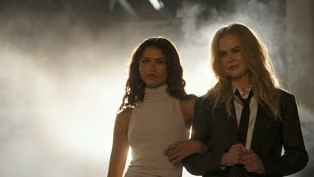
Zendaya, Nicole Kidman, Amy Adams, and more (Preview)
Preview: S21 Ep1 | 30s | Andrew Garfield, Ryan Reynolds, Amy Adams, Demi Moore, Nicole Kidman, and Zendaya. (30s)
Providing Support for PBS.org
Learn Moreabout PBS online sponsorship













Support for PBS provided by:
Variety Studio: Actors on Actors is a local public television program presented by PBS SoCal