God’s Army: Mormon Missionaries


BOB ABERNETHY, host: Salt Lake City, home of the Church of Jesus Christ of Latter-day Saints, is preparing to host the 2002 Winter Olympic Games. Although the church has agreed not to proselytize officially during the games, it has begun a campaign to educate visitors and the media about the Mormon faith. The LDS Church is one of the fastest-growing in the world, with more than 5 million Mormons in the U.S., 11 million worldwide. Our correspondent John Dancy takes a rarely permitted look at how the Church trains its missionaries — 85 percent men, 15 percent women — and what these young people face in the field.

godsarmy-post01-arriving

JOHN DANCY, correspondent: They show up in suits and ties and Sunday best. These 19- to 21-year-olds have been called to serve as missionaries for the Church of Jesus Christ of Latter-day Saints, the Mormons. Every Wednesday, about 500 new missionaries begin intensive instruction at the Missionary Training Center on the campus of Brigham Young University in Provo, Utah.

Greeter: Nicholas E.? Welcome, Elder.

Yesterday, they were wearing jeans and t-shirts. Today, they are referred to as “elder” or “sister.” Immediately, they are thrown into an unfamiliar world.

UNIDENTIFIED MALE MISSIONARY #1: I have got this. (shows blue card)

OFF-SCREEN VOICE: That’s for your food.

UNIDENTIFIED MALE MISSIONARY #1: Food would be nice.

New missionaries and families singing: “Onward, ever onward, as we glory in his name…”

DANCY: When they agree to serve a mission, they commit to go anywhere the Church needs them. Men serve two years, women 18 months. They pay their own way, or their family or congregation does. The Church now has missions in 120 nations and territories.

godsarmy-post03-wirthlin

The missionaries will spend three to eight weeks here, depending on the language they study, learning how to be missionaries. Training goes on from dawn to late at night.

DAVID WIRTHLIN (President, Missionary Training Center): We have an advantage you haven’t had, because we know where your missionaries are every minute of the day.

DANCY: As the moment arrives to say goodbye to families, the enormity of this commitment hits them. It will be two years before they come home again. The regimentation begins immediately.

Elder EARL C. TINGEY (Executive Director, Missionary Department): We want them to leave home and go out and start this new venture, learning the language. It’s not easy to be eight weeks and learn a foreign language, and to learn new techniques of meeting people, learn how to take care of yourself, learn how to wash your own clothes. All of that is new to most of these young men and women. And by leaving their families and starting anew, to look forwards and not backwards.

godsarmy-post04-chinese

DANCY: The Missionary Training Center teaches 48 different languages, more if necessary. That is because the LDS Church believes every person should hear the Gospel in his or her own language. Teachers are usually returned missionaries. Often, in the early going the spirit is willing, but the tongue just won’t cooperate. But within a few weeks, missionaries have mastered basic conversation, enough to teach others about Mormon beliefs: that God appeared with Jesus to young Joseph Smith in a forest grove in upstate New York in 1820 and told him he was restoring the true church, originally organized by Jesus Christ. Mormons also believe Jesus appeared again after his resurrection, this time to an ancient civilization in the New World. The record of that event is contained in the Book of Mormon, which they believe is divinely inspired, like the Bible. Training is sophisticated. Computers help students master pronunciation. The young missionaries are taped as they practice presenting their message to native speakers. The early going is painfully difficult.

godsarmy-post07-laundry

From now on, the missionaries get one personal day a week. Most use it to keep up the rigid personal appearance standards the Church demands. Laundry and letters go together. Missionaries are encouraged to write home once a week. Cheerful, faith-promoting letters are preferred. Phone calls are not allowed here. In fact, over the next two years missionaries will be allowed only one or two calls home a year. Often, tape cassettes are the only way to hear the sound of a girlfriend or boyfriend’s voice. In this ecclesiastical army, just as in the real one, mail becomes a lifeline to home. Serving a mission is voluntary, but the LDS culture exerts strong social pressure on young people to serve. About 40 percent of all young Mormon men agree to “put their shoulder to the wheel.”

Male missionaries singing: “We all have work. Let no one shirk. Put your shoulder to the wheel.”

DANCY: Last year, the Mormon Church had 60,000 missionaries in the field. How many is 60,000? Think of the BYU football stadium on a fall Saturday afternoon, and you get an idea. Now, imagine all those people knocking on doors, and you get a picture of the Mormon missionary effort.

godsarmy-post02-tingey

The kind of discipline and self-sacrifice involved in serving two years in a faraway place is so extraordinary it recently served as the subject of a small movie, God’s Army. The movie depicts one of the most controversial aspects of Mormonism: missionaries trying to convert members of other faiths. Church leaders are unapologetic.

Elder TINGEY: What we do is, we in effect say to that person, bring all the good, all the truth that you have, and let us see if we could add to it. And if we can, and if you are one who is attracted to truth, then we will teach you, we will help you.

DANCY: If Mormon missionaries are God’s army, then these are some of the veterans.

MICHAEL MCNIVEN (missionary, who served in Concepción, Chile): I felt like I went from the make believe world of a 19-year-old and got popped into reality. I felt like I was on the front lines on a war, and it was a war between good and evil and I felt I was right there, and I was a soldier. I mean, that sounds almost romantic, but to me it was reality.

godsarmy-post08-alums

DANCY: All these returned missionaries admit now they entered the mission field with varying degrees of faith.

NKOYO IYAMA (missionary who served in Sacramento, California): I came into the mission with questions, and each objection from a knock at the door actually strengthened my faith.

NATE MATHIS (missionary who served in San Bernadino, California): I probably wasn’t as strong going into the mission. I definitely had a desire to serve and a desire to learn, but my conviction and my testimony was definitely strengthened while I was out there.

DANCY: A problem for the Church is that many new converts the missionaries make don’t stay active. They drop out after the missionaries who converted them go home.

godsarmy-post09-knocking

MR. MCNIVEN: You immediately want to write letters, you want to go find them, you want to revisit, and go back and say: “Hey, don’t you remember all those great experiences we had together?” and “How can I help?”

DANCY: Missionaries, whether they serve on Temple Square in Salt Lake City or in Outer Mongolia, must learn to deal with rejection. Most people they approach don’t accept their message.

HEIDI ANDERSON (missionary who served in Stockholm, Sweden): Every door that is slammed in your face, every person that is not interested — it’s almost a test of what you are saying. Do you really believe this message of Christ that God has a plan for you, and that there are prophets still on this earth today? And I think we have to confront those questions and answer them in our mind and in our heart every day.

MICHAEL SMART (missionary who served in Manchester, England): The hardest was when they had little kids. I would remember that I was a little kid when missionaries came to talk to my Mom and Dad, and I knew what I gained and continue to gain from my parents accepting that message and teaching it to me, and I just wished they would do the same.

godsarmy-post10-leaving

DANCY: Over the history of the LDS Church, more than 600,000 young men have served as missionaries. In a sense, it is a rite of passage.

Elder TINGEY: They go out as older boys and come back as young men with a great maturity, with purpose in life. And they go back to school, and they know what to do in most cases. That comes as a by-product. We don’t want them to go out with that in mind, but it happens in every case.

DANCY: Every Tuesday, a new group of missionaries leaves Salt Lake City — this one, for South America. For the next 18 months to two years, these young men and women will work 16 hours a day, six days a week. On average, each one will convert ten persons during that period. But with 60,000 missionaries in the field, that is enough to produce 300,000 new converts a year.

UNIDENTIFIED MALE MISSIONARY #2: It’s the best work on earth. What can I say? I’m excited.

DANCY: Through the efforts of missionaries, the Mormons expect to have 71 million members worldwide in 50 more years.

(New missionary boarding airplane): Love you guys. See you later.

For RELIGION & ETHICS NEWSWEEKLY, I’m John Dancy in Salt Lake City.

Simchat Bat


BOB ABERNETHY: While a Bris, or circumcision ritual, has been the traditional way for Jews to welcome baby boys into the covenant, many families are now creating rituals to welcome their baby daughters. This practice, most commonly called a Simchat Bat, began about 25 years ago and has gained popularity across all branches of Judaism. Unlike the Bris, which must be performed eight days after a boy’s birth, a Simchat Bat can take place anytime before a girl’s first birthday. We spoke to Debra Nussbaum Cohen, author of a book on Simchat Bat rituals, and attended Sarah Rose Greenberg’s ceremony in New York City.

simchatbat-post02-cohen

DEBRA NUSSBAUM COHEN (Author): “Simchat Bat” means celebration of a daughter. It’s the most general term; it’s accepted in all parts of the community: Orthodox, Conservative, Reform, etc.

A Simchat Bat is usually done at home. There’s no one formula, one ritual, one set, codified ritual for Simchat Bat. It’s completely flexible, almost completely flexible, and very individual to the family, very unique to the family that’s composing it, and welcoming their individual daughter.

And I think most importantly, it’s usually led by the parents, rather than by a rabbi.

All families who do a Simchat Bat for their daughter, talk about the names. And what they mean. And a beautiful way to do that is to have relatives who are most closely related to the people for whom the girl is named, talk about these people who they knew. And of course in a large part of the Jewish community, it’s the custom to name a child after deceased relatives whose personality qualities you want … you hope the child will grow to have herself.

simchatbat-post01-family

Parents can offer their guests or a few honored guests to offer their good wishes to the baby, and they might say something very personal, or they may read some piece of poetry or prose or Jewish text that’s very meaningful to them.

Then things are wrapped up with a song and no Jewish ritual is really complete without a festive Jewish meal afterward.

This is not a woman’s only ritual by any means. It’s just a co-equal opportunity for the first time really, to welcome girls as we do boys, and for mothers to stand up with the fathers to welcome their children.

It’s significant to parents because it’s an expression of their joy, and at having a daughter and a new member of their family, and it’s a way for them to express their commitment to raising her in a Jewishly engaged way.

And it’s significant for the girl, because it’s starting her out in a way that says, “We take you seriously as a member of the Jewish people.”

Pluralism Commentary

In conjunction with our profile on Diana Eck, RELIGION & ETHICS NEWSWEEKLY invited several scholars to comment on religious pluralism in America. According to one, if you want to glimpse the future of religion in America, take a look at Flushing, Queens. Another believes that we are a religious nation because we are a nation of immigrants. And a third asserts that even in our predominantly Christian nation, religious diversity is beginning to make for some interesting new religious coalitions:

R. Scott Hanson wrote his doctoral dissertation at the University of Chicago on “City of Gods: Religious Freedom, Immigration, and Pluralism in Flushing, New York.” He is a postdoctoral research associate at Brown University.

Flushing, Queens is the most religiously and ethnically diverse community in America, with a story that mirrors the nation in microcosm.

Flushing’s town charter of 1645 was the first in colonial America to grant religious freedom. When the provision for “liberty of conscience” was jeopardized by an intolerant governor bent on persecuting anyone who was not a member of the Dutch Reformed Church, the people of Flushing came together to defend the religious minorities in their town. In 1657, they drafted the Flushing Remonstrance, declaring that “we are bound by the law of God and man to do good unto all men, and evil to no man; and this is according to the Patent and Charter of our Town given unto us in the name of the States General which we are not willing to infringe and violate … ” Their efforts proved futile, however, and it was not until 1663, when John Bowne was banished from Flushing for holding Quaker meetings in his house and then successfully appealed his case, that the town and the rest of the colony would more fully enjoy this liberty.

Today in Flushing there are ten different places of worship just on Bowne Street, named for the Quaker who defended the town charter. Hindu and Buddhist temples, Sikh gurdwaras, Muslim mosques, and Korean and Chinese churches stand next to older churches that go back to the late 17th century and alongside Reform, Conservative, and Orthodox Jewish synagogues. Services in Catholic churches are conducted in English, Spanish, and Chinese. Protestant churches of every denomination abound, including over 100 Korean (mainly Presbyterian) churches alone. All of these different places of worship and the people who attend them are densely concentrated in a small residential and commercial area encompassing just a few square miles.

After a certain point, though, it does not seem to make much difference if there are 15 or 150 different places of worship next door to each other. Flushing is interesting because it is such an extreme case and because of its place in the history of religious freedom in America, but how do people make sense of such religious diversity? How does it affect their lives, attitudes, and beliefs, if at all? What do they do with it, and what does it do to them? How have the different religious and ethnic groups in Flushing associated across boundaries over time? Where does conflict or cooperation arise?

There is quite a range of reactions. Some view the memory of Flushing’s heritage as a special blessing and are committed to the ideal of tolerance and the practice of interreligious dialogue; others have forgotten it or are simply unaware of it and see diversity only as a curse to feed their fear of change. Aside from Christians and Jews in Flushing, the numerous immigrant religious groups also have their own thoughts about the other faiths around them. There are a variety of responses to the religious plurality in Flushing, depending on who is asked.

Forty years ago, Catholic theologian John Courtney Murray asked a question that seems particularly relevant for Flushing: “How much pluralism and what kinds of pluralism can a pluralist society stand?” The extreme case of Flushing suggests that there is no limit. Indeed, the great importance of this community may be its example to the rest of the country and the world — an update of sorts on John Winthrop’s notion of “a city that is set upon a hill” and what church historian Sidney E. Mead called the “lively experiment.”

Flushing needs to be reconsidered as part of the history of religious freedom and toleration in America. It is safe to say that most Americans’ knowledge of religious freedom probably begins with Thomas Jefferson’s Virginia Statute and ends with the First Amendment. Those two acts certainly have national significance and practical meaning, but Flushing’s colonial history provides an important local context to examine the same principles on a much smaller level, in addition to a necessary historical corrective to earlier surveys of American history.

What will it mean to live with pluralism in contemporary society? Flushing is still overwhelmingly Christian and, to a lesser extent, Jewish, just like the rest of the country. But it is also confronting profound changes with the introduction of other world religions and cultures. Although there have been moments of real tension and minor conflict — over the years, there have been zoning, parking, and signage (in Chinese and Korean) complaints; newspapers have reported instances of vandalism (graffiti, eggs, destruction of lights); several attacks on new immigrants in the area, all by a white, black, and Hispanic mix of neighborhood teenagers and gang members — Flushing hasn’t experienced the same kinds of problems that have torn apart other places in the world. One reason is that historical and religious claims to territory are not as strong here as they are internationally. Another is our voluntary principle of religious disestablishment, the wisdom of the Constitution, a police precinct with a community affairs office that strives to relate to and protect the area, and the kind of vigilant “eyes on the street” that Jane Jacobs said often can be found among residents in good city neighborhoods. But diversity also seems to create tolerance over time, and the more diverse a place gets, the more tolerant it seems to become. Some or many longtime residents may move away, and those who stay may grumble about the changes and yearn for “the good old days,” but over time, a new equilibrium is reached. By contrast, conflict arises when a new group moves into a place that has been homogenous for a long time.

In 1987, to guard against any potential problems stemming from religious and ethnic intolerance or misunderstanding in the community, a group of Flushing residents, along with religious and community leaders, formed the Network for Intergroup Harmony to identify issues and promote interfaith dialogue. There is much work to be done, but NIH offers hope for the future. Meeting regularly and sitting around a table at a local church, the group sponsors annual events and is committed to being inclusive of all. On another level, local high schools also sponsor various multicultural festivals. If a more perfect civil society based not just on tolerance, but mutual understanding and respect, is to emerge in the new religious America, this is the kind of grassroots activity that other local groups across the country may wish to emulate.

Raymond B. Williams is Professor of Religion at Wabash College and Director of the Wabash Center for Teaching and Learning in Theology and Religion.

Here are two hypotheses about religion and new American immigrants:

1. Americans are more religious by some measures than people in other Western countries because we are a country of immigrants.

Every immigrant group faces the necessity of establishing its identity in a new setting, and religion functions in important ways to provide a transcendent basis for personal and group identity. For new Americans, religious identity has been a means of negotiating relations with the settled population at various stages in American history.

The years between 1920 and 1965 were a peculiar period in American history. I refer to it as “The Lull.” Immigration almost ceased due to U.S. legal restrictions, the world economic situation, the Great Depression, and World War II. The fact that there were few new immigrants during that time had a great effect on the secularization of American society and on the homogenization of American religious institutions that was related to the ecumenical movement.

The current American immigration and religious scene resembles the years between 1880 to 1920 more than “The Lull.” The likely result will be a renewed emphasis on religion as new immigrants create personal and group identities in the United States. These groups will tend to be more conservative as immigrants continue to enter and join the newly established groups. Contemporary mobility and rapid communication also permit close ties with groups and religious leaders in countries from which immigrants come in ways not possible at the end of the 19th century.

2. The increase in the Muslim population in the U.S., though probably not as great as some estimates, is nonetheless significant in at least two contexts: the relation between Muslims and Jews, and the relation between African-American Muslims and African-American Christians. Each of those is potent, with significant implications for American domestic policy and foreign relations.

Tony Carnes is co-editor with Anna Karpathakis of NEW YORK GLORY: RELIGIONS IN THE CITY and chairman of the Columbia University Seminar on Contents and Methods in the Social Sciences. He also directs the Research Institute for New Americans.

Christianity will continue to be the dominant religious framework in the United States. Muslims, Buddhists, and Hindus, after all, make up only 2 to 4 percent of the population. Consequently, Americans will still largely define their religious identity in terms of dealing with a predominantly Christian nation.

Furthermore, a large majority of the new immigrants are Christian, and their presence is fostering a renaissance of urban Christianity, particularly evangelical Protestant and Roman Catholic Christianity. Some Christians are proclaiming a new urbanism, “a Glorious Urbanism.” This new vision will tone down the “Sodom and Gomorrah” image of cities while bolstering faith-based social initiatives.

Migration to the United States is freeing people to experiment with new religious identities. As a result, there is a distinct increase in the number of evangelical Protestant congregations made up of immigrants from countries that have had few evangelicals because of persecution.

Liberal religionists will take heart that an increased religious pluralism supports their universalist theological convictions. Secularists will feel beset on all sides by opponents and vindicated by increasing conflicts among the religions. But conservative Christians will find new allies among Muslims, Buddhists, and Confucians who stress the importance of religion, the search for absolute truth, and moral values, particularly family and sexual values. This conservative coalition is even now a powerful counterweight to liberals in American cities.

Priests With Wives


BOB ABERNETHY (anchor): Last year, just over 500 men were ordained as Catholic priests in this country — about half the number ordained in 1965. One of the reasons for the current shortage of priests is that so many men have left the priesthood to get married. Because of that, some have suggested that the Church consider making priestly celibacy optional.

To average Catholics, it may be hard to imagine their priest with a wife and children. But, to a limited extent, it is already happening. Judy Valente reports.

JUDY VALENTE: Most Catholics have never seen this before: their priest, at Mass, wearing a wedding ring — with his wife and children looking on from the pews.

priestswithwives-post01-medow

His name is David Medow. And until 10 days earlier, he had been a Lutheran minister.

(to Father Medow): Did you grow up with much knowledge of Catholics?

FATHER DAVID MEDOW (St. Mary Immaculate Church, Illinois): I grew up with no knowledge of Catholics, other than seeing these exotic blue-dressed figures walking in the streets of my neighborhood in Chicago going to a local parochial school.

VALENTE: Before he could be ordained, Medow had to spend two and a half years in Catholic seminary. He represents a small but potentially significant phenomenon in the Catholic Church: the ordination of former Protestant clergymen — who are married.

FATHER MEDOW: I loved being Lutheran. But God has called me into this community, and I really had grown into being Catholic in many ways. Not only spiritually but theologically.

priestswithwives-post02-family

VALENTE: (to Mrs. Jane Medow): How have you been welcomed in the parish?

MS. JANE MEDOW (Wife): People have been very accepting, they’re very excited about David coming here.

HANNAH MEDOW (Daughter): A lot of kids have come up to me and gone, like, “Whoa, your Dad’s gonna be a priest.” And they were really surprised.

NIKOLAI MEDOW (Son): We really did this as a whole family. And that’s what makes it what it is: a family journey.

VALENTE: Father Medow’s arrival at St. Mary Immaculate Parish did raise a few eyebrows.

FATHER MEDOW: Many folks have wondered, well what’s gonna happen to Jane, my wife, after I’m ordained. As if somehow we will have to either separate or whatever. I’ve jokingly said to some people, “Well, she’ll have to go to a convent, and we’re distributing our kids to various religious communities.”

priestswithwives-post03-phillipsaltar

VALENTE: Father Christopher Phillips, of San Antonio, had been an Episcopal priest. His transition to Catholic priesthood was easier because Episcopal seminary training is similar to that of Catholics.

In the early 1980s, after the Episcopal Church had approved women’s ordination and other liberal policies, Phillips and about 20 other Episcopal priests petitioned the Vatican to let them become Catholic clergymen. Pope John Paul II said “Yes.”

Father William Stetson reviews the petitions.

FATHER WILLIAM STETSON: The specific issue was the question of the ordination of women. I believe these men felt that that was a significant departure from [the] universal tradition of the church, which one branch of the church could not reach on its own. These were also men holding a strong belief in tradition.

FATHER PHILLIPS: For me the biggest issues were the moral issues. The right to life, [the] abortion question, contraception, a number of things like that.

Father Phillips has five children — two of them born since he became a Catholic priest. The acceptance of Father Phillips and other married men as priests has raised questions about the rule that requires other priests to be celibate.

priestswithwives-post06-sipe

MR. RICHARD SIPE (Former Benedictine priest): I think it shows the contradiction in the church’s teaching.

Richard Sipe was a Benedictine priest for 18 years. He is also a psychotherapist who has counseled members of the clergy.

MR. SIPE: I think it’s an acknowledgement that married men can be as dedicated servants of the people as non-married men. I think it’s a step. I think it’s a link. I think probably it’s a very wise step toward the evolution of a married priesthood.

VALENTE: The Church defines celibacy this way: as a special gift from God by which sacred ministers can adhere more easily to Christ with an undivided heart and can more freely devote themselves to the service of God and humankind.

Sipe calls celibacy an ideal, but often not a reality.

MR. SIPE: A person who claims celibacy and is sincerely trying to be celibate isn’t always sexually abstinent. And isn’t sexually abstinent consistently.

priestswithwives-post07-ordination

VALENTE: The Church itself has said that celibacy is not essential to the priesthood. In fact, the Vatican recognizes the married clergy in the eastern Catholic churches of the Middle East, Africa, and Eastern Europe. Here at a Ukrainian Catholic Church in Chicago, James Bankston is being ordained a deacon, as his wife and two young daughters watch. He could become a priest next year. The Eastern churches have always had the tradition of a married clergy.

FATHER RICHARD KIROUAC (Ukranian Catholic priest): Celibacy was seen as the vocation of the monk. It is a special charism. It is [a] gift given by the Holy Spirit for those who are able to accept it. The authentic tradition would see that as a gift of love, and love cannot be legislated.

Even though the monastic life was an ideal, it was also recognized very clearly that sanctification could come through married life.

VALENTE: Even in the Roman Church, celibacy was not made mandatory until the 12th century. It is a vow that men like these could not keep. They left the Catholic priesthood in order to marry. They want to be priests again.

(to Ron Crowley-Koch): Do you think it’s right for the Catholic Church to ordain these married protestant clergymen as Catholic priests?

priestswithwives-post11-crowley

MR. RON CROWLEY-KOCH (Former priest): I take it as a slap in the face. Here I am, a Catholic priest, went through the seminary, was a priest for six years. I fell in love and got married. The irony is that if my wife would die, they’d welcome me back with open arms.

VALENTE: A study by Catholic University in Washington has estimated that making celibacy optional would quadruple the number of priests. But according to Richard Sipe, a married priesthood threatens the power structure of the Church.

MR. SIPE: If you have a group of people, one sex, with a central organization, none of these men have commitments to wives, to children — they have only a commitment, authoritarianly, up and down [to] this structure. It seems so clear to me how powerful that is, how hard it is to change.

VALENTE: Among the married men who have become Catholic priests, Christopher Phillips is an exception in that he is pastor of his church. Normally, married clergy are given lower-profile assignments — as chaplains or teachers — not parish work.

priestswithwives-post04-stetson

FATHER STETSON: I think the reason is so there is not confusion in the minds of the Catholic faithful with regard to the question of celibacy.

VALENTE: Father Phillips’s parishioners don’t seem to have a problem with his married status.

MS. PEGGY HUMM (Parishioner): I think the parish is very supportive, not just of his role as a married priest but also of his family’s needs.

VALENTE (to William Kirkpatrick): Do you [think] the Catholic Church should allow priests the option to be married?

WILLIAM KIRKPATRICK (Parishioner): No.

VALENTE: Why?

MR. KIRKPATRICK: Because most of them have dedicated themselves to their parishioners and that’s the way it should be.

VALENTE: But it doesn’t matter to you that Father Phillips is married. You think he’s doing a good job.

priestswithwives-post12-phillipskid

MR. KIRKPATRICK: Yeah, but he was married before he became a Catholic.

VALENTE (to Father Phillips): How have your brother priests responded to you, those priests who’ve taken the vow of celibacy?

FATHER PHILLIPS: There may be some resentment among some of them, but at least they’ve had the decency not to say it to my face if there is any.

VALENTE: Father Medow was also given a high-profile position — that of assistant pastor — because his bishop needed another parish priest. Although there is a severe shortage of priests, the number of married Protestant clergy coming into the Church is too small to make a significant difference.

FATHER MEDOW: If bishops here in this country thought this was the answer, they’d be out recruiting Protestant clergy. But they’re not.

VALENTE (to Father Medow): Do you think we should have a celibate priesthood?

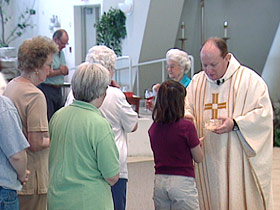
priestswithwives-post09-communion

FATHER MEDOW: Absolutely. Absolutely. And there’s one reason, among many, but for me the greatest reason is God has called men to this lifestyle, and God has gifted men to this lifestyle. That of a celibate priest.

VALENTE: It costs more to have married priests. Father Medow is paid more than other diocesan priests, and he lives in a home owned by the diocese. Father Phillips also lives in a home provided by his diocese. But he is paid only $7,000 a year. How will he educate his five children?

FATHER PHILLIPS: When the various times come, I have no hesitation whatsoever in saying — look, as a priest of the church, if my child wants to go to a Catholic college, will I go to the president and say, “Look I’m a Catholic priest with a family, don’t make a lot of money, is there something you can do for this child?”

VALENTE: The pressure for optional celibacy may be a growing idea, but Church practice is not likely to change anytime soon. And yet, the presence at the altar of even a few married priests, like these former Protestants, can only fuel the debate.

For now, in a handful of Catholic churches and institutions around the country, the word “father” — normally used to address a priest — has taken on a double meaning.

For RELIGION & ETHICS NEWSWEEKLY, this is Judy Valente in San Antonio.

The Archbishop of Canterbury


BOB ABERNETHY, host: The Archbishop of Canterbury, George Carey, was in Washington this week giving a lecture at the College of Preachers at the National Cathedral. The subject was Jewish-Christian relations. Dr. Carey also called on President Bush and helped officiate at a worship service.

Dr. Carey leads the world’s 63 million Anglicans, more than two million of them American Episcopalians.

He is an evangelical who believes Christians should try to convert others so they can be saved. But should that be done with Jews, who already have their own covenant with God? If so, how?

The complexity of that was clear when the Archbishop and I sat down to talk.

archbishop-post01-singing

DR. GEORGE CAREY (Archbishop of Canterbury): I believe that every Christian has a duty, an obligation, to share his or her faith with others. What I’m very concerned about is the character of our witness, our sharing with [our] Jewish brothers and sisters. The character of our witness must be gentle, must be loving, must be understanding of what we owe to Judaism.

I would personally, normally, never take the first step, but I would wait for my Jewish friend to ask about the Christian faith. Then I would feel it would be right to share that faith with him.

ABERNETHY: But not to actively try to convert that person?

DR. CAREY: That is not my style, of course, but because I love my faith, I love my Lord, I want to share him with others. I would wait for opportunities when I can do that in the most appropriate way.

ABERNETHY: Archbishop, do you think salvation is available to Jews?

DR. CAREY: Salvation is given to us, I believe, through Jesus Christ, and that is why he said go into the world and preach the gospel, to share it with others. So that is available to everybody. The burden of my contention is that I believe that God has already a relationship with the Jewish people, so, therefore, it’s much more complex in the case of the Jews.

archbishop-post02-cross

ABERNETHY: Do you feel that unless Jews convert to Christianity they can not be saved?

DR. CAREY: No. I would not want to say that. We must approach it from a viewpoint of a cross, which for me is not a symbol of power — this cross is not a symbol of power, it’s a symbol of service, of suffering. And therefore is an invitation to Jews and everyone to consider the claims of Jesus Christ for yourself. And let’s walk together on a journey to serving other people in our world today.

And if you want to follow him as Jesus of Nazareth, then no one will be more delighted than I. But I want to respect that I’ve got a lot to learn from you as well.

ABERNETHY: The Holocaust shattered the faith of many Jews. What do you say to Holocaust survivors and others who can not understand how a just God could have permitted the genocide?

DR. CAREY: I think that is the most awful, haunting question of all, of what theologians call theodicy. How can we account for God’s silence during the Holocaust? From a Christian point of view, there is something about the cross, which tells me what God is like, and that is He suffers with us. He was there in the Holocaust.

ABERNETHY: There has been so much anti-Semitism over the centuries. The charge commonly was that Jews killed Christ. What do you say about that?

archbishop-post03-carey

DR. CAREY: The first Christians all too easily assumed it was the Jewish race that put Jesus to death. I think that’s a bizarre interpretation. For me, it’s the human race, it was not the Jews who did that, it was us.

ABERNETHY: Would it be fair to say that we have irreconcilable differences over the question of who Jesus was?

DR. CAREY: Yes.

ABERNETHY: But we have so much in common, we just need to get on with things and do what we can together?

DR. CAREY: The person of Jesus Christ is the very heart of it. I regard Jesus Christ as the way to the Father. As the human face of God. And the Jew would look at that person differently. The Jew may well respect Jesus as a faithful Jew even. But I don’t think we need to actually say there are irreconcilable differences, and we walk away from one another. Let’s see how far we can travel together, walk together, understand one another better, and share a responsibility for the world in which we live.

ABERNETHY: Archbishop, as you look at the broad trends in the world, how do you think the tide is running between a religious view of the world and secularism?

DR. CAREY: I’m quite worried about the state of our world. I think [in] the Western world, particularly, we’ve gone far more for lifestyle and less for life substance. There is so much brokenness, broken relationships; substance of life and what really makes for good living — of justice and peace and holiness of life — these things are seen to be rather contemptible.

And I think the religious way of looking at things has still a vital role to play in our society. Therefore, our churches must recover their vigor in proclaiming a clear faith for people today. But not a simplistic faith, a faith actually that can be intellectually satisfying as well.

ABERNETHY: Last week, Dr. Carey celebrated his 10th anniversary as Archbishop of Canterbury.

Baptism


BOB ABERNETHY (anchor): Baptism is an important rite of initiation in the Christian tradition; however, the baptism ceremony varies depending upon the denomination. Catholics, Orthodox Christians, and many in the Protestant denominations baptize infants. Baptists, Anabaptists, and Pentecostal Churches baptize only adults or children old enough to profess their faith. The methods vary from sprinkling and pouring of water to full immersion. In our Belief & Practice segment, we feature the baptism of two-month old Stasha Galczynski at St. Mary’s Catholic Church and the baptism of 75-year old Natalie McCarthy at the Columbia Baptist Church.

baptism-post01-myslinski

FATHER JOHN MYSLINSKI (St. Mary’s Church, Rockville, MD): So Jesus tells us in the Gospels very specifically, when he told his disciples, his apostles: “Go make disciples of all nations, and baptize them in the name of the father, the son, and of the Holy Spirit.”

It’s a call to conversion, it forgives sin, it forgives original sin. And I think that was emphasized for many centuries. Vatican II brought another aspect and reemphasized the whole journey with Jesus Christ, discipleship, new birth. And the water is a symbol of that.

In the early Church, of course, the sacrament was conferred on adults. They were the pagan religions and the Jewish faith. As the Church grew and there were Christian families and Christian families had children, they wanted to bring their children immediately into the church and so now predominantly we have baptisms that revolve around infants.

The Church traditionally has always believed that without baptism you can’t reach that fullness, that full relationship with God in the afterlife. And throughout the centuries, it has talked about limbo and places that these unborn souls would reside for eternity. And I think that has changed, we don’t talk about limbo as much as we used to. Baptism is the fullest way that we can expect to achieve salvation, it opens those doors of the sacred.

baptism-post02-baptist

REVEREND RANDEL EVERETT (Columbia Baptist Church, Falls Church, VA): We think that when a person, herself becomes a follower of Christ then she identifies Christ with the baptism. Whether it’s a 75-year-old or a nine-year-old, it’s a picture of a beginning of a new walk with Christ.

It’s a bond between you and that person. You are participating in a life-changing experience. One of the reasons why we wouldn’t baptize infants [is that] we would be afraid that it would give them a false sense of security that there was no need for a personal decision later in life.

If they’ve been baptized by some mode other than immersion, we ask them to be baptized by immersion just because of the richness of the experience.

The very example of Jesus in the Jordan River — he was baptized by immersion and even the word “baptidzo” means “to dip” or “to immerse” — that’s why we have immersion. I know that sprinkling or other ways are significant, but we feel like you miss something if you’re not [baptized] as Romans, Chapter XI says: “We’re buried with Christ in baptism and we are raised to walk in newness of life.” It’s just a real important symbol to us.

AIDS Prevention in Senegal


BOB ABERNETHY (anchor): The AIDS pandemic has killed 17 million persons in Africa; it has created 12 million orphans. In some countries more than a quarter of the adult population is infected. But in Senegal, a largely Muslim country, the rate of infection is barely one percent.

Public health programs get a lot of the credit, but so do personal behavior, and religion. Fred de Sam Lazaro reports.

FRED DE SAM LAZARO: Senegal has the kind of profile typical of African countries staggering under AIDS. Most of its people are poor, [with] an annual per capita income of just $600, and two-thirds are illiterate. Yet, on a continent where AIDS has infected up to 30% of the population, Senegal’s rate is barely one percent.

aids-senegal-post07-ndiaye

The imams in Senegal’s mosques say there’s one important statistic: the country is 95% Muslim, and they are devout. Homosexuality is outlawed by the Qur’an, they note, as is marital infidelity. AIDS in Africa is primarily a disease of heterosexuals.

Mr. ELIMANE NDIAYE (Imam, through translator): Islam is a religion that prohibits sexual deviance — it does not allow taking liberties with your sex life. As a Muslim, you are obligated to choose your wife and stay with her.

DE SAM LAZARO: There’s no question that Senegal’s mosques are filled on Fridays, and life comes to a stand still each day during the calls to prayer.

However, this former French colony also has a thriving commercial sex industry. Prostitution is tolerated — the only condition being that it keep a low profile. Senegal is alone among African nations to not only acknowledge the sex trade, but it’s also taken elaborate steps to regulate it.

aids-senegal-post02-card

In a program that was started way back in 1969 to control sexually transmitted diseases, Senegal began requiring its commercial sex workers, or prostitutes, to register in places like the poly-clinic here in Dakar, and to come in for regular medical checkups. That program is now key to monitoring the spread of HIV in the country.

About 1,000 women are registered at this clinic in the Senegalese capital, Dakar.

Dr. ANTOINE MAHE: So every month, she has to come here for an examination, and if it’s OK, she has a stamp on her carnet. If the police goes to her, [at] her place of prostitution, she has to show her card, and the policeman checks the regularity of her visits.

DE SAM LAZARO: If she does test positive for HIV, she can continue to work, using condoms, it is hoped. Across the world, the sex trade is often the source of sexually transmitted diseases, so public health officials say the surveillance has been invaluable.

DR. SULEYMAN MBOUP (AIDS researcher): I am military by training, I am [a] colonel in the Army, and I think that even in any war, you need to know first your enemy. Knowing the current situation, you can adapt to what you are doing.

aids-senegal-post03-bambera

DE SAM LAZARO: Mama Bambera became a sex worker eight years ago. She says the registration program has been a huge help, both in health care services and information.

MAMA BAMBERA: This is a really good thing. I’ve learned how to protect myself. I didn’t know anything about AIDS. Now, I am able to get information and to pass it on to people with whom I work and my family members.

DE SAM LAZARO: Professor Suleyman Mboup has studied sex workers in Senegal for 15 years. He says the awareness campaigns have paid off. The infection rate among registered prostitutes is a relatively low 15% and hasn’t increased since the early ’90s.

aids-senegal-post04-mboup

PROFESSOR MBOUP: We was able to document very high knowledge of this population and some behavior change, very high rate of usage of condom[s]. While when you go to non-registered prostitutes, you have [an] increase of this incidence rate of STI, and you have [a] lower rate of knowledge and usage of condom[s], and also HIV. And so, I think this has been very important factor.

DE SAM LAZARO: The challenge for scientists like Mboup is to reach the so-called clandestine prostitutes, whose number could well rival that of registered sex workers. Because prostitution is socially taboo, many women work outside of the system. Many are also likely [to be] immigrants from surrounding countries.

Public health experts say its difficult to accurately measure what accounts for the low HIV prevalence, whether it’s the sex worker registration, religious conservatism, or other factors. Their big worry, looking ahead, is complacency — dangerous in the face of one of history’s most tenacious epidemics.

For example, in villages like Nomre, people pride themselves on living by Islamic family values. Many here are in polygamous marriages, where, they quickly add, fidelity to one’s spouses is still a basic value. AIDS, they say, is a distant problem.

We spoke with many women in this village. None had ever met a person with AIDS or ever seen a condom. At least, not outside a condom commercial.

aids-senegal-post06-praying

UNIDENTIFIED SENEGALESE WOMAN (through translator): Only on television. You see, we have good family values. Being faithful to our husbands is protection enough for us. We’re loyal to each other.

DE SAM LAZARO: However, many men in this village fit into a classic high risk group for HIV. They are men who travel away for extended periods in search of work — prime customers for the commercial sex industry.

That’s what happened to “Amadou,” who said a casual affair caused him to contract the virus. And although his wife has been tested HIV free, Amadou feels condemned as a social pariah. The mosque, he adds, is no refuge.

“AMADOU” (through translator): There are many imams who say that it is written in the Qur’an that people who have adulterous relationships will suffer consequences, like incurable diseases.

DE SAM LAZARO: Religious leaders say they’ll continue to admonish congregants to stick to Quranic teachings as the best prevention, but they insist they don’t condemn those with HIV.

aids-senegal-post08-ahmedndiaye

AHMED MANDAME NDIAYE (Louga imam, through translator): When I meet someone who rejects people with AIDS, I remind them that they cannot be sure that the person contracted it by cheating on his wife. There are many other ways to catch AIDS, so we have to be careful. We also have to take into account that, according to the Qur’an, God is most merciful. If a person repents, God will forgive, so who are we to not give assistance to such a person?

DE SAM LAZARO: Still, Amadou, who says he practices safe sex, is not ready too seek help from the imams.

“AMADOU” (through translator): This is very difficult. This a taboo here. If I went to see the imam or a fellow Muslim, they would say, “Okay, this guy was coming here in the mosque, praying with us, but he was a hypocrite. He engaged in bad behavior, shame on him!”

DE SAM LAZARO: Successfully discouraging that so-called “bad behavior” will be key to keeping Senegal out of the path of the AIDS epidemic.

It remains to been seen in a few years whether Senegal’s religious leaders will still mainly be preaching a message of marital fidelity in their efforts to combat AIDS, or whether they’ll be forced to shift emphasis and talk about caring for people who have the virus.

For RELIGION & ETHICS NEWSWEEKLY, I’m Fred de Sam Lazaro, in Dakar, Senegal.

Pope John Paul II Cultural Center


BOB ABERNETHY (anchor): As we reported earlier, the new Pope John Paul II Cultural Center officially opened in Washington, D.C. this week. Kim Lawton took a special tour.

KIM LAWTON: They call it a museum of faith — a high-tech facility designed to tell the story of the Roman Catholic Church and of the man who led the Church into the new millennium. Organizers say that story has relevance for all people of faith.

jpiiculturalcenter-post01-bugarin

REVEREND G. MICHAEL BUGARIN (director, Pope John Paul II Cultural Center): Even for non-Catholics, it’s a great place to come and visit.

LAWTON: The Center was spearheaded by Cardinal Adam Maida of Detroit, who had urged the Pope to consider establishing a presidential library of sorts to preserve his legacy.

REVEREND BUGARIN: The more the Holy Father heard that idea, he said he didn’t like it. He said it was focused too much on the man and not enough on the mission. His whole mission, his whole pontificate actually is teaching, teaching the message of Christ. And so here, he did not want a monument that was just dedicated to himself, but rather an institution that really focused in on our teaching role within the Church.

LAWTON: So Cardinal Maida and his team designed a multi-faceted center that would focus on the themes of John Paul’s papacy. The Pope began forwarding ideas.

jpiiculturalcenter-post02-statues

(to Reverend Bugarin): And so he was really involved in putting this together?

REVEREND BUGARIN: From day one. In fact, he was the one who chose Washington, DC. He was offered three locations. He was offered Washington, D.C, Rome, and Krakow [Poland], and the Holy Father chose Washington almost instantaneously, because he saw it as the crossroads of the new millennium, of technology and people.

LAWTON: The Pope insisted the center combine theology with state-of-the-art technology. The interactive multimedia exhibit gallery does just that. With the help of a bar-coded swipe card, visitors can read the Scriptures and learn about Catholic history and teaching.

In another exhibit, visitors learn about stained-glass windows, and make their own digital window that is projected on a wall monitor.

An art gallery houses permanent and rotating exhibitions from Vatican museums.

The Center also has a scholarly arm, a think tank that will study issues of faith and culture.

jpiiculturalcenter-post03-map

John Paul conceded that one small exhibit could be devoted to memorabilia from his life, including a pair of his skis.

All parts of the center bear the Pope’s mark. The hands of peace exhibit does so literally, with a bronze cast of John Paul’s hand.

REVEREND BUGARIN (to Lawton): This is actually the Holy Father’s hand print; in a very tangible way, we connect to people around the world that celebrate our faith.

LAWTON: The $65 million Center does have detractors, who wonder whether the money could have been put to better use. Center officials say it’s an investment in the future.

REVEREND BUGARIN: I like to tell people, give me $65 million today and allow me to spend it, and I will not make much of a dent in the world. But give me $65 million and allow us to build an institution, where we could actually have maybe 65 million visitors … [and] actively encourage them to go out into the world to make the world a better place, then I can make a dent in the world.

LAWTON: The Center hopes to have a visit from the Pope himself, perhaps later this year. I’m Kim Lawton in Washington.

New Age Tour of Sedona


BOB ABERNETHY, host: Now an update on New Age spiritual seeking; that’s seeking with the help of such things as crystals, psychic readings, channeling and astrology. If you thought New Age spirituality had disappeared or gone underground, take a look at what Lucky Severson found when he joined the millions of seekers drawn each year to Sedona, Arizona.

LUCKY SEVERSON: Legend has it that long before civilization, Native Americans felt such reverence for the red majesty of Sedona, they refused to live here. But that did not stop the white man.

newage-sedona-post01-redrock

ANGINAINE MORE (Concierge, Center for the New Age): But it is still a pretty sacred land. Lots of energy here.

SEVERSON: This is Anginaine More, the concierge at The Center for the New Age.

Ms. MORE: I direct people in helping them find psychic readers, massage therapists, things of that nature.

SEVERSON: A lot of things of that nature here in Sedona. Psychic physicians, tarot card readers, channelers, astrologers. For those in need of a psychic makeover, this is the right place.

Ms. MORE: I was just passing through and I’ve been here ever since.

SEVERSON: More people come to Sedona each year than to the Grand Canyon, about 80 miles away — six million by the latest count — many of them New Agers or spiritual seekers looking for answers.

Mrs. ANGEL BRUSKI: What about contacting spirits that have died?

newage-sedona-post02-more

Ms. MORE: Oh definitely, they can do that.

SEVERSON: Doctor Adam Bruski and his wife Angel from Pittsburgh.

Dr. ADAM BRUSKI: This is more for my wife than for me.

Mrs. BRUSKI: I think we are on the verge of a spiritual revolution and I think it is important to look beyond materialism and success and things like that and ask why we are really here.

SEVERSON: Angel wants a reading of her past life regressions. Adam sits in.

UNIDENTIFIED WOMAN: The first thing we do, is we say a prayer and then after that, we start the clock.

NOAH CARSON (Channeler and Spiritual Healer, Center for the New Age): I work with the ascended masters. I work with the angelic realm. I can actually hear the voices.

SEVERSON: This is Noah Carson, a channeler and spiritual healer who says he can commune with Christian, Hindu, and Buddhist deities and heal sick people.

newage-sedona-post03-carson

CARSON: I am channeling, and when I close my eyes I basically align my will with the higher will.

SEVERSON: Sedona attracts seekers from all over the world. This tarot card reader is from Germany.

TAROT CARD READER: One for the spirit’s advice, God’s advice, whatever you want to call it.

SEVERSON: Her client, recently retired, is a little worried about her future.

TAROT CARD READER: In the next 4 to 6 months, there will be a huge transformation.

JAMIE BUTLER (Co-Owner, Center of the New Age): People come here seeking something. They are seeking their spirituality. A lot of times they have lost their way. A lot of times they are desperate for healing in their lives. They feel empty, unfulfilled. They are old world and corporate is not working.

SEVERSON: Jamie Butler is a co-owner of the Center for the New Age. She says she can read your energy field with aura-imaging photography. And that they tell her who you are or who you should be.

Ms. BUTLER: We pick up spirit gods in the auric photo. Look here, we have angel wings. This isn’t surprising because this is actually a psychic of ours who channels the archangel Michael.

Crystals are conscious beings. They are powerful healing tools. They have been used in radio transmitters, they are conduits of energy.

SEVERSON: And they are for sale. New Age products generate one billion dollars annually.

Ms. BUTLER: This particular crystal. Oh it is on sale for $890. Though we do have crystal balls that go up to $2000 or $3000, some of them.

newage-sedona-post05-garcia

SEVERSON: We joined some newlyweds, Andy and Amy Garcia on a jeep tour of some of Sedona’s sacred sites and vortices. They are like 64 percent of visitors here, according to a Chamber of Commerce survey, looking for a spiritual experience.

AMY GARCIA: Speaking for us and our friends, at least, we are more into the spiritual aspect of religion. Or more spiritual aspect of life. Like in our daily life, for instance, our workouts aren’t just running. They are yoga, they are meditation, they are massage.

SEVERSON: Our guide, Marty, tells us we are embarking on an organic journey and speaks in a language we don’t always understand.

MARTY (Center for the New Age): There are places on the earth than can inspire and can really bring people back to a certain wholeness.

SEVERSON: And after we make our way past other jeep tours, and wait for the silence of a sky free of sightseeing helicopters, Marty translates a Native American poem.

MARTY: “Beauty to my life, beauty to my right, beauty above and beauty below me.”

newage-sedona-post07-rockcircle

SEVERSON: Native American religion is an important part of New Ageism. So are Buddhism, Hinduism, and Christianity.

Ms. BUTLER: We all believe in a higher power. Whatever that is. Buddha, God, it doesn’t matter. What the New Age is about is that it is saying hello, let’s love ourselves. Let’s release the guilt and shame. Let’s take care of ourselves.

New Age is about fun too. This is actually a vortex in a can. Bit of humor for the relatives to take home.

SEVERSON: If not for the vortexes, or vortices, Sedona would be just another magnificent home for golfers, artists, and rich retirees — what it was once.

The awesome landscape of Sedona was a well-kept secret until the 1980s, when a traveling psychic said she was visited by a 3000-year-old druid. She said the druid told her that there are powerful vortexes here in the red rock, like the one I’m standing on — where the earth’s spiritual energies are concentrated and magnified.

Dr. DONNA DARCY: I think that any type of religious person would feel that there is a God here. You have to feel it coming in.

SEVERSON: Only about 40 percent of Sedona’s visitors are New Agers. Not everyone is convinced.

(to Frank Campbell): Can you feel the vibrations? Can you feel anything?

FRANK CAMPBELL: To be completely honest, no.

SANDY ROBBINS: I think it takes people away from the real truth, which is Jesus Christ. I think it stands in opposition to everything God stands for.

SEVERSON: There are several established religions in this town of 16,000, and apparently, religious harmony. Earlier this year, religious leaders met and agreed not to speak negatively of new age disciples or their beliefs.

newage-sedona-post09-ortiz

Father J.C. Ortiz says there is no doubt that the presence of God can be felt here, but that it’s a Catholic god, a Protestant god, a Jewish god.

Father ORTIZ: I don’t think I would find fulfillment for your term New Ageism. For me, I think the fulfillment comes in living out the Gospel of Jesus Christ. Trying to be an example of what he taught us to be.

SEVERSON: Bill Leonard is dean of the Divinity School at Wake Forest University, and he is concerned about the growing popularity of New Ageism.

Dr. BILL LEONARD (Divinity School, Wake Forest University): One of the things that those of us who study religion and history might ask is whether or not some of these new age practices might represent what I call quick-fix religion. That is, you buy a crystal, you buy an amulet, involve yourself in incantations and chants as a way of hurriedly moving toward some kind of quick religious experience.

SEVERSON: One of the more common criticisms of New Age is that it is all about the individual.

Ms. BUTLER: The New Age is where we get in touch with our own self growth and take responsibility for our physical and spiritual and emotional health.

newage-sedona-post10-leonard

Dr. LEONARD: You have to ask, “are these religious practices narcissistic”? Are they so highly individualistic that they promote a kind of me-ism.

Ms. BUTLER: The culture of narcissism has gotten a bad rap. And it is about time that we started paying to ourselves. If we are not working on ourselves as human beings, if we are not taking care of our own needs, we become victimized. Or we become the people that our children can’t look up to because we have never worked on ourselves.

SEVERSON: Remember, almost two out of three people who come here are searching — for something.

Dr. LEONARD: You have people whose traditional religions just don’t speak to them. And traditional religions can get set in their ways, and expect that simply because they claim to have truth, everybody should run to them.

Mrs. GARCIA: For the most part, I think it is hard to go. The message isn’t clear. It is gibberish and it doesn’t apply to your daily life.

GARCIA: Maybe it’s that our religions in and of themselves as they are today are not getting us fully to where we need to be. The Generation Xers are just using other methods and added methods of getting there.

SEVERSON: But it is not only Gen Xers, it’s also their parents who are standing on the 300-million-year old vortexes of Sedona. The City Council predicts the number of visitors will double in six years.

For RELIGION & ETHICS NEWSWEEKLY, I’m Lucky Severson in Sedona.

The Mormon Church


BOB ABERNETHY: Today we have a special report on the Mormons, their beliefs, and their effort to enter America’s religious mainstream. Correspondent Lucky Severson reports from Salt Lake City.

LUCKY SEVERSON: A century and a half ago, Brigham Young led 600 Mormon settlers to this valley and predicted it would blossom as a rose. Today the Salt Lake valley is headquarters to what may be the fastest-growing church in the U.S., blossoming so fast it is continuously redefining itself. One of the church’s 12 apostles, Neil Maxwell.

mormonchurch-post01-slc

Mr. NEIL MAXWELL (Elder, LDS Church): Scriptures say the day would come when we’ll, as a church, come out of obscurity. I think that’s happening.

Professor BONNER RITCHIE (Brigham Young University): Now we’ve knocked the walls down and we’re going out, and I think we’re not so threatened in an ecumenical sense as we used to be.

SEVERSON: A church that was once an outcast is now held up as an example of all-American values: a church that cares for its own, with what may be the country’s largest private welfare system, not to mention its generous humanitarian aid worldwide; a finely tuned organization under the direction of church president, Gordon B. Hinckley.

Mr. GORDON B. HINCKLEY: No other church which has risen from the soil of America has grown so large or spread so widely.

mormonchurch-post03-young

Steve Young

SEVERSON: There are nearly 11 million Mormons in 160 countries, five million in the U.S.

Mr. STEVE YOUNG (San Francisco 49ers): Hi.

SEVERSON: Steve Young, the great-great-great grandson of Brigham Young — he’s a lawyer, a quarterback, and a poster boy for the 2002 Olympics, and he says as the church welcomes more people from the outside, it is changing on the inside.

Mr. YOUNG: That’s why I’m excited about the Olympics coming to Utah in 2002, for the chance for the world, for the people in Utah especially, to look over the mountains.

UNIDENTIFIED WOMAN #1: Get another big smile.

SEVERSON: Mormons have always been tight-knit and insular and mysterious to the world outside, ever since 14-year-old Joseph Smith said he had a revelation near Palmyra, New York in 1820. He said God appeared with Jesus and said that none of the churches at the time were true, and that he, God, was restoring the true gospel back on Earth. Smith said he was selected to become the first Latter-day prophet of what was to be called the Church of Jesus Christ of Latter-day Saints, later nicknamed the Mormons. The boy said he was given the authority to select his own 12 apostles.

mormonchurch-post04-vision

Mr. MAXWELL: The church, as it existed centuries ago, has been restored with apostles and prophets and with access to modern revelations. This is offensive to some people. They like to think of theology as being closed. God has spoken.

SEVERSON: Joseph Smith also said he had a visitation from an angel, who told him where to find some ancient gold tablets, and that he then translated them into what has become known as the Book of Mormon, named after one of the book’s prophets. The book, considered divine by Mormons, is a history of an ancient civilization that Christ is said to have visited on the American continent.

Because of their beliefs, church members were persecuted from the beginning, even after they moved to Illinois, where Smith was murdered. Brigham Young took over. Today the church is becoming far more mainstream. It helped when polygamy was abolished 100 years ago and when blacks were finally allowed to hold the priesthood in 1978. But Mormons have also become far more sophisticated in public relations.

mormonchurch-post02-maxwell

Neil Maxwell

(Excerpt from TV commercial)

SEVERSON: Today they tend to downplay their distinctiveness and place more emphasis on their belief in Christ.

Mr. MAXWELL: I think it’s more Christ centered, and we are making extra efforts to define ourselves rather than sitting back passively and letting other people define us.

SEVERSON: Several Christian churches, Southern Baptist prominent among them, have long held that Mormons are not Christians, partly, they say, because Mormons believe that God and Jesus are two separate beings, each with human forms.

Mr. PHIL ROBERTS (Southern Baptist Convention): One cannot hold to Mormon doctrine that God was once a man, that Jesus Christ was procreated by heavenly parents, and that the gospel means you must participate in Mormon temple ceremonies to experience the fullness of salvation and be Christian.

UNIDENTIFIED MAN: Since the Book of Mormon is translated by the power of God …

mormonchurch-post06-roberts

Phil Roberts

SEVERSON: It’s an argument lost on hundreds of thousands of new converts each year. There are 60,000 Mormon missionaries marching two by two around the world. Their most conversions by far are in Central and South America.

Prof. RITCHIE: And in a world that has perhaps high poverty or economic challenges of sorts or political challenges, this is a place to find refuge. A lot of people need answers. Sometimes they’re oversimplified, but still those answers are powerful.

SEVERSON: Mormon doctrine says there was, for all humans, a life before this one. The way we behave on Earth will determine our degree of glory in the afterlife. Those who are righteous enough may eventually become gods themselves.

Members who tithe and obey the word of wisdom, the church’s rigid health code, are eligible to enter the temple, which is essential to salvation. It’s in the temple that members can be married, not just for this life but for eternity.

mormonchurch-post08-ritchie

Prof. Bonner Ritchie

Prof. RITCHIE: My father and mother died in the last couple years and it — I kind of like the idea of being able to see them again and having a doctrine that makes that important.

UNIDENTIFIED WOMAN #2: … should be a land for the inheritance of my seed.

Yea, the Lord hath …

SEVERSON: We asked the church to find us an ideal Mormon family and they did, David and Jane Fjeldsted and their four children. The oldest son is away on a mission to Switzerland. His brothers Johan and Isaac and sister Loren also want to become missionaries. David is a financial planner. Jane is working on her doctorate in musical composition.

How many hours a week do you think you do church work?

Mr. DAVID FJELDSTED: Typically four to five. I mean, that includes our three-hour block on Sunday.

SEVERSON: The service lasts three hours and there are other meetings, extra duties, and volunteer work for those in need. Sunday service is presided over by lay pastors called bishops. All church positions, except for those at the very top, are part-time and nonsalaried.

Mrs. JANE FJELDSTED: David, why don’t you come up here and turn around?

mormonchurch-post10-fjeldsteds

SEVERSON: Until her schedule got too demanding, Jane sang in the Mormon Tabernacle Choir.

Mrs. FJELDSTED: You ask if it’s a commitment and if it’s hard, and it’s just my life. And that’s the way it’s always been. There’s a hope and a peaceful feeling that comes by living the truth. And I can’t — I couldn’t live any other way.

JOHAN FJELDSTED: There’s a lot of bad stuff that goes on around school and, because of my faith, I don’t get involved in some of those bad things.

LOREN FJELDSTED: The gospel — when I have struggles and like in school, I can just talk to my heavenly Father. And he — I can tell him about anything and I’ll just get a really special feeling back.

ISAAC FJELDSTED: You just know that it’s true.

mormonchurch-post11-fjeldstedschurch

SEVERSON: Members in good standing must tithe 10 percent of their income every payday.

Mr. FJELDSTED: People that pay tithing pay it because they have faith and there are blessings. There are blessings promised, great blessings promised.

SEVERSON: And they will tell you one and all, poor, rich, and famous, that there are great blessings received from tithing.

Mr. YOUNG: Yeah, tithing’s funny. You know, to my teammates in professional football, they think that’s crazy. But when you think about — you know, when you read the Bible and that talks about faith, faith, faith, faith — faith is the first principle of the gospel — faith — and you think to yourself, “What better example of faith [than] to give what really matters to the world, money?”

SEVERSON: Tithing and investments make the Mormon Church the richest per capita in the country. Most of the money goes toward building new churches and temples. Church leaders won’t confirm or deny reports that the organization is worth about $30 billion. The credit for much of the church’s success and improved public image goes to church president, Gordon B. Hinckley, who is still charging ahead as he approaches his 90th birthday.

mormonchurch-post09-church

Mr. HINCKLEY: I’ve never smoked, I’ve never drunk, I’ve never done those things. The idea is — that I try to follow is to go to bed every night and be sure you get up in the morning.

SEVERSON: Among Mormons, like all presidents before him, Gordon B. Hinckley is viewed as a holy man who converses with God, a modern-day prophet.

Mr. MAXWELL: I’ve been close enough now to the situation for enough years to be able to be happy to give my validation that it really does occur.

SEVERSON: Let me ask you about Gordon B. Hinckley. How do you view him? Do you view him as a — as someone who speaks with God?

L. FJELDSTED: Yeah, totally.

mormonchurch-post12-hinckley

Gordon B. Hinckley

SEVERSON: No doubt about that, huh?

L. FJELDSTED: Uh-uh. I do believe it.

SEVERSON: The criticism you hear most frequently is that the church discourages its members from questioning their religion. And when they do, if they do it too loudly, they can get in trouble.

Scott Abbott is a good example. He was a professor at Brigham Young University who spoke out publicly and strongly in defense of another BYU professor who had criticized the church. He was not fired, but he says he was pressured out of BYU.

Professor SCOTT ABBOTT: That’s something that so disappointed me deeply about this church I’ve belonged to for 50 years is that, for some reason, at this point, the people in charge have become afraid of truth, have become afraid of questions, have become afraid of critics.

SEVERSON: On the other hand, there’s Professor Bonner Ritchie, a liberal Democrat, who has been critical of church positions over the nearly 30 years he’s been at BYU.

mormonchurch-post13-abbott

Prof. Scott Abbott

Prof. RITCHIE: If you proceeded to tell a church how to think or how to behave, then you get in trouble. When it’s an honest exploration, I found support and I never felt the criticism. I never felt the inquisition. I never felt the rebuke at all.

SEVERSON: But others did?

Prof. RITCHIE: Oh, a lot of people did, and I feel sad about that and I think sometimes it was an overreaction.

SEVERSON: Another issue that troubles some Mormons deeply is the way the church views and treats women. Mormon leaders were strongly opposed to the Equal Rights Amendment and, like a decreasing number of churches worldwide, only male Mormons can hold the priesthood. Critics say there is an attitude that trickles down to women at home and in the workplace.

Prof. RITCHIE: It is an issue. It is a serious issue. A lot of women that are in the workforce, some women are still told that they should be home raising children when they have exciting professional careers and they’re making wonderful contributions.

Mr. MAXWELL: I don’t see the restlessness that may be present in a few people. It’s there, but how they handle it becomes their challenge almost more than it is an institutional challenge, and they handle it differentially, the few.

mormonchurch-post14-lds

SEVERSON: Jane Fjeldsted says she is proof that women can pursue a career — working on her doctorate — and still be a good Mormon.

Mrs. FJELDSTED: We’re partners.

Mr. FJELDSTED: No, we’re equal partners…

Mrs. FJELDSTED: We are partners.

Mr. FJELDSTED: You know, that’s the way we view it and that’s the way the church teaches it — teaches us to believe, too.

Mrs. FJELDSTED: There’s an order and I defer to David on things that because he is the leader of our home.

Mr. FJELDSTED: We’re grateful for our children. We ask …

SEVERSON: It may not be for everyone, but for the Fjeldsted family, their religion is everything there is.

Mr. FJELDSTED: It provides the happiness that life is all about. You know, I don’t know what I’d do without the church. I think I’d be lost.

SEVERSON: This year, the church will build about 400 new churches and dedicate 36 new temples. Next year, there are plans to build even more. For RELIGION & ETHICS NEWSWEEKLY, this is Lucky Severson in Salt Lake City.