Listen to this episode now:
[powerpress]

Listen to this episode now:
[powerpress]
“New Haggadahs will be written until there are no more Jews to write them. Or until our destiny has been fulfilled, and there is no more need to say, ‘Next year in Jerusalem,'” according to the preface to the New American Haggadah. Watch our interviews at the Sixth & I Historic Synagogue in Washington, DC with writers Jonathan Safran Foer and Nathan Englander about the new Haggadah edited by Foer, translated by Englander, designed by Oden Ezer, and published by Little, Brown. Interviews by Julie Mashack. Edited by Fred Yi.
KIM LAWTON, correspondent: During Holy Week, Christians remember the familiar story of Jesus’s death and resurrection. But exactly where does that story take place? The Bible offers only a few clues.
REV. MARK MOROZOWICH (Catholic University of America): The Gospels weren’t really written to record a history. They were written to provide a testimony of faith.
LAWTON: According to the New Testament, Jesus was crucified at a spot outside Jerusalem called Golgotha, which in Aramaic means “place of the skull.” The Latin word for skull is calvaria, and in English many Christians refer to the site of the crucifixion as Calvary. The Gospel of John says there was a garden at Golgotha, and a tomb which had never been used. Since the tomb was nearby, John says, that’s where Jesus’s body was placed. The Gospel writers say the tomb was owned by a prominent rich man, Joseph of Arimathea. They describe it as cut out of rock, with a large stone that could be rolled in front of the entrance.
Father Mark Morozowich is acting dean of the School of Theology and Religious Studies at the Catholic University of America.
 MOROZOWICH: At the time of Jesus, when he was crucified, he was not really a significant feature in Israel. I mean, certainly there was jealousy, certainly he had his followers. But there was no church that was built immediately upon his death or to mark his resurrection.
LAWTON: In the fourth century, as Emperor Constantine was consolidating the Roman Empire under Christianity, his mother, St. Helena, traveled to Jerusalem. According to tradition, she discovered relics of the cross upon which Jesus had been crucified. The spot had been venerated by early Christians, and she concluded it was Golgotha. Constantine ordered the construction of a basilica, which became known as the Church of the Holy Sepulchre.
MOROZOWICH: Now people throughout history have debated was it really there, or was it here? Traditionally in that fourth century time that was so amazing, they found this rock and this tomb not far from one another as we see even today in the church you know they’re just a short distance from one another.
LAWTON: Over the centuries, the Church of the Holy Sepulchre was destroyed, rebuilt and renovated several times. There have been numerous power struggles over who should control it, and even today, sometimes violent squabbles can break out among the several Christian denominations that share jurisdiction. But it is considered one of the holiest sites in Christianity, a massive place of pilgrimage and intense spiritual devotion. At the entrance, visitors can kiss the Stone of Unction which, according to tradition, marks the place where Jesus’ body was washed for burial. The dark chapel commemorating the crucifixion is in one upper corner, and the place marking the tomb on the other side.
 MOROZOWICH: What more of a moving place to walk in Jerusalem, the place of the crucifixion, to meditate at Golgotha where Jesus Christ died, the place where he rose from the tomb. So they are very beautiful and very moving moments when a person can have a very deep relationship with God.
LAWTON: During Holy Week in particular, the Holy Sepulchre is the center for special devotions, such as the Holy Fire ritual, where flames from inside the tomb area are passed among the candles of worshippers.
MOROZOWICH: The bishop brings out the light from the tomb and this illuminates and plays on this whole sense of the light of the world coming forth again.
LAWTON: But despite the history and devotion, some question whether that indeed is the true spot. Some Christians, including many Protestants, believe Jesus could have been crucified and buried at a different place in Jerusalem known as the Garden Tomb.
STEVE BRIDGE (Deputy Director, The Garden Tomb): The tomb was discovered in 1867. For hundreds of years before that it had lain buried under rock and rubble and earth and things had grown on top of it.
LAWTON: Steve Bridge is deputy director at the Garden Tomb, which is located just outside the Old City’s Damascus Gate. He says this site was promoted in the late nineteenth century by British General Charles Gordon, who argued that the hillside with the features of a human skull could be actual crucifixion site.
 BRIDGE: When we’re looking, now we’re looking side on, and you can see maybe what looks like the two eye-sockets there on the rock face. The Bible tells us Jesus was crucified outside the city walls at a place called Golgotha, which simply means the skull, and so many people believe that Skull Hill is Golgotha, the place of the skull where Jesus died.
LAWTON: This Skull Hill looms over an ancient garden, with cisterns and a wine press, which could indicate that it was owned by a wealthy person. In the garden was a tomb, hewn from the rock.
BRIDGE: The tomb itself is at least two-thousand years old. Many date it as older than that. But it’s certainly not less than 2,000 years old. It’s a Jewish tomb, it’s definitely a rolling stone tomb. That means the entrance would be sealed by rolling a large stone across.
LAWTON: Inside the tomb is a 1300-year-old marking of a cross with the Byzantine words “Jesus Christ, the Beginning and the End.”
BRIDGE: So there’s burial space for at least two bodies, probably more. That, again, matches the bible description. It was a family tomb that Joseph had built for himself and his family.
 LAWTON: Bridge says Christians are deeply moved by this visual image of where Jesus may have been placed after he was taken down from the cross.
BRIDGE: On that day, as far as people were concerned, that was the end of the story, that was the end of one that they had hoped would be the Messiah, because a dead Messiah is no good. But three days later, we believe God raised Jesus to life and that was the start of what we now call Christianity of course.
LAWTON: According to Bridge, the Garden Tomb is not trying to set up a competition with the Church of the Holy Sepulchre.
BRIDGE: There’s no doubt that historically, the Church of the Holy Sepulchre, has the evidence on its side, and we certainly wouldn’t want to do or say anything that would suggest that we think they’re wrong about the site or that we think that we’re right. What we say we have here is something that matches the Bible description.
LAWTON: And Bridge says, for him, it doesn’t ultimately matter where the actual place is.
BRIDGE: That’s very secondary to Jesus himself, who we believe he is, and why he died, and, you know, on that score us and the Holy Sepulchre would be exactly the same, telling the same story but on a different site.
LAWTON: Father Morozowich agrees that, especially at Easter time, Christians should focus more on what Jesus did, rather than on where he may have done it.
MOROZOWICH: Where he walked is very, very important. At the same time though, we know that Jesus is more than this historical figure that walked the earth, and in his resurrection, he transcends all of that. So he is as real and present in Mishawaka and in Washington, DC as he is in Jerusalem.
LAWTON: I’m Kim Lawton reporting.
FRED DE SAM LAZARO, correspondent: Every day, hundreds of people gather in a makeshift worship center on the outskirts of Ethiopia’s capital, Addis Ababa.They profess their Judaism in prayers, pictures, and words. They’re hoping to be heard most immediately by authorities in Israel, which they call the Promised Land. Many left spartan farm lives in the rural north of this ancient east African nation and moved to the city years ago in hopes that they, like thousands before them, would be taken to Israel.
Ethiopian Jew: Our members are suffering. They are destitute. They don’t have places to sleep.
Ethiopian Jew: I come to follow God’s word. He said, as I disperse you I shall bring you together. Because of that I want to go back to the Jewish home.
 DE SAM LAZARO: Their pleas have fallen mostly on skeptical ears even though more than 75,000 Ethiopians, including many relatives of these people, were accepted in recent years into Israel.Their acceptance into Israeli society, however, has been difficult. Many in Israel’s religious leadership have questioned whether the Ethiopians are truly Jewish. Many were subjected to conversion rituals upon their arrival in Israel. In recent years, Ethiopians, particularly in the second generation, have taken to street protests.
Ethiopian Jewish Demonstrator: I think what we are looking here today is thousands of Ethiopians saying here to the Israeli society: no to discrimination, no for racism. All of us we came here to Israel to be equal with Israeli society.
DE SAM LAZARO: The Ethiopian Jewish tradition dates back hundreds of years—many believe more than 2,000 years.
MESFIN ASSEFA (Scholar-Activist): The origin of Ethiopian Jews dates back to biblical times when the Queen of Sheba or Magda first went to visit King Solomon, and she returned bearing a child conceived during this visit. The young prince, later King Melenik, went to Israel to meet his father when he was 20, and he returned to Ethiopia accompanied by 1000 members from each of the tribes of Israel.
 DE SAM LAZARO: Other migrations followed from ancient Israel, he says, but this account has a number skeptics.
GETACHEW HAILE: It’s more of a legend than historical truth.
DE SAM LAZARO: Getachew Haile, a religion historian now in Minnesota, says there’s no evidence of any trail linking Ethiopia directly with ancient Israel.
GETACHEW HAILE: We have Greek inscriptions, Arabic inscriptions. There is nothing in the sort of Hebrew inscriptions.
DE SAM LAZARO: More likely, he says, Jews came here from the Arabian Peninsula or Yemen centuries later and settled amid certain isolated populations, helping convert them from the Orthodox Christianity that predominated.
HAILE: One possibility, this is a theory, is that some people might have migrated from over the Red Sea, come into Ethiopia, and converted them. The other is within the Ethiopian community, within the Christian community, who rejected Christianity.
 DE SAM LAZARO: Through the ages, he says, some Ethiopian kings enforced a rigid conformance to the predominant Orthodox Christianity. Those outside this system, called falasha or foreigners have been marginalized.
HAILE: They are considered outcasts, and I have no doubt that they have been treated like that within the Ethiopian Christians.
DE SAM LAZARO: Thanks in large part to this persecution, the so-called falasha became Ethiopia’s poorest people, and this has complicated the transition for many who went to Israel from medieval poverty to a First World economy. Still, for the Ethiopians it is a huge improvement in the standard of living. Mengistu Kebede, who’d returned to Addis Ababa on vacation recently to visit family, gave us some perspective. It was a difficult adjustment to life in Israel, he says, but well worth it.
MENGISTU KEBEDE: It’s significantly better. Everybody wears shoes, they get enough pay for work, their clothes there are nice. Everything is much better.
 DE SAM LAZARO: As part of earlier groups who were airlifted amid Ethiopia’s famine and civil war in the 1980s and ’90s, Kebede received a relatively warm welcome under Israel’s law of return. Today, however, the issue of economic motivation has clouded the politics of migration.
ASSEFA: I understand that there’s a perception that people coming from poor countries, from Africa, are coming for the economic benefits. But the issue is it’s the national law of Israel as well as the religious law to allow all Jews to return to Israel. It’s what God promised. As far as we know, all who have applied are bona fide Jews, and while there are advantages, the true motivation is a religious one.
DE SAM LAZARO: Amid the social, political, and economic challenges involving Ethiopian migration, Israel’s government has restricted the number it will allow in. In 2010 the government, in a move that it said should absorb all remaining Jews in Ethiopia, authorized visas for 8,000 new migrants. They’ll be allowed in in phases through 2016. Most of these worshipers did not make the cut. Deliverance to the Promised Land for these people, whose numbers are estimated in the low thousands, could take years, if it happens at all.
For Religion & Ethics NewsWeekly, this is Fred de Sam Lazaro in Addis Ababa, Ethiopia.
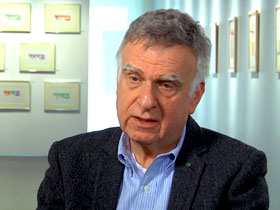
MARK PODWAL: What’s unique about this haggadah is trying to draw in as many people as possible to participate in the service. That’s why it’s called Sharing the Journey. There are wonderful explanations that are very inclusive, and so you can come to this seder not knowing anything.
Although I try to be as original as possible, I like to have some tradition not only in the concepts but in the images that were used. I wanted somehow to include the seder plate visually because it’s there in the scriptures. I also wanted to make a reference to medieval haggadahs where there were large letters that illuminated a page, and so what I decided to do was have that image with the three letters of the Hebrew word “seder” and within the samech, the first letter, I drew the seder plate.
 In trying to come up with an original way to depict the four children I did them as books and as the Torah, so the wise child, his body is the Torah, his arm is the Torah pointer, his head is an open book. The wicked son, or the wicked child, is in a suit of armor. The first time the wicked child was depicted in an illustrated haggadah was in 1526, the Prague Haggadah, where the wicked child is depicted in a suit of armor.
The first time the ten plagues were illustrated was in the Venice Haggadah from 1609, and I came up with just illustrating one plague, the last plague, when God slays the first-born of Egypt, and the way I depicted that was by having a wing and the mummies of the dead Egyptians on the wing.
The traditional haggadah text doesn’t even mention Moses. It’s repeatedly said that it’s God who led the children of Israel out of Egypt. It wasn’t an angel, it wasn’t an angel of fire, it wasn’t a messenger. It was God, and it’s a very beautiful passage.
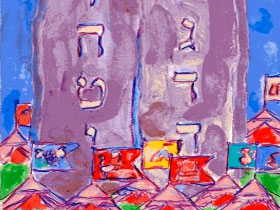 The tradition is that all the Jewish people were at Sinai for the receiving of the Torah. So there were the tents of the children of Israel, and what I did was, to identify them as such, I put the flags representing the various tribes. I drew Mount Sinai as the Ten Commandments itself. It’s also one of my favorite images.
The afikomen is part of the middle matzoh that’s hidden. It’s then needed to complete the seder, and a custom is that it’s hidden, and children go to find it, and whoever finds it will get some kind of reward. I used that image to hide the afikomen within a prayer book, within the haggadah itself, and the afikomen then serves as a bookmark.
I came up with putting Elijah’s cup in front of the Golden Gate in Jerusalem because the tradition is that the Golden Gate is where the Messiah will come through into Jerusalem and that Elijah will lead the Messiah, and so that’s why the cup is waiting for Elijah in front of the Golden Gate.
Another image that’s in the haggadah that is a reference to a previous haggadah is for the illustrations to the song at the end of the seder, Adir Hu, “Mighty Is He God.” It says in that song, “May God rebuild his temple speedily in our days.” I drew the Torah enclosing Jerusalem, and the rebuilt temple based upon how the temple was drawn in the 1695 Amsterdam Haggadah.
These paintings were really an unexpected gift. Kafka once wrote that writing was prayer, and for me my art is prayer.
Watch more of our interview with Mark Podwal about his original artwork for Sharing the Journey, an inclusive new haggadah published by the Central Conference of American Rabbis Press.
Read an excerpt from In the Company of Christ: A Pilgrimage through Holy Week by Benedicta Ward (Church Publishing, 2005):
Originally published April 7, 2006
From the fourth century until today, Christians have created things to do together, rituals, in order to experience for themselves the great simplicity of redemption. These rituals are meant to recur, they are the stones of an archway which, once built, is there to use, to go in and out by prayer and so to find pasture. We do not want to be rebuilding a different-shaped arch, however entrancing, but to use what we have, what we are used to, in order to enter into the real business of prayer. So the ceremonies of Holy Week, beginning with Palm Sunday, are there to be used, and this is a physical matter, a use of the body, so that all of ourselves will know. Intellectual apprehension of truth is all very well, and indeed for some it is enough; but for most of us, we live in a half-light, neither awake nor asleep, wanting to understand but not quite able to think it through; we need to be there to act it out, to participate. This is in no way an alternative or lesser kind of theologizing; by both ways we come to the central theme of redemption, the flesh-taking of Christ in which he returns to the Father and takes us unto the dynamic life of the Trinity which is the ultimate procession, and it is by physical processions that we can learn to become part of that reality.
 The last days of Holy Week provide a simple way of allowing the body, the flesh, to learn theological truth by doing and being in earthly processions. Palm Sunday’s procession is about how to do the basic human thing — to walk, to take one step, just to be able to do the next step, and to remain with that doing, not seeing a much quicker way to get there by a bus, a train, a ship, a plane, which are quicker than our feet; we are always dashing through in order to be somewhere else, and when we are there then we think we will begin. But the procession is a slow, corporate event, the pace set by the weakest and slowest. Like growing, a procession is something done for its own sake, and in doing it we are becoming what we are not, going by a way we do not understand, for a purpose that is God’s, not ours, in ways that are too simple for our sight. We will never of course be ready on earth for the full “procession” which is the dynamism of the life of love which is the Trinity, since we are broken human beings, with limited sight; but given our consent, God can lead us by the flesh he created, to understand and apprehend the image of God which he placed within us. All that is needed is to give a minute assent, however impatient and grudging, and then just to do it. A procession can be seen as a sacrament, “an outward and visible sign of an inward and spiritual grace.” In the same way that we read through the letter of the Scriptures to the inner truth, so we understand more by walking than we know; it is the work and gift of God.
Meditation upon the processions of Holy Week is rightly undertaken at its commencement. In the early church, for the first three days of Holy Week, on Monday, Tuesday, and Wednesday, the custom was to have only plain readings from Scripture; later, what was read each day were the separate accounts of the Passion. Then as now, these were days of stillness and silence when all were to be prepared, emptied, turned towards the Saviour’s great work. After the signs we gave ourselves during Lent of being ready to become empty by giving things up and therefore more free, now that desire will be put to the test. There is nothing now to be done or thought. It is the end of Lent, the pause before the great mystery of Redemption. In this pause, it is possible to reflect on these three processions, on Palm Sunday, Good Friday and Easter night, as ways into the great procession which is the life of Trinity, and this is not just for ourselves here and now. First we walk with so many others from the past, joined with them by our present actions. We receive life from the hands of the dead to live it out ourselves and pass it on to others, and that is true tradition. We are walking with our friends. And second, we do not do this for ourselves only, but for the whole of creation; insofar as one small portion of humanity which is us assents to the love of God, so the whole of creation becomes part of redeeming work.
Listen to this episode now:
[powerpress]
BOB ABERNETHY, host: Now, more on how the pope’s trip this week could affect Roman Catholics in Cuba. Joining me are Kim Lawton, our managing editor, and Patricia Zapor, a staff writer with Catholic News Service who was recently in Cuba. Pat, as recently as last month you were there, weren’t you?
PATRICIA ZAPOR (Catholic News Service): Yes.
ABERNETHY: For the ordinary Cubans, after all these years of official atheism by the state, persecution of religion in Cuba, are the ordinary Cubans wanting to have, be able to worship again? Are they wanting to be religious again?
ZAPOR: Well, Cubans want all sorts of freedoms, religious freedom among them. Atheism officially went away in 1992, and since then the Catholic Church has been creating more space for itself, and in ways that are trying to reach out to more Catholics, more of the general population of Cuba, and people want to participate in these things. There’s an energy.
ABERNETHY: But I think it’s, what, just a little over half of people who identify themselves as Catholics, and five percent of them only who go to Mass.
 ZAPOR: Yeah, 60 to 70 percent of Cubans identify as Catholics. But people get their babies baptized, and they come back for funerals. So people are very culturally Catholics. It’s just the stuff in the middle that they’re out of the habit of participating in.
KIM LAWTON, managing editor: How are they hoping that the visit of Pope Benedict will affect their lives, will maybe provide more space and more openness?
ZAPOR: Well, when Pope John Paul II visited in 1998, that led to new openness for the church, to the church being able to have outdoor celebrations for Easter and so on. And it also led to release of political prisoners and all sorts of other types of openness. And people have great hopes that that will happen again, that this pope will encourage and help prod the government to new openness in a whole variety of ways.
ABERNETHY: If a Cuban Catholic wants to participate openly in the church, and not hiding anything, is that person free to do so, or are they persecuted in some even informal way if they’re religious?
ZAPOR: I don’t have the impression that there’s ongoing persecution of people who just participate in the church. We did hear stories of people who very recently, for instance, a university professor lost a job after being on the board of a highly boundary-pushing laity magazine. So people who press the boundaries a little too much might end up getting smacked back, but everyday practice, I don’t think that that is a problem.
LAWTON: The church leadership has had a delicate balance, haven’t they, trying to push the government on some things, yet also maybe partner with the government?
 ZAPOR: Yeah, and that’s been very controversial among Cubans themselves, among Catholics, among Cuban Americans, as to whether any kind of dialogue with the government is helpful or not. But it’s been working. It’s been creating more space for the church to provide social services, to start an MBA program, to do all sorts of things that 25 years ago, even 10 years ago would not have been possible.
ABERNETHY: I read that there is one priest for every 19,000 Cuban Catholics. They’ve got a long way to go.
ZAPOR: They certainly do, and that’s even more dramatic than the situation of priest shortages around the world. That’s about as many priests as there are in the entire archdiocese of Miami in the whole country. But their laity networks are strong and very well-developed. That’s a situation that they’ve encouraged in these intervening years.
LAWTON: What are these house churches that you’ve talked about? How does that work?
ZAPOR: Well, in places where there isn’t a convenient church, people develop ministries within houses and neighborhoods. I encountered one parish that consists of nothing but 42 house churches. They don’t have a building. They have 42 house churches; that’s their parish.
ABERNETHY: You wrote a piece saying that Cubans want, Cuban Catholics, want more, more of everything.
ZAPOR: Right, and they’ve been getting more. More freedom, more services, well, more priests, of course, but a little bit more of everything.
ABERNETHY: And you think that this visit by Benedict will lead to that?
ZAPOR: There certainly are hopes for that. That just the attention on the church in general, the attention on the progress that they feel has been made, the attention on the problems that still exist might help open things up.
ABERNETHY: Patricia Zapor of Catholic News Service, many thanks.
ZAPOR: Thank you.
ABERNETHY: Kim, thank you.
SAUL GONZALEZ, correspondent: If growing old means growing slow, well then 89-year-old Delmar Holbrooke hasn’t gotten the memo.
DELMAR HOLBROOKE: I’m really getting ready for 90, “the big 9-0.” My family is already planning it. I am going to ski up at Mountain High early in the morning, come down and play a round of golf, and then head out to the beach to surf.
GONZALEZ: You’re not a sit on the couch kind of guy?
HOLBROOKE: No way.
 GONZALEZ: Holbrooke credits his energy to a life of exercise and healthy eating, but also his faith.
(to Holbrooke): Would you be as healthy as you are, in your opinion, without your faith?
HOLBROOKE: Oh, no, no. I am what I am because of my faith. To me that is just as clear as can be.
GONZALEZ: Like many other residents of Loma Linda, California, Holbrooke is a Seventh-day Adventist. That’s the Christian denomination that observes the Sabbath on Saturday. Adventists also emphasize a healthy diet and lifestyle as important expressions of their faith, and because of that emphasis, researchers say Adventists often have remarkably good health.
PROFESSOR LARRY BEESON (Loma Linda University): Adventists have an evidence of living longer and dying at a later age. They die of the diseases of the general population, but at a much later age—eight, ten years later.
GONZALEZ: Larry Beeson is an associate professor of public health and epidemiology at Loma Linda University. It’s a health and science institute affiliated with Seventh-day Adventists that’s been studying members of the faith since 1958.
(to Beeson): And they get to that age…?
 BEESON: …through a variety of different things. It’s not just one thing. It is their religious—how they relate to God and their fellow man, their diet, their exercise, their avoidance of tobacco and alcohol. All of that collectively contributes to longevity.
GONZALEZ: And because it has such a high percentage of Adventists who live long and active lives, researchers have dubbed Loma Linda one of five so-called health Blue Zones in the world.
BEESON: A Blue Zone is just an area where there is an unusual occurrence or more than what we would expect of people who live to be the late 90s, early 100s.
GONZALEZ: Diet seems to be especially important to Adventists’ good health and long life expectancy. Nearly 30 percent of Seventh-day Adventists practice some form of vegetarianism compared to only about three percent for the US population as a whole. In fact, at many Adventist institutions, such as the Loma Linda Health Center, only vegetarian meals are served.
PASTOR DANIEL MATHEWS(Loma Linda University Church of Seventh-day Adventists): I do follow a plant-based diet and have followed a vegetarian diet all my life, and I know you and all your viewers are going to look at me strangely, but I never tasted any meat.
GONZALEZ: Dan Mathews is a third-generation Seventh-day Adventist and a pastor. We talked to him about the connection between diet, health, and religious belief within his faith tradition.
 MATHEWS: Genesis 21:29 states that God gave mankind grains and fruits and nuts and herbs bearing seeds—the initiation of a plant-based diet. To not take care of our bodies, which is a part of the stewardship of the earth, to not take care of our bodies is an affront to our God.
VIRGINIA CROUNSE: I feel good. Yeah, I do. I feel energetic.
GONZALEZ: We met seventy-three-year-old Adventist Virginia Crounse as she was relaxing in a whirlpool. She shared her diet and fitness routines with us.
CROUNSE: I actually eat most of the time two meals a day. I’ll eat like granola or oatmeal for breakfast with two or three fruits, fresh fruit. As long as I can remember, I exercise daily, at least six days a week. I walk at least two miles, rain, sun, or snow.
GONZALEZ: It’s not well known, but Seventh-day Adventism has already made its mark on American culinary history in what millions of people eat each and every morning. It’s the creation and mass marketing of breakfast cereal by a guy named Kellogg. That’s John Harvey Kellogg and his brother, Will Kellogg, both Seventh-day Adventists who developed corn flakes, one of the first mass-marketed breakfast cereals, in the late 19th century. They saw cereal as a health food alternative to the fatty breakfast foods of their day.
 BEESON: Corn flakes and the other kinds of foods that came out of the Kellogg’s industry was really trying to deal with the whole grain thing and not trying to throw away all the nutrients when you refine and become white bread. You’re throwing a lot of nutrients away.
GONZALEZ: In our own time, as Americans search for ways to improve their diets and health, some researchers believe they can borrow some simple lifestyle ideas from Seventh-day Adventists.
BEESON: Reducing your smoking, reducing your saturated fat intake, exercising more—all that can be done by anybody. They don’t have to become an Adventist to gain the benefits that we’ve observed in the Adventist health study.
GONZALEZ: It is accessible to all of us.
BEESON: Absolutely.
GONZALEZ: At the pool, Delmar Holbrooke has his own advice.
HOLBROOKE: You have to keep your mind alive and continuing to grow, and your body just as much.
GONZALEZ: For Religion & Ethics Newsweekly, I’m Saul Gonzalez in Loma Linda, California.
