Supreme Court: Ministerial Exception


KIM LAWTON, correspondent: The case involves Cheryl Perich, a fourth-grade teacher at a Lutheran Church Missouri-Synod school in Michigan who mainly taught secular subjects, but also taught religion and led prayers. She took a leave of absence to get treatment for a sleep disorder. When the school was reluctant to let her return, she threatened to sue for violation of the Americans With Disabilities Act.

CHERYL PERICH: I can’t fathom how the Constitution would be interpreted in such a way as to deny me my civil rights as an elementary school teacher. I sure hope the Court agrees.

LAWTON: Lawyers for the school said Perich was considered a commissioned minister, and therefore she was covered by a legal doctrine known as the ministerial exception. That exception says religious groups don’t have to follow anti-discrimination laws in employment decisions about their leaders.

DOUGLAS LAYCOCK (University of Virginia School of Law): Disputes between ministers and their churches, if anything is covered by separation of church and state this is it. These cases do not belong in the civil courts.

LAWTON: For almost 40 years, lower courts have granted houses of worship and other religious institutions this exception. The idea is that under the First Amendment’s religious freedom guarantees, courts should not get involved in a religious institution’s decisions about hiring and firing its ministers. But how far should that exception extend?

post02-minsterialexceptionLuke Goodrich is deputy national litigation director at the Becket Fund for Religious Liberty, which is representing the church and school in this case.

LUKE GOODRICH: Our Constitution recognizes that the government and the church are separate entities with separate roles in society and that they shouldn’t be allowed to intrude on each other. So the church doesn’t get to pick government leaders, and the government doesn’t get to pick church leaders.

LAWTON: But some argue that the ministerial exception has been taken too far. Barry Lynn is executive director of Americans United for Separation of Church and State. He’s also both a lawyer and a United Church of Christ minister.

BARRY LYNN (Americans United for Separation of Church and State): Unfortunately, I think some religious organizations use this idea of a ministerial exception as a pretext to dismiss people on the basis of their color, their gender, their racial background, or their disability, and that really runs counter to every principle of, I think, morality and every principle of our civil rights system.

LAWTON: Goodrich says the larger religious liberty principle is too important to have juries deciding what was a religious motive for hiring or firing.

GOODRICH: Even if a church may not be acting, you know, may have mixed motives, it is important to allow the church to decide, because you have a lot of cases where there aren’t mixed motives, and the church makes a purely religious decision. But if you allow juries and courts to second-guess that, churches will not be free to make decisions based on their religious beliefs.

post03-minsterialexceptionLYNN: Courts are good at determining whether something is a sincerely held belief. We do it with conscientious objectors to war. This is just another red herring added by some religious groups that frankly want, if not themselves, others to be able to discriminate on any basis.

LAWTON: One of the most difficult questions is determining who is a minister. Is it only those who have been ordained? What about ministers of music or online ministers or teachers at religious schools?

LYNN: Unfortunately, judge-made law—some very strange judge-made law—suggests that this is a very broad idea, that it encompasses virtually all of the employees of a ministry, of a religious body, if the religious body just says you are all really ministers and thereby precludes them from filing civil rights lawsuits.

LAWTON: Many religious groups say it shouldn’t be up to the government to decide what duties are ministerial in nature.

GOODRICH: The Becket Fund’s position in this case is that the court should look at whether the employee performs important religious functions, and that includes teaching religion, leading prayer, and leading worship. If the person at issue is responsible for proclaiming the church’s message to the rest of the world, that would bring them within the ministerial exception, because the church needs to be able to choose who’s going to carry its message to the rest of the world.

LAWTON: The Obama administration is taking a hard line in the case. To the dismay of many religious groups, the Justice Department urged the Court to reject the ministerial exception altogether, saying the First Amendment doesn’t offer such special protection.

post04-minsterialexceptionKIM COLBY (Christian Legal Society): It’s very troubling that the United States government wants 40 years of law protecting this vital religious liberty, this vital component of separation of church and state—they want it repealed by the Court.

LAWTON: If the High Court keeps a ministerial exception, the Justice Department argued that it should be limited to employees who perform “exclusively religious functions.” Religious groups say that definition is unworkable because virtually all ministers do a variety of tasks that on their surface may not appear to be religious.

GOODRICH: Even the archbishop has secular responsibilities, whether it’s managing personnel or managing the finances. Even the pastor of your local churches has secular responsibilities. A lot of pastors help take care of the building, mow the lawn on the weekends, so nobody does only religious activities.

LAWTON: Lynn supports keeping a ministerial exception but says it should be narrowly defined.

LYNN: The way this could be looked at is a very narrow exception for pastors and for other people who have primarily religious functions, while other people who at best might give a prayer occasionally over cookies and milk at a religious school will not be considered a minister, and if they are fired for the wrong reason, on the basis of gender, on the basis of disability, on the basis of race, they can get into a courtroom.

LAWTON: On the other side, nearly a hundred diverse religious groups filed briefs supporting the church’s right to choose its own ministers.

RABBI DAVID SAPERSTEIN (Religious Action Center of Reform Judaism): It seems all of us, even those of us who are deeply committed to civil rights, to protection of disability rights, to preventing retaliation for claims believe strongly that church autonomy and the ministerial exception are indispensable to religious freedom.

LAWTON: The US Conference of Catholic Bishops, the Church of Jesus Christ of Latter-day Saints, the Episcopal Presiding Bishop, and the Union of Orthodox Jewish Congregations joined together on one of the briefs. They said “when the dispute is between the church and the church member who seeks to serve in ministry, there is no occasion—no justification whatsoever—for the state to become involved.”

Lower courts have been wrestling over the ministerial exception for decades, but this is the first time the Supreme Court has taken up the issue. A decision is expected by early next year.

I’m Kim Lawton in Washington.
Delhi Jews


FRED DE SAM LAZARO, correspondent: In an ancient, crowded land with wide religious diversity, Judaism has a tiny footprint. In New Delhi, it’s in this quiet enclave. A small group of worshipers gathers here every Friday, a mix of foreigners and Indians. In India’s ancient religious mosaic, Judaism is a newcomer. Its roots go back only two millennia.

EZEKIAL MALEKAR (Judah Hyam Synagogue): When Israel, the oldest Jewish community, landed, they were shipwrecked, and they came to India about 2,000 years ago.

DE SAM LAZARO: There were at least two subsequent mini-waves that brought Jews to India: people fleeing the Inquisition and people who came during British colonial days as traders. There were perhaps 30,000 Jews across the country at one time, but many moved to Israel after its formation in 1948.

post03-delhijewsMALEKAR: Now we have only 5,000 Jews all over India, and in Delhi we have just 5, 6 Indian-Jewish families. We are like a drop in the ocean.
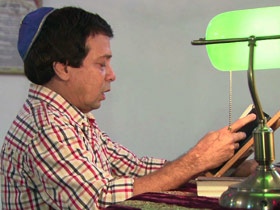
DE SAM LAZARO: Ezekiel Malekar is the keeper of Delhi’s tiny synagogue, built in 1956 on land donated by the Indian government. A lawyer and retired civil servant, he’s not an ordained rabbi, but for three decades Malekar has volunteered to lead this congregation, reconciling its ancient rituals and traditions with the practical modern reality.

MALEKAR: In order to read this portion of the Torah you require a quorum of 10 men, what we call in Hebrew minyan, so here we take into consideration the presence of women also. Some people don’t like it, especially those who are very Orthodox when they come to the synagogue. But I said that we are such a small community that if I have these practices I won’t be able to conduct the services in the synagogue.

DE SAM LAZARO: The majority of India’s remaining Jews live in the commercial capital, Mumbai. It was in this city during the 2008 terrorist attacks that six people were killed at a Jewish community center that mainly served Israelis and Western visitors and businesspeople. Since then, the Delhi synagogue has also come under 24-hour protection from the Indian government—the first time Jews here have ever faced the specter of violence.

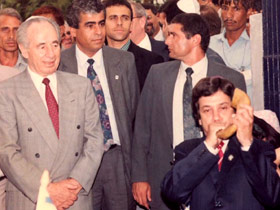
post02-delhijewsMALEKAR: Jews have been living in India for the last 2000 years and without anti-Semitism and persecution, and therefore I always say that India is our motherland. I am an Indian first and Jew second. When Mr. Shimon Peres came here…

DE SAM LAZARO: …the president of Israel…

MALEKAR: The president of Israel. I was asked by the BBC media that what is your feeling about Israel and India? And I said that Israel is in my heart, but India is in my blood.

DE SAM LAZARO: But those who call themselves Indian and Jewish are fewer and fewer. One of Malekar’s sad tasks is to tend the cemetery, whose census now exceeds the congregation in the synagogue next door.

MALEKAR: This is the last place, where we go to the divine abode.

DE SAM LAZARO: On a happier note, Malekar will soon preside over his daughter Shulamit’s wedding, which will be a historic event in Delhi’s Jewish community.

MALEKAR: I don’t remember even after 1956 there has been a single wedding in the synagogue.

DE SAM LAZARO: At 66, Malekar will finally witness a marriage here between two Indian Jews, leaving only the worry about who from the handful of young congregants might be willing to take over from him.

For Religion & Ethics NewsWeekly, this is Fred de Sam Lazaro in New Delhi.

Higher Ground

Writer and author Frederica Mathewes-Green comments on Vera Farmiga’s latest film, “Higher Ground,” which also marks Farmiga’s début as a director. The actress plays Corinne,  a woman who struggles with faith, doubt, and conservative evangelical Christianity. Interview by Julie Mashack. Edited by Fred Yi.


Using Drones Outside Combat Zones

Armed drones launched the Sept. 30 air strike in Yemen that killed Anwar al-Awlaki, the American radical cleric who tried to recruit Muslims to help al-Qaeda’s terrorist efforts. US officials had considered him one of the most dangerous threats to American security. President Obama said al-Awlaki “repeatedly called on individuals in the United States and around the globe to kill innocent men, women, and children to advance a murderous agenda.” The mission, Obama added, showed that Al-Qaeda and its allies will find “no safe haven anywhere in the world.” But some ethicists are raising questions about whether the killing violated international law. University of Notre Dame international law professor Mary Ellen O’Connell released a statement calling the strike an illegal mission. “Derogation from the fundamental right to life is permissible only in battle zones or to save a human life immediately. The killing of Anwar al-Awlaki did not occur in these circumstances,” she said. In an interview with managing editor Kim Lawton earlier this year, O’Connell discussed her ethical concerns about the increased use of drones for targeted killings outside official combat zones. Lawton also talked with retired Lt. General David Deptula, who oversaw the US Air Force’s drone program from 2006 until 2010. He said remotely piloted aircraft allow the US a greater measure of accuracy in the new realities of the war against terror. Watch excerpts from both interviews.


Catholic Charities and Gay Adoption


Head Start Leader: What number is this, Jeffrey?

Child: Six?

Leader: Six, good job.

BOB FAW, correspondent: Thousands of children in Illinois have been helped the last five decades by Catholic Charities. In Joliet, for example, the agency runs this Head Start program. It also shelters and nourishes children in need. Of 15,000 in the state’s foster care program, the agency takes care of more than 2000. Now though, as director Glenn Van Cura knows, Catholic Charities is in a bitter legal dispute with the state because when it comes to fostering or adopting children, the organization will take married and single people but will not accept same-sex or unmarried couples.

Wedding ceremony: I now pronounce you husband and husband and wife and wife.

post01-catholiccharitiesGLENN VAN CURA (Executive Director, Catholic Charities Diocese of Joliet): The idea between a man and a woman and marriage is a sacred bond, and cohabiting, gay or straight—that’s not that sacred bond. It’s not stable.

FAW: It’s in violation of church doctrine?

VAN CURA: Right.

ROBERT GILLIGAN (Executive Director, Catholic Conference of Illinois): We will continue to say that children are best raised in the situation where there is a loving home and a mother and a father, and that will be true as long as we’re able here to articulate it. It’s the truth, and that’s what the church is about is trying to speak the truth to these very sometimes controversial social questions.

FAW: Last year Illinois enacted a law recognizing same-sex unions. Now couples like Michelle Mascaro and Corynne Romine have the right to foster or adopt children.

MICHELLE MASCARO: The church can decide whether or not they want to marry a couple. That’s a church religious right, but the state has created ways for families to come together, and they’ve said, you know, that you can come together through adoption, and it doesn’t matter what that family constellation looks like. Are you fit to be a parent?

post02-catholiccharitiesFAW: Does it anger you, what’s—because that clearly is…..

CORYNNE ROMINE: It doesn’t make me feel second-rate, because I’m not. It does make me angry, yes.

Mascaro (speaking to children): Okay, David, it is going to be your turn…

FAW: Michelle and Corynne have adopted three children, David, Joseph, and Emma. Because Emma was adopted through a religious agency, the two women felt they had to hide their true relationship.

MASCARO: And they might say no, you can’t have this baby who was our baby. You know, she came right from the hospital home with us.

FAW: Catholic Charities says it’s a matter of religious freedom and that if civil law and church doctrine collide doctrine takes precedence and gives it the right to discriminate. Bob Gilligan is with the Catholic Conference of Illinois, which is the public voice of the Catholic Church in the state.

(speaking to Robert Gilligan): When it comes to gay couples, then, they are excluded. Is that not discrimination?

post03-catholiccharitiesGILLIGAN: There is a form of discrimination there, sure. We don’t accept the application of an admittedly unmarried or same-sex couple.

FAW: Now the state of Illinois is in the process of cutting off the nearly $4 million it funnels annually to Catholic Charities because it says discrimination against gay or unmarried couples who want foster children is illegal and short-sighted. Kendall Marlowe is with the Illinois Department of Children and Family Services.

KENDALL MARLOWE (Deputy Communications Director): I grew up in a family that took in foster children, and I’ve been a foster and an adoptive parent myself as an adult, and if I’ve learned anything it’s that what helps a child succeed is that unconditional love and guidance, and in both my experience and in the research literature that has been produced on this issue, there’s no indication that sexuality, sexual orientation has anything to do with parenting.

FAW: Child advocate from the ACLU Benjamin Wolf insists Catholic Charities’ policy harms children.

BENJAMIN WOLF (Associate Legal Director, ACLU of Illinois): We need everybody. It’s hard enough to provide good homes for abused and neglected children without imposing additional discrimination on the pool of foster parents.

post05-catholiccharitiesVAN CURA: There’s not one example that they can show that a child has not been placed in a home.

GILLIGAN: They’re not excluded. There’s 47 other private child welfare agencies in the state. There’s many other agencies that they can go to.

MASCARO: It’s not okay to say to people like us if we lived in a part of southern Illinois or in Peoria to say, oh, you can go to some other agency, because Catholic Charities has the lock on it. They’re the only agency out there.

FAW: Despite the fervently held beliefs on each side, the legal situation is anything but clear-cut. Catholic Charities, for example, argues that the Illinois law on religious freedom permits the agency to discriminate.

GILLIGAN: The title of the bill is the Illinois Religious Freedom Protection and Civil Unions Act. Where’s the freedom? Where is the protection for religious entities? It’s in the bill itself. There’s a section in there that says that the bill should not infringe upon religious practice, religious ministry.

MARLOWE: Every faith-based organization in the state of Illinois has the full capacity and the full right to pursue their religious freedom. The question is what happens when you are paid with taxpayers’ money, state money, to provide state services? And in those cases we have to insist that those agencies comply with Illinois law.

post04-catholiccharitiesFAW: Catholic Charities of Illinois has placed thousands of children in homes over the past 50 years. Eighty percent of its foster-care budget comes from the state. Even if it loses that money, says Bob Gilligan, Catholic Charities will continue with adoption and foster care.

GILLIGAN: It’s part of our mission, it’s part of our teachings, it’s part of what we do as Catholics. But we have to do it in honoring our own tenets and our faith that call us to do this. If we can’t do it in a faith-filled mission, then we can’t do it using public money. We’ll do on our own terms.

MARLOWE: We don’t want to see them leave this work. But if that is what’s going to happen, the Illinois child welfare system that they helped build is more than capable of taking on this transition. There are other agencies bound by the exact same regulations that Catholic Charities is that are ready to step up and take on this work.

FAW: Gay adoptive parents like Michelle and Corynne think that history is on their side, that eventually Catholic Charities’ policy of exclusion will go the way of earlier social practices, like the 1950s when black Americans were denied public accommodations.

MASCARO: It harkens back to just say you can’t eat in this lunch counter, go eat at one down the street. We know that in every other aspect that’s not right. It’s not legal. It’s not sanctioned in this country. Why is it still allowed or could it be allowed in adoption? This is an abuse of what they perceive as their religious freedom.

WOLF: There were agencies 30 years ago, 20 years ago, that didn’t want to place children in homes of interracial couples. I mean, the world is changing.

FAW: So the issue in Illinois, now focused on gay couples, comes down to this: when anti-discrimination laws and church doctrine clash, which should prevail?

GILLIGAN: This is an emerging conflict in our society. As you enact antidiscrimination laws, to what degree does a religious institution have to comply with it? We do a lot of things in the public square. Is the Catholic Church in compliance with all the rules and policies and laws of the state if we won’t do certain things against our conscience? It’s a good question.

FAW: And as the definition of the modern family continues to change, will church doctrine also have to change?

For Religion & Ethics NewsWeekly, this is Bob Faw in Chicago.

Jewish Social Justice


FRED DE SAM LAZARO, guest host: We have the story of an organization founded after federal agents raided the nation’s largest kosher meat-packaging plant in Postville, Iowa, and discovered widespread mistreatment of workers. The group, Uri L’Tzedek, which means “awakened to justice,” wants more transparency in the kosher industry, and they’ve started with restaurants.

RABBI SHMULY YANKLOWITZ (Founder & President, Uri L’Tzedek): What became clear to me in Postville was that we had to take responsibility. Not a one time act like a boycott, but something systemic and sustainable that would ensure that there was ethical transparency in the industry.

RABBI ARI WEISS (Director, Uri L’Tzedek): The Tav HaYosher, which we translate as an “ethical seal” for kosher restaurants, is an initiative that we launched in May 2009. We don’t charge anything for this seal. We have a licensing agreement which they sign. The criteria for our certification is, first and foremost, we want to make sure that people get at least minimum wage, and we want to make sure that overtime based on that minimum wage is given. Then we also want to make sure that people are respected, and work is dignified.

post01-jewishsocialjusticeYANKLOWITZ: When we started the Tav HaYosher we said, let’s strive for the ideals. We want health care, we want animal treatment, we want environmental standards, we want fair trade, we want workers comp, all these issues, and we went into restaurants finding workers getting paid $2 an hour, $3 an hour. Ridiculous! So we said we have to first just meet law.

WEISS: One of the really exciting things about this program is that it’s a grassroots program. The people who actually go into the restaurants are volunteers, college students, graduate students, young professionals who care deeply about this mission and about this project. Every two or three months or so we have a training, and then we actually assign restaurants to each of the compliance officers.

YANKLOWITZ: There is nothing easy about the work we’re trying to engage in. We are sending young volunteers to ask owners to open their books, to speak with workers about very sensitive issues.

WEISS: We take them aside so that we create a safe space away from management, and we ask them questions to verify what the payroll actually says. How many hours have you worked? What is your pay? What’s it like to work here? Do you feel ever harassed? The feedback we receive from restaurant workers, we keep it anonymous, and we also have an anonymous tip line.

post02-jewishsocialjusticeSHLOMIT COHEN (Tav HaYosher Compliance Officer): We’ve approached locations that initially didn’t meet standards. We spoke with them, encouraged them and were able to come back and actually sign them on.

YANKLOWITZ: Sitting in a dark basement with a worker who paints black and white cookies black, white, black, white all day, every day and seeing his eyes tear up when for the first time there was a customer concerned for his welfare, that rocked me spiritually, emotionally to feel the impact of merely showing somebody else that we’re present for them. We’re an advocate for them.

WEISS: We see this very much as a partnership between workers, the community, and restaurant owners.

NOAM SOKOLOW (Owner, Noah’s Ark/Shelly’s): I think I just felt as a good person, someone who believes in doing the right thing. I think it was important to set the standard. We’ve actually gotten numerous phone calls and numerous comments from customers who have come in and let us know that they are supporting us because of the fact that we have the seal.

YANKLOWITZ: This is a new wave of activism, an activism through what one eats, that what we eat and what we buy is a vote of confidence in our highest values.

DE SAM LAZARO: Tav HaYosher has certified over 90 eating establishments in 13 states and Canada.

Alabama Immigration Law


LUCKY SEVERSON, correspondent: Like many church leaders in Alabama, Father Tom Ackerman of the Catholic Diocese of Birmingham was caught off guard by the toughness of the state’s new immigration bill.

FATHER TOM ACKERMAN: I think there was some surprise about how extreme it was and how really sort of vicious it was, particularly some of the vicious rhetoric: “We want to affect every aspect of their lives. I’ll do everything short of shooting them.” These are senators and representatives saying these things.

SEVERSON: Here’s what Mayor Lindsey Lyons of Albertville, Alabama had to say about the bill’s critics.

post01-alabamaimmigrationMAYOR LINDSEY LYONS: When they say that we’re cruel or heartless or however they want to word it, you know, the fact of the matter is, we have rights. We have rights to protect our citizens, and what is wrong with coming up with solutions to protect our citizens, to protect our jobs. and to protect our quality of life?

SEVERSON: The solution the legislature came up with has caused quite a commotion. A federal judge temporarily blocked the enactment of House Bill 56 because of several lawsuits filed by four Alabama bishops of different denominations, the Justice Department, the ACLU, civil rights groups, joined by county sheriffs and 16 foreign governments. But some of the loudest protests came from church leaders like Pastor Angie Wright of the Beloved Community United Church of Christ.

PASTOR ANGIE WRIGHT: If I have ten undocumented persons in my church for an English-as-a-second-language class, or for worship, or vacation bible school. and I know that they’re undocumented, I can go to prison for 10 years and pay a $15,000 fine.

SEVERSON: In a nutshell, the bill, as it stands now, criminalizes working, renting, having false papers, shielding, harboring, hiring. and transporting undocumented immigrants. It also deprives them of most local public benefits. As it was intended, it punishes just about every aspect of illegal immigration.

post02-alabamaimmigrationFATHER ACKERMAN: The reason why we’ve filed this suit is because we want to keep the government out of our business. The government is trying to tell us what we can or can’t do in terms of works of mercy, works of charity, which are fundamental to our faith.

REPRESENTATIVE DAN WILLIAMS: Coming up on the left is where most of the Hispanics worked in town. This was the poultry processing plant.

SEVERSON: Representative Dan Williams was Mayor of Athens, Alabama for 18 years until he ran for the legislature 3 years ago. He supports House Bill 56.

REP. DAN WILLIAMS: The vast majority of people, when I was running for this office, the number one or two issue with them was illegal aliens. That’s it. Illegal aliens: “You need to do something about them. We want something done about them.”

post03-alabamaimmigrationSEVERSON: Williams was elected with the first Republican sweep of both houses in the legislature and the governorship in Alabama history. The new legislators quickly hammered out an immigration law, one that terrifies Janeth, an undocumented mother of two from Mexico who has been in the US for more than ten years. She’s a cashier in a store. Her husband works in construction.

JANETH ( with translator Helen Rivas): It’s terrorizing. Ever since they passed this law we don’t go out. We don’t go to restaurants, we don’t go to the park. We see a patrol car, and it terrifies us to think they may stop.

SEVERSON: She and her husband are buying their home at a very high mortgage rate. The new bill would allow the bank or anyone they have a contract with to cancel the contract, and they would have no recourse.

JANETH: I came here because my family didn’t even have any way to eat. To get this we’ve worked day and night, three jobs. If I have to leave here, one day to the next, if this law goes into effect I’m going to have to leave my house, my car. We’re going to arrive back home in our home countries in worse shape.

post04-alabamaimmigrationPASTOR ANGIE WRIGHT: Why make criminals out of people who have been our neighbors and our brothers and sisters and really are not causing any problems for any of us?

SEVERSON: An Alabama criminal justice survey found that violent crime in the state is down 10 percent over last year and below the national average. Property crime is also down. But Albertville Mayor Lyons says those statistics don’t hold up in his town.

MAYOR LINDSEY LYONS: When you have people coming from other countries that’s never driven a car before, and they start driving here with no insurance, no driver’s license, etc, causing multiple, many accidents.

SEVERSON: But, he says, that wasn’t the worst of it.

MAYOR LINDSEY LYONS: Because invariably you’re going to have the underlying current of crime and criminals come in with an influx of illegal immigrants, and that all is based on prostitution and brothels, your drug activity and your drug gangs, which have been present here in Albertville. That’s like it is in any community where you have the immigrant issue.

SEVERSON: He says hundreds of illegal immigrants moved in after Albertville-based poultry companies advertised in Mexico looking for cheap labor.

post05-alabamaimmigrationMAYOR LINDSEY LYONS: We had probably with our large two poultry plants here 2500 employment. They were vast all white and black American citizens, okay, and as the years went on and they were able to conduct business with the illegal alien population, well that just dwindled down, dwindled down, dwindled down.

SEVERSON: The Pew Hispanic Center estimates there are between 85,000 and 120,000 undocumented immigrants in Alabama, comprising a little less than 4 percent of the workforce. The state’s unemployment rate is above the national average at about 10 percent.

FATHER ACKERMAN: We have high unemployment not because the Hispanic immigrants are here. We have high unemployment because the housing market went bust, and we had a credit crisis. The immigrants have nothing to do with the high unemployment here. I think it’s primarily politicians preying on the fear of people. When economic times get tough, people often look for scapegoats.

REP. DAN WILLIAMS: You know, I go back “it’s the economy stupid,” that’s what it always is and people can say what they want to, but when you got a job and you’re making some money and your family is doing alright, you don’t have problems. But when my children lose their jobs, and I start having to help my children and my grandchildren, and maybe if I lose my job, I’m concerned about a guy who’s illegal coming here working. He’s doing okay and I’m not.

post06-alabamaimmigrationSEVERSON: The legislation authorizes police to demand papers from people they stop who they suspect are undocumented, something opponents say will lead to racial profiling. That’s already happening, according to Father Ackerman.

FATHER ACKERMAN: One of our priests actually has been stopped several times, pulled over. And then once they see that he has a collar on, “Oh, Father, go ahead.”

SEVERSON: Religious leaders are concerned that they will be breaking the law if they transport members they know are illegal to church.

FATHER ACKERMAN: If we’re transporting illegal immigrants, that’s a violation of this law, and those vehicles can be confiscated.

SEVERSON: Representative Williams says he thinks religious leaders’ opposition to the bill is overblown.

REP. DAN WILLIAMS: I don’t think you’re going to see policemen stopping the church buses to see if there’s somebody with brown skin riding to Sunday School.

FATHER ACKERMAN: If that wasn’t going to happen then they should have written that into the law. I’m talking about how the law is written, not how they expect it to be applied.

post07-alabamaimmigrationSEVERSON: Williams says he and his Republican colleagues have been called racists and that it’s unfair.

REP. DAN WILLIAMS: People still look at Alabama, and they see those grainy films from the 1960s and the police dogs and the water hoses in Birmingham. Well, Alabama is not like that anymore, but they’re trying to bring this back, that that’s what we are.

Speaker at rally: I myself overwhelmingly love this country.

SEVERSON: The young man speaking here, Victor, was brought here by his parents when he was a toddler. Victor is undocumented and part of a group of high school kids calling themselves Dreamers, who have been very vocal against the law because they’re the one’s who will likely suffer the most if they or their parents are deported. This is Jose. He’s undocumented. He says his dream was to become a teacher or a doctor.

JOSE: I came here at the age of 3. In all honesty, Mexico, it seems like a foreign world to me, and with all the problems it has now it’s frightening, the thought of having to go back there.

SEVERSON: Eduardo has his papers, unlike many of his friends.

EDUARDO: I’m mostly sad because I’ve got papers and then my friends, most of them are going to have to go back to their country or whatever, and I’m here lucky, being able to have the education and all the benefits they can’t.

REP. DAN WILLIAMS: You know, we’re all trying to get along. We’re all trying to raise our children, our grand children and everything. It’s just, you got that “illegal” word there that makes a difference.

SEVERSON: The judge who stayed the enactment of the law says she will issue her decision by September 29th. Regardless of the outcome, it is likely to be appealed.

For Religion & Ethics NewsWeekly, I’m Lucky Severson in Birmingham, Alabama.