
SIGILLUM SECRETUM
(Secret Seal)
On the image of the Blackamoor in European Heraldry
(a preliminary proposal for an iconographical study)
by
Mario de Valdes y Cocom
Considering the deep roots of Christianity
in the cultural experience of the African American community,
it is only natural that even in the most cursory of discussions
on Black history, the hope always is raised of discovering Christ
as a man of colour. Moreover, in this global village of television
and transatlantic travel, the standard Euro-centric portrayal
of Christ is both anomalous and anachronistic, particularly in
these racially sensitized times.
It might therefore prove a great source
of spiritual strength and psychological affirmation for those
of us of African descent if a relatively unknown and forgotten
medieval European tradition regarding the image of the black was
reconstructed for all to see and share.
What I am referring to are the coat
of arms of the blackamoor which proliferated in both the private
and civic European escutcheons (coat of arms) throughout the 13th,
14th and 15th centuries.
 Due likely to the tradition attached
to Sardinia's arms, these insignia have been all too facilely
explained as the grizzly prize of some crusader conquest. The
four African heads each displayed in one of the four quarters
created by the cross on the shield are referred to by an early
motto associated with this island's crest as 'trophea.' The traditional
explanation is they represent the four Moorish emirs who were
defeated by a king of Aragon sometime in the 11th century. (The
possibility of a more probable approach to these insignia will
be raised further on.) Such an interpretation would, of course,
be more than welcome today, especially in the face of establishment
attempts to portray as white the Islamic power that was able to
withstand three successive waves of European invasions.
Due likely to the tradition attached
to Sardinia's arms, these insignia have been all too facilely
explained as the grizzly prize of some crusader conquest. The
four African heads each displayed in one of the four quarters
created by the cross on the shield are referred to by an early
motto associated with this island's crest as 'trophea.' The traditional
explanation is they represent the four Moorish emirs who were
defeated by a king of Aragon sometime in the 11th century. (The
possibility of a more probable approach to these insignia will
be raised further on.) Such an interpretation would, of course,
be more than welcome today, especially in the face of establishment
attempts to portray as white the Islamic power that was able to
withstand three successive waves of European invasions.
And, a common corollary to this negative
view was the African figure became a symbol of evil, universal
or personal, that had to be subjugated or vanquished. Given the
economic/political positions of those with the right to bear arms,
the hold that heraldry has had on the imagination of the West
has been a very powerful one and this particular perception of
the blackamoor as a symbol of the negative has undoubtedly played
an enormous part in the propagation of racism.
- Articles about Mario de Valdes y Cocom's research and writings on St. Maurice
- The pope and a puzzling African king
Boston Globe columnist Alex Beam turned to Valdes for help decoding the "African king" depicted on new Pope Benedict XVI's coat of arms. (Aug. 4, 2005)
- Catholic martryr's ancient sacrifice seen as symbol for African-American community
"If an award-winning Boston television producer has his way, the legend of St. Moritz will be recaptured from the dustbin of history to inspire a new generation to turn away from violence and self-indulgence and live up to the principles of fidelity, humility and service personified by the saint." (The Bay State Banner, July 27, 2006)
- A fresh take on the life of a saint
"As a boy growing up in Belize, Central America, Mr. Valdes absorbed the stories of King Arthur and the Knights of the Round Table. He said St. Moritz's exploits are the "black foundations" of the King Arthur stories. ... But does the message of a battle-ready black martyr stand a chance of being heard in a youth culture that embraces thugs and pimps as heroes and role models?" (The Ottawa Citizen, Aug. 3, 2006)
- Plea to St. Moritz: Give them strength
"If you Google St. Moritz these days, you'll come up with scads of information about the chic Swiss ski resort. But Valdes ... hopes to reclaim the name as a symbol of strength and will." Also, read Valdes' follow-up letter, and view the painting mentioned in the article. (The Boston Globe, March 18, 2007)
The Imagery of St. Maurice
Modern specialists in the science of heraldry suspect, however, that this blazon (coat of arms) of the blackamoor is instead the very opposite of a negative symbol.
In the last decade or two it has been pointed out that the moor's
head quite possibly could have referred to St. Maurice, the black
patron saint of the Holy Roman Empire from the beginning of the
10th century.
Because of his name and native land,
St. Maurice had been portrayed as black ever since the 12th century.
The insignia of the black head, in a great many instances, was
probably meant to represent this soldier saint since a majority
of the arms awarded were knightly or military. With 6,666 of
his African compatriots, St. Maurice had chosen martyrdom rather
than deny his allegiance to his Lord and Saviour, thereby creating
for the Christian world an image of the Church Militant that was
as impressive numerically as it was colourwise.

 Here, no doubt, is a major reason why
St. Maurice would become the champion of the old Roman church
and an opposition symbol to the growing influence of Luther and
Calvin. The fact that he was of the same race as the Ethiopian
baptized by St. Philip in Acts of the Apostles was undoubtedly
an important element to his significance as well. Since this
figure from the New Testament was read as a personification of
the Gentile world in its entirety, the complexion of St. Maurice
and his Theban Legion (the number of which signified an infinite
contingent) was also understood as a representation of the Church's
universality - a dogmatic ideal no longer tolerated by the Reformation's
nationalism. Furthermore, it cannot be coincidental that the
most powerful of the German princes to remain within the Catholic
fold, the archbishop Albrecht von Brandenburg, not only dedicated
Here, no doubt, is a major reason why
St. Maurice would become the champion of the old Roman church
and an opposition symbol to the growing influence of Luther and
Calvin. The fact that he was of the same race as the Ethiopian
baptized by St. Philip in Acts of the Apostles was undoubtedly
an important element to his significance as well. Since this
figure from the New Testament was read as a personification of
the Gentile world in its entirety, the complexion of St. Maurice
and his Theban Legion (the number of which signified an infinite
contingent) was also understood as a representation of the Church's
universality - a dogmatic ideal no longer tolerated by the Reformation's
nationalism. Furthermore, it cannot be coincidental that the
most powerful of the German princes to remain within the Catholic
fold, the archbishop Albrecht von Brandenburg, not only dedicated
 practically all the major institutions under his jurisdiction
to St. Maurice but in what is today one of the most important
paintings of the Renaissance, had himself portrayed in Sacred
Conversation with him. Even more blatant was the action taken by Emanual Philibert, Duke of Savoy. In 1572 he organized the order of St. Maurice. The papal promulgation published at its institution declared quite unequivocally that the sole purpose for this knighthood was to combat of the Reformation. The order still exist exists although it has now combined with the Order of St. Lazarus. The white trefoiled cross of the combined order belongs to the former.
practically all the major institutions under his jurisdiction
to St. Maurice but in what is today one of the most important
paintings of the Renaissance, had himself portrayed in Sacred
Conversation with him. Even more blatant was the action taken by Emanual Philibert, Duke of Savoy. In 1572 he organized the order of St. Maurice. The papal promulgation published at its institution declared quite unequivocally that the sole purpose for this knighthood was to combat of the Reformation. The order still exist exists although it has now combined with the Order of St. Lazarus. The white trefoiled cross of the combined order belongs to the former.
The particular symbol of St. Maurice's
blackness that must have most antagonized the Protestant faction,
however, was the one regarding the mystery of Papal authority.
Scholars have been able to show, for example, that in the theological
debates of this period, even the abstract adjectives, black and
white, were defiantly acknowledged by apologists of both stripes
to represent the Church and the Reformers respectively.
Prester John
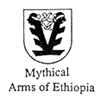 In addition to St. Maurice, there is
also another figure connected to the blackamoor coat of arms.
It is the semi-mythical Negus (emperor) of Ethiopia, Prester John.
To Otto von Freising an Imperial Hohenstauffen Prince Bishop
of the 12th century who was tired and torn by the endless struggle
between Church and State, this black man who was both priest and
king and ruled a land of peace and plenty at the edge of the world
became the personification of the ideal state. To this day the
arms of the see of Freising is the bust of a crowned blackamoor.
In addition to St. Maurice, there is
also another figure connected to the blackamoor coat of arms.
It is the semi-mythical Negus (emperor) of Ethiopia, Prester John.
To Otto von Freising an Imperial Hohenstauffen Prince Bishop
of the 12th century who was tired and torn by the endless struggle
between Church and State, this black man who was both priest and
king and ruled a land of peace and plenty at the edge of the world
became the personification of the ideal state. To this day the
arms of the see of Freising is the bust of a crowned blackamoor.
Because of their ethnic and geographic
origins, it is likely that St. Maurice and his Theban Legion became
associated with Prester John as the ideal soldiers for the ideal
state. It should be pointed out, furthermore, that, heraldically,
since he was the only monarch who could claim the 'Sang Real'
or the 'Royal Blood' of Christ because of his descent from Solomon,
Prester John was the only individual deemed worthy of the right
to bear as arms the image of the Crucifix. Even the earring traditionally
worn by the blackamoor is a reference to this sacred privilege.

The Golden Ring in the Blackamoor's Ear
To understand how these two objects
are related to each other--the earring and the image of the Crucifix--we
must refer back to the Old Testament. In the Book of Leviticus
can be found an ordinance describing the ritual ear piercing of
any slave who chooses to continue in his master's service after
being granted his freedom. Since one of the most important of
all Ethiopian royal titles was "Slave of the Cross,"
the golden ring in the blackamoor's ear was probably meant to
be interpreted as a deeply devotional and--considering the belief
in the Bible as the Word of God--a highly rhetorical symbol.
Ethiopia and the Holy Grail
Due also to the age-old belief that
the Ark of the Covenant had been hidden in Ethiopia, the great
epics of the Arthurian cycle transformed the Ethiopian emperor
into the founder of the Grail dynasty and the ancestor, nine generations
later, of the only knight of the Round Table who would achieve
the Quest, Sir Galahad. It would appear that the long-standing
confusion over whether the Holy Grail was a cup or a stone was
a deliberate one. Considering the opportunity afforded by these
Ethiopian traditions, medieval writers were able to theologically
fuse together the symbols of both the Old and the New Testament:
the Tablet of the Law and the Chalice.
Part II Divine Darkness
|


