Visit Your Local PBS Station PBS Home PBS Home Programs A-Z TV Schedules Watch Video Support PBS Shop PBS Search PBS

Chimpanzees: An Unnatural History
Alternatives to Chimp Testing

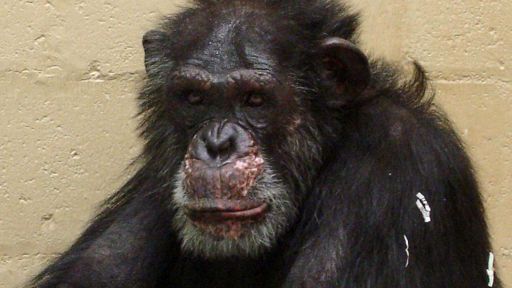
In 1923, Psychobiologist Robert Yerkes purchased two young chimps from a zoo for his own behavioral studies. These two chimps, named Chim and Panzee, would be the first of thousands to be used for the sake of scientific research in the United States. And while internationally, the use of chimps in research has declined over the last decade, in the US, chimps continue to be used in biomedical research. According to the Humane Society of the US, approximately 1300 chimpanzees live in 11 laboratories around the US-making the US chimp population the largest collective chimpanzee colony for biomedical research in the world.

It is a harsh irony that what makes chimps so like humans, makes them such sought-after research subjects. Sharing so much of our biological makeup (99% of DNA, in fact), chimps have been used in the study of infectious diseases, gene therapy, vaccine development, reproduction, language, behavior, even anatomy.

Though they can catch or be infected by nearly all known human infectious diseases, Hepatitis research remains the largest area of chimpanzee use in the US. Nearly one third of chimp research dollars in 2003 and 2004 went to Hepatitis studies. The research has virtually eradicated Hepatitis B and C infections acquired through blood transfusions, though critics of chimp research say the first Hepatitis B vaccine was made from the blood of infected humans.

Introduction What are the alternatives for medical research? Slideshow Interview with Gloria Grow, founder Fauna Sanctuary Caring for Captive Chimps Q and A with the filmmaker Video Links and books Download Wallpaper For Educators In the 1980s, during the height of the HIV and AIDS outbreak, chimps were aggressively bred as subjects for studies of the disease. But this breeding campaign would soon result in thousands of surplus chimps when they were found to be poor models – never developing full-blown AIDS.

Critics of chimp research argue that the case of HIV is not an isolated case of scientific indiscretion. Even in the case of Hepatitis, chimps respond differently from humans. Chimps infected with Hepatitis B will not become sick while humans exhibit traditional symptoms of liver disease. And chimps infected with Hepatitis C will not develop cirrhosis of the liver or liver cancer, though humans will. And in fact, with regard to drug development, 70% of drugs that have tested safe in nonhuman primates are known to be harmful to the human fetus.
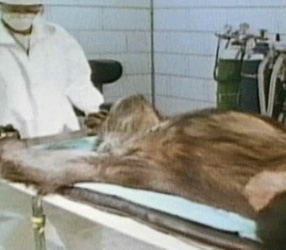
Fortunately, science presents some possible solutions. In July of 2005, Hepatitis C researchers reported a breakthrough in the technology to grow the virus entirely in cell culture. And the vaccine for this disease is now made from bacterial culture.

Using human volunteers with a specific illness in clinical trials for new drugs is, say animal research critics, a more accurate and humane alternative to testing drugs in animals like chimps. Today, a great deal of Hepatitis research is successfully carried out through observation and clinical trials on humans with the disease. The perceived risks of participating in trails is getting smaller. In one form of human clinical trial, called micro dosing, human volunteers are given minute doses of an experimental drug too small to even have negative effects on the body. The physiological effects of the drug are then extrapolated using high tech laboratory equipment like a mass spectrometer. This method can be very effective, and was used during clinical trials for drugs to treat AIDS and HIV.

Unfortunately, human studies are expensive to undertake and are limited by a shortage of human volunteers. While it may be some time before they replace testing in animals such as chimps, they can still provide valuable clues as to how different classes of substances elicit their effects, and thus reduce the need for animal testing. They can also provide a much-needed framework for the development of alternatives based on human or animal tissue and cell systems.

In in-vitro testing on human cell cultures and tissues has become an emerging alternative. Conducted on living cells in containers such as a test tube or Petri dish, the method tests the toxicity of substances, essentially “in bulk,” meaning that large numbers of compounds can be screened rapidly and simultaneously in numerous cell lines, rather than in one individual animal. The method is not only much faster than animal tests, it is also more accurate since human cell lines are used. In-vitro studies on human cells and tissues have made possible the investigation of the immune-stimulating effects of potential vaccines and the analysis of HIV transmission.

New research tools and equipment can also provide alternatives to testing in animals such as chimps. By providing scientists with a clearer and more precise understanding of the physiology of disease(s), scientists can monitor actual patients of the disease they are studying at the cellular level. Techniques such as paper chromatography, radioimmunoassay, genetic engineering polymerase chain reaction, and positron emission tomography have all advanced our understanding of biomedical knowledge. Positive emission tomography, for example, can be used to safely and noninvasively examine the activated lymph nodes and spleens of patients given vaccines or to monitor viral infections in a temporal and spatial manner.

Of course, the genomic revolution has equipped scientists with unparalleled tools for engineering “personalized medicine.” Knowing the correlations between human disease and specific genes could allow doctors to prescribe the right drug at the right dose for the right person, based on unique variations in their DNA- not on the DNA of a chimp, or even a mouse.

While some of these techniques are years away, others are already here and in place. But as more viable humane options are uncovered, perhaps testing our drugs on chimps will seem less necessary and less ethical. And we can finally release chimps from their role as research subjects in our society.

 

   Print    Email    comments (40)

(3 votes)
Loading ... Loading ...
40 responses
Kelly H. -- November 12th, 2008 at 9:17 am

You people are so wrong and cruel!!!! I may be a kid that thinks animal testing is wrong, but these facts and pics. are true, and they disgust me. No one cares about you so do the tests on yourselves!

JILL -- December 2nd, 2008 at 4:36 pm

I THINK THE MURDERS & RAPISTS & CHILD ABUSERS ON DEATH ROWE SHOULD BE USED FOR RESAERCH TESTING THE ANIMALS DONT’T DESERVE THE PAIN BUT THE CRIMINALS DO.

deej -- December 4th, 2008 at 6:04 pm

Who gives us the right to do any experiments on any animals…are they really beneath us. you don’t see unnatural stuff done by animals to others. I agree with Kelly & I really would like us humans to look into the statement that Jill had.

Mark Danga -- December 16th, 2008 at 2:50 am

Yes the animals are beneath us. PBS has a left wing agenda, but nobody with a brain is buying.

Maybe we should test on this idiot filmmaker Ms. Allison Argo who made this propaganda.

hi -- February 4th, 2009 at 11:52 am

This is so cruel. You people should be ashamed of yourselves. The animals you test have feelings too. They might not be able to talk, but they do not need to be abused like this.

echo -- February 4th, 2009 at 11:59 am

how dare you. you people are sick animals.these chimps are said to be our closest relatives.I know im only 12 but i’m going to do all in my willpower to stop this cruel thing

Kaitlyn Sawyer -- February 12th, 2009 at 11:12 pm

i think that chimpanzees need to be treated with more respect because they are you used pretty much like human dummies and im sick and tired of it they need to be treated well like us

sincerily,

Kaitlyn Sawyer of HICKMAN COUNTY,TENNESSEE

Alicia -- February 25th, 2009 at 5:48 pm

Chimpanzees should never be treated this way and the people who do it should feel very bad for harming this beautiful animals!!!!!

Your friend,
Alicia Simpson Of Batesvill Ar.

Wanda -- March 23rd, 2009 at 3:44 am

I agree with all the comments, please write or email you state representatives and demand they stop using chimpanzees in research…..
Project R&R has petitions and enormous info that will help you help the Chimpanzees….
It does not matter if you are are young or old you can help stop this……

KK -- March 30th, 2009 at 5:34 pm

stipid

superman -- April 6th, 2009 at 11:58 am

this is gross and stuped they need to stop!!!!!

hailey -- April 20th, 2009 at 9:57 am

so bad soosooo bad i feel really bad for these animals i dont get y they have to suffer so much.

Bethany -- April 21st, 2009 at 8:58 am

This is not right. I feel very bad for them.

Hailey -- April 21st, 2009 at 9:03 am

what can we do to save these chimps?
Oh i know we can make funraisers.
c at our school we r doing this project on how to save these animals lives and i think its a great thing to do
we started this project after we read this book called Hurt GO Happy and it was good so read it and if u want more info of wat were doing put down another coment and ask me thing or give me some more ideas

Bethany -- April 21st, 2009 at 9:05 am

Wow! That’s a great idea and that sounds alot like my school!

Hailey -- April 21st, 2009 at 9:06 am

well duh u go to my school so lets think of more ways to save these animals ok

Bethany -- April 21st, 2009 at 9:07 am

You don’t go to my school!

Hailey -- April 21st, 2009 at 9:09 am

well then be like i dont wat to sit here and argue with u because i want to find out how to save these chimps

Bethany -- April 21st, 2009 at 9:09 am

GOOD IDEA SMART ONE!

Hailey -- April 21st, 2009 at 9:10 am

i no right so lets get to thinking ok

hailey -- April 21st, 2009 at 9:11 am

lol haha hehe tehe

Bethany -- April 21st, 2009 at 9:11 am

maybe we could have a car wash!

Hailey -- April 21st, 2009 at 9:14 am

oh ya that sounds like sooooooooooooooooooo much FUNN!!!!!!!!!!!!!!!!!! call me up then well do it ok lol lets save the chimps

Bethany -- April 21st, 2009 at 9:15 am

May 4

Hailey -- April 21st, 2009 at 9:17 am

ok sounds great c u then

Bethany -- April 21st, 2009 at 9:17 am

MWHAHAHAHAHAHAHAHAHAHAHAHAHAHA

hailey -- April 21st, 2009 at 9:19 am

yupyupyup

Bethany -- April 21st, 2009 at 9:20 am

mmmhmmm

hailey -- April 21st, 2009 at 9:22 am

ya

Bethany -- April 21st, 2009 at 9:23 am

nooooooooooo kiki is here

Bethany -- April 21st, 2009 at 9:24 am

kiki is anoying

hailey -- April 21st, 2009 at 9:25 am

whats up y friends o heyy kiki ur on here now thats so cool :)

Bethany -- April 21st, 2009 at 9:25 am

no more animal testing

hailey -- April 21st, 2009 at 9:27 am

ya nooooooooooooooo MORE TESTING GOSH OK MONKEYS AND CHIMPS AND CATS AND DOGS R ALL MY FAV ANIMALS OK SO ANIMAL TESTING PPLE U BETTER BACK OFF

hailey -- April 22nd, 2009 at 8:50 am

HEYY WATS UP

Bethany -- April 22nd, 2009 at 8:52 am

hey have we saved the chimps yet?

HAILEY -- April 22nd, 2009 at 8:53 am

WHAT DOSE STATE THE INFO MEAN ON OUR PAPER FOR THE CHIMP THING

Bethany -- April 22nd, 2009 at 8:53 am

hey did we save the chimps yet

HAILEY -- April 22nd, 2009 at 8:54 am

IDK

Peace -- October 7th, 2009 at 10:34 am

Really?? You people need to think about what you are sayin, just because people do bad things doesn’t mean they wshould suffer the same cruel fate as the animals that are being tested on. In-vitro is probably a very good way to end animal testing, if the had enough funding, then animal testing would be reduced, and maybe in the future ended.

post a comment
Please note that the THIRTEEN editorial staff reserves the right to not post comments it deems to be inappropriate and/or malicious in nature, as well as edit comments for length, clarity and fairness. No solicitations or advertisements will be allowed. Users may link to other Web sites relevant to discussion, but most often links to commercial Web sites will not be permitted.

Produced by THIRTEEN    ©2009 Educational Broadcasting Corporation. All rights reserved.

Major corporate support for Nature is provided by SC Johnson, Canon, CPB.