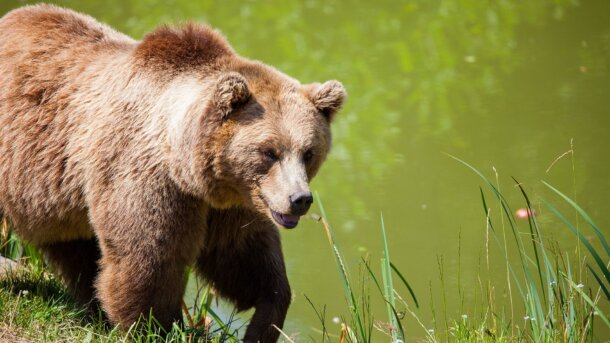
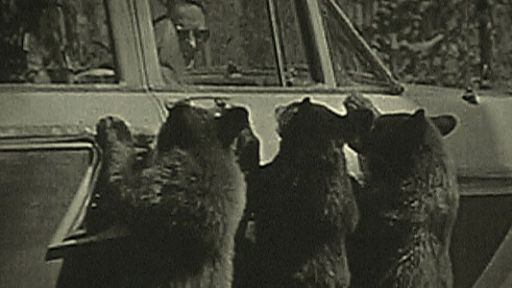
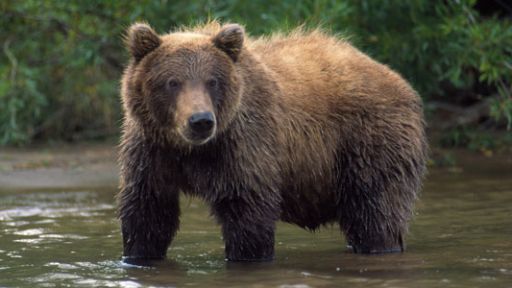
Before visiting Yellowstone National Park or “bear country” familiarize yourself with safety precautions in order to avoid bear encounters. “Run for your life” may seem like common sense if a grizzly approaches you, but such action is highly unlikely to foil an attack. The recommended steps are not easy to follow, but they offer the best chance for survival. Here’s what the experts say:
If you encounter a grizzly, do not run.
Avoid direct eye contact.
Walk away slowly, if the bear is not approaching.
If the bear charges, stand your ground (you cannot outrun it).
Don’t scream or yell. Speak in a soft monotone voice and wave your arms to let the animal know you are human. If you have pepper spray, prepare to use it.
If the grizzly charges to within 25 feet of where you’re standing, use the spray.
If the animal makes contact, curl up into a ball on your side, or lie flat on your stomach.
Try not to panic; remain as quiet as possible until the attack ends.
While in bear country, be aware that you may encounter a bear at any time.
Be sure the bear has left the area before getting up to seek help.
Some other interesting things about grizzlies:
- Most human injuries from grizzly bears are caused by females acting aggressively to protect their young.
- Grizzlies are omnivores; they will eat almost anything. Although a large part of their diet is vegetation, grizzlies will also kill and eat large and small animals.
- Fewer than 1,100 grizzlies exist in the lower 48 states, in 5 populations in Wyoming, Montana, Idaho, and Washington. An estimated 500 to 600 grizzlies populate the Greater Yellowstone area.
- Grizzlies are North America’s slowest reproducing land mammal. A female may not have her first litter until she is 5 or 6 years old, after which she will then typically produce two cubs every 2.5 years. Cubs from the same litter can be from different fathers. Grizzlies have a natural life span of 30 years or more.



@charlotte w. – Actually, humans are the unpredictable ones, that is why animals are scared of us and like to stay away. Bears will only act on instinct so if you know the warning signs, they are very easy to read and their movements can be very predictable. But yes I do agree that a human life is definitely worth more than the life of a charging bear, but the death of one of god’s creatures could be prevented with only a little education. Don’t you think that’s worth it?
I have read many articles and survival stories and the overall key with bears is to just act casual and not to make any sudden, unpredictable movements. And it is true that all bears have their own personalities but that does not mean that they dont make decisions based only on instinct. Also I have worked with many animals in my time(snakes, rabbits, turtles, lizards, ect.) and I know that almost every time a severe attack occurs, it is because the victim acts spastically or out of fear and the animal takes it either as a challenge(common with bears and species of wild dogs) or it see’s the random movements, and makes the conclusion the human is weak/injured and unable to protect themselves and sees and easy meal(most common with sharks) And the reason any animal(other than a polar bear or a tiger) would aproach you, is becuase you are invading their terratory and want you out. All you have to do in that situation is slowly retreat if the animal starts to follow you, put on an agressive act. start with puting your arms up and making a low, growling sound to warn them to stay away, that your human. (my above comment still applies [: )
(for all the strong catholics out there)
If the animal makes contact, pray a hail mary and make a vow that if you survive the attack to go to confession :D
If your still conscious when the bear leaves, write wherever you can as follows-
“I’m catholic, in case of an emergency, call a priest.”
\(just thought I’d put my dad’s joke out there :D )
to Ugh, people these days- I completely agree with you. I liked your statements a lot and found them to be very true :] and I agree with you too naughty. (For the most part) although I can’t agree that bears hunt people. Unless bears have fed on a human, they will not normally hunt them. The only ‘man eaters’ out there that will actually track and stalk humans are tigers and polar bears, but bears ARE creatures of habit and, like humans, are very quick to develop bad ones as well as good ones, so if a bear has eaten from a human victim it has killed, it will then add humans to the ‘possible pray’ list and will attack a human if it comes across one. Though, I’m pretty sure they don’t stalk us. :T
and to Ugh, people these days again: I am also under the age of 18( I am 16 ) and also find many of the people on this site terribly unbearable an immature.. :P I also find it troubling that teens are seeming more mature than most of the adults on this site and in the news recently. It makes me wonder who we should REALLY be putting in charge of this country. :T but I guess all I can say is that I am, in the least, dissapointed.
my landlord, who lives in the mountain behind our house, just 3 days ago saw a momma bear and 2 cubs. now we cant let the kids outside. does anyone know if there’s a way to get rid of them? i doubt it though cuz bears have a mind of their own.
@charlotte w. good job!!!! couldn’t of said it better myself!
The National Park Rangers are advising hikers in Glacier National Park and other Rocky Mountain parks to be alert for bears and take extra precautions to avoid an encounter.
They advise park visitors to wear little bells on their clothes so they make noise when hiking. The bell noise allows bears to hear them coming from a distance and not be startled by a hiker accidentally sneaking up on them. This might cause a bear to charge.
Visitors should also carry a pepper spray can just in case a bear is encountered. Spraying the pepper into the air will irritate the bear’s sensitive nose and it will run away.
It is also a good idea to keep an eye out for fresh bear scat so you have an idea if bears are in the area. People should be able to recognize the difference between black bear and grizzly bear scat.
Black bear droppings are smaller and often contain berries, leaves, and possibly bits of fur. Grizzly bear droppings tend to contain small bells and smell of pepper.
I prefer to use non-lethal methods. I would stand my ground with pepper spray & a pistol. DEFEND WILDLIFE!