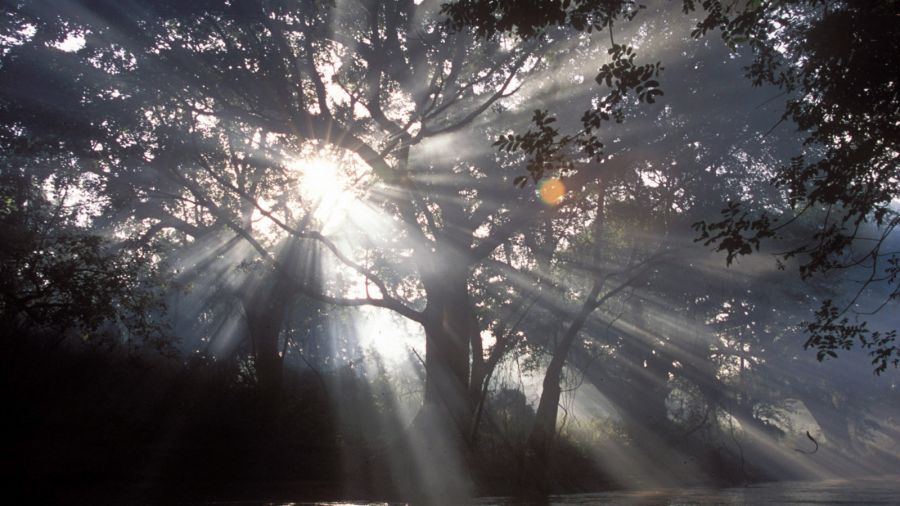
NATURE reveals the importance of an unlikely partnership between a regal tree and a tiny wasp in The Queen of Trees.
It may be one of nature’s oddest couples: a tiny wasp that can barely be seen, and a giant fig tree, the sycomore, which shelters a remarkable menagerie of wildlife among its limbs. The wasp and the fig depend on each other for survival. Without the wasp, the tree could not pollinate its flowers and produce seeds. Without the fig, the wasp would have nowhere to lay its eggs.
The Queen of Trees shows this delicate dance of survival in exquisite detail, including spectacular close-ups of the wasp’s remarkable life inside a ripening fig. To capture such incredible images, filmmakers Victoria Stone and Mark Deeble spent two years camped out near a giant sycomore fig in Kenya’s outback, documenting the tree’s pivotal role as a source of food and shelter for everything from gray hornbills, Africa’s largest bird, to swarms of invading insects searching for food. In a surprising turn, some insects come to the tree’s aid — sparking a battle you won’t want to miss.
Online content for The Queen of Trees was originally posted April 2006.
To order a copy of The Queen of Trees, please visit the NATURE Shop.


(57 votes)

I love your show, I have since I was little. But I want to know what more I can do to help conservation.
This is the best nature doc I have ever seen, period!
Oh – do wasps have breasts? I was loving it until that description, please don’t dumb it down. I would like to show this to my high school biology students – but really??
of course wasps do not have breasts, as only mammals have mammary glands. It was a colloquial usage of the word.
I also get frustrated when my local PBS station chooses not to show Nature at the normal time. I am glad some episodes are available online, but hope to see more online ones in the future.
Dumbing down the science takes away from the program. If they take such liberties with the facts as saying wasps have breasts, what else would the writers be willing to distort. Just use the correct terminology, please. The credibility of PBS is at stake.
I missed it, due to the fundraising. It was my dream episode.
Definition of “breast” (brst)
n.
1.
a. Either of two milk-secreting, glandular organs on the chest of a woman; the human mammary gland.
b. A corresponding organ in other mammals.
c. A corresponding rudimentary gland in the male.
2.
a. The superior ventral surface of the human body, extending from the neck to the abdomen.
b. A corresponding part in other animals.
3. The part of a garment that covers the chest.
4. The seat of affection and emotion: “Griefs of mine own lie heavy in my breast” Shakespeare.
5. A source of nourishment.
—-
so, whaddya know … it might appear that you all might have definitions of “breast” that are too restrictive !
The “breast” of the female wasp 1) topologically conforms to the upper front of the human and, 2) provides nourishment !
Ok, so an insect is not a mammal. So what.
Near the beginning of the show there was a brief picture with no commentary of an extraordinary pink fuzzy insect. I would love to know the name of this creature if anyone can help. Very unusual white/pink feathery/fuzzy prancing motion. thanks in advance.
This is absolutely the very best(among many great)piece I have ever seen on PBS or elsewhere. But I wonder how anyone can believe it happened without intelligent guidance.
Keep up the good work.
Health and Happiness,
Nevin Hawlman
Rebecca – The name of the pink insect you saw in the program is the pink mantis.
This was wonderfull from start to finish, when can we see it again so i can tell my friends to watch. I was learning so much that the whole breast thing must have gone right over my head, some of you are just to picky. I’m sure your students could still learn a thing or two.
This is probably the best Nature program I have ever seen – and that is saying something. If you need a classroom video that really describes the complex interdependencies between communities of organisms, it just doesn’t get any better.
Great program, amazing footage. Two gripes: stop the inane anthropomorphizing. The tree is not a “she” or a “queen.” Irritating as all hell. Second, why don’t you identify the birds? You identified every insect and mammal but not the weavers, the barbets, the pigeon…
The best nature show I have ever seen ! Just enjoy the wonder of it all and stop complaining.
I didn’t catch the whole show but what I saw I couldn’t keep away from watching the show of the queen tree. I wanted to watch it on the internet but it does not show it there either. I really have an interest to see it some time soon.
I’d go further – this is the best TV show EVER!! get rid of big brother and replace it with more films like this!
Dear Victoria & Mark,
Thanks a lot for an extremely good film. Certainly of the best nature films ever been made. Photo, athmosphere, message, all is clean and pure as life was intended for.
Thanks again.
Per and Marita Lindstrom
Sweden
Why can this episode no longer be viewed online? I know that it is an old episode, but why make people wait until it aires again on PBS to watch it? I have no television, only a computer, and I am always working during normal programming times, as I am sure many people are as well.
Does this mean I have to find some DVD to buy?
This was one of my favorites. Beautiful in content and presentation.
While I think the “breasts” complaint is a bit silly, I would like to see more information included in Nature. At least tell us what animals we are looking at so we can look up more details on our own.
I loved this film, amazing!!!
I accidently ran across this film on PBS and was enthralled! Couldn’t stop talking about it so I bought the DVD- Also people, stop over analyzing and criticizing! Just recognize and appreciate awesomeness.
MOTHER NATURE IS SIMPLY AMAZING!!!!!!!!
[...] between the tiny fig wasps and the fig tree is the stuff of ecological legend and fascinating natural history. Anyone who has spent an hour under a fruiting banyan can attest to the life that such a tree [...]
ooooooh, I’m looking forward to the fig tree!
I mostly enjoyed this program. The photography was great and the narrative was engaging. I must say, though, that I was very put off by the sudden inclusion of humans in the program. They were talked about as if there were simply other animals engaging in the vast ecological system provided by the fig tree. I think it was quite insulting to those two men. Had this been a program about a European ecological system, I wonder if the humans would have been shown the same way. Furthermore, Africa is a continent, it would be nice to know the location (i.e. country) this film took place in. These kinds of things can nearly ruin a program for the multicultural viewers.
IS there more than one queen fig tree?
PBS Nature is always the best hour on TV each week.
Absolutely incredible documentary. Spectacular closeups of all the insects. I was sad it lasted only an hour, it seems like there was so much more material with all the other lifeforms that utilize the fig tree. You guys did an incredible job. As a photographer I must ask though what kind of cameras were you using for those immaculate close ups? Excellent job A+.
Unsurpassed natural beauty. And the sweet voice of Patricia Clarkson was rivaled only by The Queen’s nectar itself.
A lovely program from beginning to end. Who did the narration for this program? She has a beautiful voice.
Just watched this beautiful, fascinating program. Most exciting since it was new knowledge. Is this real? I thought. Thank you, Nature!
I loved it!!!! how do they get those video shots??!?!?!?!
I loved it!!!! simply AMAZING!!
wow…..again. supurb!!!!!!i’m buy’en this one for my grandkids…….keep up the good work, and thanks……GOD is great, isnt HE????????
Female fig wasps have it rough from pre-”birth” to death. What a great episode!
This was the best nature documentary I have ever seen! It unfolded like a symphony, layer upon layer as each new amazing inter-relationship was added to the ones before it, a distillation of a huge amount of information and research. It simply had more content and less intrusion than other documentaries, many times more than those that feature puffed-up intrusive narrators or teasing, anthropomorphic plot lines. The photography and editing was tremendous as well – this one should win some awards! I also loved the inclusion of humans as part of the ecosystem, putting us all in proper perspective as part of the natural world.
A terrific program with marvelous video photography. Regarding the term “breast” on a fig wasp: A more appropriate term is thorax. The paired “pollen baskets” are on the lower (ventral) side of the thorax. I have many articles about this remarkable insect-tree relationship on my website Wayne’s Word: http://waynesword.palomar.edu/indxwayn.htm#figwasp
This is a stunning film about the most remarkable co-evolutionary relationship in nature. Although I read about this in some books, it was a pure joy of seeing these tiny wasps. I really appreciate the staffs who were dedicated to film this amazing nature.
What a superb program! Couldn’t take my eyes from the screen for one moment. So glad I recorded for future viewing. Nature is amazing; incredible how she provides for all living creatures on planet Earth!
These kind of shows are the only reason that I have a t.v. in the house – this was an incredible undertaking, and I learned so much – wish I had saved it, as there’s much to learn from seeing it again! Thanks so much for spending so much time capturing something so extraordinary!
Marvelous documentation. It touched a 74 old man’s heart.and I will show it to my 2 grandsons.
i agree! this is the best.
An incredibly photographed, amazing story about something most of us probably never knew anything about before this show. Than you PBS!!!
Nature itself is an unlikely partnership–we seem to be the only life forms on the planet who do not understand this
Very inspiring show
I saw this for the first time at 2 AM this morning, I was absolutely mesmerized by this film. Even though the narrator kept talking about how all the relationships were “evolved”, I could see this complex system of systems and relations to be nothing but one of the most wonderous and majestic works of art and science that could only be created by God Himself. None of this happened by accident. It’s so obvious to me that the tree, the insects and the animals and all their interrelationships were all intricately designed by a Genius, down to the most infinitesimal details.
Awesome show. Bravo to Nature and the photographers, narrator, producers, director and to everyone involved in this project. Superb.
I watched it twice. Excellent photography; elegant narration. I thought the two natives that wre shown might have a bit more to offer. I don’t know how anyone can watch this and not believe in God.
Whoa baby! Evolution is awesome!!!!!!!
It is the best show I have seen. Thanks GPB tv.
I clicked on this site after seeing the show earlier today. I thought, as I watched it, that it was beyond good. I see that I am not alone. It makes one seek more than it tells. A must-see for all.
A ‘best ever’ documentary! To feel the magnificence of nature as presented in the wonderful narrative and enthralling photography is to understand the interdependence of species on our planet.
If we could teach all students the simple and subtle concepts developed in ‘Queen of Trees’, this fragile Earth would surely benefit from a new generation of able stewards and protectors. How do we do this?
Bravo Nature! This powerful and elegant program is an educational step forward.
A year ago Ellen commented, “…stop the inane anthropomorphizing. The tree is not a “she” or a “queen.” Irritating as all hell.”
I’m guessing nobody ever told Ellen that trees can sometimes be separate sexes. This fig is what’s known as being gynodioecious. Therefore, this tree CAN be a female and CAN be referred to as “she.” I don’t think that’s being anthropomorphic. It’s simply designating the gender of the tree and calling it as such.
Thank you for sharing this “miracle tree” with the world. I, unlike many, take no offense to your use of “less than scientific terminology”. I just can’t imagine that any child that sat down to watch this cinematic marvel asked their parents if fig wasps produce milk from the mammary glands in their breasts. I purchased a copy to share with my students. I teach at a high school in rural North Carolina and my students loved the show. they are going to be posting some comments so that your readers can read the opinions of 16 and 17 year olds to the show. For me it was the wonderful examples of coevolution that I loved. Thank you.
I am only 16 years old, but I enjoyed and understood this program very much. I learned much from this program.
I think the documentary was very educational. It was interesting to watch. It kept my attention.
I am a high school student taking AP Biology with Mrs. Campbell and we found the movie to be very interesting. We loved all of the pictures of the wasps in the fig and the story of the bird in the tree. It was the first video viewed in a science class that was interesting and EXCITING.
I really enjoyed this video and I highly recommend this to anyone of all ages. It was very interesting and I think you should make another. Great Job!!!
This was a great video. It really showed me how so many different species interact with each other in one environment. Keep on keeping on scientists!
This documentary presented my class and I with extraordinary information of the subject of coevolution. It really helped me to understand this subject better. It was amazing to be able to see the activity going on inside of the fruit.
While the footage of the wasp inside the fig fruit was remarkable, I think my favorite shot in the whole program was the fish skeleton with the fig seed blooms close by. The program was a remarkable visual demonstration of seed disbursal!
This episode was simply amazing, amazing story and amazing footage, thank you
The narrator and filmmakers did an outstanding job on this amazing program. It was absolutely the most remarkable story I have ever watched on nature. Thanks to the filmmakers for letting me sit in my living room and enjoy the beautiful presentation. “Good Job Keep it up”
to think this wonderful program supports the notion of a higher power is to commit the logical error of survivorship bias. a beautiful ecosystem neither supports nor refutes the existence of such.
think of how many ecological systems once existed but no longer are around from over the past several million years, and think of the ones that have existed during recent times but have vanquished, or those that will die out in the future. that some survive and thrive while others die do not support one theory or the other.
separately, thank you (those who make Nature possible) a million times over for your excellent programming.