
12: 1209: Artist Cindy Chinn and More
Season 12 Episode 9 | 27m 30sVideo has Closed Captions
An artist transforms a school into her studio, the unique musical instruments and more.
An artist transforms a school into her studio, new conservation methods to save Nebraska's Pine Ridge Country, a Holocaust education program for Omaha students, and the unique musical instruments of Jay Kreimer.
Problems playing video? | Closed Captioning Feedback
Problems playing video? | Closed Captioning Feedback
Nebraska Stories is a local public television program presented by Nebraska Public Media
12: 1209: Artist Cindy Chinn and More
Season 12 Episode 9 | 27m 30sVideo has Closed Captions
An artist transforms a school into her studio, new conservation methods to save Nebraska's Pine Ridge Country, a Holocaust education program for Omaha students, and the unique musical instruments of Jay Kreimer.
Problems playing video? | Closed Captioning Feedback
How to Watch Nebraska Stories
Nebraska Stories is available to stream on pbs.org and the free PBS App, available on iPhone, Apple TV, Android TV, Android smartphones, Amazon Fire TV, Amazon Fire Tablet, Roku, Samsung Smart TV, and Vizio.
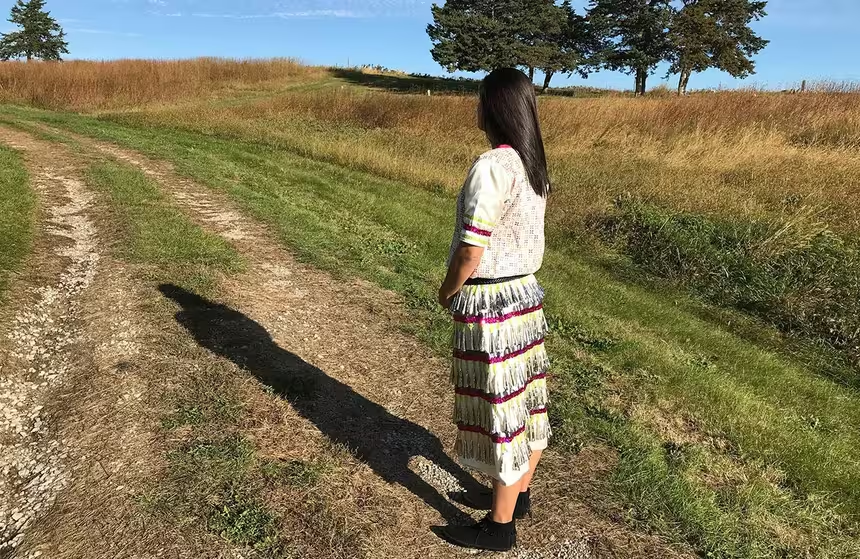
Do you have a Nebraska Story?
Do you have a story that you think should be told on Nebraska Stories? Send an email with your story idea, your name, your city and an email address and/or phone number to nebraskastories@nebraskapublicmedia.org. Or, click the link below and submit your information on nebraskastories.org.Providing Support for PBS.org
Learn Moreabout PBS online sponsorship[Narrator] Coming up on Nebraska Stories, a visit with Cindy Chinn, the school-house artist.
Using fire to fight wildfires.
Students explore the art and history of the Terezin ghetto.
And, the uncommon music of artist Jay Kreimer.
(theme music) (theme music) (smooth music) - I moved to Chester in 2006.
I wanted a bigger studio.
(intense music) I worked for the world's largest video screen Fremont Street experience.
I ran the company that produced the light and sound shows for that.
I've painted large murals for hospitals.
I have painted ceiling murals in a dental office.
I've painted the dive tank at the welding school, the underwater dive tank.
That was interesting, actually.
I was the lead animator on the Lion King video game.
(gentle music) I found a school in the Sandhills that had the whole upstairs was skylights and it's like, "Oh my God, this is so great.
"Why am I building a studio in the backyard "of my house in Vegas "when I can have this giant building "for 14,000 square feet with skylights?
"Why am I even putting skylights in my house in Vegas?
"Why aren't we just packing and moving?"
(gentle music) The closest airport was six hours away, and it was just too far.
So I kept looking, and then I came across the school in Chester.
It was perfect for what I was looking for.
I was looking for a lot of space I'm into a lot of different things, and I thought, "Well, if I had a classroom for every medium "that I work in, that would be perfect for me.
"I would never have to put away my tools."
My retirement goal is to have an artist retreat.
So it was just a perfect building.
(gentle music) It was February.
And the weather was perfect.
Absolutely perfect.
And we thought, wow this is great for February.
We're wearing shorts.
It hasn't been that way since.
My first thoughts on Chester were that it was very small.
I've lived in small towns before, but it was very small.
After being here for 15 years, Chester is actually pretty big.
The best thing about having a giant studio is that I live there, I don't ever have to leave.
I just, I get up in the morning.
I go to bed when I want, I don't have to get in the car, go anywhere.
I just walk downstairs, go to sleep, get up, go to whatever studio I decide I'm going to work in that day, and work.
I paint.
I carve wood.
I've carved church pews.
I sculpt ceramics.
I do glass work, fusing stained glass, glass mosaic, candle making, and tie-dye!
(laughs) Stop frame animation!
(upbeat music) (plasma torch hissing) I bought a plasma torch because I've always wanted a plasma torch.
And I thought, "Oh, this will be fun."
I called my friend, who's a welder.
And I said, "Hey, come over and show me how to turn this thing on."
Gave me a quick 20 minute lesson, and left.
And he came back the next day and I cut everything.
(laughs) Everything that I had that was flat and metal.
And I'm like, "I don't have any more shovels.
"I don't have any more metal.
"I need something else to cut."
I get my saws through yard sales, estate sales.
And I have several people who collect saws for me, and they go to all the auctions and they hunt them down.
I call them my saw hunters.
They'll call me and say, "Hey Cindy, I've got 50 saws.
"Can you meet me in York?"
(light music) Really into miniatures.
I love doing miniature art.
And every year I enter a miniature show in Grand Island, and I thought this year I'm going to do something different, because I always do paintings for that.
And I decided to do something different this year.
And I thought, I'm going to do a carved pencil.
And I decided to use a carpenter pencil because it has a wider lead.
And I thought, well, my first time carving.
I should do something that's a little easier than a standard pencil.
Looking at the end of the carpenter pencil, it looked like kind of like a tunnel.
It could be tunnel.
So I decided to do a train, to carve a train coming out of a tunnel on the end of the pencil.
That very first pencil took me about 10 hours.
And I thought, Oh, I'll get a microscope.
And the microscope will make it go faster.
Well, I was wrong.
I was so wrong, because now I can see more detail.
And now I can put rivets on the seams of the of the engine.
And it's so micro, but I can see so much clearer with a microscope that it takes me about 20 hours, now, to do a train when it used to take me 10.
(whimsical music) I've always been creative.
Forever, always.
(gentle music) My long-term goal is to have an artist retreat.
Honestly, I think I'd be comfortable wherever I was.
At least I would hope I would be.
Community is very important.
I ended up finding this place and it was perfect for my needs and what I wanted to do for the future.
It was just a perfect building.
(somber music) (calm music) SANDY MONTAGUE ROES: 2012 was a fire that basically destroyed the entire grazing area of this property.
And it was significant, not only for us but our neighbors.
(somber music) ROES: It was so intense, and so quick that we were very fortunate to have not lost our home.
NARRATOR: Sandy Montague Roes still gets emotional when she thinks back to the wild fire that swept through her Chadron ranch, and the devastation it left behind.
ROES: For whatever reason, I felt the need, I was compelled to look at every single part of this area because, woo.
(emotionally) It was devastating.
And as you would, go up hills and look over at neighbors, there was a cabin that had been destroyed.
There was animals dead.
(fire crackling) I mean just everything, it was like a war zone.
(fire crackling) NARRATOR: 2012 wasn't the first time the Chadron area was hit by catastrophic fire, and it won't be the last.
The land tells the story.
Once pine covered hillsides are bare.
A few clusters of surviving trees dot the land beneath.
BUSKIRK: So we're standing in the middle of the 2006 Spotted Tail fire south of Chadron, on the Pine Ridge Ranger district of the Nebraska National Forests and Grasslands.
The area was, as you can see as you look out, very hot fire, burned in late July, really did a number on our forests here south of Chadron.
JACK RHEMBRANDT: Of course, the fires out there, when we do have them it's hot, usually dry, so it takes a big toll on the volunteers.
As you work on that fire, in the back of some people's heads out there is when's the next one, or where's the next one?
NARRATOR: While tall grass and thick forests may look beautiful, through the eyes of a forester they're fuel for a disaster.
(washing fire truck) Foresters give a lot of credit to hard working volunteer firefighters, but say a lot is owed to an unlikely first responder.
(cow mooing) These cows and their calves feed on grass that could potentially fuel another devastating forest fire.
District Forester Doak Nickerson has been protecting this area for many years.
(axe hitting dirt) And he's a big believer in grazing as a fire management tool.
DOAK NICKERSON: The beef cow and her calf right now, in this part of the world, are what I call the first responders.
And they're ahead of the volunteers.
The more they eat grass, the shorter that grass fuel becomes.
If you don't have the cow calf, then all the other exciting stuff we do with this forest, in terms of logging, thinning, sawmills, chip mills, the wood energy plant at Chadron State College, all of that is a moot point, if we don't graze this ecosystem.
Because we will lose this forest if we're not managing the grass fuel model underneath it.
McCARTNEY: So, which ones did you plant last year?
NARRATOR: Sandy used to think of grass as a tool to feed cattle, but now thinks of cattle as a way to control the grass.
ROES: When I was young, and as I grew up, my understanding was that the grass and the land was just an ancillary piece of raising the cow herd, or the animal herd.
I have that all changed around.
So it's really being conscious and mindful of how you tend the grasslands that are here.
NARRATOR: Grazing is just one of the ways used to mitigate fire.
(grass burning) Prescribed burns are another.
BUSKIRK: If we can safely get fire back on the ground, that's gonna be the most cost effective way for us not only to treat the burned areas, but to protect our green areas as well.
So I'm really excited about that, and where we can go with prescribed fire on the Pine Ridge landscape.
NARRATOR: But burns can't be done safely in an overgrown forest.
Foresters support thinning the forest, but it's a practice that's often misunderstood.
FRED McCARTNEY: You can't fix this problem by just reintroducing fire.
Because we have forests here, a lot of these haven't had any management since this area was homesteaded.
To come back in and say well, we're gonna just reintroduce fire, we don't need to go in and thin these forests first, would be totally irresponsible.
(logging saw whirring) NICKERSON: We've come in with chainsaws, and we've thinned those forests out.
We've given the trees some elbow room.
We now have happy trees.
And happy trees are healthy trees, versus a forest that's really heavily stocked with trees.
Those trees aren't happy, those trees are doomed to fail because they're gonna burn out.
McCARTNEY: We haven't managed them for many years, and we're paying for our sins, in these holocaust wildfires that we've been experiencing here in Western Nebraska, and all over the western part in this country.
We're paying for our lack of management.
We've loved these forests to death.
To go in and proactively manage these, yeah sometimes you got to make some stumps.
(tree saw cutting stump) BUSKIRK: We talk a lot about restoration, when we're talking about fires.
How do we bring the forest back?
Really that's not our goal, believe it or not.
Our goal is to create a forest that's resilient next time the fire comes through, a forest that can handle a fire the next time it comes through, an ecosystem that can handle it.
The key word that we're using now is resiliency, the ability to bounce back.
NARRATOR: And, albeit slowly, the area is bouncing back.
The land at Spotted Tail, take another look.
Below the barren hills, new ponderosa pines are slowly taking root.
(calm music) BUSKIRK: You can see some of the work that we have been doing since that fire.
These trees that you'll see here in the, here near us, they were planted probably in 2008.
And they're already nearly 10 feet tall.
So the forest is coming back.
NARRATOR: And the Montague Ranch is bouncing back too.
ROES: Fred, this is a perfect example of what we've been seeing survive from the planting.
Throughout this the devastation was severe and significant, yes, but as a person that's being responsible to agriculture, I have learned a significant amount, because I've been forced to.
And when you have some life changing event like that, you have to be the best you can be to make things better.
There's something good that has come out of this whole event.
Sunsets are now gorgeous again, you can see a tree line.
It looks like it's re-birthing, and we're re-growing.
And it's gonna be good.
I can see the light now.
♪ Music ♪ NARRATOR: FRIEDL DI CKER-BRANDEIS WAS 44 YEARS OLD WHEN SHE FIRST SAW THE JEWISH GHETTO TEREZIN.
SHE WAS GREETED BY SOLDIERS WITH GUNS, THOUSANDS OF PEOPLE LINING THE STREETS, AND TOTAL CONFUSION.
BETH DOTAN: There is a thirst for trying to understand this very difficult history and I think that our world is difficult today and people want to know how to make it a better place.
NARRATOR: AS AN ARTIST, FRIEDL DICKER-BRANDEIS HAD WORKED WITH CHILDREN BEFORE.
SHE KNEW TEREZIN WOULD BE A FRIGHTENING PLACE FOR THEM.
SO, IN HER LUGGAGE, FRIEDL PACKED PAINT, BRUSHES, PAPER, AND BOOKS...NOT FOR HERSELF, BUT FOR THE CHILDREN.
SURROUNDED BY THE WALLS OF TEREZIN, FRIEDL OPENED HER SUITCASE AND, IN SECRET, THE CHILDREN BEGAN TO CREATE.
JIM SCHANTZ: There are ways to find meaning by looking at art and listening to music.
and I think it's important as artists to bring that to others.
ANNA ORNSTEIN: So it's not just the child in Terezin.
The Terezin child also expresses the feelings of many children in this country now.
Let people know, this is how I feel.
This is what I want you to know about me.
NARRATOR: THESE OMAHA STUDENTS ARE JUST BEGINNING TO LEARN ABOUT THE HOLOCAUST.
BETH: We wanted to show that children were a big part of this story... NARRATOR: ALONG THE WAY THEY WILL MEET FRIEDL'S STUDENTS FROM TEREZIN.
BETH: We can't teach about the Holocaust unless we give the kids some context.
We had to think of a way to get them to connect.
I mean, you know, they don't get it.
And we chose the topic of freedom.
BETH: How about "If my freedom were taken away"...
GIRL PINK: If my freedom were taken away I would fight for the freedom.
GIRL: We couldn't follow our dreams.
We couldn't listen to our iPod all day.
URIEL: If freedom were gone every day would not want to be lived.
If freedom were gone every day would be lived without drive.
If freedom were gone every day would be lived without purpose.
If my freedom was taken away I would not care to go on.
BETH: He represented much more than just that poem he read.
BETH: It's not easy, it's not easy.
Thank you for sharing that.
BETH: What has happened is their understanding that this topic and the ramifications of what happened in the Holocaust can be translated into their own personal experiences.
GIRL: I wanna know how they felt when this was happening.
NARRATOR: TO FURTHER THEIR LESSONS, THESE OMAHA STUDENTS WERE ENCOURAGED TO DRAW, WRITE, AND FORM WITH THEIR HANDS.
DANNY & FRANCISCO:...and then they put 35 girls in each room...
BOY & GIRL: ...35 girls in a room.. Whoa - I could not live with 35 girls in my room.
BOYS: I wrote people were separated by age and gender.
GIRL: Mine's about when they had to be punished.
GIRL: And that made them feel weak and hopeless.
♪ Music ♪ NARRATOR: THE CHILDREN OF TEREZIN CREATED OVER 5,000 DRAWINGS AND COLLAGES.
THEY WROTE NEWSPAPERS AND POEMS.
THEIR CREATIONS WERE HIDDEN FROM THEIR NAZI OPPRESSORS.
AT THE END OF THE WAR THEY WERE FOUND, STUFFED INTO WALLS AND SUITCASES.
ANNA: It means that up until the very last moment, you don't give up hope for survival.
These children knew that they were meant to die.
But hope is a remarkable, remarkable human property of the mind.
♪ Music ♪ music) (thrumming music) JAY KREIMER: I work up in this space.
Welcome to it.
One thing that people usually notice is the amount of stuff that's around.
And it's not from sloth, it's from curiosity.
(weird music) I was making stuff from a really young age.
I was modifying instruments from age 16 on.
I'd get something and I'd modify it.
If I'm gonna be really honest, it's probably an extension of that teen rebellion.
It's like enough of this stuff, let's hear some other things.
(weird music) It turns out that making instruments feels like really slow performing to me, which I probably like the best is performing.
But I'm also involved in a number of art projects.
I'm Jay Kreimer, welcome to my world.
I make instruments from found objects and common objects.
And I search for the sounds that are hidden in them and release them into the world.
(string music) I see heads and sometimes the heads take a while to become manifest.
So for instance, that orange tube over there.
The tube is from a radon removal project, and the strings are made from tennis racket string.
(string music) I had acquired these things separately without a vision, but thinking, I've gotta be able to do something with these.
And they kind of composted mentally for a couple of years.
And then one day I thought, oh, I know what to do.
So, I put it together and it worked right then.
Hardly ever does that happen.
Usually it don't work because you have to develop it.
But sometimes it's like that.
(eerie music) The metal bowl there with the spines on it, that was in a thrift store and those things were sitting next to each other.
I looked at them, I thought, I know what to do with that.
So, I took it home, drilled a hole, put a pickup on and it worked.
(eerie music) I love that sound.
And this ones been all over.
This one's been in Beijing, it been all over Europe, all over North America, and it's been to India.
(string music) That's how finding things really works for me.
Just paying attention and stumbling on 'em.
And it's not just plain luck, apparently it's having paid attention to this stuff for a long time, so I notice stuff.
(string music) Tuning is a little suspect, but that's not what were here for.
(string music) And I formalize the sounds I discover a little bit and make it slightly unpredictable, but slightly controllable, and perform with those.
(string music) I played in D-22 in Beijing, which was the hip club at the time.
It's gone now.
(string music) Played all over this continent.
(string music) Cooled off in Montreal.
(string music) Played 12 cities in Europe.
(percussive music) I've played in a place called The Electric Church in Berlin, the Cork Arts Center in Ireland.
(laughing) I do carry a little tool kit and glue.
So, I like that and I want people to experience it.
You can get interesting results without any technique at all.
There are a certain range of people who are really into music that like this nontraditional stuff, avant-gardish, improvised, experimental stuff.
Sometimes the academics think that's not music, but that's some old school and that feels irrelevant at this point.
It's conservative.
(percussive music) Boing.
Little kids and old people, they're not trying to be cool, they love it.
(string music) It's the truth of how I work is I like to look at and listen to found things.
(string music) I love it, I love all of it.
(string music) ♪ ♪ >> WATCH MORE "NEBRASKA STORIES" ON OUR WEBSITE, FACEBOOK, AND YOUTUBE.
"NEBRASKA STORIES" IS FUNDED IN PART BY THE MARGARET AND MARTHA THOMAS FOUNDATION.
♪ ♪
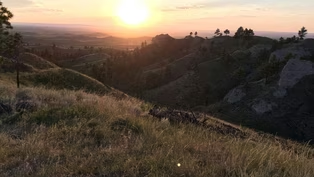
Video has Closed Captions
Clip: S12 Ep9 | 7m 20s | Learn about new conservation efforts to save Nebraka's Pine Ridge Country. (7m 20s)
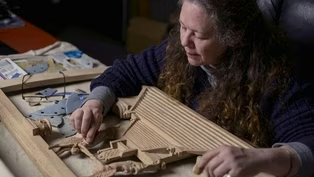
Old School Cool Artist Cindy Chinn
Video has Closed Captions
Preview: S12 Ep9 | 8m 12s | An artist turns a former school into her studio. (8m 12s)
Providing Support for PBS.org
Learn Moreabout PBS online sponsorship















Support for PBS provided by:
Nebraska Stories is a local public television program presented by Nebraska Public Media