
12: 1211: Ginger's Labyrinth and More
Season 12 Episode 11 | 27m 38sVideo has Closed Captions
A woman’s miraculous recovery from a traumatic injury and more.
A woman’s miraculous recovery from a traumatic injury, the fountains of Nebraska's State Capitol, a Wilber man who's loves running for president, a very special apple tree, and an old cemetery walkway.
Problems playing video? | Closed Captioning Feedback
Problems playing video? | Closed Captioning Feedback
Nebraska Stories is a local public television program presented by Nebraska Public Media
12: 1211: Ginger's Labyrinth and More
Season 12 Episode 11 | 27m 38sVideo has Closed Captions
A woman’s miraculous recovery from a traumatic injury, the fountains of Nebraska's State Capitol, a Wilber man who's loves running for president, a very special apple tree, and an old cemetery walkway.
Problems playing video? | Closed Captioning Feedback
How to Watch Nebraska Stories
Nebraska Stories is available to stream on pbs.org and the free PBS App, available on iPhone, Apple TV, Android TV, Android smartphones, Amazon Fire TV, Amazon Fire Tablet, Roku, Samsung Smart TV, and Vizio.
Do you have a Nebraska Story?
Do you have a story that you think should be told on Nebraska Stories? Send an email with your story idea, your name, your city and an email address and/or phone number to nebraskastories@nebraskapublicmedia.org. Or, click the link below and submit your information on nebraskastories.org.Providing Support for PBS.org
Learn Moreabout PBS online sponsorship(theme music) Narrator: Coming up on Nebraska Stories...
The miraculous recovery of Ginger Theisen... A design nearly a century in the making... Meet a Wilber man who loves running for president... Sir Issac Newton's Apple Tree...in Nebraska.
And a small town's historic cemetery walkway.
(upbeat music) - Closure, downpour, shooting star, electric scooter, matrix, rejuvenate.
(chimes chiming) It's relearning everything.
I mean, it's all there.
It's just figuring out how to get it all going again.
(dramatic uplifting music) (dramatic uplifting music) (dramatic uplifting music) LEITNER: What it is, it's an opportunity to really make a pilgrimage to your own center, to this place where God dwells within you.
You walk it, you walk in, and at the center then, you are there with God, who supports you and strengthens you with His love.
And then you walk out again and are able to face the challenges of life with new strength and joy.
(uplifting music) Our labyrinth is modeled after the labyrinth in the cathedral in Chartres in France, which can still be visited today.
Since Saint Benedict says in his rule we should keep death before our eyes daily, and so the labyrinth reminds us that ultimately this earthly life is more than those few years that we spend here on this planet.
And on the other hand, as we live conscious of having to die at some point, we can live more intensely in the present.
(soft foreboding music) THIESEN: He described it as a beautiful day.
It was really warm in September of 2013, and saddled up the horses.
There's these little chunks of rock, and the horse just must have stepped on a little rock that completely lost her balance, taking me with her, like that, and just kind of (slaps).
(foreboding music) And that's why I ended up with broken bones over here.
And I guess there were problems that were discovered over on this side too, because this was the side that hit the ground, and this was the side that the horse landed on me.
(soft music) I was definitely not down here on this earth.
I was somewhere out in the universe.
(uplifting music) LEITNER: In her wonderful, exciting book, in her memoir, something that touched me right at the beginning was her near-death experience.
And I'm sure this was really a getting in touch with the divine reality.
THIESEN: I was around my sister, Diane, all my parents, my niece's daughter who passed away the year before.
And I mean, it was pretty cool.
(chuckles) It was absolutely beautiful, in fact.
I kinda compare it to a Maxfield Parrish painting, like incredible colors, like bright, brilliant colors.
And I don't know, it was definitely not down here.
They were going to unplug me because they didn't really see any movement in my brain, encouraging the neurosurgeon that I was starting to come out of the coma.
But then somehow, some way, I squeezed his hand.
I mean, Nolan told me that, my son.
(soft hopeful music) (soft hopeful music) The television was on, and I heard the sound, a person's voice.
- On my right is the new Dodge Durango with up to 360 horsepower.
On my left, is one horse.
- I knew the person who was speaking, and I looked up at the TV, and I realized for some reason, somehow it came back to me that that was Will Ferrell, who I'd worked with on "The Other Guys."
Whoa, and so that completely triggered that, yeah, I had this whole career before the accident.
It's like, all these things started flashing back.
(hopeful music) (metal clanging) (marker squeaking) (dragonfly buzzing) (upbeat dramatic music) (adventurous music) (intense dramatic music) (sword clanging) - [Agent] Self-destruct in five seconds.
(intense dramatic music) (explosion booming) (lightsabers whooshing) ♪ Come on, get it ♪ - [Announcer] "Hidalgo."
(foreboding music) - [Billy] Come on!
(intense dramatic music) (waves crashing) - It's making magic happen, but it's all done through a computer with an incredible team of people.
(chuckles) It's a lot of work to put even one shot together.
(uplifting piano music) It's like the beginning of a new chapter for me.
it's figuring out how to get back to me.
'Cause it's not straight forward when you come back from a TBI.
There's nothing straightforward about it.
And it's really just being in prayer and meditation on what God is guiding me to, and then to actually be at that labyrinth, and actually walking it and going right to the center was just like astonishing to me.
And then walking back out, which is, if you're kind of focused on just thinking about going outward again, then it was a more kind of circuitous kind of complex route.
(upbeat hopeful music) Yeah, there's a complex world out there, and I'm not exactly sure exactly the direction I'm gonna go in or the path that's next, but I am ready to start new things and start a new chapter.
LEITNER: This experience gives her so much strength and inner clarity as she embarks upon the circuitous and challenging journey of really healing from the traumatic brain injury.
And I'm sure she knows that she now has important things still to do in this world.
(upbeat hopeful music) THIESEN: That's this whole process of pieces to the puzzle, and this whole recovery is the pieces are together.
(laughs) They're intact.
Now it's kind of figuring out what's next.
(upbeat hopeful music) (theme music) (gentle music) - [Narrator] For nearly a century, the Nebraska State Capitol has stood as an iconic symbol of art and architecture.
- [Woman] We've got lots of room over here.
- Certainly the timing makes sense.
- [Narrator] The Nebraska State Capitol is an active work place in an artistic setting.
- [Man] Thank you Mister Clerk.
- [Woman] How many of you are 10 years old?
Imagine, it would've taken your entire lifetime to build this building.
- [Narrator] The Capitol's design was selected in a national competition from plans by 10 leading architects.
One stood out from the rest, a design by renowned architect Bertram Goodhue.
From the beginning, Goodhue had a grand plan with detailed drawings.
- It's just apart from anything that had ever been done before.
It's all carefully planned and laid out to tell a story of Nebraska and world history.
- [Narrator] Not only was Goodhue's design innovative so was his plan for construction.
The new Capitol was built in four phases around the building it was replacing.
By the time the new Capitol opened in 1932 its bold designed dazzled the public as a masterpiece of artistic architecture.
As the administrator of the Capitol Commission, Bob Ripley is responsible for the upkeep of the State house.
- They should be able to work without much trouble.
For Nebraskans who've been here many, many times they probably have assumed whatever they see is the completed work.
- From the outside it appears to be finished and actually from the inside you would think it's finished but it wasn't.
- As a matter of fact, when they moved into the Capitol in 1932, it really wasn't finished.
You wouldn't have seen the murals in the Great Hall, for example, you wouldn't've seen the murals in the North Rotunda, that was equally true of the courtyards because if you looked at the courtyards, you would've seen paths converging in the center of the courtyard with a little round space, well, you knew that that was designed for something and more than likely it was for a fountain.
The Capitol's construction spanned from before and then after the Stock Market cash of 1929, that changed the whole landscape, especially financially for the state.
- Courtyards were never finished, there was always a financial issue and so there was never any extra money and during the years since then, they have finished many of the murals but never went so far as to totally finish the Capitol and that would be the four courtyards.
- It's been a topic that's been considered by the legislature, well at least in the early 2000s.
- [Narrator] By 2013, a group of former State Senators began meeting to seek a strategy to complete the Capitol courtyards.
- That is the last element in the Capitols design.
- We as former State Senators absolutely love this Capitol and as a combined force many of the Senators want to do their part to enhance the building.
- And I think the legislature had a real sense that they did want to finish the Capitol building, that they particularly wanted to finish it during the 150th year for the state.
- The timing was right, I think, financially and I think there comes a time where you say, you know what, if not now, when?
(applause) - [Narrator] The former legislatures convinced acting State Senators to pass legislation in 2014.
And then the Capitol Commission began carrying out Bertram Goodhue's unfinished design.
- Goodhue died just two years into the 10 years it took to build the building but the terms of the details, he had the vision for the building as a whole and his office provided drawings to the Capitol Commission.
Many of those preliminary sketches were just suggestions, however, Goodhue's office left us enough detail that we could clearly do the design for the fountain from their preliminary drawings.
So we did that.
- [Narrator] New architectural drawings were sent to State Brass Foundry and Atlas Bronze Casting in Utah to fabricate the designs.
Soon after, ground was broken to begin renovation of the Capitol Courtyards, including concrete foundations and service and drain pipes.
7 A.M., March 15th, the first of four fountains are arriving at the State Capitol.
- This stuff here he'll touch up when they get back.
We'll unbolt it when we get it off the trailer.
I'm the lead welder on them.
I've done all the welding so far.
The casting company casts them, brings us the pieces.
and I clean 'em up and make sure everything lines up.
Each bowl has 28 pieces to it, it takes fitting all 28 pieces and the challenge comes in making sure all the pieces stay level through the whole process.
And flat so the water won't spill out.
This piece is different because they couldn't fit it through the doorway, so I made it completely just like all the other three bowls and then we cut it apart after it was all fabricated.
(chains rattling) Just keep bringing it this way, I want it up on the blocks.
The reason we cut it on a zig zag, there's some structural members that go out for support.
So we wanted to arrange our cuts to affect those thick areas and the structural integrity of the piece as little as possible.
I thrive on worthy projects.
It's a lot easier to put your heart and soul into something that is very important because that's what makes the work worth while and that's what makes the difference between a mediocre piece - [Narrator] Once the welds are done the raised portions are then removed and smoothed out with grinders and sanders by Bronze Foundry owner, Stan Watts.
Then a patina or chemical coloring process is applied to all bronze surfaces to complete the fountain bowls.
One by one, the remaining fountain bowls are brought into the three other courtyards.
Each eight foot fountain weighs 1800 pounds set atop a bronze collar.
The base of each fountain is surrounded by granite curbs and like most of the artwork in the Capitol, the fountains tell a story.
- We chose to use eight different icons of the Native American culture to represent water and that is consistent with much of the iconography that exist elsewhere in the Capitol.
- [Narrator] To preserve Goodhue's original design of the courtyards workers are relaying diagonal walkways of red sandstone with contrasting black and white paving tiles.
- If you look down on those courtyards now, those black and white tile were in the rotunda of the second State Capitol.
- [Narrator] The renovation is in its final phase.
Today, workers are installing rolls of sod to complete the landscaping.
Before the courtyards can be unveiled to the public workers are running a test of the fountains' water system.
Goodhue designed the fountains to conserve water, once filled, water cascades over the rim and is recycled.
September 23rd.
- We are here to not only celebrate a fountain, we're here to celebrate the 150th anniversary of our statehood.
- [Narrator] Today the fountains are being dedicated as part of Nebraskas 150 birthday celebration.
- It is truly an honor and a privilege for me to be here today as we put this final piece in place for the finishing of our Capitol building.
So, without any further ado, I wanna wish our state of Nebraska happy birthday.
(cheering and applause) (bright music) (engine hums) - [Dennis] The small town of Wilber in Southeast Nebraska is known as the Czech Capital of the U.S.A.
While its heritage is Eastern European, there's one thing that's all-American.
(energetic patriotic music) (car horn honks) (energetic patriotic music) Les Vilda is a portrait of patriotism, from the star-spangled hat on his head right down to his red and white striped pants.
His white beard completes the Uncle Sam look he's perfected, which is the perfect look for a politician.
Yes, Les has run for president of the United States four times.
The fact that he never wins or even gets more than a handful of votes doesn't bother him.
- Okay, well, I didn't get this one.
Let's start.
Let's come up with something new.
Let's run again for the next four years.
- [Dennis] He's never really not running for president.
Why does he do it?
- Because you couldn't do any worse.
It's my campaign slogan.
I've been using it ever since I started running for president in 2007.
Get more with Les because you couldn't do any worse.
- [Dennis] You can't accuse less of not telling the truth.
He even refuses to make campaign promises to voters.
- If I promise you nothing and I accomplished nothing, you won't be disappointed that you voted for me.
(engine turns over) (engine putters) - [Dennis] Transportation is one issue that brings attention for Les.
He calls this 1920 Model TT Ford truck his mobile campaign headquarters.
It's the same truck his dad drove when he was in high school back in the 30s.
Everyone knows when this candidate pulls into town.
- Oh, the looks I get, oh, my goodness, it's more pointing.
"Look at that!"
But I'm not sure if they're pointing at me or they're pointing at the truck, but I guess we're a group package, so it doesn't really matter.
- [Dennis] Even though Les never wins these election races, it hasn't stopped him from preparing.
He knows who he wants in his presidential cabinet, names like Jim Beam, Jack Daniels, and Johnny Walker.
He also tells voters his platform is solid.
- [Les] It's an eight by 14 made of Redwood, sets off the back of my house.
It's a beautiful platform.
(truck horn playfully honks) - [Dennis] Even if Les never wins an election, and he most assuredly won't, he will still be remembered, thanks to the Les Vilda Presidential Museum and Library, which is already built right off the highway in Wilber.
- Some people think it looks like an outhouse.
I say it's all in the eyes of the beholder.
It's a two-story structure.
The library's on the first floor.
The museum's in the basement.
And we're proud to boast that there's new exhibits added daily.
Free admission, children half price.
- [Dennis] Another place Les frequents is the local Fox Hole Tavern.
- B.E.E.R.
Party supporters!
Hey, how's it going?
- Woo!
- [Dennis] The beer in this B.E.E.R.
Party actually stands for the group's mascot, a biologically engineered cross between a bear and a deer, at least that's what they say it stands for.
- Les usually buys the rounds.
- [Dennis] His campaign supporters take up an entire table in the back, and no matter the year and no matter the opponent, they know how the race will end.
- I would put Les's chances at less and less.
- [Dennis] Yet it's not so much about the winning and losing with Les.
They see him as someone who's not just a local character, but a candidate with character.
- I guess I'd say there's so much hate in this world anymore, and I could not tell you one person that hates Les or one person Les would hate.
He is just an awesome guy, awesome guy.
- [Man] Bravo, bravo.
(applauds) - [Dennis] Which leads to the real reason Les has been running for president since 2007.
It's about a different campaign, one to encourage us to use politics to bring the country together instead of tearing us apart.
- Because I see a lot of the conflict, maybe hatred is too strong of a word, but it's, I dunno.
It seems that people, when people are having a good time, things seem to fall into place.
It's going to work out better than when they're fighting, when they're conflict.
So yeah, put that smile on their face.
- [Dennis] That smile is the only campaign promise Les knows he can deliver.
(crickets chirping) ANTHONY STARACE: I'm Anthony Starace.
I'm a George Holmes University Professor of Physics at UNL.
(soothing music) Newton generalized the theory of gravity to be a universal effect between any two objects that have mass.
He said that they would attract each other.
The story goes, as he himself told it, he saw an apple fall to the ground and he mused maybe this attraction between the apple and the earth is more general.
Maybe the force of gravity could extend not only up to the tree where the apple is, but maybe it could extend all the way to the moon.
(soothing music) So the story of how the tree got to Lincoln.
Ed Lyman, a retired Physician here in Lincoln read a biography of Newton.
He consulted Joseph Young, a retired horticulture professor at UNL.
The two them went to England, they met up with Richard Keesing, a professor of physics at York University, who had done a lot of research into the veracity of the story that the apple tree existed.
Joseph Young brought a cutting back to Lincoln.
They brought it to east campus, grafted the scion onto a Nebraska rootstock tree.
A tree that could survive Nebraska winters.
And then when the tree got large enough they transplanted it in 1991.
(soothing music) So even today it's important as a symbol of how science develops.
And people know the story of the apple.
And so showing them that this really existed is important.
(soft music) This is gravity.
(solemn light music) (clandestine light music) ♪ ♪ ♪ >> WATCH MORE "NEBRASKA STORIES" ON OUR WEBSITE, FACEBOOK, AND YOUTUBE.
"NEBRASKA STORIES" IS FUNDED IN PART BY THE MARGARET AND MARTHA THOMAS FOUNDATION.
♪ ♪
Video has Closed Captions
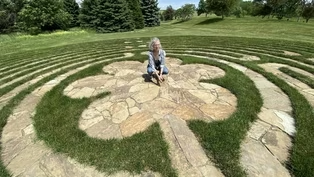
Clip: S12 Ep11 | 8m 21s | Learn about Ginger Theisen's road back from a brain injury (8m 21s)
Video has Closed Captions
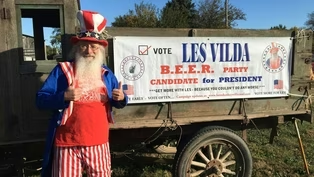
Clip: S12 Ep11 | 5m 6s | Les Vilda loves running for president of the United States. (5m 6s)
Providing Support for PBS.org
Learn Moreabout PBS online sponsorship

- News and Public Affairs

Top journalists deliver compelling original analysis of the hour's headlines.













Support for PBS provided by:
Nebraska Stories is a local public television program presented by Nebraska Public Media