
12: 1212 The Grand Dame of Raptor Rehab & More
Season 12 Episode 12 | 27m 42sVideo has Closed Captions
Learn about Betsy Finch and the Raptor Conservation Alliance and more.
This episode features a profile of Betsy Finch and the Raptor Conservation Alliance, the Pawnees regain a parcel of their homeland, and a look at the Willa Cather statue destined for the National Statuary Hall.
Problems playing video? | Closed Captioning Feedback
Problems playing video? | Closed Captioning Feedback
Nebraska Stories is a local public television program presented by Nebraska Public Media
12: 1212 The Grand Dame of Raptor Rehab & More
Season 12 Episode 12 | 27m 42sVideo has Closed Captions
This episode features a profile of Betsy Finch and the Raptor Conservation Alliance, the Pawnees regain a parcel of their homeland, and a look at the Willa Cather statue destined for the National Statuary Hall.
Problems playing video? | Closed Captioning Feedback
How to Watch Nebraska Stories
Nebraska Stories is available to stream on pbs.org and the free PBS App, available on iPhone, Apple TV, Android TV, Android smartphones, Amazon Fire TV, Amazon Fire Tablet, Roku, Samsung Smart TV, and Vizio.
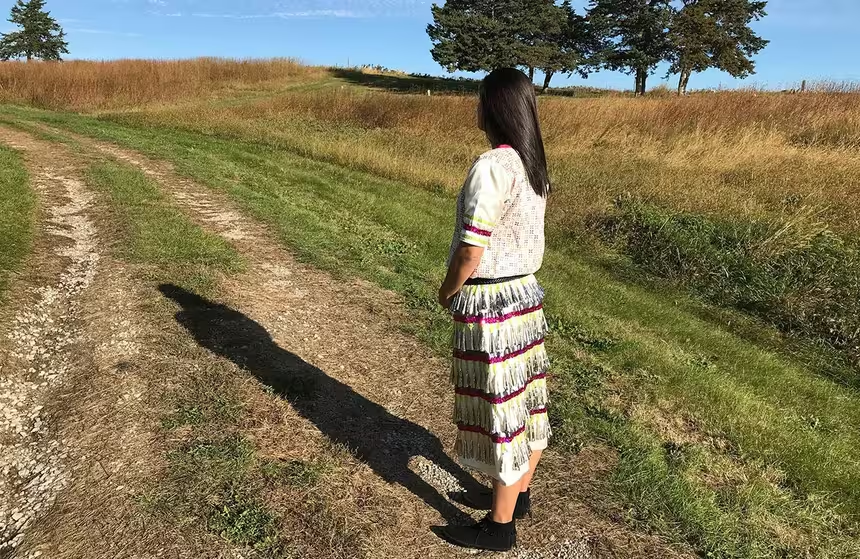
Do you have a Nebraska Story?
Do you have a story that you think should be told on Nebraska Stories? Send an email with your story idea, your name, your city and an email address and/or phone number to nebraskastories@nebraskapublicmedia.org. Or, click the link below and submit your information on nebraskastories.org.Providing Support for PBS.org
Learn Moreabout PBS online sponsorship(theme music) Coming up on Nebraska Stories... Rehabbing injured raptors and returning them to the wild...
The repatriation of land to the Pawnees... And, a sculptor reveals his vision for a statue of Willa Cather.
(theme music) (gentle piano music) - It's okay.
- [Betsy Finch] Birds come in over the weekend or they come in the evening, so the first thing we do in the morning is check those birds out.
There's the ear.
- [Narrator] Betsy Finch has been rehabilitating raptors for 45 years.
- [Betsy] It must've been the tibia.
- [Woman] Okay.
- [Narrator] And still, every day is different.
- Pretty good, a little thin, but he didn't eat for a while.
The thing that makes a raptor a raptor, and it comes from the Latin word to grasp or to seize, are the claws, the large claws that are the killing instruments.
They have a hooked beak.
They have specialized eyes for finding their prey.
I would like to see people really appreciate the raptors for what they are, for their intrinsic nature and appreciate the role they play in the environment.
- Here we go kiddo.
- [Narrator] Brook Manes has been working and volunteering with Finch for the last five years.
- It's good to feel like I have a higher purpose in helping these birds, getting them back out into the wild.
- [Narrator] This junior bald eagle was found in northeast Nebraska with a severe case of fowlpox... - You can see that one eye is completely closed.
- [Narrator] unable to hunt or survive in the wild.
- He can't see to catch food.
- [Narrator] The prognosis is uncertain.
The eagle is dangerously thin and may never see again.
- How about on the other foot?
You ready kiddo?
- [Narrator] But Finch has seen this before and has developed her own medicinal elixirs and ointments to treat an array of injuries.
Up next, a checkup on two young Swainson hawks in the large flight pen... - Here he comes, look at that.
- [Narrator] that need to fatten up and build muscle.
Time is running out for these two young raptors if they're going to be ready in time for migration.
- One of them was blown out of a nest, so he came in barely before he fledged.
And the other one, I think came in shortly after he fledged.
We don't really know why he was thin.
- [Narrator] Even after 45 years, Finch's face lights up... - And here he comes again.
- [Narrator] when she sees one of her raptors taking flight.
- We like getting them off the free lunch program, that's good, because that means they're good, they're ready to go.
- [Narrator] In a smaller flight pen, it's release day for these three kestrels.
(bird squawking) - [Betsy] There we go, she's number 74.
(bird squawking) - [Narrator] Finch's husband, Doug, is retired these days and volunteers as needed.
Capturing, moving, and treating raptors often requires at least two to three people.
- There you go, buddy.
(bird squawking loudly) Good thing we don't speak kestrel.
- [Narrator] And it's one last checkup for this great horned owl who got caught in a fishing line.
- It's okay.
- [Betsy] So, you are good to go kid.
There's a little thread of skin connecting all of it.
- [Narrator] It's only lunchtime at the non-profit Raptor Conservation Alliance located on Finch's acreage in Elmwood, and already, this is shaping up to be a typical Monday.
- 337.
- [Narrator] A full slate of about 30 patients with several new ones on the way.
- We're just waiting for John to get here with 338.
- [Brooke] Hey John.
- [Betsy] Hey, come on in.
- [Narrator] As the only raptor rehab facility in Nebraska, birds arrive from across the state, sometimes out of state, thanks to a network of volunteers who transport the injured birds of prey.
- [Betsy] This is actually their elbow.
I don't feel anything.
I wonder if he's just weak because he's so thin.
(soft guitar music) - [Narrator] A week later, and after months of rehabilitation, the young Swainson hawks are ready to join the migration.
- So we'll head on over there.
- Okay.
- [Narrator] As she does with all of the creatures in her care, Finch talks with the hawks.
- Aren't ya, okay?
- [Narrator] She's been preparing them for this day.
- Go.
The best part is releasing them back to the wild.
They don't belong with us, they belong out there, and we're just kind of a way station to get them back on their feet.
- [Doug] Hey Tim, what did you bring us today?
Got a great horned owl in there?
Let's see.
- [Narrator] Back inside the trauma care unit, this great horned owl is not looking good.
- Feel all along the wing bones.
It could be West Nile too.
- She's very quick to assess.
She can tell just by sometimes how a bird is standing or just in its posture, their body language.
- [Narrator] But the prognosis is good for this peregrine falcon from the North Platte area.
- I wonder if that's a talon mark?
Laceration there.
It looks like there's little puncture marks there.
She probably doesn't want to fly right now because of the bruising.
I'm sure the wing hurts.
- Her heart and soul are in this for the long run, you know.
Every bird is an individual.
- [Narrator] What began as a volunteer project in 1976 has become her life's work.
- Over the past 45 years, we've handled almost 14,000 raptors, which makes us one of the biggest rehabilitation centers in the country.
- [Narrator] With nearly half a century of records and at least 500 new patients each year, Manes and the other volunteers maintain a detailed database of the raptors who come through here.
- She's been one of the best mentors I could ever ask for, really.
She's so knowledgeable, and her experiences and stories that she has, it's so awesome to hear them.
- [Betsy] Boy, we're going to have to get him out pretty quick.
- [Brooke] Yeah.
- [Narrator] It can take months to rehabilitate a bird.
Half never recover and have to be euthanized.
Others are no longer able to survive in the wild but can live on as ambassadors.
- He's beautiful.
- Isn't he beautiful?
- Yes.
- And look at those big yellow eyes.
- He sees you Ellie.
- Holy cow, he's got big yellow eyes.
- [Narrator] Finch treated Orion about a decade ago.
- So Orion came to us because he was illegally gunshot out of a tree.
- [Audience] Aww.
- And what's really kind of sad is Orion wasn't even a year old.
(owl hooting) - [Narrator] For those that can be rehabilitated, it takes a trained eye to know when a raptor is ready to be released.
- We'll come check on him in a little bit.
Somebody might say, "oh, that looks good."
And I'm going to... ah, one wing is a little off, but it takes experience again to notice that.
A little thin but not bad.
- Just a little thin.
- [Narrator] After 4 1/2 decades, Betsy Finch has been helping injured raptors perhaps longer than anyone else.
- [Denise] She's the grande dame of raptors.
She's like the Jane Goodall, because there aren't too many folks that have been doing this for as long as Betsy has.
- [Narrator] It is a grueling schedule.
- Okay, we just slip it in.
- [Narrator] Up at first light to feed the hawks and the eagles.
- That's the first time they've left anything, here.
(water running) - [Narrator] Making the rounds three times a day with food and water... - [Betsy] Let's find out what's going on.
- [Narrator] treating injuries, - I think it's going to be this one.
- [Narrator] before finally feeding the owls after dark.
(owl hooting) - Are you gonna come this way?
Soon as you leave.
In this cage, we have Alberta.
She's our queen mum.
She's probably fostered well over a hundred babies.
(owl hooting) (slow-tempo soft piano music) We are at DeSoto National Wildlife Refuge.
Ooh, hey, don't bite.
This young one can hook up with all of the other eagles, they're a very social species, and can learn more from the adults, especially on how to hunt.
Look at that face, isn't that wonderful.
- [Narrator] And it is days like this one that make the 24-7 demand, the successes and the failures, worthwhile.
(wings flapping) - [Doug] You always have to maintain a certain level of humility when dealing with these birds, because I mean just in a split second things can go from mediocre to bad really fast because they're so fast, they're so strong.
- That's the best part of what we do, it really is.
I mean, this is a celebration.
That's why we're here, you know.
All right kid, here we go.
- Should we count.
- Yeah.
- Three, two, one.
- Whoa.
Look at that, nice and strong.
Oh yeah, I'm sure he'll stay around.
There he goes.
- [Narrator] Even for Finch, these days are special.
- I guess I've been doing this for so long that it's just a part of me now, so I don't think much about it.
I don't know what else to say except that I feel a connection to 'em.
(soft piano music) I've done it many times.
(choking up) Yeah, you can really feel their spirit when you have 'em, you really can.
- [Narrator] While this young eagle couldn't be reunited with his family, after two months of rehab, he's regained his sight and has a second lease on life.
- Makes it worthwhile, oh absolutely.
Every one we can turn back to the wild is a celebration and a victory, really.
Because without us or other rehabilitators, none of them would make it.
All this preparation and it's over in five minutes.
(chuckles) Really, it is, but that's okay, you know, that bird has the rest of its life to, to live now free.
(soft piano music) (relaxing music) (suspenseful music) - The story goes that there were two stars.
They called them the evening star, which was Venus, the female, and then, the morning star, which was Mars.
So, when they get together, they made the first Skidi, which was a girl.
She was brought down here on a tornado.
The first male was created by the sun and the moon, you know, and of course, we all know when they get together, it's an eclipse.
- [Narrator] In 2017, members of the Pawnee tribe of Oklahoma traveled to view the historic solar eclipse from land once owned by Nebraska folklorist and humorist, Roger Welsch.
- There were 16 tents and camps down here and we had ceremonies going on down at the river and ceremonies here and up on the hill in different ways of celebrating the eclipse.
(inspiring music) - [Narrator] The Pawnee's visit to Nebraska that year capped a nearly four-decade relationship with Welsch.
Roger practically defined Nebraska for the nation.
He presented more than 200 postcards from Nebraska as a correspondent for Charles Kuralt's CBS Sunday Morning in the 1980s and 1990s.
(inspiring music) In 2007, Roger and his wife, Linda, did what few descendants of European immigrants have ever done in the 500-year history of America.
They returned their land to its original owners.
- Every means known to man was used to acquire Indian property during the growth of our nation, but Roger, despite that great lengths that the country went to to get our land by hook or crook, by force of arms, he undercut all of that by simply returning it back to the Pawnee people.
Along all of the major rivers in Nebraska, had permanent earth lodge villages, where we grew mother corn and followed the herd three months in the summer and then, a winter hunt.
So, that was a vast indigenous homeland that we had when the world was young.
- [Narrator] In the 1870s, pressures built for the Pawnees to leave Nebraska and move to Indian territory, today known as Oklahoma.
- Our numbers are dwindling.
Diseases and stuff was taking place.
You know, was kind of starvation was starting to happen.
So, it was about survival.
- My great-great-grandparents walked down from Nebraska and that was Latakuts Walking Bear Fancy Eagle.
She was forced to leave her father to die on the trail and so, she never had any love for Americans.
So, she never learned English.
(inspiring music) - That when we came to Nebraska, it was a real, real, real time of depression, real time of depression for our folks here.
So, we lost a lot of our ceremonies, a lot of our old folks.
- [Narrator] While the Pawnees struggled in their new home, settlers in Nebraska began unearthing the homes they had left behind.
We had no sooner left that people started digging up our cemeteries up there and carting the remains off to federal and state universities and museums.
- We were told that, you know, their spirits can't rest and there was consequences and we felt like it was real imperative to get our ancestors back, and then be at rest.
- [Narrator] In 1988, the Pawnees decided to act.
They wrote to the Nebraska State Historical Society seeking the return of their relatives.
- I was one of the attorneys that were involved in negotiating with the Nebraska State Historical Society and to get our remains.
- I was on the board, the highest thing I'd ever aspired to, and the Pawnee, Winnebago, and Omaha came asking for their remains off the shelves.
- [Narrator] The Historical Society said, "No."
- At the present time, there is really a lack of protection for unmarked burials and there is no protection or procedure for the proper treatment of Indian dead.
- Everybody on the face of this earth is allowed to be concerned about what happens to the remains of their ancestors, can be allowed to regard those remains with respect, veneration or whatever it is they feel, to put together appropriate ceremonies, except the indigenous population of this country and the purpose of this bill is to correct that.
- [Roger] Are we digging up any pioneers?
Are we digging up anybody on the Oregon Trail, see what they died of?
What kind of things were they buried with?
No, we weren't and that idea was ridiculous, too.
The more rude the other people got to be and the more I saw just kicked me over the edge.
- He was an enemy at first, but what really shined was when he resigned off that board.
That spoke volumes right there.
You know, and we realized, hey, you know, we do have an ally.
- Almost lost my job, the governor attacked me, the State Historical Society attacked me, the legislature attacked me, but I knew it was on the right side.
- [Narrator] Finally, after a bitter fight, in 1989, the Nebraska state legislature became the first legislative body in America to pass a law to protect Native American graves and return remains to tribes.
- We'd go to the museums of the universities and then, we would go in into the rooms and look over the inventories and lots of times, we would go to the storage facility.
Makes you think, when you have a little skull that big, you know, a child, and you had to put him down, you know, and they're usually in just little brown sacks or some kind of wrapping paper.
- [Narrator] Eventually, the Pawnees were able to regain thousands of their relatives from the storage vaults of the Nebraska State Historical Society, but then, they faced a new issue.
Where would they bury them?
- The first time the contingent came out here to survey a place for the reburials, and I showed them all kinds of places down here and it was easier then.
Right now, it's not easy to get to the river on this side, but we went down to the river and here were distinguished celebrities leading men in the tribe in suits, good clothes, and I had to stand there and watch them wade into the river, crying and pulling the water over their hair, drinking the water, because it was their river.
It's the Loup River, the Loup Pawnee River.
It's Plenty Potatoes River.
- [Pat] That was like a healing type deal, because of that river, the Loup River.
That's where, you know, our ancestors lived all up and down that river.
- I got home that night and then, Linda and I looked at each other and said, you know, they're not visiting us on our place.
We're visiting them on their place and that sealed it.
So, we were gonna leave it to them in our will and then, they needed a place for reburials and it was Linda's idea.
She said, "Why don't we give it to them now?"
And that way, instead of missing all the fun, 'cause we're dead, we can be here and celebrate with them all of these things and boy, it's been that way.
(Native Americans vocalizing) - They retained a life estate, but the Pawnee Nation owns the property now and that sorta led to a land return movement.
(Native Americans vocalizing) - We have made him an honorary member of the Pawnee, you know, gave him a Pawnee name.
Pari Taak, that means white Pawnee, and you know, he likes that name.
(Native Americans vocalizing) - [Narrator] But what would the rest of Dannebrog's residents think about this?
- The Pawnee flag flies on main street.
There's a new mural over here on the American Legion building and while there's a picture of the Danes coming to America, there's also a picture of the Pawnee who were here before and more and more, the Pawnee have become an integral part of this community, which means that the community has accepted them, but I think equally important is that the Pawnee have accepted this town.
- You know, it's not just the land that we received, you know, back and it's the relationships that we've developed in doing that with Roger and so many people who have, you know, been raised here or raised somewhere else and they go to Nebraska and they're Pawnee, they feel that connection, that very, very strong connection to the land and to the water.
- We really do have a strong desire to not only maintain the homeland ties, but to really look into what it would take to have a government presence in Nebraska again.
- I think that, you know, if a person is wanting to heal historical injury or to bring about a reconciliation or a true atonement of a painful past, you know, when it comes to our native people, it's all about the land and there's nothing better that one can do than to return the land.
(suspenseful music) c) LITTLETON ALSTON: I look at the maquette as a poem and then I look at the four-foot version as a short story.
And then the seven-foot which will be in bronze of Willa in Statuary Hall will be the novel.
(soft piano music) NARRATOR: Red Cloud, Nebraska, where people come from all over the world to experience the little town that Willa Cather brought to life in her novels.
(horse neighs) ALSTON: How absolutely wonderful it is to see everyone in their white shirts and their Sunday best to come out and actually be seen but also to see and experience the town life itself, how rich it is.
I bet these people thought that this would only grow to another Chicago.
(clapping) This is an American society that's curious about the world.
And things as interesting as a Ferris wheel is magic to children.
And maybe this is a renaissance for this town, to come back to its cultural hub, it's heart.
NARRATOR: The house where Willa Cather lived as a child has been preserved just as it was in the late 19th century.
ALSTON: I think visiting Red Cloud enriches me.
There's no question about it, slows everything down.
And you start to really measure by inch everything.
We're standing in her life which is a novel.
And I'm creating a sculpture of her and I want to capture the poetry.
So, it's really the essence of her and yet, it's as rich as say the chapters of a novel.
For the artist, for me, it's research for sure but it's a research that I lovingly engage in.
(piano music) ALSTON: It's a fascinating journey.
(door clangs) (audience applauds) ATTENDEE: It's really nice to meet you.
Thanks for coming to Red Cloud.
See you soon.
ALSTON: Absolutely.
ALSTON: Thank you, thank you.
(muffled conversing) WOMAN: She's lovely.
ALSTON: Thank you.
WOMAN: And she's gonna be seven-foot tall?
ALSTON: Yes.
(upb ♪ ♪ >> WATCH MORE "NEBRASKA STORIES" ON OUR WEBSITE, FACEBOOK, AND YOUTUBE.
"NEBRASKA STORIES" IS FUNDED IN PART BY THE MARGARET AND MARTHA THOMAS FOUNDATION.
♪ ♪
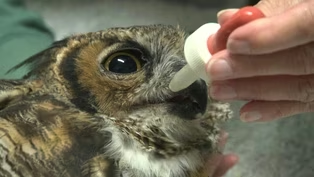
The Grand Dame of Raptor Rehab
Video has Closed Captions
Clip: S12 Ep12 | 11m 12s | One woman's quest to rescue and rehabilitate injured raptors and return them to the wild. (11m 12s)
Video has Closed Captions
Clip: S12 Ep12 | 11m 41s | The Pawnees return to their homeland. (11m 41s)
Providing Support for PBS.org
Learn Moreabout PBS online sponsorship















Support for PBS provided by:
Nebraska Stories is a local public television program presented by Nebraska Public Media