
12: 1213: When the World Changed
Season 12 Episode 13 | 28m 47sVideo has Closed Captions
This episode takes a look at how Covid-19 changed our world and resonates through history.
This episode takes a look at how Covid-19 changed our world and resonates through history, the challenge of learning during a shutdown and fighting pandemic boredom with a trip to all 531 Nebraska towns.
Problems playing video? | Closed Captioning Feedback
Problems playing video? | Closed Captioning Feedback
Nebraska Stories is a local public television program presented by Nebraska Public Media
12: 1213: When the World Changed
Season 12 Episode 13 | 28m 47sVideo has Closed Captions
This episode takes a look at how Covid-19 changed our world and resonates through history, the challenge of learning during a shutdown and fighting pandemic boredom with a trip to all 531 Nebraska towns.
Problems playing video? | Closed Captioning Feedback
How to Watch Nebraska Stories
Nebraska Stories is available to stream on pbs.org and the free PBS App, available on iPhone, Apple TV, Android TV, Android smartphones, Amazon Fire TV, Amazon Fire Tablet, Roku, Samsung Smart TV, and Vizio.
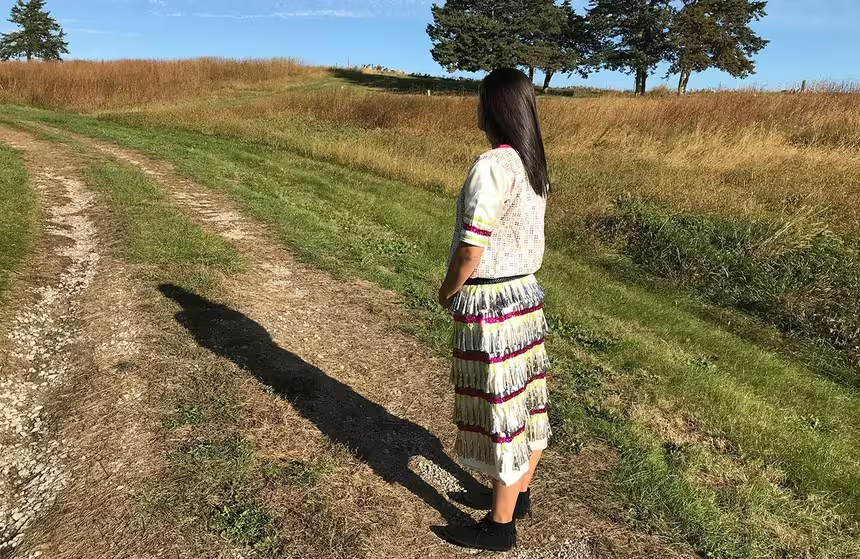
Do you have a Nebraska Story?
Do you have a story that you think should be told on Nebraska Stories? Send an email with your story idea, your name, your city and an email address and/or phone number to nebraskastories@nebraskapublicmedia.org. Or, click the link below and submit your information on nebraskastories.org.Providing Support for PBS.org
Learn Moreabout PBS online sponsorshiparrator] On this specialepisode of Nebraska Stories, a look at how the Coronavirus pandemic changed our world.
With an essay about the wake-up call of COVID-19 as it resonates through history.
Explore the similarities between two pandemics, a century apart.
Through her own words, a superintendent shares the difficulties and triumphs of learning during COVID-19.
And meet two young men who fought the boredom of pandemic shutdowns by visiting every town in the state.
- It happens once, twice, maybe more in a lifetime.
That first moment you realize the world has changed.
After 9/11, Nebraska poet, Twyla Hansen turned one of those moments into a poem.
She writes, "We are a nine mile prairie when the news reaches us of twin towers and collapse.
This early report, not yet registering."
I've thought about Twyla Hansen's poem as the world changed yet again with COVID-19.
This time it's more of a slow motion wake up call.
Two crew members and I were in Boston in early March, 2020 just before reality hit.
We were there to film Omaha's own Thomas Wilkins conducting Friends In Harmony for the Boston Symphony Orchestra.
Busloads of children from all over the city poured into the great hall to share the joy of classical music.
- [Mark] We provide free tickets for all the urban kids that don't necessarily have the means to buy a ticket.
We've had a real commitment to reach as many young people as we can.
- We knew about the virus by then but on that first day, everything seemed almost normal.
(orchestra plays) The day later the world clicked one more degree into strangeness.
We took an Uber to the Faneuil Hall Marketplace and found this lonely busker.
Not far away from the harbor where we filmed, the first cases of COVID-19 were just hitting Boston, thanks to a hotel conference.
(somber music plays) At our hotel, I met a young man who was in town for a concert which had just been canceled.
He didn't seem worried, but I was.
Trying to sleep that night I found comfort from the thought that this too will one day be a part of history.
The story of the rise and fall of invisible killers.
I know these stories well from the films our PBS station has produced over the years.
I thought about Susan LaFlesche Picotte, America's first Native doctor.
Dr. Sue traveled by horse and buggy to save the lives of her patients on the Omaha Reservation in Nebraska.
A century earlier, her tribe had been devastated by the Smallpox virus, which killed 500 million people worldwide.
In the late 19th century, the threat was a bacterium, tuberculosis.
Susan believed that science held the answer.
When she returned home from medical school in Pennsylvania, she got rid of the communal water cup, which spread disease.
And then she built a hospital for TB patients based on the healing powers of fresh air and sunshine.
I thought too of Willa Carther whose cousin died in World War I and inspired her Pulitzer Prize winning novel, "One Of Ours" along with the war, a pandemic was raging.
The Spanish Flu, which actually started in Kansas came to Cather's hometown of Red Cloud.
In 1918, the schools were closed and public gatherings prohibited.
As Cather wrote to a friend, "Before I left Red Cloud we had seven funerals in one week for boys who were sent home from Camp Dodge, Iowa.
The rumor is that more of our boys have died in camp at home than have been killed in France."
And I've thought of General John Pershing, who spent part of his career at the University of Nebraska.
He commanded troops in Europe and saw it all firsthand, as this documentary excerpt makes clear.
- [Narrator] The total number of influenza cases treated in hospitals was nearly 70,000 of who many developed a grave form of pneumonia.
The death rate from influenza rose to 32% of cases for the AEF.
- [Man] Not even Pershing was immune from the virus he called "the grip".
His diary shows it forced him to bed for several days under doctor's orders.
Some epidemiologists believe the unsanitary trenches caused the virus to mutate into a global killer strain.
It hurt the effectiveness of soldiers fighting on both sides of the war.
- [Christine] Cather's remark about so many local boys dying from the flu in Nebraska was true everywhere.
In World War I, the flu killed more Americans than enemy weapons.
Worldwide it killed more people than The Great War itself.
But like smallpox, the Spanish flu has been defeated and even tuberculosis though still deadly, is treatable.
When I woke up the next morning, our third day in Boston everyone was in a state of shock.
- The city is shutting down.
All the museums are closed.
All the businesses have sent people home.
And so we had a very small audience.
Didn't affect Thomas in the least, the kids that got here, he was going to really give them the energy and the attention and the focus they deserved.
- [Christine] We flew back to Nebraska just as Boston was shutting down.
And like Dr. Susan and Willa Cather and Black Jack Pershing, we knew life would never be the same again.
And we would all be changed in ways we can't predict.
They survived the worst and ultimately we will too.
So where were you when the world changed?
Perhaps the better question is, how has this new world changed you?
(music plays) - [Kristin] My focus has always been rural areas and some of that has to do with growing up in Nebraska.
My name is Dr.Kristin Watkins and I have a PhD in the history of infectious diseases and public health.
My expertise is the 1918 influenza pandemic, specifically in rural areas.
It was truly through transportation hubs and urban centers.
When you look at 1918, you have an installation of troops coming into Omaha and Lincoln.
You start to see those communities just having exponential death and you can really see it in the data.
Lincoln had 400 deaths in the month of October in 1918.
And to this day has never, ever had that many deaths in one month.
In 2020, you see Omaha and the Western part of the state start to get infections and then you see the culmination happen in Grand Island in the meat packing industry.
I mean, infections just rage.
[Kristin] The other thing we had in 1918 that people think we had in 2020 that we didn't have, was house arrest.
We truly had house arrest.
- I actually was able to find a placard from Fillmore County, Nebraska, that very plainly states, that this house is quarantined due to Spanish influenza and the fine is five to a hundred dollars.
In 1918.
[Kristin] A great story is Wayne State.
And at that time they were the teacher's college and the students recognized that to keep themselves healthy and to keep the community healthy, they had to self isolate.
So they did.
In the same way that we've created the social bubbles in COVID19 and it really worked.
So Santa Claus comes in on the train from Denver and he gets off the train and then of course, all the kids hear that Santa is coming and rush to the train.
And Santa proceeds to get arrested because he has broken the quarantine and gathered a large group.
They pulled his wig and they pulled his hat and of course everyone recognized the local businessperson but the kids didn't care.
They still believed it was Santa Claus and they got their pennies together and they went to the jail and they bailed him out.
And it's a really cute and funny story of, you know resilience, in particular children, children's resilience.
But we know if you can get them back together again they will be children, it's why they bring us such joy.
They will do the thing that makes something fun and wonderful in the midst of all this sadness.
Disease is natural influenza truly means influence of the winds and it comes in on winds.
We know it comes in, we know it's seasonal.
Now with influenza we've really normalized it.
- [Tawana] I remember feeling devastated on March the 15th, 2020.
That was the day we announced we'd be closing our schools due to the COVID-19 pandemic.
You see at Grand Island Public Schools, we take care of the whole child from education to nutrition to social emotional wellbeing and everything in between.
We didn't dwell on that devastation though.
We acted at the velocity that matched the pandemic.
Within 24 hours, we fed thousands of students who rely on us for meals.
Within days, our foundation board opened an emergency fund to address the rising needs of students, staff and families.
Within weeks we had made our technology infrastructure to provide internet access and remote learning opportunities to every home in our district.
And later we opened a virtual school that still continues to this day.
Through all of it, our graduate profile remained our North Star.
We adopted a collective mindset that we are stronger together.
We didn't cancel school.
We re-imagined it.
And that evolution of thought will carry us into the future.
The pandemic was an invitation for innovation.
Our students led the way.
When the world called for courageous acts of sacrifice, they were part of the solution.
Many were essential workers in grocery stores and hospitals.
They saved lives.
And when our kids needed us, I'm proud to say that Grand Island Public Schools was there for them.
We have provided in-person learning five days a week since August.
And we do not take a second of that for granted.
I have heard from students how thankful they are to be with their friends, to be in school, still learning, still growing.
I've heard from staff that they are grateful to have their students back with them.
I have heard from our community members that in these trying times, Grand Island Public Schools was a beacon of hope.
That's what I'll remember from 2020 that we were there for each other through it all.
We put safety first and we never wavered from our commitment to every student, every day, a success.
- [Navigation] Starting route to Pickrell.
- [Seth] Off to Pickrell we go.
There we go.
- [Michele] It is trip number 16 for Seth Gardner and Austin Schneider to University of Nebraska, Omaha college sophomores on a quest to visit all 531 towns in Nebraska.
The two are headed to their first town of the day and number 300 on their journey.
(soft music) (camera clicking) A quick photo and they're back in the car, headed to their next stop in Pickrell at a Veterans Memorial.
- Respect toward the town and respect to the people who gave their lives.
- [Michele] Just like that, Seth and Austin are on to number 301.
One driving, the other creating a post on Facebook for their 22,000 followers to learn a little something about Pickrell.
At a time when it seemed the entire world was shutting down and self isolating, these two best friends and college roommates decided to fight their COVID-19 boredom with a grand adventure.
- We're sitting around at home doing nothing.
So I got to Austin one day, I'm like, Hey, I'm gonna go visit all 531 towns in the state.
- And I was all for it.
- [Michele] Armed with masks, Lysol, and a healthy supply of antibacterial lotion, the two hit the road every few days.
Taking day trips that begin and end in their hometown of Wahoo.
- We stayed away from people for the most part as best as we possibly could.
That was probably the biggest challenge, I guess was just keeping in mind there's a pandemic.
Try to do what you can to keep other people safe without spreading the virus.
- So I have cystic fibrosis.
So I had to take a lot of precautions.
I do treatments every night and morning to help my lungs.
I take medicine every day.
So just trying to keep as cautious as possible.
- 76 people, that's what the population said online.
- [Michele] While COVID-19 devastated families, disrupted lives and limited human interaction, these two found a way to forge new connections through social media, with strangers in Nebraska and beyond who were isolated in their own homes.
For many, it became a virtual escape.
- People started offering free food.
People are like, hey, when are you gonna be here?
People are saying, have you been to this town yet?
Have you seen this yet?
Will you go here?
- [Michele] Others became so invested in their journey.
They donated funds to pay for gas, food or lodging.
In the end, they broke even, thanks to followers who just wanted them to see it through.
They visited every county courthouse, all 93 and brought along a mascot to remind them to keep going.
,They wanted to learn more about their state, the origins of towns, to historical markers.
- Oregon Trail is the only like trail in Nebraska that does this.
The California Trail doesn't have like big markers.
- [Michele] As well as a few odd, perhaps lesser known bits of history.
- You can fit five Rhode Islands into just Cherry County.
The voice of Tony the Tiger was born in Norfolk, Nebraska.
- Strobe light.
- The strobe light was invented in Aurora, Nebraska.
In Blue Hill, there's actually this law where it says any woman in public eating an onion, wearing a hat that could scare a timid person can technically be arrested.
- [Michele] Seth and Austin even had a chance to look into their own family histories at the Homestead National Monument.
- His father's also John Taylor.
- [Michele] One of the few stops open for visitors.
- You'll see a few names here, right?
- Yep.
- P and W. (upbeat music) - Where you're standing in front of the old bank, that used to be post office right there.
It's what's left of it, is just the bowl.
What else would you like to know?
- [Jerry] I love what you guys are doing.
I think it's great.
This has been a pretty strange year and not the best for everybody but this is a great thing we can take from it.
I hope you guys achieve your goal.
I'm sure you will.
- [Michele] So how did they accomplish such an enormous undertaking in just a few months during a crisis?
This was a bucket list goal for Seth and the pandemic provided a rare opportunity of time.
- Probably right there.
That's good.
- [Michele] Plus it doesn't hurt that Seth is an Eagle Scout and you might say a bit of a planner.
- I plan all my family vacations.
I've been doing it for years now.
- [Michele] Heading out West was a bit more challenging.
- That one was a killer, that took 35 hours of planning because it's really hard to get 198 towns in a certain order over eight days.
- [Michele] On one of those days, they visited 32 towns and traveled more than 600 miles.
It was exhausting yet rewarding.
- [Austin] I just kept an open mind because there's a lot to learn about a town when you get to one even like old rundown schools you kind of think to yourself, well, when did this shut down?
How long was it active?
What kind of stuff?
What's the history behind it?
- And just people they have those connections, just taking a picture of the building and people have this memory pop in their head and they'll leave that memory for us.
It's all about like just connecting Nebraska together.
That's what the main thing that happened with this is that.
- We didn't expect it to happen.
- No, but it did.
- I don't know what they were going to the roof maybe?
- [Michele] Almost by accident their impulsive adventure and online travel journals created a positive virtual connection as well as a distraction from a very real world of darkness for thousands of strangers.
- So town 530 is Verdigre, And we put up this post saying like, Oh, thank you guys for all your support.
We're not quite done with our journey but this is all the space and the tail end of it.
We got a couple hundred comments of people just saying, thank you for letting us travel vicariously through you, knowing that 22,000 people were following us around the state just 'cause we were visiting towns, we were just there to learn about the town and really not a whole lot else.
Just have some fun road tripping around the state.
That's all it's supposed to be.
- [Michele] The last of 531 town signs.
The last of 93 county courthouses.
- Yeah.
I'll let you know.
- [Michele] And one last Veteran's Memorial.
More than 9,000 miles and a gallon of hand sanitizer later the adventure ended where it began, town number 531 their hometown of Wahoo.
- It's basically like going from Los Angeles to New York city back to Los Angeles back to New York city and then like about the Chicago Omaha area.
- [Michele] And Wahoo welcomed the travelers home with a celebration and keys to the city.
What could possibly follow this experience?
They documented their travels in a book a demand from their Facebook fans.
- Here it is, we got our first proof copy the other day.
Over the course of last two months, over 200 people, unique people have said, if you make a book, we'll buy it and you need to make this book because everyone wants to experience the journey over and over and over again in perpetuity (laughs).
- [Michele] For now Seth and Austin are just hoping the world can get back to normal.
- Thank you.
- [Michele] Well, maybe.
After a parade through their favorite and final town.
(soft music) - [Announcer] Watch more Nebraska stories on our website, Facebook and YouTube.
Nebraska Stories: When the World Changed, was funded in part by the Margaret and Martha Thomas Foundation and Humanities Nebraska.
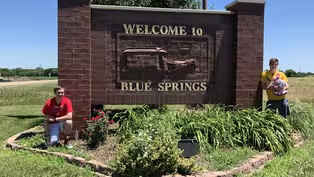
Video has Closed Captions
Clip: S12 Ep13 | 8m 57s | Gp pn the road with the dynamic duo of "Visit 531 Nebraska" (8m 57s)

Video has Closed Captions
Clip: S12 Ep13 | 3m 20s | Superintendent Tawana Grover discuesses meeting the challenge of COVID-19. (3m 20s)
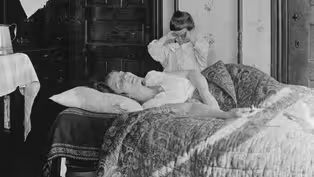
Video has Closed Captions
Clip: S12 Ep13 | 5m 18s | A look at the parallels between COVID-19 and the 1918 flu. (5m 18s)
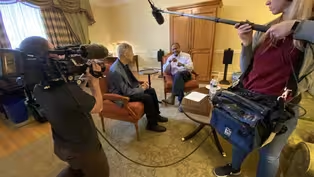
Video has Closed Captions
Clip: S12 Ep13 | 8m 22s | Taking a look at how COVID-19 echoes through history. (8m 22s)
Providing Support for PBS.org
Learn Moreabout PBS online sponsorship















Support for PBS provided by:
Nebraska Stories is a local public television program presented by Nebraska Public Media