
12:1204 Celebrating Nebraska Black Pathmakers
Season 12 Episode 4 | 26m 22sVideo has Closed Captions
Nebraska Stories presents four segments featuring Nebraska Black Pathmakers.
Nebraska Stories presents four segments featuring Nebraska Black Pathmakers including a 20th century photographer, a female locomotive engineer, a member of the Baseball Hall of Fame, and the Tuskegee Airmen.
Problems playing video? | Closed Captioning Feedback
Problems playing video? | Closed Captioning Feedback
Nebraska Stories is a local public television program presented by Nebraska Public Media
12:1204 Celebrating Nebraska Black Pathmakers
Season 12 Episode 4 | 26m 22sVideo has Closed Captions
Nebraska Stories presents four segments featuring Nebraska Black Pathmakers including a 20th century photographer, a female locomotive engineer, a member of the Baseball Hall of Fame, and the Tuskegee Airmen.
Problems playing video? | Closed Captioning Feedback
How to Watch Nebraska Stories
Nebraska Stories is available to stream on pbs.org and the free PBS App, available on iPhone, Apple TV, Android TV, Android smartphones, Amazon Fire TV, Amazon Fire Tablet, Roku, Samsung Smart TV, and Vizio.
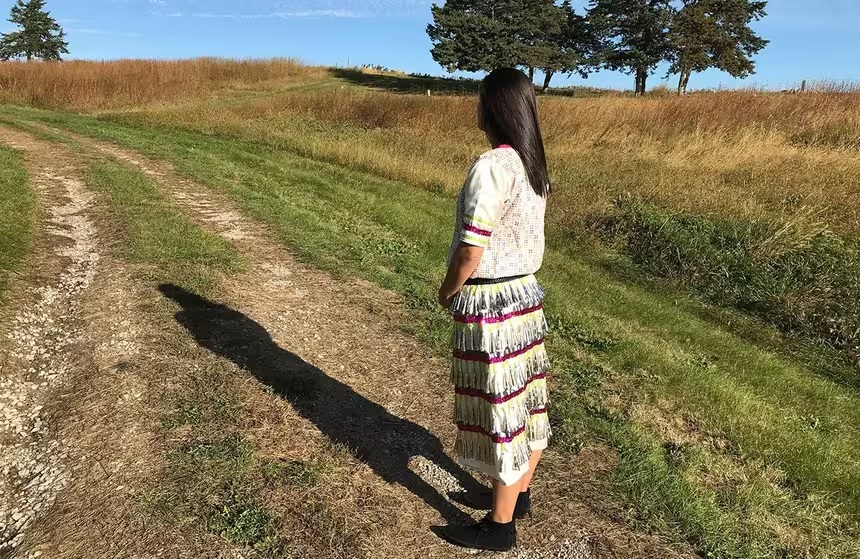
Do you have a Nebraska Story?
Do you have a story that you think should be told on Nebraska Stories? Send an email with your story idea, your name, your city and an email address and/or phone number to nebraskastories@nebraskapublicmedia.org. Or, click the link below and submit your information on nebraskastories.org.Providing Support for PBS.org
Learn Moreabout PBS online sponsorship♪ ♪ In this special episode of Nebraska Stories, we're celebrating contributions made by Nebraskans of African American heritage.
Coming up.
One of the great photographers of the 20th century.
An Omaha woman breaks through gender and racial barriers.
The legacy of former St. Louis Cardinal Bob Gibson.
And, two Tuskegee airmen who helped win World War II reflect on the battles they faced when they returned home.
♪ ♪ (upbeat music) (jazzy piano music) DOUG KEISTER: You think of photographs and things like that as being so static.
VISITOR: Yes.
DOUG: But they're not.
I mean this things, 100 years after they're taken have this whole life to them.
NARRATOR: For more than 50 years, Doug Keister has held the key to an American treasure.
DOUG: It just makes a great natural sort of picture.
NARRATOR: In 1965, he bought a box of glass plate negatives from a good friend for only 10 dollars.
When he put them up to the light, what he saw was a forgotten world, frozen in time.
Lincoln, Nebraska in the early 1900's.
DOUG: Originally, they thought that a guy by the name of Earl McWilliams had taken them because the family knew that one of their relatives, Earl McWilliams, had worked in a photo studio, but further research showed that it was actually a guy named John Johnson.
We found his signature on stuff and Earl McWilliams was a photographic assistant.
NARRATOR: One of the negatives proved especially interesting.
DOUG: When I scanned it, I realized that back here is John Johnson.
That's the photographer.
MAN: My dad used to work in that post office.
DOUG: Oh okay.
MAN: Yeah, we used to come down there.
On 9th Street, there was a, well we called it The Tavern and that's where a lot of the black folks went in the evenings and we would park down there when we were waiting to pick up my dad sometimes.
DOUG: This is Clyde Malone, the Malone Center.
NARRATOR: A son of slaves, John Johnson lived his whole life in Lincoln.
He made a living as a manual laborer, but once he picked up a box camera, he found his passion.
DOUG: When you look at John Johnson's photographs, the lighting, or him using the existing light in a certain way of positioning people and turning them a certain way so they're not in bright sun so you get this softer light, more even skin tones, these are not snapshots.
This is a guy that knew how to do it.
So you see the environment that people are in.
It's sort of like walking into somebody's life.
This is a snapshot of a particular time in America.
It's the old thing of it.
You know, a picture's worth a thousand words and it really is in some of these cases.
There are so many stories around the edges and they keep unfolding.
There's more and more information all the time.
There's all these pictures of people with books.
WOMAN: Uh-huh.
DOUG: And but there, she's holding this out and this was in the show in Chico, California and my cousin saw it and I've seen this for 50 years and I always wondered why he got it right away.
Why is she holding the book out?
WOMAN: To show that her hairstyle is similar?
DOUG: You got it!
Yeah, so she is saying, you know, the pose.
She's got a little more attitude, but the hairstyle.
She's saying I'm every bit as good as that woman.
WOMAN: Okay.
(jazzy music) DOUG: One of the interesting things about John Johnson was that he took pictures of African Americans and immigrants together and sometimes separately, but he was documenting this part of Lincoln, Nebraska that was integrated.
What was going on in America at the beginning of the 20th century was something called the New Negro Movement.
And it was about education and about equality and about fighting against Jim Crow Laws and the Ku Klux Klan.
If you look at the photographs, they are ennobling.
These are majestic people.
He is showing them as educated people.
Many many many of the photographs have people reading.
You see them reading books, you see them reading the Bible, you should see them displaying a book.
It's all about literacy.
I paired this with one of my favorite Oprah Winfrey quotes and it says "Books were my pass to personal freedom.
"I learned to read at age three and soon discovered "there was a whole world to conquer "that went beyond our farm in Mississippi."
My personal opinion, this photograph and this quote should be in every school and every library in America.
(jazzy piano music) DOUG: I've asked many many people in my field and the Smithsonian is there anything else like this?
They say, "Nope, nothing, nothing like this "as a body of work."
And so it's part of my job and others that are trying to do this to elevate him to be one of the great photographers, one of the great African American photographers for sure of the 20th century, but one of the great photographers of the 20th century.
He just is.
(jazzy piano music) (upbeat music) EDWINA JUSTUS: The real thing was just being here at the window and you could see all around.
You could really just enjoy life, just enjoy being quiet and the only sounds you could hear were the wheels on the tracks.
NARRATOR: Edwina Justus grew up in Omaha and came of age during the Civil Rights movement.
EDWINA: I was encouraged all the way through school until I got to be in high school.
One of the counselors told me that there wasn't any need for us to go and take college prep courses.
NARRATOR: In 1960, she graduated from Omaha Technical High School and began working in the area.
EDWINA: About 1967 or so, and I went down to Union Pacific to put in my application and they wouldn't even let me fill an application out.
NARRATOR: These were changing times, and just a few years later, Edwina ran into a former classmate who was working for Union Pacific.
She asked him to put in a good word for her and it worked.
In 1973, UP hired Edwina as an office clerk.
EDWINA: And at that time there were probably maybe five black women doing clerical work and I was very proud of myself.
NARRATOR: Edwina moved up the ranks, becoming a traction motor clerk where she kept track of repairs.
EDWINA: My job was to check on the traction motors and see where they're pulled out and I didn't even know what a traction motor was.
So they took me down to the shop and they showed me a traction motor.
NARRATOR: The train engineer showed Edwina how he operated the engine.
It was a brief conversation but it set Edwina on a history-making path.
EDWINA: And so I got on the inside and it looked like the job was not so hard, I could do that.
And he said, "Well why don't you go down and put in your application?"
But I was only kinda teasing when I said that I can do that and I wanted to.
I didn't really know what was in store for me.
NARRATOR: She did apply and in 1976 Edwina Justus became the first female, African-American locomotive engineer for Union Pacific Railroad.
The promotion required Edwina to move to North Platte, it was a town of about 22,000 people and less than 100 were African-American.
EDWINA: I thought that I was gonna be going on a passenger train.
I was in for the biggest surprise of my life, I had to sit on this train, on this work train and it was this old engineer and this old conductor and they're sitting there looking all mean.
When I got off that engine, these people were looking out a window.
NARRATOR: Being the only female Black train engineer in the railyard attracted attention.
Some of her coworkers were friendly and called Edwina by her nickname, Curly, others used slurs.
NICK ALOI: I can't say specifics, I can't remember even the people but there were people that, well she's taking our job type thing.
She had two strikes, she was a woman and she was Black.
EDWINA: One night one of them came in and he didn't see me and wanted to know if the N-girl, if she's coming in tonight and then he turned and looked me right in the face because he didn't know that I was already in there.
NARRATOR: Edwina withstood the racism and flourished.
She spent 14 of her 17 year career at Union Pacific as a railroad engineer.
NICK: I think Curly was a good engineer and made it in a man's world running that train by her personality and she was bubbly all the time and jolly, having fun, joking.
And she made a long day a short day.
And she operated the train as good as any man.
I think she opened up the window for a lot of people to have the opportunity to be engineers.
EDWINA: It didn't matter whether you were a woman or a man, if you qualified for the job and you had enough seniority, you could get the job.
So I worked my way up.
From the very first department that I was ever in at Union Pacific, most of the guys and probably some of the women too, had never been close enough to a Black woman to touch, period, and I changed every department that I went into.
NARRATOR: By the time she left in 1990, the workforce of Union Pacific was changing as well and in more recent years, the company has been recognized for it's commitment to diversity and inclusion.
Bob Gibson: Nobody ever thinks about a statue.
First of all you don't think about going into the hall of fame.
What I thought about was that I want to be the best that I can possibly be at whatever it was that I tried to do.
I never thought about well maybe one day there will be a statue.
You just don't think about those things.
Alston Littleton: I got a call from Lee Polikov.
And he said, he'd like to come down to visit my studio and visit me.
We had a nice conversation just talking about their desire wanting to honor Bob.
Felt as though there was a very big need for that.
Also, since that he was part of Nebraska history and still is, but in a real vibrant way, and that there was nothing of that magnitude out there.
Lee Polikov: I met Bill White who was a first baseman for the Cardinals and later became the first Black president of the National League.
He was in Omaha for a get-together and I was talking to him.
And then, a couple weeks later he called and said, you know, Why hasn't Omaha ever done anything for Bob?
And it was an interesting question.
Lee: Bob is a very private guy, a very principled man, and so he's not out in the community talking about his accomplishments and achievements.
Narrator: Still revered in Major League Baseball lore today, Omaha's Bob Gibson was nothing sh ort of spectacular throughout this seventeen year career with the St. Louis Cardinals.
A graduate of Creighton Un iversity where he played both basketball and baseball, Gibson would go on to win two World Series, two Cy Young Awards and a National League MVP Award.
Cardinal's number 45 was inducted into the Hall of Fame in 1981 after retiring and re turning home to Omaha in 1975.
Nearly 40 years later Omaha prepared to honor Gibson in a larger than life way.
To accomplish this, the Sarpy Co unty Sports Commission rallied around this Bob Gibson heritage project and chose Omaha artist Littleton Alston to create the sculpture.
Alston, an associate professor at Creighton, Gibson's alma mater, is no stranger to creating monumental pieces around Omaha.
Lee: When Littleton and I first met, he said this needs to be a major league piece.
This is not a-not nothing wrong with minor league, but this is what you would expect to see at Yankee Stadium or in Kansas City or any of the major league teams and that's our goal is to make it something that people want to come out and see.
Alston: I did a series of sketches and drawings, talked to Bob and to the committee about it and then when we settled pretty much in general ideas, I'd began to do my mockette.
And it's some sketching and it's in small play versions and then did a final clay version, which was unveiled at Werner Park.
I'll have models come in first and do drawings and photographs and I was fortunate to have Chris Gibson, Bob's son, pose a couple of times in uniform.
Alston: My process is from the inside out.
So even on the head, I would sculpt a skull and then from the skull work my way out.
Well, even on the clay I would begin to shape the forms and then flay it-put all the muscles in.
Some work from the outside and where they scale it and work it in.
And some even use computers to scale things in.
Like how you manufacture cars.
I don't believe in that at all.
I believe in the human hand.
I believe in the emotion, the intelligence of the human hand.
It's a long journey, and it's one that an artist-it's a hard one.
Narrator: The artistic journey that Littleton began reached a boiling point during the summer months as the heat swelled in his downtown Omaha studio.
Alston: There's a critical decision that was made by me, but it was just by chance or providence.
I think it's providence.
I had the choice and it seemed like a casual choice to get a high temperature clay or a regular temperature clay.
And just for some reason, I said I think I'll take the high temperature.
Now the high temperature's a little harder to work.
Well, this summer was a bit much.
And created issues with sagging, but not close to the issues I would have faced if I'd gone with the regular temperature clay.
If it were not that hot, I probably could have gone much longer, but six or seven hours and you're whipped.
But when you leave, you feel a sense of accomplishment even though it's going slower the heat slows your response.
But that world that you enter, that you want to go in, that's part of the creative process where time really sort of slows down.
It's what you seek and live for so it was worth every second.
Gary Anderson: When I saw it, you know, shortly before it went out to be cast, I was looking at those little details of the socks, the stitching around the numbers, the glove, and those kinds of things and he spot on on all that.
Lee: The rule was Bob has to approve whatever we do.
And if he's happy, I'll be happy.
Narrator: With the final clay sculpture approved, Littleton set out to take the sc ulpture apart- piece by piece- and begin the process that casts the 8 foot tall sculpture in bronze.
Throughout a series of molds, wa x and more molds the sculpture begins to take its final steps at a Colorado foundry.
Alston: Once that happens and you get that metal poured into the molds, what you're doing is you're just replacing what was wax with bronze.
At that point then; everything is put together like a puzzle that allows you to put structure in.
So inside the Gibson is a network of stainless, which helps support it and lift that bronze up into the air Narrator: As the countless hours of crafting the sculpture came to a close, friends and fans al ike of Bob Gibson came out to see the unveiling of this spectacular piece of art on a cold April morning that became even more special before the final reveal.
Dave Heineman: Now therefore I, Dave Heineman, the Governor of the great state of Nebraska due hereby proclaim the 11th day of April 2013 as Bob Gibson Day in Nebraska.
Congratulations Bob.
(Applause) Alston: Well, the day is here.
It's been a very long time since we first had conversations about what the work would be.
And now today in a cold but for this room it is warm, we honor Bob Gibson in bronze.
(Applause) Alston: I'm a firm believer that when you put something in bronze, when you make it, it should be relevant and important.
And so at that moment, the reveal, the dedication is for Bob Gibson.
You know, it's not about me.
It's about Bob's memory and Bob's efforts and Bob's life.
Narrator: Efforts and a life that inspired this 8 foot bronze marvel.
But as with Gibson, he hopes in the long run it means more and inspires someone else to greatness.
Bob Gibson: I hope it does.
You always hope that what you do especially that's positive inspires somebody else whether it's a kid or an adult.
Maybe I did something else in my life that an adult would say you know that's pretty neat.
But yeah, you hope that happens.
He built it ♪ MUSIC ♪ LT.
COLONEL CHARLES LANE: Prior to President Roosevelt setting up the program in 1941, Blacks were not allowed in the Air Corp and in the service, they would be limited primarily to service units.
Meaning the cooks, the bakers, the clean-up, the gardeners.
And in fact, the attitude was that in the general population of the United States felt that Blacks did not have the capability to manage technical situations.
You know, I was 18 when I went through the program.
I thought I was bullet-proof so what the hell.
I was following Paul and he was an upper classman.
And we bowed to the upper classman, you know.
By the time I was 16, having built model airplanes and knowing and understanding that Blacks were not allowed to fly, when I turned 16, I knew-I knew-I knew all the regimens dealing with aerodynamics.
When the Tuskegee Airman Program became available, I jumped at the chance.
And I just wanted to learn how to fly.
And once I did, it was just-I just enjoyed it.
I loved it.
LT.
COLONEL PAUL ADAMS: No more praises.
Nobody to tell me what to do and what not to do.
When flying, I felt free.
(Aircraft engine) LT.
COLONEL PAUL ADAMS: I felt free for a change.
(Aircraft engine) LT.
COLONEL PAUL ADAMS: Until you come on the ground and land an airplane, come up to the operations and sign the papers, you was-you-Did you pilot that airplane?
No way.
No way, no way no Black man could pilot no airplane.
Not in South Carolina.
LT.
COLONEL CHARLES LANE: I did things that I normally wouldn't do.
You were actually within yourself.
You know, you were there by yourself.
As a fighter jockey, you didn't have a navigator, bombardier or anything.
You did everything.
In other words, you were king unto yourself.
And I loved it.
And I was king of my own regiment at the time.
I loved it.
And we knew what was happening.
We knew what we had to do.
We knew from time to time it'd still take a little effort to get first-class citizen down to the street.
(Aircraft engine) LT.
COLONEL CHARLES LANE: We had a saying.
First-class citizen in the air.
Second-class citizen on the base.
Third-class citizen once you left the gate.
♪ MUSIC ♪ ♪ ♪ >> WATCH MORE "NEBRASKA STORIES" ON OUR WEBSITE, FACEBOOK, AND YOUTUBE.
"NEBRASKA STORIES" IS FUNDED IN PART BY THE MARGARET AND MARTHA THOMAS FOUNDATION.
♪ ♪
Video has Closed Captions
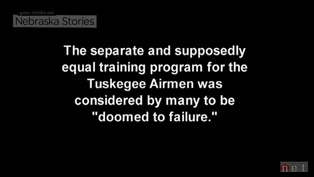
Clip: S12 Ep4 | 3m 31s | Nebraska war vets reflect on their Tuskegee Airmen experience. (3m 31s)
Providing Support for PBS.org
Learn Moreabout PBS online sponsorship














Support for PBS provided by:
Nebraska Stories is a local public television program presented by Nebraska Public Media