
12:1205: Hector Anchondo and More
Season 12 Episode 5 | 27m 4sVideo has Closed Captions
This episode will include stories about Hector Andondo, a time capsule in glass and more.
This episode will include stories about Hector Andondo, a time capsule in glass featuring the Strategic Air Command Memorial Chapel, the Haute Stacker and the Cordial Cherry, and Matt Sesow's Paint Therapy.
Problems playing video? | Closed Captioning Feedback
Problems playing video? | Closed Captioning Feedback
Nebraska Stories is a local public television program presented by Nebraska Public Media
12:1205: Hector Anchondo and More
Season 12 Episode 5 | 27m 4sVideo has Closed Captions
This episode will include stories about Hector Andondo, a time capsule in glass featuring the Strategic Air Command Memorial Chapel, the Haute Stacker and the Cordial Cherry, and Matt Sesow's Paint Therapy.
Problems playing video? | Closed Captioning Feedback
How to Watch Nebraska Stories
Nebraska Stories is available to stream on pbs.org and the free PBS App, available on iPhone, Apple TV, Android TV, Android smartphones, Amazon Fire TV, Amazon Fire Tablet, Roku, Samsung Smart TV, and Vizio.
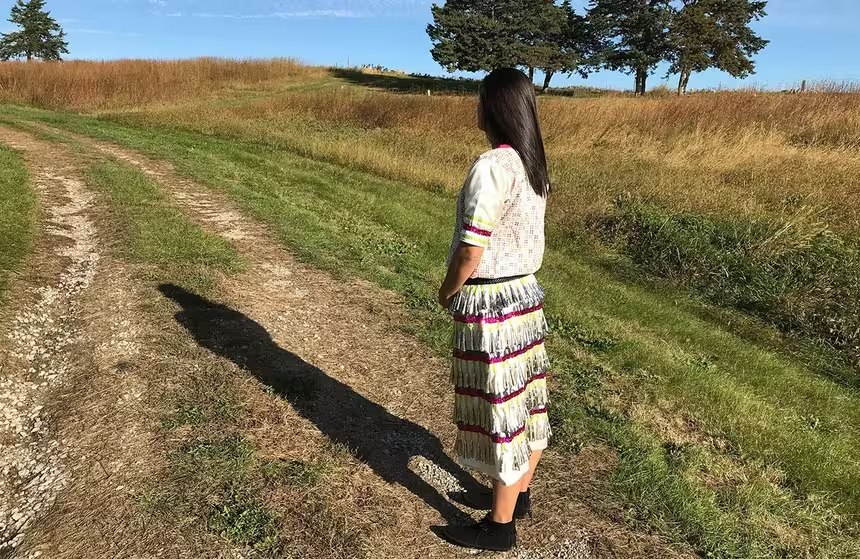
Do you have a Nebraska Story?
Do you have a story that you think should be told on Nebraska Stories? Send an email with your story idea, your name, your city and an email address and/or phone number to nebraskastories@nebraskapublicmedia.org. Or, click the link below and submit your information on nebraskastories.org.Providing Support for PBS.org
Learn Moreabout PBS online sponsorship♪ ♪ >> COMING UP ON NEBRASKA STORIES: INTERNATIONAL BLUES CHAMPION HECTOR ANCHONDO SHARES HIS VERSION OF THE BLUES; THE HISTORIC WINDOWS OF STRATEGIC AIR COMMAND MEMORIAL CHAPEL AN ELEGANT INVENTION FOR DECADENT DESSERTS AND A MAN TURNS HIS CHILDHOOD TRAUMA INTO ART.
♪ ♪ ♪ Song excerpt "Colorado" ♪ >> HECTOR ANCHONDO: That's what I love about music is the expression side.
♪ ♪ That's one of my favorite things about blues is the expression, you know, and the feeling.
♪ ♪ >> NARRATOR: Blues musician Hector Anchondo has always been drawn to music.
>> ANCHONDO: I love it all.
It's easy to just connect to everybody and we're all here.
♪ ♪ >> ANCHONDO...tapping into whatever that is and just being there and casting out that energy.
♪ ♪ >> NARRATOR: Anchondo fronted his own rock band for years before realizing his heart was somewhere else.
He moved to Chicago for a year, immersed himself in blues music...and came out of it with a clear vision for his future.
>> ANCHONDO: I felt like with blues, I felt like I could grow older and stay relevant with a genre like blues, too.
Everything felt right and seemed right.
Playing music really has a lot to do with just just believing that you can in the first place.
And if you don't really believe you can, it's really a struggle.
So, until I was 16, I didn't believe that I could, and then in that moment I was like, "I can do that," I got a guitar and I just started practicing and figuring things out note for note.
Once it struck me that I wanted to do that, it just all happened in that moment where I just decided to dedicate my life to the craft.
♪ ♪ >> NARRATOR: It's hard to believe there was ever any doubt for Anchondo, who brings a positive energy to his version of the blues.
For him, a good show is like having a great conversation.
>> ANCHONDO: When I'm sitting with a great friend that I can go there with, it feels like I'm playing music, you know.
And that's what music feels like.
It feels like I'm having a intellectual conversation with the audience.
♪ ♪ >> ANCHONDO: Whether it's your happiness or sadness or anger, you should tap into that in your soul so that it comes through the music.
♪ ♪ >> NARRATOR: Anchondo loves traditional blues but he definitely has his own distinctive take on the genre, pulling from other styles and infusing his sound with aspects of his Hispanic and Irish roots.
>> ANCHONDO: I just love technique.
And so, I just love everything about music.
And style, all the style in music, and it's just impossible for me to not apply different styles because that's part of just music in general, that's like playing different notes to me.
♪ ♪ >> ANCHONDO: Even playing with two different styles in the same song is like just so fun, you know?
>> NARRATOR: After 25 years and three blues albums under his belt, Anchondo is hitting his stride.
>> ANNOUNCER: First place, solo/ duo winner representing the Blues Society of Omaha, Hector Anchondo!
[applause/cheers] >> NARRATOR: He won first place in the solo/ duo category at the 2020 International Blues Championship and took home the prestigious 2020 Memphis Cigar Box Award for best guitarist in the same category.
And now, with a calendar of future bookings for some of the biggest festivals and tours of his career, Anchondo is hard at work doing what he loves... >> ANCHONDO: Let loose.
>> NARRATOR: ...playing music, spending time with his wife and two toddlers, and working on new material.
>> ANCHONDO: I'm kind of like a pressure cooker.
I don't write all the time, I just build up ideas, and then all of a sudden, it just comes roaring out and I just write, write, write.
The best ones I've written are just like that.
I still just write what feels right.
It's hard to explain.
>> NARRATOR: Sometimes, a song chooses him.
♪ >> ANCHONDO: What turns a man into a father?
♪ >> ANCHONDO: I have heard about songs coming to people in dreams.
"If it came to you in a dream, is it something you created?"
I thought a lot about that.
♪ ♪ So, Let Loose Those Chains , that one came to me in a dream.. and it kind of feels like the song chose me.
It might sound funny but it did feel like that.
I felt like it came from somewhere and I was just, you know, the lucky one that got to write it out.
♪ "Let Loose Those Chains" ♪ ♪ Let loose those chains.
Let loose those chains.
♪ ♪ My back is aching.
♪ ♪ In so much pain.
♪ ♪ The shackles are tight.
♪ ♪ I can't see the light.
♪ ♪ Please, oh Sam, let me be own man.
♪ ♪ I can move a mountain with my own free will.
♪ ♪ Don't need no enforcer pushin' me up the hill.
♪ ♪ With these two hands I'll transform the land.
♪ ♪ Please, oh Sam, let me be my own man.
♪ ♪ Let me splash the water onto my face.
♪ ♪ To wash the tears and the salty taste.
♪ ♪ To cleanse my soul of all that's foul.
♪ ♪ Please, oh Sam, let me be own man.
♪ ♪ Let loose those chains.
Let loose those chains.
♪ ♪ My back is aching.
♪ ♪ In so much pain.
♪ ♪ The shackles are tight.
♪ ♪ I can't see the light.
♪ ♪ Please, oh Sam, let me be own man.
♪ ♪ ♪ ♪ Let me be my own man.
♪ ♪ ♪ ♪ Give back the seed, so I may sow the fields.
♪ ♪ I'll turn the earth and I'll reap the yields.
♪ ♪ I can feed myself without command.
♪ ♪ Please, oh Sam, let me be my own man.
♪ ♪ Let loose those chains.
Let loose those chains.
♪ ♪ My back is aching.
♪ ♪ In so much pain.
♪ ♪ The shackles are tight.
♪ ♪ I can't see the light.
♪ ♪ Please!
Oh Sam, let me be my own man.
♪ ♪ Let me be my own man, let me be my own man.
♪ ♪ Let me be my own man, let me be my own man.
♪ ♪ Let me be my own man, let me be my own man.
♪ ♪ ♪ ♪ ♪ ♪ ♪ ♪ ♪ ♪ ♪ ♪ ♪ ♪ ♪ ♪ ♪ ♪ (melodic piano music) ♪ >> MELISSA STEPHENS: I feel like when I come to work every day I'm actually coming to play.
So, I get to be creative and I get to be an artist every day.
>> NARRATOR: Most days Melissa Stephens can be found at her chocolate shop, The Cordial Cherry, in Omaha.
She's known for her beautiful, cute chocolate covered cherries she designs by hand.
>> STEPHENS: I love making things pretty.
I love adorning cakes and cupcakes and pies.
>> NARRATOR: As a creative soul, Stephens has a knack for occupying each second of the day doing something productive.
>> STEPHENS: I have so many interests that I am constantly coming up with ideas and products and inventing things and working in the garage, working at my sewing machine, all kinds of fun stuff.
>> NARRATOR: Stephens is an interesting mix of artist and scientist.
She has a background in pottery with a bachelor's degree in biotechnology and a Master's degree in biology.
>> STEPHENS: I'm left brain, right brain definitely so I have this analytical side of me but I also have the super creative side.
>> NARRATOR: An unforeseen element of her chocolate business is the cyclical nature of it.
She's extremely busy making chocolate from October through May then business tapers off and opportunity for her creative juices to flow heats up.
>> STEPHENS: I had an idea for a product but I kind of got to a point where I was like, you know I think I'm done just coming up with ideas.
I'm gonna' take one of my ideas and turn it into a true product and market it and sell it and I have no idea how to do that but I'm just gonna' start.
I had this idea to be able to stack pastries without them crushing each other and to create really cool, huge towers of pastries and other food items.
I do now have a patent pending on my product.
It's called Hot Stacker, or Haute Stacker.
Haute or "'Oat" is a French word that means grand or fancy or high and then stacker is an American word which means to stack.
I'm born and raised in Nebraska.
All my education has been in Nebraska.
I love this state, I love my town and one of the things that was important to me is to, as best I could, to develop this product and have it manufactured in Nebraska.
My daughter, who is an animation student, designed my logo for me for Haute Stacker.
So that's a neat point of pride for her and then, of course, for me, as well.
>> NARRATOR: Stephens debuted Haute Stacker at the Event Planner Expo in New York City and a month later it was in the hands of customers.
♪ (melodic string music) ♪ >> STEPHENS: A stacker kit comes with a base and a stainless steel rod that's 18 inches tall and onto that rod you can stack any number of stacker plates or accessories.
So depending on the height of the stacker plates or the shape of them you can stack anywhere from probably eight to a dozen stacker plates depending on what you're wanting to go for.
We have about a dozen accessory pieces included in my patent application.
So people will be able to stack, ultimately, strawberries, and bowls of ice cream, all kinds of cakes, every size and shape you can imagine.
So this is Haute Stacker.
And it's real simple.
You can set it on any pedestal.
You can lift it up, everything's really sturdy.
When you're ready to serve, you just twist off the topper, which is also a handle and can be swapped out with any number of standard cabinet drawer knobs just to change up the look and then the stacker plates just slide right off and they can be used as actual plates.
You can swap them out and mix it up however you would like.
But you can also connect them together.
So you can suspend them and string them together to create towers ten feet tall if you wanted.
>> NARRATOR: Creating new cherry designs and inventing new products for patent all with a friendly smile.
That's the Melissa Stephens way.
♪ ♪ ♪ ♪ ♪ ♪ >> MATT SESOW: For this show, the "All in the Family" show, I decided to try to focus on some Nebraska themes, or some of the experiences from childhood and just living in Nebraska.
>> NARRATOR: For Washington D.C.-based artist Matt Sesow, the journey back home to Nebraska has been a long and complicated one.
This show is at a gallery in Lincoln, and the story that changed his life more than 40 years ago started just down the road.
It was a warm summer afternoon next to a grass airstrip near his home just outside of Lincoln.
He was 8-years-old and playing with his friends.
>> SESOW: Turned out, one of the airplanes was landing, so as I ran, I guess I ran out towards the runway and onto the runway and it landed on me and severed my left arm.
They reattached that and had to amputate the hand because of gangrene at the hospital.
>> NARRATOR: It was trauma Sesow learned to live with.
His family and friends didn't treat him any differently.
He played baseball and ran track in high school, and was the football team's most valuable player.
>> SESOW: In a sense it was kind of like that.
I had to stick with it attitude and I think that taught me a lot, as well.
As much as I hated practice and hated I gotta' play football, it did a lot for me.
>> NARRATOR: After college, Sesow took a job as a computer programmer in Washington D.C., far from his childhood in Nebraska.
His painting started as an accident, a way for him to fit in with new friends who were artists and musicians.
>> SESOW: My painting came to me because I realized I'm not a good singer and I can't play guitar or at least I couldn't very well.
I would have had to play it with my feet or something.
But, I realized painting was a way to express that some kind of rising up, or that some kind of not so much rebellion, but almost like I'm growing, I want to grow.
I want others to hear what I think and what I believe.
And maybe I have something to say.
>> NARRATOR: Sesow adopted an aggressive, almost obsessive style, with sharp lines and bright colors.
His work has been described as "urban anger."
>> SESOW: When I started painting, I was painting about the accident.
I was painting myself as, like, I always think because, of course we have the phantom hand and everything, I feel my hand right now, but unless I look, I don't see it's not there.
What I started to do was I was painting self-portraits, but I was doing it with one hand.
So I was really starting to look at myself from a visual sense and then I was starting to think about the emotions and trying to use colors and lines that showed that maybe I was angry.
I think I was very angry at the beginning and it was a way for me to take that and put it onto canvas or onto the paper, whatever I was using.
And it was very therapeutic and it still is.
Here's some of my icons here.
Here's the severed hand that I lost.
That deals with drinking, which I probably had some drinks while I did this.
This is one of the rabbits.
It's a bunny or an innocent character in a trauma cup.
The idea is taking -- you want to take all the bad things that you feel, all the negativity, and keep it in a little cup or keep it contained.
>> NARRATOR: He's become a prolific artist, with more than 17,000 paintings so far.
He repeats symbols and icons in most of his work, reminders of what he's been through.
>> SESOW: This little line here with the three dashes, that's called my trauma scar.
They had to go in and cut open and shorten the muscle and that hurt more than getting hit by the airplane.
>> NARRATOR: He spends most of his days in his studio in Washington, D.C. and doesn't expect that to change anytime soon.
There's still anger about what happened more than 40 years ago near Lincoln, but his work is evolving.
>> SESOW: I can paint someone screaming, easily right now, it's -- but it's not me screaming anymore.
It more like how would someone feel if this happened to them.
I mean, of course I'm human, I have bad days and stuff, but most of my days are good.
A wide majority of my days are good.
>> NARRATOR: Sesow still thinks about his accident and about something that happened in the hospital afterward.
>> SESOW: When I woke up in the intensive care unit, I felt, I don't even know if there was a real person there or not, but there was someone there asking me, do you want to live or die.
It was kind of like almost like a live forever or live an interesting life and I definitely said interesting life because I was still that kid out there running on the runway.
I have stuff to play.
There's a lot of play left to do.
My life changed when I was playing and I think I'm still playing.
♪ ♪ ♪ ♪ >> WATCH MORE NEBRASKA STORIES ON OUR WEBSITE, FACEBOOK, AND YOUTUBE.
NEBRASKA STORIES IS FUNDED IN PART BY THE MARGARET AND MARTHA THOMAS FOUNDATION.
♪ ♪ CLOSED CAPTIONING PROVIDED BY CAPTION SOLUTIONS, LLC www.captionsolutions.com
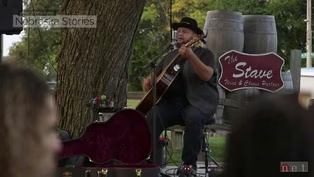
Letting Loose with Hecton Anchondo
Video has Closed Captions
Clip: S12 Ep5 | 9m 48s | Meet rising star blues musician Hector Anchondo. (9m 48s)
Video has Closed Captions
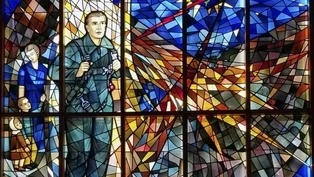
Clip: S12 Ep5 | 5m 48s | Iconic symbolism of the Cold War captured in stained glass (5m 48s)
Providing Support for PBS.org
Learn Moreabout PBS online sponsorship

- News and Public Affairs

Top journalists deliver compelling original analysis of the hour's headlines.













Support for PBS provided by:
Nebraska Stories is a local public television program presented by Nebraska Public Media