
12:1206: Marion Crandell and More
Season 12 Episode 6 | 26m 5sVideo has Closed Captions
The first American woman to die in WWI combat, the biodiversity of the Sandhills and more.
The first American woman to die in WWI combat, a profile of a national dog agility competitor, a look at the championship season of the Winnebago boys basketbal team,and the biodiversity of the Sandhills
Problems playing video? | Closed Captioning Feedback
Problems playing video? | Closed Captioning Feedback
Nebraska Stories is a local public television program presented by Nebraska Public Media
12:1206: Marion Crandell and More
Season 12 Episode 6 | 26m 5sVideo has Closed Captions
The first American woman to die in WWI combat, a profile of a national dog agility competitor, a look at the championship season of the Winnebago boys basketbal team,and the biodiversity of the Sandhills
Problems playing video? | Closed Captioning Feedback
How to Watch Nebraska Stories
Nebraska Stories is available to stream on pbs.org and the free PBS App, available on iPhone, Apple TV, Android TV, Android smartphones, Amazon Fire TV, Amazon Fire Tablet, Roku, Samsung Smart TV, and Vizio.
Do you have a Nebraska Story?
Do you have a story that you think should be told on Nebraska Stories? Send an email with your story idea, your name, your city and an email address and/or phone number to nebraskastories@nebraskapublicmedia.org. Or, click the link below and submit your information on nebraskastories.org.Providing Support for PBS.org
Learn Moreabout PBS online sponsorship♪ ♪ >> COMING UP ON NEBRASKA STORIES : AN OMAHA WOMAN WHO BECAME A HERO TO FRENCH SOLDIERS DURING WORLD WAR I.
A LOOK AT THE SPORT OF DOG AGILITY.
REMEMBERING THE WINNEBAGO BOYS CHAMPIONSHIP SEASON, AND TRACKING THE TINY CRITTERS OF THE SANDHILLS.
♪ ♪ ♪ ♪ >> SCOTT WILSON: When the war broke out, the safest place in the world would have been at an all-girls school in Davenport, Iowa.
Marion Crandell volunteered to go to France and she did it simply because she loved the French people.
For her to volunteer to go into that, and we know that the Western Front of 1918 was maybe the worst place on earth to be, she wanted to go there.
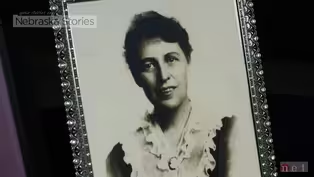
>> NARRATOR: Marion Crandell was the first American woman to be killed in active service in World War One.
Crandell graduated from Omaha High School, now known as Central High.
She then went on to study at the Sorbonne in Paris, before returning to the States to teach at an all-girls school in Davenport, Iowa.
Nearly a century later, her story was dangerously close to being forgotten.
That is, until Central High teacher Scott Wilson's annual history project brought her story back to life.
>> WILSON: The students drew names out of a hat.
And one of my students, Peter Bock, who is in the Central High class of 2010, a senior that year, picked the name, Marion G. Crandell, a name that's clearly on our World War I Memorial.
And Peter will tell you that he struggled.
He wrote to the government, wrote to the archives, and was really kind of drawing a blank in his initial research.
He got a tip from a classmate - she got ahold of Peter and said, "Peter, I think Marion is a woman.
And I think she was a volunteer for the Allied Forces in France, in World War I."
>> NARRATOR: Peter arranged to meet with a local Davenport historian.
>> WILSON: He got into the special collections archive at the Davenport Library, and he went to work.
The project that he created out of his research really put a light on this woman's contribution to the war effort, and really her life story, which was really fascinating.
>> NARRATOR: In February of 1918, Crandell shipped off to France to volunteer with the YMCA.
>> WILSON: The women who volunteered through the YMCA did a number of things such as the hot chocolate, lemonade.
Basically, their purpose was to be a comforting presence for soldiers who had been at the front and had really been in the muck and mire of the trenches of the Western Front.
It's in this German offensive of the spring of 1918 in which Marion Crandell was killed.
While they were evacuating the house that she was in, Marion ordered the rest of her team out, and she was the last one in the hut and was packing up the supplies when a German artillery shell came through the building, it detonated, and fatally wounded her.
They took her to our nearby hospital and a few hours later, she died.
And at that moment, she became the first American woman killed at the front in World War I.
>> NARRATOR: Crandell was given a soldier's burial at Sainte-Menehould, the first woman to be buried in the cemetery among 6,000 French soldiers, a distinct honor.
Her body was later moved to the Meuse-Argonne Cemetery in Northern France, the largest American cemetery in Europe.
>> WILSON: I'm sure that the French were impressed by a woman from the United States who had volunteered, had no obligation to be there.
She impressed all of her colleagues.
At her memorial service, just about everyone who commented, commented on her energy, her enthusiasm, her positive attitude.
And you can imagine for the French soldiers who are coming off the line to have someone like Marion Crandell and her colleagues around them was a huge benefit.
And that had to make an impression on all those soldiers that she saw.
And when she died, the respect that they gave to Marion in her funeral service demonstrates the kind of respect that they had for her in her short time as a volunteer at the front.
>> NARRATOR: While Crandell made an impression on the French soldiers of World War I, her story was largely unknown, even to historians.
>> WILSON: She at the beginning of the year was a name.
By the time Peter was done, she was a real person, who had this extraordinary story of sacrifice and volunteering.
Peter ended up going to the University of Nebraska and while he was there, he and I worked on a nomination for Marion Crandell to the Central High School Hall of Fame.
And the very next year, she went into our Hall of Fame, and Peter accepted the award.
We have started taking our Central High students to Europe to study the World War I and World War II battlefields.
In 2018, we decided to add a visit to Marion Crandell's grave site at Meuse-Argonne Cemetery.
Our students laid purple and white flowers at her grave.
And that was really special to see students, literally a hundred years after she died, visiting her grave.
And I think for those students, I don't want to speak for them, but I think for those students, that was really felt, the long history of their school that they are now a part of, as well.
It's easy to talk about World War I and World War II from a male perspective.
The soldiers, the fighting, the generals, the political leaders in those cases tended to be all men.
And in this case, it's great to introduce and include stories like Marion.
Women, of course, were integral parts of all of that history and with Marion's example, we get a chance to show that women were every bit engaged.
They were at the front, in Marion's case, and it allows us to kind of enrich the story of the First World War, by including some of our Central High history into that.
♪ ♪ ♪ ♪ ♪ Van Halen's "Jump" ♪ >> Narrator: Though she may not be as well-known as the band she was named after, Halen's already following in the paw steps of her champion roomie, Pixel.
>> AMI SHEFFIELD: Pixel has a little fan club, which is super cute.
Her breed, it's not a crazy popular breed.
It is gaining popularity.
She is an eight-year-old miniature American shepherd, or they call them miniature Australian shepherds or mini Aussies.
They derive from the Australian shepherd, which is the larger version.
They're a herding breed.
So they were meant to help out on farms and ranches to help herd cattle and sheep and stuff like that.
So they're working ranch dogs.
Yeah!
Good girl!
Woo!
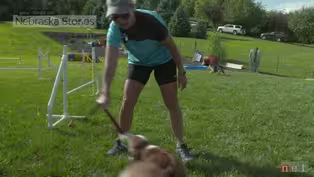
>> NARRATOR: Ami Sheffield and her dogs Pixel and Halen compete in a sport called Agility.
♪ ♪ >> ANNOUNCER: Let's see if Punk can punk this.
Here we go, into the weed pole.
>> SHEFFIELD: Agility is a sport of getting your dog through an obstacle course as fast as possible and without incurring any faults.
So the fastest and cleanest dog wins, and they have them separated by height division, so little dogs, medium dogs, big dogs.
That way a little dog's not competing against a dog with a mammoth stride.
NARRATOR: Ami's always been involved with four-legged friends, but it was a much taller version that first held her interests.
>> SHEFFIELD: When I was in fourth grade, my parents got me horseback riding lessons, and then I was like, "I love this."
I did Paint horses and Quarter horses and Appaloosas, so we kind of did all-around.
Halter, showmanship, western pleasure, western riding, just kind of a little bit of everything.
I had won three trophies at Douglas County Fair, and they got a really neat picture of me sitting there on my horse.
It ended up being in color on the newspaper -- I don't know if it was the living section, but my dad went down to The World-Herald and bought the photo from them, which is really cool.
I had it framed.
♪ ♪ Gradually, as my horse got older, I kind of started getting into the dogs.
And I found out that they were much simpler, easier, cheaper to compete and train with and it just kind of was a natural progression into the dog world.
>> NARRATOR: Ami began competing in Agility in 2004 with her first dog, Neelah.
>> SHEFFIELD: I found a little club in Omaha that taught lessons, and I took my very first dog there, and I was totally hooked.
I was like, this is awesome.
It's so much fun.
It got me out of the house.
It let me be active and then train my dog.
I never thought I would compete.
And once I did, I was like, "Oh, I'm totally hooked now.
Here we go."
Make sure that as your dog is coming off the line you connect with them.
>> NARRATOR: Today, Ami not only competes in Agility, she teaches classes where she trains her students on how to train their dogs.
>> SHEFFIELD: We've got some stuff to do here to ensure that there is not a collision on the course.
I love interacting with other people.
It also adds a little bit of -- it gets me out of the house more than anything, but then it also lets me challenge other people to positively train their dogs, make sure that they are being kind to their dogs, and making sure that they are rewarding their dogs appropriately, and also having fun.
So, I do love to challenge individuals, and I love training.
I come from a long background of training wide different things, so I just love to be able to teach others, and break it down, and give them the tools that they need to be successful.
♪ ♪ >> SUSAN SCANLAN: I've been taking classes from her for probably eight, 10 years.
Both of my dogs are very, very energetic.
They need stimulation, they need mental and physical stimulation and it helps in the home, too.
It's a great relationship.
And that's where you need to start, is at the bottom, it's just a foundation and build the way up.
♪ ♪ >> GRAYSON TREVETT: She's experienced.
She's super knowledgeable.
She's fun.
She's upbeat.
She makes things logical.
She really slows things down, breaks it down so that you can be successful each time.
>> SHEFFIELD: We're going to get our hand in that tunnel a little bit to give her that visual, that "Hey, by the way, we're turning" because you don't have the luxury of being, like, "Hey, I need you to turn."
>> When people do something correct, you give them praise, or a high five, or, "Yeah!"
Really?
So, the praise that you're giving the person, and then also seeing their success is like, the reward, the cookie, or the toy for the dog.
So yeah, there are similarities.
♪ ♪ JOHN COPENHAVER: You know, it is one of the most challenging things I've ever had to learn in my life because anytime if you're doing a sport on your own, it's you, but now you've got you and a four-legged creature that needs to know what to do, either on hand signals or verbal signals.
So, the level of difficulty is up there with anything I've ever had to do in my life.
>> SHEFFIELD: First and foremost, it's all a game for the dog.
It should be fun.
They're our buddies and our pets first.
Agility is just something they do.
And you're cute, too!
I pick something that I want to train that day, and we work on it for about five to 10 minutes.
Go!
Yay!
Dig, dig, dig, dig, dig!
I am much more quality over quantity.
I may sometimes only train one day a week.
>> NARRATOR: Ami must be doing it right because she and Pixel have won many national championships including back-to-back wins at the Westminster Kennel Club Dog Show.
Yes, that Westminster!
>> ANNOUNCER: From Omaha, Nebraska.
Pixel the defending champion in the 12-inch class has also competed internationally representing the United States.
>> SHEFFIELD: You do two runs, a jumpers and a standard, and she had ended up doing very well in both of those which put us in the finals very easily in our height division, and next thing you know, we're in finals and we won and it was just crazy and I've never been to an event where there's so many people.
The energy there is just electric.
It's just crazy.
It's just nice to say, "Hey, cool, you know, we went to New York and we went to Westminster, and you know, we were back-to-back champions" which was just a really neat thing.
>> NARRATOR: Ami has also been a member of the USA World Team, competing in international competitions in Europe.
>> ANNOUNCER: Next up is Pixel.
Pixel, a Nebraska fruit bat handled by Ami Sheffield.
♪ ♪ >> SHEFFIELD: And once you get out there, it's just the adrenaline and the joy of running with your little teammate out there and saying, "I trained my dog to do this."
The vast majority of competitors are women, in the United States.
There's a lot of older women that compete in agility.
It's not a super young person's sport.
You may -- a lot of people think, "Oh, you have to be young and fit to be able to do this."
Most of my students are older than I am.
Some people are -- they don't have to run.
You can put verbal words on your dog to send them around the course, so you don't have to be there all the time.
>> KATHY SHIPLE: I get enjoyment, first of all.
I really enjoy it.
I find it's like a hobby.
My husband says it's my hobby, because it's something I can do with Watson.
Our kids are moved out of the house.
I'll tell ya', my daughter will say, "Why do you humiliate yourself so much?"
Because, I don't care.
It's just fun.
A lot of people are excellent, like Amy is an excellent, excellent competitor.
We're not in that level, but you go out, you get nervous.
I get out there and I kind of get sick.
You get out there, and sometimes I forget the course, but everyone, like I said, is very encouraging.
It's just a great place to go with a bunch of people all with the same objective and you learn as you watch.
♪ ♪ >> NARRATOR: In a sport where enthusiasm runs high in dogs and their humans, it's hard to find a negative.
But for Ami, she wishes one thing could be different for her four legged companions.
>> SHEFFIELD: Probably the biggest disadvantage is they just don't live long enough.
Every time I get a dog, I know, these dogs are going to bring me so much joy.
"Oh, If they could only just live a little bit longer."
♪ ♪ ♪ ♪ (squeaking, ball hitting basketball hoop) >> ANNOUNCER: And Winnebago will dribble the time away.
>> DAVID WINGETT, SR.: They expected to have everyone against them.
>> ANNOUNCER: Crowd is on its feet here Pinnacle Bank Arena, and what an excited group!
>> DARLA LaPOINTE: Matthew was probably about, I would say third or fourth grade when he came in and he said, "Mom, am I Indian?"
>> ANNOUNCER: Came down here battling for some respect--.
>> DOUG MACKLING: A lot of people said, "Who is Winnebago?"
"Who are they?"
>> JEFF BERRIDGE: There are stereotypes against the Winnebago basketball team every year that they're on.
"Yeah, they got talent but they don't got the drive to win."
>> DAVID WINGETT, JR.: It's so much more than basketball.
It's more of a family thing.
>> They love basketball here.
>> Yeah, it's always been basketball growing up.
>> It felt really good just to do that for the community.
>> ANNOUNCER: And congratulations, the Winnebago Indians are Class C1 state champions!
♪ (inspiring music) ♪ >> DRAKE GORRIN: Rez ball came through.
♪ (inspiring music) ♪ >> ANNOUNCER: Wingett to Medina, the three from the wing, got it!
>> DTV ANNOUNCER: Now, the road back to state has certainly been a long and challenging one, but now, the Indians are bringing Rez Ball to Lincoln.
( crowd cheering ) >> ANNOUNCER: Wingett hits again on the baseline.
>> BERRIDGE: (laughs) Yeah, Rez ball is just an up-tempo, fast-paced game.
My philosophy is defense first.
If we get defensive stop, if we get turnovers, we get rebounds, we can push the ball faster.
>> GORRIN: Running, quick shots and hustle.
>> MATTHEW WINGETT: Just keep running, and don't stop.
You just keep going and keep going.
>> DAVID WINGETT, JR.: Oh, my legs are just -- I can't really feel 'em at the end of the games, they're so, so sore.
>> ANNOUNCER: Winnebago on the run again.
>> MACKLING: I think it's something that's been instilled in them as a young child, growing up from the time they could dribble a basketball is, you share the ball.
It isn't about you, it's about the whole team on the court.
Running as fast as you can, just working harder than the other team that you're playing against.
>> BERRIDGE: Every sport is 90 percent mental, 10 percent physical.
♪ ♪ >> ANNOUNCER: Wingett gets the ball.
>> MATHEW WINGETT: 90 percent mental.
He said that a lot.
>> ANNOUNCER: Good ball movement by Winnebago, Wingett's got it.
Into the defense and what a shot by the senior!
Wingett behind the back.
Oh, what a spin move!
Winnebago wins the district championship, and now, on its way to Lincoln seeking their first state championship in 75 years.
♪ (electric guitar music) ♪ ♪ ♪ (crickets chirping).
>> NARRATOR: Dr. Keith Geluso is researching the many animals that inhabit blow outs or sandy areas in the Nebraska Sandhills.
>> DR. KEITH GELUSO: You might pick out certain areas like this to seek out to find your biodiversity of insects or small mammals or snakes or the lizard that we just found out here.
Oh, there's a little velvet ant.
♪ ♪ >> NARRATOR: At a young age, Keith's father who is also a field biologist, encouraged him to have an appreciation for animals and the environment.
>> GELUSO: What is this?
We have got a mole run.
Their scientific name is scalopus aquaticus and so you think with aquaticus that they swim.
They don't swim in water but they swim in sand.
To prove to yourself that there was something through here, I'm gonna' put my hand and all of a sudden, it's gonna' break into, there it is and I can feel a hole and tunnel going all through there.
>> NARRATOR: He's currently working on a research project to map biological diversity on the Switzer Ranch in the Nebraska Sandhills.
>> GELUSO: My hand is not leaking water but this is a defense mechanism of a little critter that I found.
This is a woodhouse toad.
Oh my gosh.
This thing is almost white.
>> NARRATOR: Blow outs provide habitat for a large number of species.
>> GELUSO: Species have edges and there's reasons why they have edges and so it's gonna' end when they hit the end of the Sandhills or the Sandhills that get too much rain and so there won't be enough open sand for the adaptations for them to best survive.
Look at that big tail.
>> NARRATOR: As the Vertebrae Ecologist, Keith spends a lot of time outside studying the distribution and number of species in an ecosystem.
>> GELUSO: I wouldn't be necessarily going down the middle unless I was looking for insects or tiger beetles but I'm gonna' be on the edge where there's some cover.
I am absolutely a kid in a candy store.
There's a prairie lizard running along the edge.
Kangaroo rat hole.
there's another one, there's another one.
Here's a little cutting.
Oh yeah, that's been clipped off by a rodent.
Here's where the kangaroo rat might be going in one way.
Here's an out hole where he shoots, and an animal doesn't even see he's coming out the other side.
So we can see with nice sand the story unfold right in front of us.
There's where they're feeding.
>> NARRATOR: There are a variety of habitats in the Nebraska Sandhills.
♪ ♪ Here along Gracie Creek, they are setting live traps.
>> GELUSO: They walk in there, they step on the back and the door closes.
There are some species you can reach in there and grab them and they're not gonna' bite ya.
Other ones I wouldn't do that (laughs) cause they'll chew your little finger off.
>> NARRATOR: As a biology professor, Keith encourages his students to develop a sense of wonder and curiosity about the natural world.
>> GELUSO: It's a runway of animals down here.
We're going to have quite a few voles tomorrow.
♪ ♪ >> NARRATOR: Keith often continues his research late into the evening.
Many mammals like the kangaroo rat are nocturnal species.
They sleep during the day and forage at night to avoid being easily spotted by predators.
(owl hoots) In the morning, Keith checks the traps and records information about the species that make their home along the creek.
>> GELUSO: Open the door here.
(plastic rattles) Meadow voles, microtus pennsylvanicus .
There's a lot more data we can take on these, weights and I just take down usually the sex and the age.
Follow your passions if you have an interest in science and getting out there.
If you're interested and have a passion for it, go for it.
There's just the unbelievable paths you can take to become somebody who cares about the environment.
♪ ♪ ♪ ♪ >> WATCH MORE NEBRASKA STORIES ON OUR WEBSITE, FACEBOOK, AND YOUTUBE.
NEBRASKA STORIES IS FUNDED IN PART BY THE MARGARET AND MARTHA THOMAS FOUNDATION.
♪ ♪ CLOSED CAPTIONING PROVIDED BY CAPTION SOLUTIONS, LLC www.captionsolutions.com
Video has Closed Captions
Clip: S12 Ep6 | 7m | The story of Marion Crandell, the first American woman to die in combat in World War I. (7m)
Video has Closed Captions
Clip: S12 Ep6 | 10m 17s | Meet national dog agility champion Ami Sheffield. (10m 17s)
Providing Support for PBS.org
Learn Moreabout PBS online sponsorship















Support for PBS provided by:
Nebraska Stories is a local public television program presented by Nebraska Public Media