
12:1208: Paper Stadiums and More
Season 12 Episode 8 | 28m 50sVideo has Closed Captions
Creating stadiums from paper, underwater with the American Dipper and more.
Creating stadiums from paper, underwater with the American dipper, Agate Fossil Beds National Monument and a community garden growing hope and healing.
Problems playing video? | Closed Captioning Feedback
Problems playing video? | Closed Captioning Feedback
Nebraska Stories is a local public television program presented by Nebraska Public Media
12:1208: Paper Stadiums and More
Season 12 Episode 8 | 28m 50sVideo has Closed Captions
Creating stadiums from paper, underwater with the American dipper, Agate Fossil Beds National Monument and a community garden growing hope and healing.
Problems playing video? | Closed Captioning Feedback
How to Watch Nebraska Stories
Nebraska Stories is available to stream on pbs.org and the free PBS App, available on iPhone, Apple TV, Android TV, Android smartphones, Amazon Fire TV, Amazon Fire Tablet, Roku, Samsung Smart TV, and Vizio.
Do you have a Nebraska Story?
Do you have a story that you think should be told on Nebraska Stories? Send an email with your story idea, your name, your city and an email address and/or phone number to nebraskastories@nebraskapublicmedia.org. Or, click the link below and submit your information on nebraskastories.org.Providing Support for PBS.org
Learn Moreabout PBS online sponsorship[Narrator] Up next on Nebraska Stories, the healing power of art.
Tour the Chihuly Sanctuary.
A quilt made of hopes and dreams.
Dancing through barriers, and an artist redefines life with ADHD.
DR. KEN COWAN: I think this is the first and largest single investment in a purposeful healing arts program that's part of a cancer center.
Designed from the ground up.
We know that patient's feelings does have an impact on their disease.
When patients are under stress it can affect their immune system.
It can affect their blood pressure.
And that the immune system does play a role in all of illness.
Over time when these experiences are multiplied with multiple chances to visit the art and participate in its beauty and serenity and hope.
We do believe that the arts, in a healing way, will provide a positive benefit on patients.
Possibly in their outcomes but definitely in their quality of life.
(mellow music) We want this to be uplifting.
We want this to take them away from where they are in their difficult periods.
And provide additional hope and inspiration to them.
(mellow music) MARY ROBINSON: I still consider myself a patient.
So I was first diagnosed with acute myeloid leukemia in August of 2014.
And I went into remission.
2017 I was diagnosed again with acute myeloid leukemia.
So I was in the hospital for long durations.
There's days that you just want to get out.
To go outside and get fresh air.
I think back to those days that I had to where the mask and gloves.
And, I remember going into the sanctuary and sitting there and looking up high because there's a glass there and you could see outside.
And just praying to God, thanking him for giving me another day.
Even on those darkest days.
It actually took me away from my illness.
And let me think about peacefulness and calmness.
I was able to pray and kinda meditate on the way I want my life to look and how I want to feel.
I think that just looking at it changes your mindset.
It keeps that hope inside you.
I do feel that this truly helped me heal.
I really do.
In my heart of hearts.
I definitely think it helped my healing.
(mellow music) PEGGIE HARTWELL: It's so good to see them.
NARRATOR: It's an exciting day for artist Peggie Hartwell and the students who helped her create an unusual tapestry that's about to be unveiled.
HARTWELL: Wait until you see the finished piece, it is so pretty.
♪ MUSIC ♪ NARRATOR: It began the previous fall as the girls left their classrooms, got on a bus and took a trip back in time- to the Stuhr Museum of the Prairie Pioneer in Grand Island.
♪ MUSIC ♪ These girls are from Sudan, Africa's largest country.
Their families came to Nebraska as refugees.
They go to school here and they're quickly absorbing American culture.
Today an expert quilt maker from South Carolina will guide them as they create quilt blocks inspired by their memories of the past and dreams of the future.
HARTWELL: My name is Peggie Hartwell and I make story quilts.
This quilt is about my dream.
When I was growing up I had many dreams to be a doctor, to be a nurse but then I discovered dance.
This is a dancer and these are little dancers going around.
You are the artist and so you create what it is that you want to represent your dream.
NARRATOR: Over the next five days the girls get a crash course in quilt making.
Their classes take place in historic homes furnished just as they were in the late 19th century.
HARTWELL: What dream is this?
STUDENT: That's a memory.
NARRATOR: Peggie Hartwell works with the girls one-on-one.
Members of a Grand Island quilting club share what they know about fabric, color and stitches.
WOMAN: There, very good.
WOMAN WITH IRON: Listen to it sizzle.
Listen.
(Laughter) WOMAN: Maybe she has a longer skirt?
STUDENT: I'm making pants.
WOMAN: Oh, pants.
Okay.
WOMAN: And your piece is going to be so nice.
Tomorrow I want to show you to make a decorative stitch.
It's going to be so pretty.
NARRATOR: Famine and war have killed over two million Sudanese.
One country is now two.
These girls are survivors.
Many of their parents work in meat packing plants.
But they have bigger dreams.
WAJDAN YUSIF: My name is Wajdan.
My dream is to become a doctor.
This is me being a doctor.
NYARIEKA KIER: I wanna be a judge and a lawyer.
This is me holding up the gavel.
NYAKIM WAL: This would be me.
And then this is the football.
And this is me running to the goal post with the football.
NYAMUOCH THIYANG: This is my dream that everybody get houses and nobody poor eats outside in the dumpster, the dog says ruff ruff and this is me smiling.
KAY GRIMMINGER: This country is an immigrant country and I think sometimes we forget that, don't we?
And Grand Island was founded with a group of people coming from Germany and settling here in the Platte Valley.
It's just more of the same.
They're just different colors.
But they come the same way that my ancestors came from Germany with very little and hopes for the future.
GIRL: This is going to turn out great.
TEACHER: It's going to be wonderful.
♪ MUSIC ♪ NARRATOR: Six months later the quilt woven of the hopes and dreams of Sudanese girls is about to be unveiled for the first time.
Voice of JOHN SORENSEN: So, one, two, three... (APPLAUSE) NYAKIM WAL: My name is Nyakim and this is my dream.
HARTWELL: When I look at those girls I know that everything is possible to stand in front of their quilt was unbelievable because for the first time they were able to see their voice on cloth they were able to see in the complete form the blocks they had created.
(APPLAUSE) The memory of Sudan combined with the dream of America they were able to see it as a continuation of their hope.
♪ MUSIC ♪ (upbeat music) (fast upbeat music) - [Narrator] Heidi Latsky is an award-winning performer and choreographer with a dance company that has toured the world.
And yet creating great art is only part of her goal.
She also wants to change the way people think, especially with her latest work, entitled "GIMP".
- There's something about the body that we have, inhabiting that body that we have, using that body as the expression of who we are and discovering what that body can do that nobody else can do.
- [Narrator] The company features dancers with prosthetic limbs, muscular dystrophy and other issues that challenge notions of dance, performance and body image.
Right now they're preparing for a premiere at Lincoln's Lied Center.
- To me, the people that I work with are beautiful and multifaceted.
And that's when I started thinking, how could we when we bring GIMP to a community, get dancers and people with disabilities to be in it with us.
- The hazards of disabled dancing.
- [Narrator] One of the lead dancers in the performance has cerebral palsy.
He's a former disability advocate who was nearly 40 years old before he started dancing.
- People seem to think of dancers in one way and they seem to think of people with disabilities in a certain way.
This is no prearranged safe marriage.
This is more of a collision.
You know, it's two worlds that come together, that were never supposed to be together.
- Some have wondered if people with disabilities are being exploited in the dance, but the performance impacts the dancers as well.
- We're not even expected to exist, to live, to thrive in the bodies that we've got.
And so that's 90% of our bodies for most people that are cut off.
So if we can help people, I think, inhabit the space of their own skin, you know, then something significant has happened.
- From one to two to three.
- [Narrator] For Heidi, this latest work is about diversity and inclusion, which is why for the first time she's working with local community members to create a dance piece.
- Go one, going to keep repeating it.
- [Narrator] Barely off the plane from New York, Heidi leads the first of three rehearsals with a group of community members she has never met.
Some have disabilities, some are young aspiring dancers.
Together this group of strangers will perform at the Lied Center just four days from now.
- Really feel the breath.
This piece is about being watched, but it's also about being revealed.
It's about being seen and being aware of being seen and when you want it, and also, and also being very private.
- [Narrator] Even with a mix of new and experienced dancers, disabled and not, everyone receives the same instruction.
The rehearsal is intense.
Some struggle with the experience.
- Does anybody have any questions?
- I don't want to waste your time, and my memory is so terrible.
But I, I don't think I remember all the moves.
- I think you should.
I don't, I don't want you to worry about it.
- I don't want to screw up your - You're not going to screw it up because you know what we might do with you is something different.
But thank you for telling me, because I think what we could do is if you can't remember all of it, then I'll give you something very specific.
- All right.
- You want to do that?
- Sure.
- Yeah.
Yeah.
Cause I want you to be in it.
- Okay.
- Okay.
- No problem.
- [Narrator] In 1998, Rafael Tatee suffered a traumatic brain injury in a car accident.
With rehabilitation he's on the road to recovery, but he still has difficulties with memory retention.
- I was totally green, I had no idea about anything.
And today it was a little challenging, you know, remembering all the moves and motions, but I tried my best and we'll see I guess.
- The fact that he could tell me that and offer to actually leave the process because he had such respect for the process was so refreshing.
And I really thought about it the whole night.
What I'm I going to do with him?
And the next day when I walked in, I had ideas for him.
And then I just said to him, you know, I just want you to stand there and look at the audience and not move.
- [Narrator] Amanda Rettke was born with several congenital anomalies and had never even thought of dancing.
- I was a little uncomfortable at first But I don't really know how to, how to describe it.
I mean, it was, it was pretty fun by the end.
You know.
(laughing) - Amanda has, she struck something in my heart.
She does a movement, it's just so uniquely her.
She's fierce.
Her focus is clear.
It's really honest.
I, she doesn't know this.
I, I told her I had to speak with her because I want her to know I would work with her.
I'm going to put you in your places now, and then we're going to go over stuff.
But I want to see what it looks like in this space so.
- [Narrator] By the third night, the group had their final full rehearsal at the Lied Center.
- One, one, two, three.
- [Narrator] And then it was time to perform.
As the audience entered the theater to a soundtrack composed only of breathing, the community participants began their performance on stage and from the audience.
(slow breathing) Next Heidi Latsky dance company took the stage with their own performance.
- Part of what GIMP says is, do you want to look?
You want to look, look, look, get a good look.
You know, we give people the opportunity to stare.
Which they're not supposed to do out in the world, out in polite society.
And I think by having the space to open that up, that you see a piece like this, which first and foremost has to work as art.
You change attitudes, you change minds, you change possibilities.
(gentle orchestral music) - I didn't expect it to be that beautiful.
I didn't expect it to be that wonderful.
And it really was.
And it's made me feel like there's a lot more I could do too.
- It was really, really thrilling.
I basically come from a, an all sports background.
So coming out of that shell you could say, was actually a really, really fun for me.
- I'm not used to moving naturally in my wheelchair.
Heidi had us exploring our chairs and our bodies, and not being afraid to do that.
I learned how to be me in my chair.
(upbeat music) - [Heidi] This is not a sentimental piece.
This is what we're fighting is we don't want people to think that it's therapeutic or look how brave these people are getting on stage with dancers who've been training all their lives.
This is a piece that uses the performers to their maximum, pushes them.
I push them really hard.
Never losing sight that this is an art piece.
This is a dance piece, this is not a do good piece.
(gentle music) (upbeat music) DANI DONOVAN: I've been drawing for forever, half of my pictures of me when I was younger were of me coloring with my brother, me coloring with my grandma.
And I've honestly wanted to be an artist pretty much my entire life.
So to now be doing comics, or being able to make people laugh and talk about things I care about, it's been really great.
BARISTA: For here or to go?
DANI: For here.
BARISTA: For here, all right, $4.93.
NARRATOR: Dani Donovan, an artist with ADHD has channeled her creativity to help others with the disorder.
Through her mental health comics on life with ADHD, her works have gone viral in online communities.
DANI: It wasn't on purpose, I did not start making comics with this intention of like, I wanna have this larger conversation about ADHD and I'm gonna make this whole series of stuff and we'll see what happens.
That was not it.
I had an interest in mental health comics forever.
I found them maybe two years ago and I just cried my face off finding some of these things that really, I mean they weren't even sad, they just said something that I have felt my whole life and either never really thought about that much or had to process or had never felt like someone else got it.
And so that deep feeling really hit me.
NARRATOR: Dani was diagnosed with ADHD later than most, while a freshman in college.
DANI: It's such a relief for me and for a lot of people to have a reason, not a reason but an explanation for, this is why I've felt different my whole life.
DR. HELEN GRACE: ADHD stands for, attention deficit/hyperactivity disorder.
The newest nomenclature is either ADHD, attention deficit disorder with hyperactivity or without hyperactivity.
So as best we understand ADHD it is a different way that your brain sort of processes information and thinks.
It has nothing to do with intelligence or ability to learn.
It's more related to how you think and how you learn.
DANI: For me, I kick into this thing called hyper focus a lot, which not everyone with ADHD has.
My brain gets so fixated on the thing that I'm doing that I forget, I'll say, "What time is?"
But don't realize how much time is passing.
Get into like really obsessive perfecting mode.
So for design, for me it's been a blessing and a curse because I can stay up til five in the morning working on something that I'm really interested in and perfect it.
I can't stop or my brain gets angry.
When I'm in the mood to make a comic, it's cathartic in a way that I get to talk about stuff that I haven't talked about before.
NARRATOR: As Dani began to explore this medium as a way to communicate about ADHD, her first foray went viral.
DANI: I had this idea for a drawing how my thought process works and the pattern that I've done so many times.
It was so easy to draw because I do it constantly.
I want people to know that I made it for them, I didn't try to make it to appeal to the widest amount of people that I could.
It turns out there were a lot of people who liked it and that it applies to a lot of people.
I knew pretty quickly, like wow, this is a thing because it was like maybe an hour in and it was at like 400 likes.
It was viewed by like 24 million people in three days.
So it was this incredible moment of me trying to add up, okay how many giant cities is that?
Like is that New York plus L.A. plus Chicago?
As far as just even trying to conceptualize how many people had seen this or how many people liked this.
(bouncy music) DANI: It's definitely rewarding, rewarding work, to not just affect people who directly have ADHD, because it is really important to feel understood and seen.
Especially with a disorder that is much more complicated than, oh you have attention problems.
There's so much there.
NARRATOR: Along with the popularity of her comics in the ADHD community, she's seen her profile rise.
DANI: I got hit up by Penguin Random House to do like a illustrated memoir of my childhood, which is crazy because that's on my bucket list and I thought for sure that that's one of the things that I don't have the attention span to make a book.
So being able to do that.
So it's great and a little overwhelming because I have more things that I'm interested in that people want to collaborate on than I can possibly do.
NARRATOR: While these ADHD comics serve to show how people are affected by the disorder, she makes certain to mention it is not a diagnostic tool.
DANI: I have specifically put if anyone asks me, does this mean I have ADHD?
My response is always, no, not necessarily.
If you look at my entire body of work as a whole and you're relating to most of them if not all of them, you need to go talk to a doctor.
To have people tell us that you are changing lives because people are getting help now, that's probably the best part.
You can't feel what it feels like to be me, but I'm gonna try to help you get it.
That's what I go for with my comics and I think that's what we need to be aiming for as a whole.
It's very interesting and ...
I don't like it, I'm not gonna cry.
I never felt like I was understood and seen.
And so they say to make the kind of content that you wanna see and that you wish you'd seen and so I feel like I get to do that now and it feels like such a privilege and purposeful work that I get to do all my favorite things.
I get to feel like I'm helping people and improving lives.
>> WATCH MORE "NEBRASKA STORIES" ON OUR WEBSITE, FACEBOOK, AND YOUTUBE.
"NEBRASKA STORIES" IS FUNDED IN PART BY THE MARGARET AND MARTHA THOMAS FOUNDATION.
Video has Closed Captions
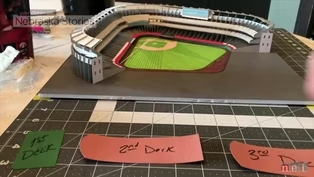
Clip: S12 Ep8 | 6m 26s | An artist creates renowned sports stadiums from paper. (6m 26s)
Providing Support for PBS.org
Learn Moreabout PBS online sponsorship

- News and Public Affairs

Top journalists deliver compelling original analysis of the hour's headlines.













Support for PBS provided by:
Nebraska Stories is a local public television program presented by Nebraska Public Media